
10 Best Wireless Fence for Dogs
 Brianna York
Please note that we participate in affiliate marketing programs. When you purchase through links on our site, we may earn a commission. As an Amazon Associate we earn from qualifying purchases. This comes at no additional cost to you and helps support the resources required to provide valuable content.Advertising Disclosure
Top-rated Wireless Fence for Dogs Comparison
1

2
3


+
4
5
6
7
+
8


9
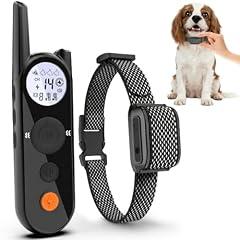
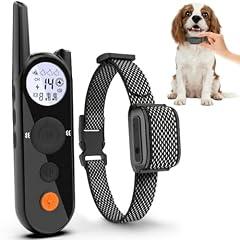
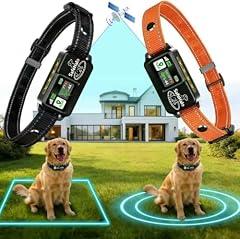
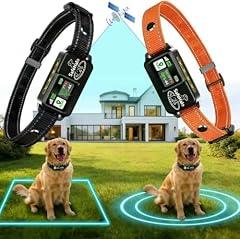
Wireless fences for dogs: what to look for
Wireless dog fences use a collar and either a radio transmitter, buried boundary wire, or GPS positioning to create an invisible limit. When the collar detects that a dog is approaching or crossing it, the system may give a tone, vibration, or static correction. These systems are training aids, not physical barriers: they do not stop another animal or person from entering, and the supplied reviews repeatedly warn that containment cannot be guaranteed.
The first practical question is whether the boundary suits the property. Radio systems generally create circular boundaries and can be affected by metal, buildings, vehicles, electrical equipment, terrain, and other signals. GPS systems may require clear sky view and can lose accuracy around trees, walls, buildings, and covered spaces. A claimed radius or acreage is not the same as a measured boundary. Look for an independent, model-matched field test that reports boundary drift, warning-zone width, trigger consistency, and performance across relevant terrain, weather, sky-view, and interference conditions. The strongest evidence described in this category used a commissioned field report, but even that test used tape-and-flag ground measurements rather than RTK-GNSS surveyed boundaries and did not prove guaranteed containment.
A buyer should also distinguish operating modes. Tone-only or vibration-first use is less aversive than a system that defaults to or automatically escalates to static correction, but several supplied products still make static available through the collar or remote. The American Veterinary Society of Animal Behavior position cited in the reviews recommends reward-based training and advises against aversive electronic collars. Clear training instructions should include leash-supervised sessions, visual flags or boundary markers, gradual distractions, stress signs, and exclusions for aggressive, fearful, very young, ill, undersized, or otherwise unsuitable dogs.
Fit and failure behavior matter as much as range. Look for a stated neck-size and weight range, contact-point guidance, skin checks, repositioning instructions, a maximum daily wear time, and clear instructions to stop use if irritation develops. Useful fail-safes include low-battery warnings, correction cutoffs, lockouts, wire-break or transmitter alarms, static-free re-entry, and documented behavior during signal loss, GPS degradation, power loss, pairing failure, and battery depletion. No product should replace supervision or a physical barrier where escape could expose a dog or another person to immediate danger.
For electrical and radio claims, a waterproof label such as IP67 or IPX7 is only meaningful when tied to a stated test method and the exact collar. Check for model-matched UL, ETL, or CSA listings, rechargeable-cell safety evidence, and an exact FCC identification matching the marketed transmitter, remote, and collar. FCC authorization supports legal radio use; it does not establish animal welfare, boundary accuracy, charger safety, or waterproof performance. Finally, consider lifecycle responsibility: rechargeable parts, replaceable batteries, repair or replacement support, battery chemistry disclosure, and a usable U.S. recycling or take-back route.
Across the supplied products, the recurring safety caveats are substantial. Static correction is common, and the reviews repeatedly say these systems are unsuitable for fearful, reactive, aggressive, very young, ill, medically vulnerable, undersized, or skin-sensitive dogs. They are also unsuitable as the sole safeguard near roads, wildlife, livestock, water, neighbors, visitors, or other hazards. Owners must expect signal or GPS variation, power and battery limitations, supervised training, daily collar checks, and a physical backup when reliable separation is essential.
Integrity
These topics separate a convenient containment aid from a product whose welfare, fit, failure behavior, environmental impact, and technical claims have been examined more carefully. Scores are relative to the supplied products and reflect the evidence and reviews provided, not a guarantee of safe use.
HHealth & Safety
Low-stress containment method
This measures whether the collar can avoid aversive stimulation through tone-only or vibration-first operation and whether the evidence addresses dog welfare. Higher-scoring examples offered tone or vibration without automatic shock in fence mode; lower-scoring products made static central, automatic, or available through remote training. Even higher scores do not establish that electronic containment is welfare-neutral.
Collar fit and skin safety
This measures stated dog and neck-size limits, contact-point precautions, wear-time limits, repositioning, skin checks, materials, and safety guidance. Higher-scoring products commonly specified one- or two-finger fit, daily checks, repositioning, and a 12-hour maximum; lower-scoring products lacked wear limits, breakaway information, or clear contact-care instructions. Fit must be checked against the individual dog, not just the advertised size range.
Responsible training and suitability guidance
This measures whether instructions require supervised, visual-boundary training and identify dogs for whom electronic containment is unsuitable. Higher-scoring products described flags, leash work, staged sessions, stress signs, or exclusions for aggressive and vulnerable dogs. Lower-scoring products offered little suitability screening or no structured visual training plan. Training guidance cannot make a physical barrier out of an electronic one.
Escape and malfunction fail-safes
This measures protection during low battery, power or signal loss, GPS degradation, wire damage, pairing problems, re-entry, and correction events. Higher-scoring products documented several safeguards such as low-battery indicators, alarms, lockouts, correction cutoffs, and correction-free re-entry. Lower-scoring products left signal-loss, battery-depletion, or re-entry behavior unclear. A warning or cutoff reduces risk but does not guarantee containment.
Electrical, charging, and waterproof safety
This measures evidence against shock, overheating, battery failure, charger hazards, and water ingress. Higher-scoring products had somewhat stronger stated or traceable safety details, but the supplied reviews repeatedly found no exact-model UL, ETL, CSA, battery-cell, charger, or ingress certification. A manufacturer IP67 or IPX7 claim alone is weaker than a model-matched test using a stated method.
EEvidence
Proven boundary accuracy
This measures repeatable outdoor performance rather than the advertised radius or acreage. High scores require independent reporting of drift, warning-zone width, trigger consistency, and conditions such as sky view, terrain, weather, and interference, ideally against surveyed ground truth. Most supplied radio products lacked this evidence; the GPS product with the strongest score had a model-matched field report, but its commissioned method still had limits.
Legal radio compliance
This measures whether each transmitting base, remote, and collar is traceably authorized for U.S. use and correctly identified. Higher-scoring products had FCC records that matched the relevant hardware or model family. Lower-scoring products lacked an exact FCC identification or relied on general compliance language. FCC authorization addresses radio legality and interference rules, not boundary reliability, electrical safety, or humane training.
Honest safety and performance claims
This measures whether range, accuracy, waterproofing, harmlessness, containment, tracking, and suitability claims match disclosed limitations. Higher-scoring products acknowledged interference, GPS drift, power loss, or the absence of a physical barrier. Lower-scoring products paired absolute or reassuring language with limited evidence, such as unsupported waterproof or reliability claims. Buyers should treat untested range and safety promises as manufacturer statements.
Independent verification beyond seller claims
This measures model-matched evidence from qualified third parties, including field, electrical, radio, and battery testing. Higher-scoring products had traceable external reports or authorization records; lower-scoring products relied mainly on manuals, listings, badges, or self-issued claims. In this category, even the better independent boundary report was commissioned by the manufacturer and did not prove performance in every property or welfare safety.
Recall and incident accountability
This measures whether the responsible company, model, contact information, recalls, incident reports, and corrective-action path can be checked. Higher-scoring products had clearer manufacturer or support traceability and no exact recall found in the reviewed records. Lower-scoring products had limited company identification or marketplace documentation. No recall found is not the same as proof that a product is risk-free.
EEcology
Battery and e-waste responsibility
This measures disposable-battery use, rechargeable-component durability, battery chemistry disclosure, replacement or repair support, unnecessary accessories, and a U.S. recovery route. Higher-scoring products generally used rechargeable collars and, in one case, documented replacement and recycling guidance. Lower-scoring products relied on disposable batteries or had no battery replacement, take-back, repair, or recycling pathway. Rechargeable does not automatically mean repairable or responsibly recoverable.
Full reviews
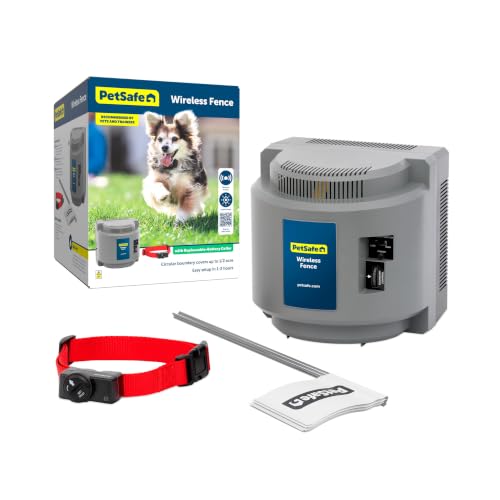
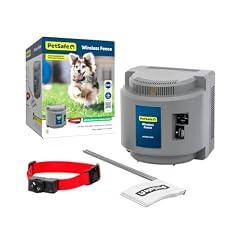
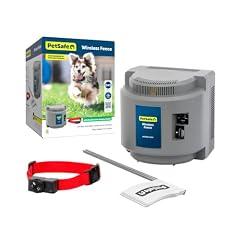
PetSafe Wireless Pet Fence Containment System
Overview
This product is a plug-in radio transmitter and battery-powered receiver collar that creates an adjustable circular boundary, stated by PetSafe to reach up to 90 feet from the transmitter, or up to one half acre. It is intended for dogs over 8 pounds, with a collar that offers a tone-only setting plus five static-correction levels. Training flags and a test light are included to map and practice the boundary. The manual provides meaningful operating limits. It says the collar stops static correction after 30 seconds, does not correct on re-entry, and shows a low-battery warning. It also explicitly says this is not a physical barrier and cannot guarantee containment. However, the same manual documents boundary fluctuation of up to 5 percent from electronic noise, and says signal loss can activate the collar. No independent, model-matched field accuracy study or waterproof test rating was located.
What works
- A tone-only setting allows boundary practice without static stimulation.
- The manual includes a structured multi-day training plan, flags, stress-sign guidance, and a separate leash instruction.
- Clear collar-care directions limit wear to 12 hours daily, call for frequent repositioning, and require daily skin checks.
- The manual discloses important limits, including that the system is not a solid barrier and cannot guarantee containment.
- The collar has documented low-battery indication, a 30-second correction cutoff, and static-free re-entry.
What does not
- Static correction remains a core operating mode. AVSAB recommends reward-based training and advises against aversive methods, including electronic collars.
- The manufacturer documents signal-related risks. Electronic noise can shift the boundary, and signal loss can activate the collar, including near metal crates.
- There is no independent, model-specific field test establishing real-world boundary drift, repeatability, or performance across terrain and interference conditions.
- The waterproof claim is not paired with a disclosed IP rating or a traceable third-party ingress test for this collar.
- The collar uses a replaceable disposable battery, creating continuing battery waste and requiring attentive replacement.
Who is it for
This product is most suited to an owner with a relatively open, circular yard who understands that it is a training aid rather than secure fencing. The dog should be over 8 pounds, old enough for structured training, non-aggressive, healthy enough to wear a contact-point collar, and already responsive to basic cues. It fits households able to supervise initial sessions, test the boundary in several locations, check collar fit and skin daily, and use another containment method when reliable physical separation is needed.
Who is it not for
It is not suited to fearful, reactive, aggressive, very young, medically vulnerable, or skin-sensitive dogs. The manufacturer specifically warns against use with aggressive dogs, and the manual acknowledges that static tolerance varies and containment cannot be guaranteed. It is also unsuitable where a dog could reach roads, wildlife, neighbors, visitors, or other hazards if it escapes. Avoid use in metal-heavy locations, around metal crates, or in yards where a circular boundary cannot stay safely inside the property line.
Integrity
The key health issue is the collar's use of static correction through neck contact points. Although tone-only operation is available, static correction is integral to the standard containment design. AVSAB's current position recommends reward-based training only and advises against aversive methods, including electronic collars. The product manual does provide unusually specific pressure-injury precautions, including a 12-hour daily wear limit, repositioning every one to two hours, daily skin inspection, and stopping use if a rash or sore appears. The transmitter manual documents FCC Part 15 compliance language and identifies interference precautions. No model-specific UL, ETL, CSA, or IP waterproof certification was located. The collar uses a replaceable RFA-67 battery. PetSafe instructs users to keep spent batteries out of household waste and contact customer care for disposal guidance, but the system still relies on disposable batteries rather than a rechargeable collar. No recall for this exact product was located in the reviewed U.S. recall sources.

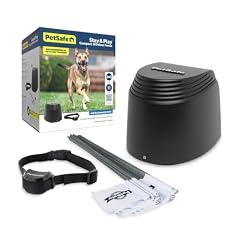
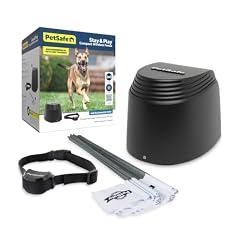
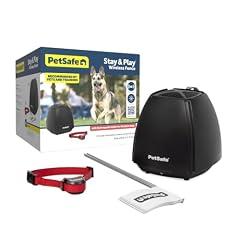
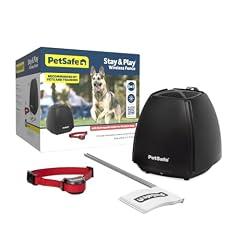
Stay & Play Wireless Pet Fence
Overview
This product is a plug-in radio-based containment system for dogs at least 5 pounds. An indoor transmitter creates an adjustable circular boundary, and the supplied rechargeable receiver collar warns with a tone and can then deliver one of five static-correction levels. PetSafe states coverage reaches a 105-foot radius, or up to 3/4 acre, with a 2- to 3-foot boundary zone. The collar is stated to fit 6- to 28-inch necks and to charge in 2 to 3 hours. The manufacturer manual documents useful controls, including tone-only mode, a 15-second correction cutoff, 10-second correction lockout, low-battery indication, transmitter alarms, and correction-free re-entry. It also documents meaningful limitations. Power loss leaves the dog unprotected, metal and electronic interference can alter the usable boundary, and the electromagnetic field can fluctuate. No model-matched independent field-accuracy report or third-party electrical or waterproof certification was located.
What works
- The manual provides unusually specific skin-safety instructions, including a maximum 12-hour daily wear time, daily neck checks, repositioning every 1 to 2 hours, and no leash attachment to the receiver collar.
- Tone-only operation is available for training or dogs that no longer require static correction, according to the manufacturer manual.
- Documented safeguards include a 15-second correction limit, a 10-second lockout, low-battery status lights, transmitter alarms, and correction-free re-entry.
- The manual requires flag-based, leash-supervised boundary training over multiple days and excludes aggressive pets.
What does not
- This is an aversive containment product when static mode is enabled. The current AVSAB position calls for reward-based training and advises against aversive methods, including electronic collars.
- The stated boundary is not a physical barrier. PetSafe says it cannot guarantee containment, and independent research found owner-reported escapes were more common with electronic fences than with surveyed physical fences.
- Boundary repeatability is a real concern, not merely an evidence gap. The manual says nearby metal, vehicles, terrain, and electronic noise can change the boundary, with fluctuation of up to 5%.
- No exact-model independent boundary test, accredited electrical-safety listing, or ingress-protection test report was located. The waterproof claim is manufacturer-stated.
Who is it for
This system fits an owner with a roughly circular, open yard who needs a portable no-dig boundary and is prepared to test the perimeter repeatedly, use the supplied flags, and complete the supervised training plan. The dog should be at least 5 pounds, comfortably fit the collar, be healthy enough for close skin monitoring, and not be aggressive. It is most appropriate where the owner can supervise outdoor time and has a backup plan for outages or an escape.
Who is it not for
It is not appropriate for aggressive, fearful, reactive, very young, medically vulnerable, or skin-sensitive dogs, particularly where a static correction could worsen distress. It also does not suit homes needing a true barrier against visitors, wildlife, other dogs, roads, or a dog that could cause harm after escape. Avoid it for irregular lots, yards with substantial metal structures or parked vehicles near the area, frequent outages, or households unable to perform daily collar checks and structured training.
Integrity
The strongest health protections are procedural rather than independently certified. The manual specifies direct but not excessive contact, daily checks for redness or sores, a 12-hour wear limit, repositioning, and stopping use if irritation occurs. It also says the product is not for aggressive pets. Those are important safeguards, but the collar can deliver static correction through neck contact points. That exposure conflicts with AVSAB guidance favoring reward-based methods and avoiding aversive electronic collars. The rechargeable lithium-ion collar battery avoids routine disposable battery use, and the manual says users should recycle the equipment rather than place it in municipal waste. However, the battery is non-replaceable, so battery failure can shorten the useful life of the whole collar. A U.S. rechargeable-battery recycling route exists through Call2Recycle, but no model-specific PetSafe take-back program, repair pathway, IP test rating, UL listing, or ETL listing was located. No recall for this exact product was located in the CPSC results reviewed.

Lilyeel GPS Wireless Dog Collar Fence System
Overview
This is a GPS-based outdoor containment collar with a phone app and handheld remote. The seller says the app can draw either a custom polygon or a circular boundary, manage up to five collars, and provide activity monitoring without a monthly app charge. The remote is presented as a first-stage training tool for up to two dogs when a second collar is added. The seller says the collar can issue sound, vibration, or static stimulation near the digital boundary and advises beginning with remote training. It also limits the intended environment to open outdoor areas with stable GPS, not indoor or heavily wooded locations. No product-specific technical manual, independent boundary-accuracy report, electrical safety listing, waterproof test record, or matching FCC equipment authorization was located in the checked sources.
What works
- The seller gives a meaningful operating limitation, open outdoor areas with strong GPS reception rather than indoor or heavily wooded locations.
- The setup is intended to support irregular map-drawn boundaries, which may help owners mark driveways, gardens, or other no-go areas without burying wire, manufacturer-stated.
- The seller explicitly recommends introductory remote training before independent boundary operation.
- The app is stated to manage up to five collar devices without a recurring app fee.
What does not
- Static stimulation is an available boundary and remote-training mode. AVSAB and APDT guidance advises against aversive electronic collars and favors reward-based training.
- No independent field test was located for trigger location, GPS drift, warning-zone width, re-entry behavior, or performance during degraded satellite reception.
- A verified purchaser review reports GPS signal loss and fence failure. This is a reported problem, not a controlled test, but it matters because the seller's containment claim depends on continuous location service.
- No accessible product-specific instructions were found for neck sizing, maximum wear time, contact-point checks, battery chemistry, ingress rating, charger certification, replacement batteries, recycling, or a correction cutoff.
- No matching FCC, UL, ETL, or CSA record was located for the exact marketed collar, remote, or supplied charger.
Who is it for
This product is most suited to an owner of an adult dog already responsive to reward-based recall cues, who has a large, open outdoor area with dependable GPS reception and can directly supervise early use. The owner should be prepared to map and repeatedly test the boundary, train with sound or vibration cues first, inspect neck contact regularly, and retain a physical leash or barrier as backup. It may also fit a household that needs an irregular temporary boundary and accepts the seller's no-monthly-fee app model.
Who is it not for
It is not suited to fearful, reactive, aggressive, very young, ill, or very small dogs, or dogs with neck skin problems. These dogs need an individualized plan from a veterinarian or qualified reward-based behavior professional, not an electronic correction system. It is also unsuitable where GPS is obstructed by dense trees, buildings, steep terrain, or poor sky view, and for properties bordering roads, water, wildlife, or other hazards. Do not treat it as a substitute for supervision or a secure physical enclosure.
Integrity
The key welfare issue is the availability of static stimulation. The seller describes sound, vibration, and static modes, while AVSAB and APDT recommend reward-based training and advise against shock or other aversive tools because of welfare risks. The seller does recommend initial training, but no product-specific suitability exclusions, structured visual-boundary protocol, wear-time limit, or contact-point skin-care instructions were located. The listing makes no verified claim of UL, ETL, CSA, FCC, or independently tested waterproof certification for this exact product. No exact-product recall was located in the checked CPSC sources, but searchable public records also did not establish a robust responsible-company trail or corrective-action route. Battery chemistry, replacement support, repairability, and U.S. take-back or recycling guidance were not disclosed, leaving its end-of-life handling unverified.

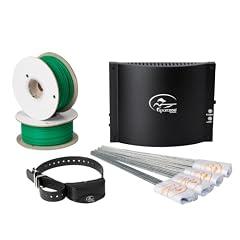
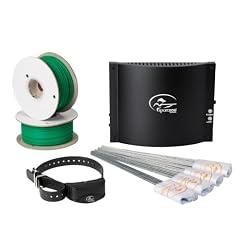
SportDOG Rechargeable In-Ground Fence System
Overview
This is a wired, in-ground dog containment system. A powered transmitter sends a signal through a continuous buried boundary wire, while the dog wears a rechargeable receiver collar. The supplied kit includes 1,000 feet of wire and 100 visual flags. SportDOG states that this starter layout can enclose up to 1 1/3 acres, with expansion possible through added wire and collars. The collar has a tone and vibration-only setting, plus seven static-stimulation levels. Its official guide documents a low-battery indicator, a wire-break alarm, and correction events limited to up to 15 seconds. The same guide cautions that this is not a physical barrier and cannot guarantee containment. No model-matched independent field test was located to establish real-world boundary accuracy or escape performance.
What works
- The official guide gives unusually specific skin-safety instructions, including a 12-hour daily wear limit, collar repositioning every 1 to 2 hours, daily skin checks, and stopping use for irritation.
- A structured 30-day training plan uses visible flags, short sessions, direct supervision for the first two weeks, and instructions to slow training if the dog shows stress.
- The default setting is tone and vibration only, with no static stimulation. Static levels are selected separately.
- The collar has a rechargeable lithium-ion battery, a low-battery indicator, stated replacement support, and end-of-life recycling instructions from the manufacturer.
What does not
- Static stimulation remains a core containment mechanism at settings 2 through 8. AVSAB recommends reward-based training and advises against electronic shock collars because of welfare risks associated with aversive methods.
- This system is not a solid barrier. The manufacturer warns that a dog can cross the boundary during a power loss, wire damage, or other system failure, and an owner survey found higher reported escape rates with electronic fences than with several physical-fence types.
- The guide documents that nearby electrical, telephone, television, antenna, satellite, and neighboring containment wires can produce inconsistent signals or accidental activation. No independent accuracy testing for this product was located.
- The waterproof claim is manufacturer-stated as IP67 and NEMA 6P. No traceable public listing for the exact collar and supplied charger in UL, ETL, or CSA directories was located.
Who is it for
This system fits an owner of a healthy, non-aggressive dog above the stated minimum size who has a stable yard layout, can bury and periodically inspect wire, and is prepared to complete hands-on boundary training. It is most appropriate where visible flags, direct supervision during early sessions, frequent collar-fit checks, and a separate physical plan for gates, roads, visitors, and outages are practical. The owner should be willing to use the tone and vibration setting first and involve a veterinarian or qualified trainer if suitability is uncertain.
Who is it not for
It is not suited to fearful, reactive, aggressive, medically vulnerable, or undersized dogs, or to dogs with existing neck irritation. It is also unsuitable where an escape could create an immediate road, wildlife, livestock, bite, or neighbor-safety risk, because the system cannot physically stop a dog or outsiders from crossing the boundary. Households unable to supervise training, inspect for wire damage and interference, recharge the collar, or remove and reposition it within the stated wear limits should use a non-aversive physical containment approach instead.
Integrity
The main health concern is the collar's static-stimulation mode. The official instructions include a tone and vibration-only setting, staged training, stress-sign monitoring, and a warning not to use the product with aggressive dogs. Those safeguards are meaningful, but they do not remove the welfare concern from static correction. AVSAB's current humane-training position recommends reward-based methods only and advises against aversive tools including electronic collars. The manufacturer provides practical contact-point safety guidance and identifies the collar as rechargeable lithium-ion rather than disposable-battery powered. It says the battery should provide hundreds of recharge cycles, generally last 3 to 5 years, and be replaced through customer care. Its manual also directs users to recycle the equipment rather than discard it with household waste. The collar's IP67 and NEMA 6P water-resistance claims are manufacturer-stated, not backed here by a public third-party certification listing for the exact product.

PetSafe Stay & Play Wireless Fence for Dogs
Overview
This is a plug-in radio containment system with one rechargeable receiver collar, training flags, short and long contact points, and a circular boundary that PetSafe states can extend 5 to 105 feet from the indoor transmitter, or up to 3/4 acre. It is intended for dogs at least 6 months old and 5 pounds, with a collar adjustment range of 6 to 28 inches. The collar gives a warning tone, then can deliver static correction at five selectable correction levels beyond tone-only mode. The manual documents a 15-second correction cutoff, a 10-second lockout, low-battery indication, and static-free re-entry. Those are manufacturer instructions, not independent field-test results. PetSafe also acknowledges that the radio boundary can fluctuate by up to 5 percent from electronic noise, collar orientation, and movement speed. Independent model-specific accuracy, electrical-safety, and welfare testing was not located.
What works
- The manual gives unusually concrete fit safeguards, including a 12-hour maximum daily wear time, daily skin checks, repositioning, and instructions to stop use if sores develop.
- The system includes a tone-only setting, visual flags, and a structured two-week period of direct supervision during boundary training.
- Documented correction controls include a 15-second cutoff, a 10-second lockout, low-battery status lights, and no correction when a dog re-enters the pet area.
- The manual explicitly says it is not a solid barrier and should not be the sole containment method for a dog that could harm itself or others.
What does not
- This product is designed to deliver static correction, including a high setting. AVSAB advises against aversive methods, including electronic collars, because reward-based training has better welfare and training support.
- The boundary is not demonstrated by an independent, model-matched field test. PetSafe's own manual says the electromagnetic field can fluctuate up to 5 percent and can be affected by interference, collar orientation, and speed.
- A transmitter power outage leaves the pet unprotected. The manual recommends a separately purchased uninterruptible power supply and warns that signal loss can activate the collar in some settings.
- No exact-model UL, ETL, CSA, ingress-protection rating, or FCC equipment authorization record was located. The manual contains a manufacturer compliance statement, but no matching FCC ID.
- The lithium-ion battery is nonreplaceable, which can shorten the useful life of an otherwise functional collar.
Who is it for
This system is for an adult, non-aggressive dog that has already been assessed as suitable by a veterinarian or qualified trainer, and for a household with a roughly circular outdoor area, indoor transmitter placement, and time for hands-on boundary training. The owner should be able to test the perimeter repeatedly, use the tone-only setting during setup, inspect the neck daily, remove the collar indoors, and maintain a separate plan for outages, visitors, and escapes. It suits portability needs better than a fixed buried-wire layout.
Who is it not for
It is not suitable for aggressive dogs, dogs younger than 6 months, dogs under 5 pounds, or dogs with skin sensitivity, fearfulness, pain, or behavior concerns without professional veterinary and behavior guidance. It is also a poor fit where a dog must be physically prevented from reaching roads, wildlife, neighbors, children, or other hazards. Do not treat it as supervision, a secure physical barrier, or protection during a power failure. Households unable to check fit and skin daily should avoid prolonged collar use.
Integrity
The main health concern is not an unverified ingredient or material claim. It is the intended use of electrical static correction through metal contact points. The manual has meaningful skin-protection instructions, including limiting wear to 12 hours daily, moving the collar regularly, checking the contact area every day, and stopping use for redness or sores. It also excludes aggressive dogs and requires direct supervision during the first two weeks. However, AVSAB's current humane-training position opposes aversive tools, including electronic collars. The collar contains a rechargeable lithium-ion battery, reducing routine disposable-battery use. PetSafe states that the battery is nonreplaceable and instructs users not to put the electronic product in normal municipal waste, instead returning it through a recycling route or contacting customer care. A general U.S. rechargeable-battery recycling pathway exists, but a product-specific PetSafe take-back program or repair pathway was not independently confirmed. No exact-product CPSC recall was located in the checked records.

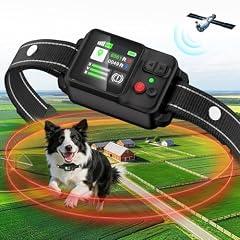
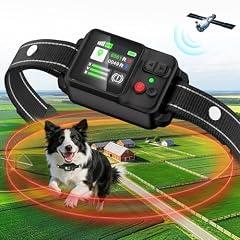
ATESON GPS Wireless Dog Fence System
Overview
This product is a GPS-based circular containment collar for medium and large dogs. The marketplace listing states a boundary setting from 49 to 6,561 feet, an 8 to 31 inch neck range, and a stated dog-weight range of 20 to 160 pounds. The package is listed with 20 marker flags, four metal contact prongs, two magnetic charging accessories, and manuals. The collar uses a warning zone before its boundary. The seller says it beeps 10 feet before the set perimeter and offers five selectable combinations of beep, vibration, and adjustable static stimulation. It also claims an automatic stimulation cutoff after repeated triggers, IP67 water resistance, and up to 30 hours between charges. These are manufacturer statements, not independently verified results. No model-matched field test reporting GPS drift, trigger repeatability, or performance under tree cover and changing sky conditions was located.
What works
- The listing provides a beep-only option, so static stimulation can be avoided in the selected mode.
- Twenty marker flags are included, which can make the otherwise invisible training boundary visible during setup.
- The seller discloses an important GPS limitation, stating that the product is not for indoor use or densely forested areas.
- The collar is rechargeable, rather than using disposable primary batteries.
What does not
- Static stimulation remains one of the selectable boundary responses, including combinations that pair it with warning signals. AVSAB recommends reward-based methods and advises against electronic shock collars.
- No independent, model-matched GPS field test was located to verify the advertised range, accuracy, warning-zone width, or trigger consistency.
- No public evidence was located for exact-product UL, ETL, CSA, or comparable electrical certification, nor for an IP67 test report tied to this collar and charger.
- Public listing material does not clearly provide wear-time limits, skin-check instructions, low-battery behavior, GPS-loss behavior, re-entry handling, or a battery replacement and recycling program.
Who is it for
This product is most relevant to an owner of a 20 to 160 pound dog who has a large, open outdoor area and wants a portable circular boundary without trenching wire. The seller specifically frames it for farms, ranches, and open fields, and includes flags that can support supervised boundary training. It is better aligned with a handler willing to use the beep-only or vibration-only setting, monitor charging, verify the boundary in person, and treat the system as a training aid rather than an unattended barrier.
Who is it not for
It is not suited to fearful, noise-sensitive, reactive, aggressive, medically vulnerable, very young, or poorly conditioned dogs, because automated static stimulation is available and can create aversive associations. It is also unsuitable for indoor areas, dense woods, irregular properties needing a non-circular boundary, or sites near roads and hazards where a physical barrier is necessary. Households unable to supervise training, inspect the neck for irritation, maintain charging, or test performance after weather and site changes should not rely on this product for containment.
Integrity
The central welfare issue is the selectable static-correction mode. Although beep-only, vibration-only, and mixed modes are listed, the product can automatically deliver static stimulation when a dog reaches its GPS boundary. AVSAB's current humane-training guidance recommends reward-based methods and identifies electronic shock collars as aversive tools to avoid. The seller's 10-foot warning and claimed repeated-trigger cutoff are potential safeguards, but neither was independently verified for this product. The listing calls the collar IP67 waterproof and rechargeable, with a claimed 30-hour runtime and magnetic charging. No exact-product UL, ETL, CSA, battery-safety, or waterproof-test documentation was located in public certification sources. No exact-product recall or public incident report was located in the searched U.S. databases, but the public materials also did not show a battery replacement, repair, take-back, or recycling route. Rechargeability reduces disposable battery use, while the sealed electronic collar still creates e-waste at end of life.

FAWNALGE Wireless Dog Fence and Training Collar
Overview
This is a handheld, wire-free dog-boundary system that also functions as a remote training collar. Retail listings for the X802 describe an adjustable circular boundary from 25 to 3,500 feet, dual-channel control for up to two dogs, and use for dogs stated to weigh 10 to 130 pounds. The housing is listed as ABS plastic, with a buckle collar and rechargeable electronics. The available product information describes vibration, boundary-reminder, and light functions, and calls the collar IP68 waterproof. Those are manufacturer-stated claims reproduced by retailers, not model-matched laboratory findings. No independent field test was found that measured its actual boundary drift, warning-zone width, trigger consistency, signal-loss behavior, or performance around terrain and interference. The product is therefore a portable training aid, not evidence that a dog is reliably contained without supervision or a physical barrier.
What works
- Wire-free setup avoids burying a boundary wire, according to the manufacturer-stated product description.
- The stated 10 to 130-pound range and dual-channel control could accommodate many one or two-dog households, though neck-size limits were not provided.
- The collar instructions include a useful skin-care precaution, keep an appropriate fit and remove it at night.
- Rechargeable operation can reduce disposable-battery use, and a two-year manufacturer warranty is stated.
What does not
- No model-matched independent testing was found for boundary accuracy, repeatability, signal loss, re-entry behavior, or battery-depletion fail-safes.
- The IP68 waterproof claim, battery safety, supplied charger safety, and radio authorization could not be traced to an exact third-party listing or test report.
- The product is marketed with correction and boundary-reminder functions. Veterinary behavior guidance recommends reward-based training and advises against aversive electronic-collar methods.
- The stated weight range does not substitute for a neck-size chart, contact-point guidance, breakaway feature, or clear maximum daily wear limit.
- Claims of safe, stress-free, reliable containment are broader than the disclosed model-specific evidence.
Who is it for
This product is most suited to an owner of one or two dogs within the stated 10 to 130-pound range who wants a temporary, portable boundary cue for open outdoor spaces and is prepared to supervise closely. The owner should use reward-based boundary teaching, introduce vibration cues conservatively, check fit and skin daily, and remove the collar at night. It is more appropriate where the goal is structured training support rather than relying on the device as the sole protection from roads, visitors, wildlife, or neighboring animals.
Who is it not for
It is not suited to fearful, noise-sensitive, reactive, aggressive, very young, ill, or very small dogs, particularly where a startle or correction response could worsen behavior. It is also unsuitable for homes near traffic, unfenced hazards, shared boundaries, or areas where an escape would have serious consequences. Owners who need a documented fail-safe response to signal loss, a proven boundary tolerance, certified charging safety, or a collar that replaces direct supervision should use another containment approach. Do not leave it on overnight or use it without training and frequent fit checks.
Integrity
The main health concern is behavioral welfare. Product descriptions frame the X802's vibration and boundary reminders as gentle, but no independent welfare study was found for this product. AVSAB and APDT guidance recommends reward-based training and advises against aversive electronic-collar methods. The listing does include practical care language to maintain proper tightness and remove the collar at night to help protect skin, but it does not provide full neck measurements, contact-point instructions, or a documented daily wear limit. The collar is stated to be rechargeable, which can avoid routine disposable batteries, and the product carries a stated two-year manufacturer warranty. Battery chemistry, replaceability, repair parts, and a manufacturer take-back route were not disclosed. No matching CPSC recall or public incident report was found in the searched databases. At end of life, rechargeable electronics and batteries should go to an appropriate battery or electronics collection program, not household trash or curbside recycling.

MIMOFPET Wireless Dog Fence System
Overview
This is a portable radio-frequency containment system, consisting of a handheld remote that acts as the boundary center and one rechargeable receiver collar. The manufacturer states that the circular fence radius has 14 settings, from about 25 to 3,500 feet in open conditions. It also combines manual tone, vibration, and static training functions, with vibration settings from 0 to 9 and static settings from 0 to 30. The most important model-specific safeguard is manufacturer-stated, automatic fence alerts use beep and vibration rather than automatic static correction. The same manual warns that walls, metal, electromagnetic interference, collar position, and the operating environment can change effective range. The radio transmitter has a matching FCC authorization for the X1, X2, and X3 family, but no independent field test was found that measures this product's real boundary drift or trigger repeatability.
What works
- Automatic fence mode is documented to use beep and vibration alerts, not automatic static correction.
- The manual gives unusually concrete collar-care directions, including a 12-hour daily wear limit, repositioning every 1 to 2 hours, daily skin checks, and no leash attachment to the receiver.
- The manufacturer documents environmental range limitations rather than presenting the maximum radius as universal performance.
- A matching FCC equipment authorization identifies a 433 MHz remote-control transmitter made by Shenzhen Saiku Electronic for the X1, X2, and X3 family.
What does not
- The collar retains a manually activated static mode with up to 30 levels. AVSAB recommends reward-based methods and advises against aversive methods, including electronic collars.
- No independent, model-matched test was found for boundary accuracy, warning-zone width, signal-loss behavior, battery-depletion behavior, or containment reliability.
- The stated IPX7 rating and rechargeable lithium-polymer batteries were found in manufacturer documentation, but no traceable UL, ETL, CSA, or model-specific battery safety listing was found.
- The product is marketed for small dogs, while the manufacturer documentation gives a broad 10 to 130 pound suitability range and maximum 23.6-inch collar circumference, without a small-dog-specific minimum neck measurement.
Who is it for
This product suits an owner of a healthy dog at or above the manufacturer's stated 10-pound minimum who needs a portable, circular boundary in an open area and is prepared to test the boundary in person before each use. It is most appropriate where the owner can use the fence's automatic tone and vibration alerts, supervise training, inspect the skin-contact area daily, and treat the system as a training aid rather than a secure perimeter. The documented 12-hour wear cap also requires a routine that does not depend on all-day collar use.
Who is it not for
It is not suited to dogs under 6 months, dogs below the manufacturer's stated weight range, or dogs that are elderly, ill, pregnant, fearful, reactive, aggressive, or prone to skin irritation. It is also a poor fit for properties needing a reliably shaped boundary around roads, hazards, neighboring animals, or escape routes, because the boundary is circular and manufacturer documentation says walls, metal, interference, and placement affect range. Households seeking reward-based-only training should avoid a collar with a manual static mode.
Integrity
The fence function is better constrained than many electronic containment designs because the manufacturer states that crossing the boundary triggers automatic beep and vibration rather than automatic static correction. That does not remove welfare concerns from the product as a whole. Its remote training function includes static stimulation, and AVSAB's current humane-training guidance recommends reward-based methods and advises against aversive tools. The manual's fit precautions are useful, especially its daily skin checks, collar repositioning, and 12-hour maximum wear instruction. The collar and remote use rechargeable lithium-polymer batteries, which can reduce disposable-battery waste. The manufacturer provides a one-year warranty, but no verified replacement-battery, repair, or brand take-back program was found. At end of life, rechargeable lithium batteries and battery-containing electronics should go to an appropriate battery or electronics recycler, not household trash or curbside recycling. No product-specific CPSC recall, public warning, or enforcement action surfaced in the checked U.S. records.

Safehalo GPS Wireless Dog Fence System
Overview
This product is a rechargeable GPS containment collar for dogs stated to weigh 20 pounds or more. The Amazon listing says it can create either a circular boundary from 65 to 9,840 feet or an irregular boundary with three to six sides. Setup is stated to occur outdoors each time the collar is powered on, with no app, Wi-Fi connection, or subscription required. Its defining safety feature is also its central concern. The seller states that feedback progresses from a beep to four vibration settings and then to static stimulation with 10 settings. That is a seller claim, not independent welfare evidence. The listing also claims GPS, GLONASS, and Galileo positioning, IPX7 water resistance, and up to 48 hours between charges, but no model-matched independent accuracy, electrical-safety, radio-authorization, or waterproof test report was located.
What works
- The stated circular and three to six side layouts can accommodate simple or irregular outdoor areas.
- The seller states that no app, Wi-Fi connection, or ongoing subscription is required for core use.
- The collar is stated to use a rechargeable battery, which can reduce routine disposable-battery waste.
- The listing identifies signal limitations in extremely dense forest and deep canyons, rather than claiming universal satellite reception.
What does not
- The collar delivers static stimulation. AVSAB advises reward-based training and opposes aversive tools including electronic collars because of welfare risks.
- The seller's claim that static stimulation is safe, mild, calming, and stress-free is not supported by product-specific independent welfare evidence.
- No independent field test was located for this product's actual boundary drift, warning-zone width, trigger consistency, or performance in trees, terrain, weather, and obstructed sky conditions.
- No exact product FCC identifier, UL, ETL, CSA, or other traceable third-party electrical-safety listing was located.
- The public listing does not document low-battery behavior, signal-loss behavior, correction timeouts, re-entry handling, or a physical-containment backup plan.
Who is it for
This product is most specifically suited to an owner of a healthy adult medium or large dog who has a large, open outdoor area and wants a portable, app-free way to mark a circular or simple polygon boundary. The owner should be present, prepared to conduct careful boundary training, and able to monitor GPS reception and battery condition. Its stated 65-foot minimum circular setting makes it more relevant to open properties than tight urban spaces. Static stimulation should remain a material welfare consideration.
Who is it not for
It is not suited to fearful, reactive, aggressive, sick, injured, very young, or undersized dogs, or to households unable to supervise outdoor use and training. It is also a poor fit near roads, pools, wildlife, dense canopy, deep canyons, tall buildings, or other places where an escape creates immediate danger. Buyers needing documented GPS reliability, independently verified waterproofing, electrical certification, or traceable U.S. radio authorization need stronger model-specific evidence than the public listing supplies. It does not replace a physical fence or direct supervision.
Integrity
The product uses contact-point stimulation and, according to the seller, can escalate to static stimulation. This conflicts with AVSAB guidance favoring reward-based methods and advising against electronic collars and other aversive training tools. Research on electronic containment systems has also found higher owner-reported escape rates than with several physical-fence types. The listing provides no independent evidence that its static setting is harmless or that its GPS boundary performs consistently in difficult environments. The seller states that the collar has a rechargeable lithium-ion battery, an IPX7 rating, and up to 48 hours of use per charge. No model-matched third-party listing or test report was located to validate those electrical or ingress-protection claims. No manufacturer battery replacement, repair, take-back, or recycling program was located. At end of life, EPA advises recycling lithium-ion batteries and battery-containing devices through an appropriate battery or electronics recycler, not household trash or curbside recycling.