
10 Best Wifi Routers
 Daniel Kenitz
Please note that we participate in affiliate marketing programs. When you purchase through links on our site, we may earn a commission. As an Amazon Associate we earn from qualifying purchases. This comes at no additional cost to you and helps support the resources required to provide valuable content.Advertising Disclosure
Top-rated Wifi Routers Comparison
1

2
4
5
6
7
8
9
10
Wi-Fi routers: what to look for
A Wi-Fi router connects an internet gateway such as a cable modem, fiber gateway, DSL modem, or fixed-wireless device to wireless and wired devices in a home. Some products are router-only units; others combine a cable modem and router. That distinction matters: a router-only product cannot replace a provider-approved cable modem, while a modem-router combination may have limits tied to the provider, service tier, address, or voice service.
Whether a router works well depends on more than its Wi-Fi generation or combined speed label. Check the bands it supports, the number and speed of its Ethernet ports, compatibility with your internet connection, the distance and building materials between the router and devices, interference, client-device capabilities, and whether additional access points or mesh nodes are needed. A headline such as “5,000 Mbps” or “6,000 Mbps” generally describes a combined theoretical wireless link rate, not internet speed. Coverage figures such as 1,500 or 2,000 square feet are estimates rather than guarantees, and independent testing in the supplied reviews found that performance can fall substantially with distance.
For wired networking, look for model-specific documentation of port speeds and distinguish a 2.5 Gbps WAN port from a 2.5 Gbps LAN port. A product may support a fast internet handoff but still provide only gigabit connections to local devices. For cable equipment, verify the exact hardware on the provider’s current approved-device list and check the supported DOCSIS version and speed tier. Provider approval is not interchangeable between models or guaranteed at every address.
Security should be assessed as an ongoing property, not a list of features. Prefer unique setup credentials, WPA3 where compatible, protected administration, no insecure remote administration by default, and usable guest or IoT separation. Look for automatic, signed firmware updates, public security advisories, a vulnerability-reporting channel, and a stated end-of-support date. A current firmware release does not by itself establish a long support horizon. The strongest independent cybersecurity evidence in this category would be an exact-product U.S. Cyber Trust Mark or an accredited assessment covering the shipped firmware and support commitments.
Radio and safety claims also need to be separated. An FCC equipment-authorization record can substantiate U.S. radio compliance and an RF-exposure evaluation; it is not electrical-safety certification and does not establish a health benefit. For the power system, look for a model-matched UL Product iQ or Intertek ETL listing, and check the CPSC recalls database. Wi-Fi Alliance records can help verify the exact Wi-Fi capability, while independent throughput, range, and latency testing is more useful than an unqualified whole-home promise.
Privacy and sustainability are easy to overlook. Determine whether local administration works without an account or cloud service, what the app and optional security services collect, and whether essential networking remains usable offline. For an always-on device, an adapter’s maximum wattage is not its typical electricity use; prefer measured operating and standby results with test conditions. Also check support duration, replacement adapters, repair routes, and a verified recycling or take-back path.
Recurring cautions in the supplied reviews are significant: several products lack a public support end date, exact-model U.S. electrical-safety listing, or independent cybersecurity certification; older firmware vulnerabilities make updates important; one modem-router has a known default administrator password that should be changed; some guest networks are disabled by default or have weak default settings; and app or cloud management can introduce data collection or tracking. Large or multi-level homes should not assume one router will provide reliable whole-home coverage. No category-wide contraindication was found, but buyers who require documented long-term support, model-matched electrical certification, or fully local administration should treat missing verification as a meaningful limitation.
Integrity
The topics below distinguish documented protections and evidence from claims that are merely listed in a product description. Scores are used comparatively within the supplied products; a higher score indicates stronger supporting documentation and fewer unresolved concerns for that topic.
HHealth & Safety
RF exposure and health-claim discipline
This measures whether the router has U.S. radio authorization, an RF-exposure evaluation, and restrained health messaging. For a Wi-Fi product, an FCC record supports radio compliance but is not a health endorsement. Higher-scoring products in this set generally had model-specific FCC exposure documentation and no unsupported health claims; lower scores reflected incomplete model traceability or weaker documentation.
Electrical and fire safety
This measures whether the router and supplied adapter have model-matched third-party electrical-safety certification, clear operating limits, and no unresolved recall signal. FCC authorization does not replace electrical-safety certification. Scores were relatively close, but the supplied reviews repeatedly found no public UL or ETL listing for exact router-and-adapter combinations, so even higher scores do not mean that this verification was complete.
Security updates that last
This measures the maker’s commitment to timely signed updates, public advisories, vulnerability reporting, and a stated support period. Routers remain internet-facing for years, so update duration matters as much as launch features. The eero 6 scored highest at 90 because updates are committed through June 2031; products scoring in the 60s to 70s had active fixes but no public end date.
Safe defaults and device isolation
This measures protection against account takeover, unauthorized administration, and compromised smart devices. Useful indicators include unique credentials, WPA3, protected management, and guest or IoT isolation. The strongest supplied scores were supported by documented local setup, WPA3, and isolation; lower scores reflected defaults such as a known administrator password, disabled guest networking, open guest settings, or UPnP enabled by default.
Privacy and cloud dependence
This measures data collection by the router, app, and optional cloud services, as well as whether core administration works locally without an account. This matters because network and device information can be continuously associated with a household. Higher-scoring products offered local browser management and limited cloud dependence; lower scores reflected app disclosures involving identifiers, location, diagnostics, tracking, or substantial cloud reliance.
EEvidence
Independently verified cybersecurity
This measures whether an exact product and shipped firmware have an independent cybersecurity assessment, such as a U.S. Cyber Trust Mark or accredited laboratory report. Security features stated by a seller are not equivalent. Scores were clustered around the high 60s and 70 because none of the supplied products had a traceable exact-product Cyber Trust Mark or equivalent accredited assessment.
Verified radio, safety, and Wi-Fi capability
This measures whether the exact hardware revision can be matched to FCC, NRTL, and Wi-Fi Alliance records where applicable. It matters when a listing mixes revisions or advertises a Wi-Fi generation without independent traceability. Higher-scoring products had model-specific FCC or other records; lower scores reflected missing exact-version records, such as the version 3.0 product whose public support and authorization trail was incomplete.
Honest speed, range, and device claims
This measures whether theoretical link rates, coverage estimates, and device counts are clearly distinguished from real internet performance and tied to test conditions. Independent testing helped separate close-range performance from distance limitations. Higher scores reflected qualified claims or model-specific testing; lower scores reflected manufacturer-only coverage or speed figures without independent exact-product throughput, range, or latency testing.
EEcology
Always-on energy use
This measures continuously consumed electricity and whether energy claims are reported under defined conditions. Router adapter ratings such as 15 W, 18 W, or 24 W are maximum or capacity figures, not typical consumption. The ASUS product had the strongest supplied evidence, including a reported 0.1 W networked-standby result and adapter-efficiency figure; most others lacked measured operating-power results.
Long usable life and responsible end-of-life
This measures support duration, replacement accessories, repair routes, warranty service, and verified recycling or take-back options. Long software support can prevent premature replacement. The eero 6 scored highest at 88 because it has a stated update horizon and documented replacement adapters; other products generally had warranties or active firmware but lacked a public support end date, replacement parts, or a product-specific recycling route.
Full reviews

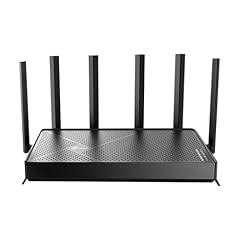
TP-Link Archer BE6500 Dual-Band Wi-Fi 7 Router
Overview
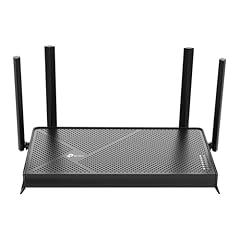
This product is a standalone dual-band Wi-Fi 7 router for a home modem or fiber gateway. It broadcasts on 2.4 GHz and 5 GHz, has six fixed external antennas, five Ethernet ports, including one 2.5 Gbps WAN and one 2.5 Gbps LAN port, plus USB 3.0 for local storage sharing. Setup and management can use either its local web interface or the Tether app. Its radio authorization is independently traceable to the exact product through an FCC equipment authorization granted in July 2024. TP-Link states a combined theoretical wireless link rate of 6.5 Gbps, not an internet-speed guarantee. Independent testing found strong short to medium range throughput and useful range, while confirming there is no 6 GHz band. Firmware updates remain active, but the maker has not published a product-specific end-of-support date.
What works
- Exact-product FCC authorization and RF exposure documentation are publicly traceable.
- Independent testing found strong short to medium range speeds, useful range, and two 2.5 Gbps Ethernet ports.
- TP-Link documents WPA3, guest networks, a separate IoT network, firewall controls, and both VPN client and server functions.
- The support page shows firmware releases through June 2026, including improvements and automatic updates in access point mode.
What does not
- This is a dual-band router without 6 GHz, so compatible devices cannot use that less congested Wi-Fi band.
- A high-severity nearby-attacker denial-of-service flaw affected earlier firmware. TP-Link published a fix, so prompt updates matter.
- No exact-product UL or ETL listing for the router and supplied adapter was located in the searched certification directories.
- No product-specific U.S. Cyber Trust Mark or equivalent independent cybersecurity assessment was located.
- TP-Link's policy covers account, device, network-use, and optional protection-feature data, so cloud-linked features require privacy tradeoffs.
Who is it for
It suits a household using cable, fiber, or fixed wireless service through a separate modem or gateway, especially one with a multi-gig internet plan or wired workstation, console, or network storage device. It is also appropriate for people who want a conventional router with local web administration, plus optional app control, guest access, and a separate network for smart-home devices. The independent test evidence supports apartments, small homes, and many ordinary multi-level homes where 6 GHz is not a requirement.
Who is it not for
It is not for a household that specifically needs 6 GHz Wi-Fi for compatible Wi-Fi 6E or Wi-Fi 7 devices, or for a very large property that needs proven whole-property coverage from one unit. It is also not for users unwilling to keep router firmware current, because an earlier version had a nearby-attacker service-disruption vulnerability. Buyers requiring independently verified electrical certification, a published security support end date, or a product-specific independent cybersecurity label need more documentation than is available here.
Integrity
The exact product is covered by an FCC authorization for its 2.4 GHz and 5 GHz radios, with published RF testing and exposure documentation. The filing specifies installation conditions that include a 46 cm separation from people for the evaluated antenna configuration. The product marketing reviewed focuses on network security and does not make health-promoting wireless claims. Use it indoors, follow the installation guidance, and retain the supplied adapter rather than substituting an unknown power supply. The supplied adapter is rated by TP-Link at 12 V and 2.5 A, which is a capacity rating rather than a measured always-on consumption figure. No model-specific operating-power measurement, exact-product NRTL electrical listing, or U.S. take-back program was located. Active firmware releases and a two-year manufacturer warranty can extend useful life, but TP-Link does not publish a product-specific support end date or a replacement-parts commitment.

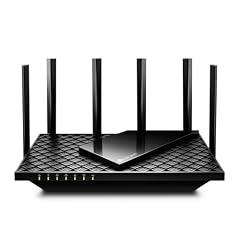
TP-Link Archer AXE75 Tri-Band WiFi 6E Router
Overview
The Archer AXE75 is a standalone tri-band Wi-Fi 6E router, not a cable modem. It connects to an existing modem or gateway and provides 2.4 GHz, 5 GHz, and 6 GHz Wi-Fi. The current U.S. product page describes six fixed antennas, five Ethernet ports including one 2.5 Gbps WAN/LAN port, WPA3 support, guest networks, a private IoT network, and local web administration. Those are manufacturer specifications and vary by hardware revision. Its radio authorization is independently traceable through FCC equipment records for the Archer AXE75. Independent reviewers have also tested the product with measured throughput, range, and latency methods, rather than relying only on its 5,400 Mbps theoretical link-rate claim. Firmware maintenance is active, but ownership requires attention to the exact hardware revision and firmware channel.
What works
- FCC equipment authorization is traceable for the Archer AXE75, supporting U.S. radio compliance.
- The current U.S. specification lists WPA3, guest Wi-Fi, a private IoT network, firewall controls, and local web management.
- TP-Link maintains a public vulnerability-reporting process and has issued model-specific patches for recent high-severity AXE75 V1 flaws.
- Independent reviews tested real throughput, range, and latency, providing more useful evidence than headline link rates alone.
- A published small-network-equipment efficiency filing reports 7.84 W idle power for the Archer AXE75 configuration tested.
What does not
- Hardware revisions differ materially. The original version has gigabit WAN and USB 3.0, while the current version lists a 2.5 Gbps WAN/LAN port and USB 2.0, so buyers should confirm the unit actually supplied.
- Recent advisories affected AXE75 V1 firmware and included high-severity authenticated command-injection issues. Updating promptly is important.
- No model-specific U.S. Cyber Trust Mark or publicly traceable accredited cybersecurity assessment was found.
- No publicly traceable, model-matched UL or ETL listing was found for the router and supplied power adapter.
- Tether app disclosures indicate collection of identifiers, usage data, diagnostics, and some account information. Local web management reduces, but does not eliminate, cloud and app privacy considerations.
Who is it for
This product suits a household with an existing cable, fiber, DSL, or fixed-wireless modem or gateway, especially one that has newer Wi-Fi 6E phones, laptops, or VR hardware able to use 6 GHz. It also fits users who want a conventional router with wired LAN ports, a local browser-based management option, guest access, and a separately configured IoT network. It is most appropriate for someone willing to identify the hardware revision, enable WPA3 where client support allows, and keep firmware current.
Who is it not for
It is not for someone who needs an all-in-one cable modem and router, because it has no DOCSIS modem or provider-specific cable approval. It is also a weaker fit for households that require independently certified cybersecurity assurance, a publicly documented U.S. support end date for every hardware revision, or verified NRTL safety certification for the exact bundled adapter. Users unable or unwilling to install security updates should avoid leaving an affected older firmware version in service. Privacy-sensitive users may prefer to administer locally and avoid optional cloud services.
Integrity
The product has FCC equipment authorization records and the manufacturer publishes U.S. transmission-power limits for its Wi-Fi radios. These support regulatory RF compliance, but they do not make health claims or establish a special health benefit. No U.S. consumer-product recall or regulator exposure warning specific to this router was found in the reviewed sources. Its supplied 12 V, 2.5 A external adapter should be used as directed, and there was no public model-matched UL or ETL record located during this review. For energy, a voluntary small-network-equipment filing reports 7.84 W idle power for an Archer AXE75 configuration, which is useful measured evidence for an always-on device. TP-Link also publishes a two-year U.S. warranty process and lists security support for the V1 model through at least December 31, 2028 in its PSTI compliance statement. A product-specific U.S. take-back or recycling route was not verified, so end-of-life handling should use a reputable electronics recycler.

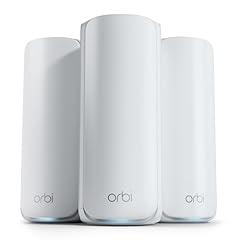
NETGEAR Orbi 770 Tri-Band WiFi 7 Mesh System
Overview
This product is a three-unit home mesh Wi-Fi system, with one router and two satellites. It connects behind an existing modem or gateway, then spreads one wireless network through the home. The manufacturer specifies simultaneous 2.4 GHz, 5 GHz, and 6 GHz radios, up to 11 Gbps aggregate wireless link rate, 2.5GbE internet and local ports, and wired satellite backhaul support. The router and satellite models are covered by an FCC Part 15 radio test filing, including the 6 GHz capable hardware. Its 8,000 square foot and 100-device figures are manufacturer estimates, not independently reproduced whole-home results. The product supports local browser administration without the mobile app, and automatic firmware updates are enabled by default.
What works
- FCC radio test documentation identifies the included router and satellite hardware under FCC Part 15 testing.
- Automatic firmware updates are enabled by default, and the maker has issued model-specific fixes for documented security flaws.
- Local web administration is available on the home network without requiring the mobile app.
- Separate IoT and guest network options are available, and the main network supports WPA3-Personal.
- Wired 2.5GbE backhaul is documented, which can avoid relying on wireless links between nodes.
What does not
- A January 2026 advisory documented an authentication bypass affecting this product until firmware 10.5.20.7 or later, so installed firmware and automatic updating matter.
- The guest network is off by default, but its security and encryption are also off by default when enabled. The owner must select WPA2 or WPA3 protection.
- HTTPS-only local administration is optional rather than the documented default, and password recovery can rely on security questions.
- No model-matched NRTL electrical-safety listing was located in the UL or Intertek public directories checked.
- No exact-model U.S. Cyber Trust Mark record, Wi-Fi Alliance certificate, transparent operating-power measurement, or independent whole-home throughput test was located.
Who is it for
This product fits a technically attentive household that needs a router plus two satellites, has an existing cable or fiber modem or gateway, and can place nodes where they have good signal or Ethernet access. It is most suitable where multi-gig wired connections, Wi-Fi 7 capable devices, and a separate network for smart-home equipment can be used. It also suits an owner willing to verify firmware versions, secure the guest network before sharing it, and use the local browser controls when preferred.
Who is it not for
It is not well suited to households that want a fully hands-off security setup. The documented guest-network setup starts without encryption, HTTPS-only administration must be enabled manually, and a recent local-network authentication bypass required a firmware fix. It is also a poor fit where an independently measured coverage guarantee, a public Cyber Trust Mark assessment, confirmed Wi-Fi Alliance certification, or disclosed always-on electricity use is required. This is a router system, not a cable modem, so it cannot replace a provider-approved modem where one is needed.
Integrity
The radio hardware is traceable to an FCC Part 15 test filing that names the router and satellite models, and the manufacturer does not market Wi-Fi as health-promoting or uniquely harmful. The 6 GHz radio is subject to indoor-use limits. No product-specific CPSC recall or U.S. exposure warning was identified in the checks performed. As with other Wi-Fi equipment, placement should follow the supplied installation directions and should not block ventilation. Security maintenance is a practical safety consideration. The product receives automatic firmware updates by default, but it was included in a January 2026 authentication-bypass advisory and needs the stated corrected firmware or later. NETGEAR's policy says updates stop three years after the last sale date, which limits long-term use. No public exact-model operating-power measurement, replacement-adapter listing, or model-specific take-back route was found, so its continuous energy demand and end-of-life provisions remain insufficiently documented.

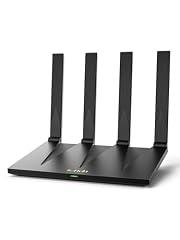
Tenda RX12 Pro V3.0 WiFi 6 Router
Overview
This is a dual-band Wi-Fi 6 home router with one gigabit WAN port and three gigabit LAN ports. It is intended to connect to an existing modem or fiber gateway, then provide wired and wireless home networking. Tenda documentation for related RX12 Pro versions states 2.4 GHz link rates up to 574 Mbps and 5 GHz link rates up to 2402 Mbps. Those are Wi-Fi link rates, not verified internet speeds. Product identification needs care. The catalog calls this product RX12 Pro version 3.0, while Tenda's current support materials list RX12 Pro versions 1.0 and 2.0, and list a separately named AX12 Pro version 3.0. Tenda documents WPA3 capability, guest networking, app and browser management, and online firmware upgrades for the related models, but independent records located for the RX12 Pro identify earlier hardware rather than the catalog's version 3.0 designation.
What works
- Tenda documents gigabit WAN and LAN ports, useful for wired devices and internet plans up to gigabit-class Ethernet limits.
- Manufacturer documentation for related RX12 Pro hardware lists WPA3 transition-mode support and a guest network.
- Tenda maintains a public security-reporting channel with encrypted reporting support and a stated initial response target of five working days.
- Current Tenda support materials for the separately named AX12 Pro version 3.0 show a firmware release dated April 2, 2026.
What does not
- The product name and hardware version are not cleanly matched across the catalog, Tenda support pages, and the available radio authorization record.
- No model-matched UL or ETL listing for the supplied power adapter was located in the searched public directories.
- The located radio authorization is for earlier RX12 Pro hardware, so it does not independently confirm the catalog's version 3.0 identity.
- Tenda publishes firmware files, but does not state a public end-of-support date or provide detailed security fix notes for this product.
- Cloud management privacy materials describe collection of device identifiers, network settings, connected-device information, logs, and traffic statistics when cloud functions are used.
Who is it for
This product suits a budget-focused household that already has a separate modem or fiber gateway and needs a basic dual-band Wi-Fi 6 router with several gigabit wired ports. It is most appropriate for someone comfortable checking the label on the delivered unit, setting a strong administrator password, enabling WPA3 where their devices support it, and periodically checking Tenda's support site for firmware. Browser management provides a local setup route for users who prefer not to rely solely on an app.
Who is it not for
It is not suited to buyers who need every advertised hardware revision independently traceable before installation, because the catalog's RX12 Pro version 3.0 name does not line up cleanly with Tenda's published RX12 Pro support versions or the located radio record. It is also a poor fit for security-sensitive households that require a published support end date, automatic security patching with detailed advisories, or a model-specific independent cybersecurity certification. Buyers needing an integrated cable modem should use a modem-router product instead.
Integrity
A radio authorization record was located for RX12 Pro hardware sold in the United States. That record specifies Part 15 operation and a minimum 20 cm separation between the antennas and people. This supports ordinary installed-router use, but it does not independently establish that the catalog's version 3.0 designation is the same certified hardware. No health-promoting or health-protective Wi-Fi claim was found in the manufacturer material reviewed. Electrical and environmental documentation is incomplete for this exact catalog designation. Tenda lists FCC, RoHS, CE, and UKCA claims for the separately named AX12 Pro version 3.0, but no model-matched public UL or ETL listing for the supplied adapter was located. Published related RX12 Pro specifications also differ on adapter output, listing 12 V at either 1 A or 1.5 A. Tenda supplies firmware downloads, but no public support-end date, repair-parts program, take-back route, or measured always-on power figure was found for this product.

NETGEAR Nighthawk RS700S WiFi 7 Router
Overview
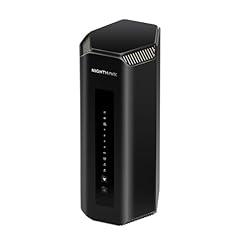
The RS700S is a single upright tri-band Wi-Fi 7 router for use with a separate cable, fiber, DSL, or satellite modem. It is not a modem-router. It has 2.4, 5, and 6 GHz radios, one 10 Gbps internet port, one 10 Gbps LAN port, four gigabit LAN ports, and USB storage support. The supplied package includes an Ethernet cable and a 19V power adapter. NETGEAR states a combined wireless link rate up to 19 Gbps and coverage up to 3,500 square feet, while clearly noting that throughput and coverage vary with clients, traffic, regulations, and building materials. Independent testing supports strong real-world midrange performance, rather than the headline link-rate figure. The hardware is FCC-authorized under the RS700 model, and its documentation shows locally accessible browser administration, WPA3 options, separate guest and IoT networks, and automatic firmware updates enabled by default.
What works
- Independent testing found strong throughput at middle and longer test distances, including 691.8 Mbps at 50 feet in one controlled review.
- A 10 Gbps internet port and separate 10 Gbps LAN port can avoid a wired bottleneck for households with compatible multi-gig service and devices.
- The manual documents distinct setup-created administrator credentials, WPA3 protection on 6 GHz, and separate guest and IoT networks.
- Automatic firmware updating is enabled by default, and NETGEAR released an RS700S firmware update addressing security issues on April 24, 2026.
- Independent testing measured 15.1 watts during operation, a relatively modest always-on draw for this class of router.
What does not
- The advertised 19 Gbps is a combined theoretical wireless link rate, not a promise of 19 Gbps internet service or per-device throughput.
- The 3,500 square foot coverage claim is manufacturer-stated and depends materially on walls, floors, radio interference, client hardware, and placement.
- No model-specific U.S. Cyber Trust Mark record or equivalent accredited cybersecurity assessment was located.
- The manual permits mixed WPA2 and WPA3 security on 2.4 and 5 GHz by default for legacy-device compatibility, rather than WPA3-only operation.
- A model-matched UL or ETL listing for the router and supplied adapter was not located in the public certification directories reviewed.
Who is it for
This product suits a technically confident household using a separate modem, with multi-gig internet service or fast wired storage and several newer Wi-Fi 6E or Wi-Fi 7 devices. It is most relevant where one centrally placed router can serve a medium-size home and where the buyer will use the 10 Gbps ports, create a separate IoT network for smart devices, and leave automatic updates enabled. It also fits users who prefer browser-based local administration instead of relying only on an app.
Who is it not for
It is not suited to households that need a cable modem included, because this is router-only hardware. It is also a poor fit for very large, long, or heavily masonry homes with persistent dead zones, where one access point may not reach every area despite the manufacturer coverage estimate. Buyers who require a publicly traceable third-party electrical listing, a U.S. Cyber Trust Mark, or a clearly model-specific long-term support date should note that those forms of evidence were not located. Legacy-only devices also reduce the value of Wi-Fi 7.
Integrity
The radio hardware has a traceable FCC authorization record for the underlying RS700 model, and the product materials reviewed do not make health-promoting or alarmist RF-exposure claims. Wi-Fi equipment should still be installed according to its supplied instructions and FCC labeling. No relevant U.S. recall or regulator exposure warning was located in the reviewed sources. For security, the documented default auto-update setting and April 2026 security-fix release are meaningful strengths. NETGEAR also publishes an end-of-service policy, although the reviewed U.S. materials did not provide a fixed end-of-service date specific to this version. Independent testing measured 15.1 watts in operation, which gives a useful real-world energy reference for an always-on router. The package includes a 19V external adapter, but public evidence of a model-matched UL or ETL listing and a product-specific U.S. take-back route was not located.

TP-Link Archer BE230 Dual-Band Wi-Fi 7 Router
Overview
This product is a compact dual-band home router using the 2.4 GHz and 5 GHz bands. It does not include a cable modem, so it connects to an existing cable, DSL, fiber, or Ethernet gateway. It has one 2.5 Gbps WAN port, one 2.5 Gbps LAN port, three gigabit LAN ports, USB 3.0, four fixed antennas, and a 12 V, 2 A power adapter rating. TP-Link states a combined 3.6 Gbps physical Wi-Fi rate, WPA3 support, guest networks, an IoT network, local browser management, and optional cloud and app services. Its speed caveats appropriately say actual throughput and range vary with client hardware, interference, building materials, and service limits. Independent testing supports strong close-range performance, while also finding a substantial 5 GHz decline at longer distances. FCC authorization records identify this router family, but no model-matched NRTL electrical-safety listing or Wi-Fi Alliance certificate was located.
What works
- Independent testing measured 993 Mbps average 5 GHz throughput at 10 feet, showing that the product can deliver near-gigabit local wireless performance under favorable test conditions.
- The manufacturer specifies both 2.5 Gbps WAN and 2.5 Gbps LAN ports, which can avoid a gigabit wired bottleneck when the internet plan, cable, and connected device also support that rate.
- WPA3, separate guest networks, an IoT network, firewall controls, and local web administration are documented by the manufacturer.
- TP-Link publishes product-specific security advisories and firmware fixes. The listed support period for the version 1 product runs through August 3, 2029.
What does not
- The product is dual-band only. It has no 6 GHz band, so it cannot provide the 6 GHz capacity available to some Wi-Fi 7 clients.
- Distance is a material limitation. Independent testing found 5 GHz throughput fell from 993 Mbps at 10 feet to 198 Mbps at 60 feet.
- TP-Link disclosed high-severity authenticated command-injection flaws affecting earlier version 1 firmware. Users need firmware 1.2.4 Build 20251218 or later for the published fix.
- No model-matched UL or ETL electrical-safety listing, U.S. Cyber Trust Mark record, or independent Wi-Fi certification record was located. This is missing verification, not evidence of a safety defect.
- The optional Tether app declares collection of identifiers, account details, app activity, and crash logs. Local browser administration reduces, but does not eliminate, cloud and app privacy considerations.
Who is it for
This product suits a small to medium home that already has a modem or gateway and needs a conventional router with fast nearby Wi-Fi, wired multi-gig connections, and separate networks for guests or smart devices. It is especially relevant where the main workstations, console, or media device can use the 2.5 Gbps LAN port, or where the router can be placed centrally rather than at one end of a large building. It also suits users willing to check firmware updates regularly.
Who is it not for
It is not for a household needing a built-in cable modem, since this product requires a separate modem or Ethernet handoff. It is also a weaker fit for very large, dense, or long-layout homes relying on one router, because independent testing found much lower 5 GHz throughput at 60 feet. Buyers who require independently certified cybersecurity assurance, a traceable NRTL safety listing, or Wi-Fi 7 access on the 6 GHz band should use a product with those exact records and capabilities.
Integrity
The radio has an FCC authorization trail and TP-Link makes no health-promoting or uniquely hazardous Wi-Fi claims for this product. Normal placement guidance remains important, including keeping the adapter accessible, avoiding prohibited wireless-use areas, and not enclosing the router in a corner or closet. No product-specific CPSC recall or exposure warning was located in the checks performed. The supplied U.S. adapter is rated 12 V and 2 A, which is a 24 W maximum electrical rating, not a measured always-on consumption figure. No model-specific operating-power test or efficient-external-power-supply certification was located. TP-Link documents firmware support for version 1 through August 3, 2029, which can extend useful life if updates are installed. It also provides technical-support and replacement-service routes, but a product-specific take-back or recycling path and replacement adapter availability were not independently confirmed.

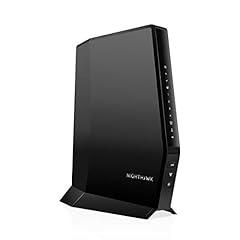
NETGEAR Nighthawk CAX30 Modem Router Combo
Overview
This product is a cable modem and dual-band WiFi 6 router in one upright unit. It connects directly to a cable outlet, then provides wired networking through four Gigabit Ethernet ports and wireless networking for a home network. NETGEAR describes it as a DOCSIS 3.1, six-stream WiFi 6 design with an aggregate wireless link-rate claim of up to 2.7 Gbps, plus a USB 3.0 port. Those speed and coverage figures are manufacturer-stated link and environment claims, not verified internet-speed results. The radio hardware is independently traceable to an FCC equipment authorization for an AX2700 cable modem router. The authorization includes a 27 cm separation condition from people and indoor-only use for part of its 5 GHz operation. NETGEAR's current support materials also document firmware fixes for this product, but do not state a public end-of-security-support date.
What works
- The radio hardware is traceable to an FCC authorization and accompanying RF exposure evaluation.
- A product label provides a preset WiFi name and password, rather than relying on a shared default password.
- NETGEAR documents WPA3 capability and a separate guest network, which can reduce routine guest-device access to the main network.
- NETGEAR has published model-specific security advisories and firmware fixes, including fixes released after the product's launch.
- The modem-router format can replace separate cable modem and router hardware where the cable provider allows it.
What does not
- No exact-product U.S. Cyber Trust Mark, accredited cybersecurity assessment, or public independent firmware test report was located.
- NETGEAR does not publish a firm end-of-security-support date for this product. Cable-side firmware is controlled by the internet provider, not solely by the owner.
- The companion app's Apple privacy disclosure says usage data may be used to track users and lists a broad range of data linked to identity. Local browser administration remains available.
- No model-matched UL or ETL listing was located in the checked public certification directories for the supplied power adapter.
- NETGEAR's speed and 2,000-square-foot coverage figures are manufacturer claims. No independent, exact-product throughput or range test was located.
Who is it for
This product suits a household with a compatible cable internet plan that wants one physical device instead of a separate modem and router. It is most appropriate for users who can confirm approval with their own provider before setup, can keep router firmware current, and want local browser administration alongside app setup. The four wired ports and guest WiFi are practical for a small to medium home with a mix of fixed devices, visitors, and modern WiFi equipment. It is intended for cable service, not fiber service or bundled cable voice service.
Who is it not for
It is not suited to households that need provider-managed hardware, fiber internet, or cable service bundled with voice service. Buyers who require a published multi-year security-support commitment, independently assessed cybersecurity certification, or a verified low-energy operating-power figure should use a product with those records. It is also a poor fit where a modem must support a provider's newer enhanced upload tiers unless that exact service address and speed tier have been confirmed. Keep the unit away from routinely occupied positions within its stated 27 cm RF clearance distance.
Integrity
The radio portion has an FCC equipment authorization and RF exposure documentation for the specific hardware. Its installation condition calls for at least 27 cm separation from people, and part of the 5 GHz radio is restricted to indoor use. No health-promoting or health-protective WiFi claims were identified in the product materials reviewed. No product-specific CPSC recall or safety warning was identified in the reviewed public materials. NETGEAR has published security advisories and fixed-firmware information for known flaws, and it maintains a vulnerability-reporting process. That is useful evidence of ongoing response, but it is not a stated support-life guarantee. The supplied external power adapter's model-matched NRTL listing and measured always-on electricity use were not publicly verified. A one-year limited warranty is stated, while a clearly documented replacement-parts path or product-specific take-back route was not confirmed.
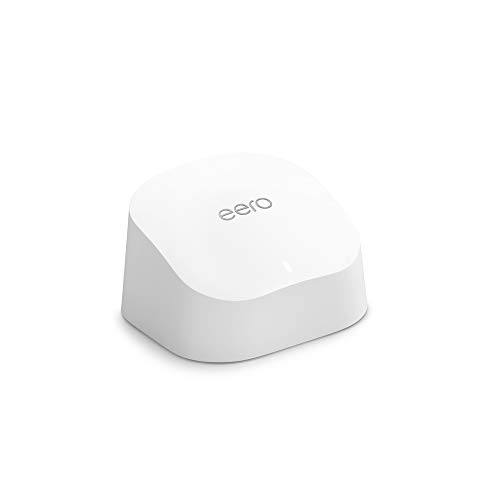
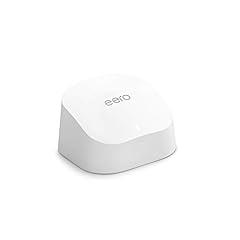
Amazon eero 6 Mesh Wi-Fi Router
Overview
This compact mesh router connects by Ethernet to an existing cable, DSL, or fiber modem or ONT, then provides dual-band Wi-Fi 6. It has two auto-sensing Gigabit Ethernet ports, a 1.2 GHz quad-core processor, 512 MB of memory, 4 GB of storage, Zigbee and Thread radio hardware, and a 15 W USB-C supply. Setup and routine administration require the eero mobile app and an internet connection. The maker states that one unit supports internet plans up to 900 Mbps and covers up to 1,500 square feet. Those are conditional estimates, not a guaranteed result through every wall or layout. A TÜV Rheinland radio-emissions report filed for this exact hardware identifies it as a dual-band Wi-Fi 6 router. The maker also publishes rolling software releases and has stated support for this model through 2030 or later.
What works
- FCC-filed laboratory documentation identifies this exact router hardware and its dual-band radio configuration.
- Automatic over-the-air software updates are available without the paid eero Plus service.
- A guest network can be enabled to isolate visitor devices from the main network and from one another.
- Two Gigabit Ethernet ports can each serve as WAN or LAN, which makes basic modem and wired-device connections flexible.
- The maker states support for WPA3, WPA2, TLS-protected cloud connectivity, and Zigbee and Thread smart-home radios.
What does not
- Essential setup and administration depend on a phone app, an eero account, and cloud connectivity rather than a full local browser-based administrator interface.
- eero's privacy notice describes collection of network performance, bandwidth, connected-device, identifier, and app-use data linked to an account.
- No model-specific U.S. Cyber Trust Mark or equivalent accredited cybersecurity assessment was located.
- The supplied 15 W adapter is documented, but a model-matched NRTL directory record and measured operating-power report were not located.
- Coverage, device-count, and up-to-900 Mbps performance figures remain manufacturer estimates that vary with placement, interference, client hardware, and wireless backhaul.
Who is it for
This product suits a household with an existing modem or fiber ONT, a modest-sized coverage area, and a preference for app-guided administration instead of detailed router tuning. It is particularly relevant where guest devices or smart-home equipment need basic separation from household computers and storage devices. It also fits users whose broadband service is below the maker's stated 900 Mbps ceiling and who value automatic firmware delivery. Place the primary unit in an open, central indoor location with Ethernet access to the modem.
Who is it not for
It is not suited to people who need fully local router administration, want to avoid an account-linked cloud service, or have strict data-minimization requirements for network telemetry. It is also a poor fit where one unit must reliably cover a large, heavily built, multi-story home, because walls, interference, and placement can materially reduce range. Buyers needing multi-gigabit wired networking, a dedicated wireless backhaul, USB storage features, or an independently certified cybersecurity label should use a product whose documentation specifically provides those capabilities.
Integrity
The exact router hardware appears in FCC-filed testing under FCC ID 2AEM4-61704, with a TÜV Rheinland report identifying the eero 6 model. eero's U.S. safety information says its devices comply with FCC radio-frequency exposure limits for an uncontrolled environment and instructs users to maintain 30 cm separation. Wi-Fi is not a health treatment, and this product makes no verified health-promoting claim. No relevant U.S. recall or regulator exposure warning was located in the review search. The router uses an external 15 W USB-C power supply, which limits its rated input compared with larger network gear, but no model-specific operating-power measurement was found. The maker documents a 1-year limited warranty, support contact route, firmware support stated through 2030 or later, and general instructions to recycle electronics through appropriate local channels. A verified product-specific take-back program, repair manual, replacement-parts catalog, and NRTL directory match for the supplied adapter were not located.
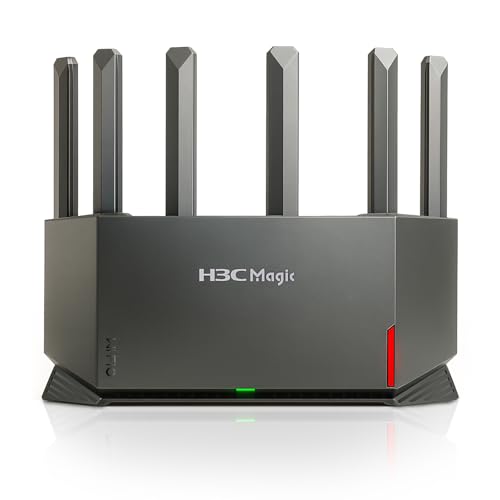
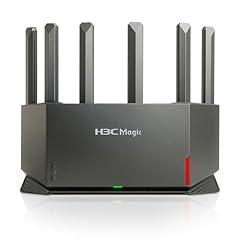
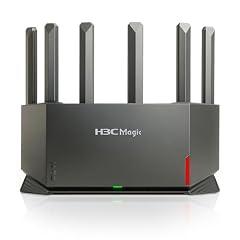
H3C NX54 AX5400 WiFi 6 Router
Overview
This is a dual-band Wi-Fi 6 home router, not a cable modem. H3C’s product page identifies the NX54 as a 5,378 Mbps combined-rate design, with 574 Mbps on 2.4 GHz and 4,804 Mbps on 5 GHz, six external antennas, four gigabit Ethernet ports, a 12 V, 2 A power supply, and app or browser-based administration. Those rates are manufacturer-stated theoretical wireless link rates, not expected internet speeds. The product record has a meaningful naming inconsistency, describing the product as NX54 while its title also says NX30. H3C documents NX54 and NX30 as different router models with different advertised wireless rates. H3C publishes safety documentation and firmware release notes for NX54, including a July 2025 release, but the review could not confirm a model-specific U.S. FCC authorization, NRTL electrical-safety listing, Wi-Fi Alliance certificate, or independent cybersecurity assessment for the exact product offered.
What works
- Four gigabit Ethernet ports support wired connections for fixed devices, according to H3C specifications.
- H3C documents WPA3, guest Wi-Fi, access controls, firewall functions, parental controls, and web administration.
- H3C has published NX54 firmware release notes, including a release dated July 2025, indicating post-launch maintenance activity.
- The manufacturer discloses a maximum power consumption of 24 W and a 12 V, 2 A external supply specification.
What does not
- The product record mixes NX54 and NX30 names. This is a concrete identification problem because these are separately specified H3C models.
- No model-specific U.S. FCC authorization, UL or ETL listing, Wi-Fi Alliance certificate, or Cyber Trust Mark record was confirmed for the exact product.
- The AX5400 figure is a manufacturer laboratory link-rate claim. H3C notes that actual results vary, and no exact-model independent throughput or range test was found.
- The H3C Magic app privacy policy says cloud-enabled device management can collect the router identifier, Wi-Fi name and password, IP and MAC addresses, device login password, and system configuration.
Who is it for
This product fits a household that needs a standalone router behind an existing modem or fiber gateway, has several devices that benefit from wired gigabit ports, and is comfortable administering network equipment through a browser. It is most suitable where Wi-Fi 6 client devices can use 160 MHz channels and where the buyer can verify the label, included power adapter, and regional compliance markings on delivery. The published guest-network and WPA3 features are useful for a conventional home network with visitors and smart devices.
Who is it not for
It is not suited to buyers who need a confirmed U.S. compliance trail before installation, including households with strict landlord, insurer, workplace, or safety documentation requirements. It is also unsuitable for someone seeking a cable modem-router, since H3C describes it as a router only. Privacy-sensitive users who plan to use cloud app management should take particular care because the app policy covers Wi-Fi credentials, device credentials, identifiers, network details, and configuration information. Buyers should avoid relying on the listing title alone because it mixes model names.
Integrity
No health-promoting or unusual RF-health claim was identified in H3C’s NX54 materials. The maker provides a compliance and safety manual and describes normal indoor operating limits of 0°C to 40°C. However, a model-specific U.S. FCC equipment-authorization record could not be confirmed for the exact product, so the supplied unit’s label and regulatory markings matter. No CPSC recall or U.S. regulatory warning specific to NX54 was identified in the checks performed. H3C states a maximum 24 W consumption and specifies a 12 V, 2 A adapter, which provides a useful upper-bound disclosure for an always-on device, though no independent wall-power measurement was found. H3C has released firmware notes for NX54, but does not publish a clear end-of-support date, replacement-adapter route, repair program, or product-specific U.S. take-back pathway. Its app privacy policy also warrants attention when cloud functions are enabled.

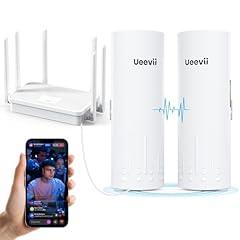
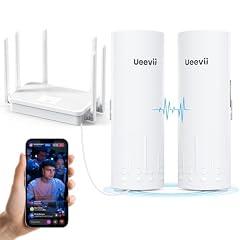
UeeVii Wireless Bridge and Router Kit
Overview
This product is a three-piece network-extension kit. It combines two outdoor 5.8 GHz CPE450 directional wireless bridges with an indoor WR3000K dual-band Wi-Fi 6 router. The intended setup is a point-to-point wireless link from an existing internet connection to a separate building, followed by local Wi-Fi from the supplied router. The bridge pair has 10/100 Mbps Ethernet ports, so its wired connection is capped at 100 Mbps even though the listing uses higher Wi-Fi figures. The CPE450 bridge radio is independently traceable to a U.S. FCC authorization. Its authorization specifies a minimum 20 cm separation from people during operation. The stated 3 km bridge distance is a manufacturer figure for barrier-free, line-of-sight conditions, not a verified real-world coverage result. The included router is documented as having WPA3 and guest-network options, but its manual also discloses shared default administrator credentials and a shared default Wi-Fi password.
What works
- The CPE450 bridge model is traceable to an FCC equipment authorization for 5 GHz operation in the United States.
- It provides a concrete building-to-building network layout, with two outdoor bridge units plus an indoor router in one package.
- The bridge documentation clearly identifies 10/100 Mbps Ethernet ports, which sets a realistic wired throughput ceiling.
- The router documentation lists WPA3 capability and a guest network that can separate guest devices from the main network.
- UeeVii states a two-year replacement warranty and lifetime technical support for its wireless bridges.
What does not
- The router ships with a shared default Wi-Fi password and admin/admin management credentials. Change both before connecting it to an internet service.
- No public support end date, security advisory archive, signed-update policy, or vulnerability-disclosure policy was located.
- No model-matched UL or ETL electrical-safety listing was located for the bridge, router, or included power adapters.
- The router portion could not be matched to a public FCC authorization or Wi-Fi Alliance certification record during this review.
- The 3 km range and AX3000 class figures lack an identified independent throughput, latency, or range test for this product.
Who is it for
It suits a user who needs to carry an existing wired internet connection to a detached garage, barn, workshop, camera location, or small outbuilding without trenching Ethernet cable. The installation is most appropriate where the two outdoor bridge locations have clear or near-clear line of sight, the needed connection is no more than 100 Mbps at the bridge Ethernet handoff, and the user can mount outdoor equipment, protect cables from weather, and change default router credentials during setup. It can also fit a basic remote-camera backhaul arrangement.
Who is it not for
It is not suited to households that need a security-managed router with unique factory credentials, automatic security updates, a published support lifetime, or independently assessed cybersecurity. Do not treat the stated 3 km distance as an expectation through trees, walls, terrain, or dense radio interference. It is also a poor fit for internet plans or local transfers above 100 Mbps across the bridge, since the CPE450 handoff ports are 10/100 Mbps. Users unable to safely mount and align outdoor radios should use professional installation or another network design.
Integrity
The outdoor bridge model is linked to a U.S. FCC authorization for 5 GHz operation. The associated filing requires the antennas to remain at least 20 cm from people and not be co-located with other transmitters except under applicable FCC procedures. No health-promoting or health-protective wireless claims were identified. This product should be installed according to that separation instruction and its mounting guidance. The bridge manual lists power use of up to 3 W for each CPE450 unit, but no independent whole-kit power measurement was found. The supplied adapters were not matched to a public UL or ETL listing in this review. UeeVii states a two-year replacement warranty and lifetime technical support for its bridges, which may help keep the bridge units in service. No manufacturer take-back program or verified recycling route for this product was located. No U.S. CPSC recall or safety warning specific to this product was found during the review.