
10 Best Teeth Whitening Strips
 Lauren Wilson
Please note that we participate in affiliate marketing programs. When you purchase through links on our site, we may earn a commission. As an Amazon Associate we earn from qualifying purchases. This comes at no additional cost to you and helps support the resources required to provide valuable content.Advertising Disclosure
Top-rated Teeth Whitening Strips Comparison
1

2
4
5
6
7
8
9
Teeth-whitening strips: what matters
Whitening strips hold a gel against the teeth for a set time. Peroxide-based strips use hydrogen peroxide or carbamide peroxide to change the color of natural teeth. Peroxide-free strips use other ingredients, such as enzymes, oils, salts, or arbutin, but a named ingredient does not by itself show that the sold product produces a measurable shade change.
The most useful evidence is human clinical evidence on the exact formula, peroxide strength, strip design, wear time, and treatment schedule. Look for a randomized human trial that reports objective color change using a CIELAB instrument or a VITA shade guide. A trial of a similar peroxide concentration or a related product can support the general mechanism, but it does not prove the result of the exact product in the box.
Independent verification is a separate question. An ADA Seal of Acceptance listing for the exact product and variant is stronger than a brand statement that a product is “clinically proven,” “dentist formulated,” or “enamel safe.” Other meaningful checks include a full third-party laboratory report naming the product lot, test methods, date, and chain of custody; an ISO/IEC 17025-accredited laboratory whose scope can be checked through an accreditation body; and, where relevant, an FDA 510(k) record or device listing. FDA registration or facility registration should not be treated as FDA approval, clearance, or proof that a cosmetic product works.
Buyers should be able to identify the active ingredient, its concentration, the amount delivered per strip, the number of treatments, contact time, maximum course, and storage conditions. A product that states only “hydrogen peroxide,” “natural,” or “professional strength” leaves the exposure difficult to compare. The headline number can also mislead: “up to” a stated number of shades may not describe the typical result; a study of a different formula may be presented as evidence for the product; a purple tint may create an immediate visual color correction without bleaching; and an LED or other add-on may not provide extra whitening at the sold dose. Whitening claims also concern natural teeth. Crowns, veneers, fillings, bridges, implants, and bonding generally do not lighten in the same way, so bleaching can reveal a mismatch.
Peroxide whitening commonly carries a temporary risk of tooth sensitivity and gum or other soft-tissue irritation. Stronger peroxide exposure can increase that concern, and gel touching the gums or a poorly fitting tray can irritate tissue. Do not use casually with untreated cavities, cracked or damaged teeth, active gum disease, mouth sores, loose teeth, exposed roots, unexplained discoloration, or substantial existing sensitivity. Several supplied reviews also advise caution or professional guidance during pregnancy or breastfeeding, with braces, recent dental treatment, or extensive restorations; age restrictions commonly exclude children or younger adolescents. Follow the received package directions, do not swallow the product, respect the wear-time limit, and stop if pain, burning, gum irritation, or worsening sensitivity develops.
Integrity
For this category, a high score reflects clear, product-specific information and evidence rather than attractive claims alone. The supplied products span well-documented peroxide strips and trays, products with plausible mechanisms but incomplete dosing, and peroxide-free products whose clinical whitening results remain uncertain.
EEvidence
Proven whitening at the sold dose
This measures human clinical evidence for the exact formula, strength, wear time, and regimen, with meaningful color change measured objectively or by a shade guide. It is the clearest defense against inferring whitening from an ingredient alone. Higher-scoring products have exact or closely related human evidence; lower-scoring products rely on mechanism, laboratory work, or a study of a different product.
Independent proof, not brand claims
This measures current, product-specific review by an independent body, such as an exact ADA Seal listing, a report from an appropriately accredited laboratory, or a relevant FDA record where the product is marketed as a device. Higher scores reflect reviewable independent support. Lower scores reflect manufacturer studies, unsupported “FDA” language, or claims that cannot be matched to the sold variant.
Claims match the evidence
This measures whether shade, speed, sensitivity-free, enamel-safe, dentist-formulated, clinically proven, and FDA-related claims are specific and supported for the exact product. Higher-scoring products qualify their evidence and avoid implying approval or guaranteed results. Lower-scoring products promise large shade changes or absolute safety while withholding the protocol, formulation match, or independent result.
No unsupported LED or add-on promises
This measures whether LEDs, trays, hydroxyapatite, enzymes, botanicals, or desensitizing additions have evidence of benefit at the sold dose. An accessory can improve convenience without improving whitening. Higher scores reflect products that avoid unsupported accelerator claims or provide relevant evidence; lower scores use lights or add-ons to suggest faster or safer results without product-specific testing.
HHealth & Safety
Clear active ingredients and exposure dose
This measures whether the product names every whitening active, concentration, amount per strip, wear time, treatment count, and storage conditions. That matters because peroxide strength and contact time affect both expected whitening and irritation risk. Higher-scoring examples disclose a concentration and defined routine; lower-scoring products identify only a vague active or omit dose, gel quantity, storage, or expiry information.
Low risk of tooth sensitivity and gum irritation
This measures whether sensitivity, gum burns, oral irritation, and accidental ingestion are addressed with evidence and practical safeguards. Strips can place peroxide directly against the gumline, while dissolving formats leave ingredients in the mouth. Higher scores combine warnings, stop-use directions, or sensitivity-focused ingredients with supporting evidence; lower scores rely on “no sensitivity” wording without quantified product-specific safety results.
Protects enamel and is honest about dental work
This measures whether enamel-safety and remineralizing claims are supported and whether the product explains that bleaching changes natural teeth, not restorations. This is important when crowns, veneers, fillings, bridges, bonding, or implants are visible. Higher-scoring products clearly state the restoration limitation and have stronger compatibility support; lower-scoring products make broad enamel-safe or restoration-safe claims without a product-specific study.
Useful directions and safety warnings
This measures whether instructions give age limits, maximum wear time, stop-use advice, storage guidance, and cautions for damaged teeth, oral disease, braces, pregnancy-related questions, or dental treatment. Higher-scoring products provide concrete timing and screening instructions, sometimes including ingestion or gum-contact guidance. Lower-scoring products leave important groups and misuse scenarios unaddressed.
Traceable, stable, and recall-ready
This measures whether the manufacturer, seller, lot or batch code, expiry date, storage controls, and recall path are identifiable. Whitening gels can change with age or storage, making traceability relevant to potency and safety. Higher scores in the supplied set reflect identifiable manufacturers and basic accountability; lower scores reflect missing lot, expiry, stability, or recall information.
EEcology
Less waste from single-use strips and packaging
This measures the material burden of strips, backing liners, individual sachets, trays, applicators, batteries, and outer packaging per treatment. Single-use strips create recurring waste even when the box is compact. Higher scores among the supplied products generally reflect clearer treatment quantities or potentially reusable components; lower scores reflect many disposable pieces with no material or disposal disclosure.
Environmental claims that can be checked
This measures whether recyclable, compostable, plastic-free, recycled-content, cruelty-free, or sustainable claims identify their scope and can be checked through a public certification or disposal route. A “natural,” “plant-based,” “vegan,” or “eco-conscious” description is not proof of lower impact. Higher scores have more qualified or checkable claims; lower scores provide no material specification, certification, or realistic disposal instruction.
Full reviews

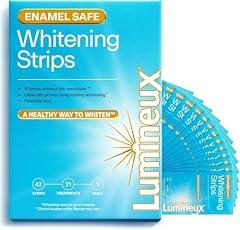
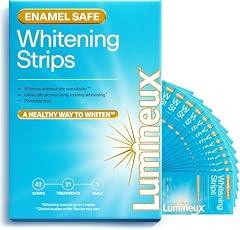
Lumineux Teeth Whitening Strips 21 Treatments
Overview
This is a 21-treatment home whitening-strip pack. Each treatment uses one upper and one lower strip for 30 minutes. The manufacturer lists vegetable glycerol, water, carbomer, carboxymethyl, coconut oil, Dead Sea salt, sage oil, and lemon peel oil. It states that the formula is peroxide-free and recommends seven consecutive days, followed by one or two uses weekly for maintenance. Its defining evidence is a 90-person randomized, double-blind controlled study using Lumineux strips with the same stated whitening actives. After 14 daily uses, the study reported significantly greater measured color change than placebo. The product maker supplied the strips, so this is meaningful human evidence but not a fully independent certification. A separate advertising review found reasonable support for the narrower claim that the strips whiten without sensitivity.
What works
- A randomized, double-blind 90-person study found significantly more whitening than placebo after 14 daily uses.
- The same study found one report of mild, transient sensitivity in the Lumineux group, with no dentist-observed hard or soft tissue changes during the 14-day study.
- The formula, treatment count, and 30-minute wear time are clearly stated by the manufacturer.
- Available label directions include a 60-minute maximum, stop-use advice for irritation or sensitivity, and a warning not to swallow the strips.
- A 2023 National Advertising Division review found a reasonable basis for the claim that the strips whiten without sensitivity.
What does not
- No ADA Seal of Acceptance or publicly reviewable accredited laboratory report was found for this product.
- The manufacturer does not disclose concentrations for its listed whitening ingredients, limiting dose comparison and exposure assessment.
- The clinical study was short, used young adults, and the product supplier provided the strips. It does not establish long-term safety or results for all users.
- The absolute no-sensitivity wording is too broad. One study participant reported mild transient sensitivity, and the label itself tells users to stop if sensitivity or oral irritation occurs.
- The product remains a disposable-strip system, and no product-specific recycling, recycled-content, or material-reduction documentation was found.
Who is it for
This product suits an adult seeking a peroxide-free strip format for visible surface stains from drinks or smoking, especially someone concerned about the sensitivity often associated with peroxide whitening. The 21-treatment format supports an initial seven-day routine plus maintenance uses, rather than a single application. It is most appropriate for natural teeth in otherwise stable oral health, with willingness to follow the 30-minute wear time and stop if gum irritation or sensitivity develops. The controlled study supports use over a 14-day course, not an instant result.
Who is it not for
It is not appropriate for children under 12, people who cannot reliably avoid swallowing the strips, or anyone with active gum or oral-tissue irritation. People with untreated cavities, cracked teeth, severe sensitivity, unexplained tooth pain, or current dental treatment should consult a dentist before whitening. It is also a poor fit for buyers expecting dental work to whiten, because crowns, veneers, bonding, and fillings do not change color like natural enamel. Pregnancy or breastfeeding questions warrant advice from a clinician.
Integrity
The health case is stronger for short-term sensitivity than for broad enamel or non-toxic marketing. In a 90-person controlled study, the Lumineux group had one mild transient sensitivity report and no dentist-observed oral hard or soft tissue changes over 14 days. The formula is peroxide-free, but peroxide-free does not by itself prove that every user will be sensitivity-free. Label directions warn users not to swallow the strips, limit use to 60 minutes, and stop if irritation or sensitivity occurs. The full ingredient list is available, but ingredient concentrations and a public lot-specific test report were not found. The manufacturer identifies Oral Essentials and related retail label information indicates lot and expiration coding. The strips are disposable, with 42 individual strips in this pack. No verified product-specific recycling, recycled-content, compostability, or packaging-reduction information was found. Claims of certified non-toxic status were not supported by a publicly reviewable certifier record for this specific product.

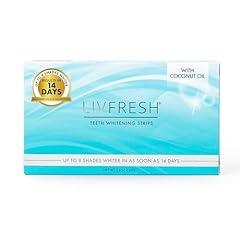
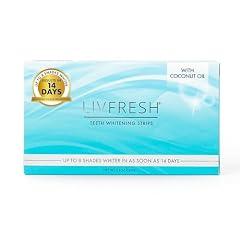
LIVFRESH Teeth Whitening Strips
Overview
This is a box of 28 peroxide-based whitening strips, arranged as 14 upper and lower treatments. LIVFRESH instructs users to apply one pair daily for 20 to 30 minutes, rinse afterward, and continue for 14 days. Its manufacturer-listed formula includes water, glycerin, hydrogen peroxide, cellulose gum, disodium EDTA, coconut oil, menthol, and citric acid. Hydrogen peroxide is a clinically established whitening mechanism in human studies of other strips, but LIVFRESH does not disclose the peroxide concentration, amount per strip, or product-specific clinical results. The manufacturer claims up to eight shades of change and very low sensitivity, but no independent trial, public lab report, or ADA Seal record for this product was located. The product is therefore more transparent about named ingredients and routine than about the dose and evidence behind its outcome claims.
What works
- Uses hydrogen peroxide, a whitening active supported by randomized human studies of other strip products.
- The manufacturer provides a complete named ingredient list rather than naming only coconut oil and peroxide.
- Directions specify one upper and lower treatment daily for 20 to 30 minutes over 14 days.
- Each treatment comes as a sealed strip pair, which supports dose-by-dose handling.
What does not
- The peroxide concentration and amount per treatment are not disclosed, preventing a meaningful comparison of chemical exposure.
- No product-specific randomized human whitening trial, ADA Seal listing, or public third-party laboratory report was located.
- Claims of being sensitivity-free, enamel-safe, and up to eight shades whiter are manufacturer claims without publicly located product-specific substantiation.
- The safety instructions lack clear screening for cavities, cracked teeth, active gum disease, orthodontic appliances, pregnancy-related questions, and recent dental work.
- The strips are disposable and individually sealed, while package materials and disposal instructions are not disclosed.
Who is it for
This product is most suited to an adult seeking a structured, short at-home regimen for visible surface staining from coffee, tea, wine, or tobacco, and who can follow a once-daily 20 to 30 minute routine for 14 days. It may fit someone who values a named ingredient list and wants a peroxide-based strip without an LED accessory. Because the peroxide dose is undisclosed, it is better suited to people without current tooth sensitivity, untreated dental problems, or uncertainty about their dental work.
Who is it not for
It is not well suited to children or adolescents with primary or mixed dentition, people with active cavities, gum disease, mouth sores, cracked teeth, exposed roots, or significant baseline sensitivity. Those with braces should seek dental guidance before bleaching. It is also unsuitable for anyone expecting crowns, veneers, bridges, fillings, or caps to become whiter, since bleaching changes natural tooth color rather than the color of restorations. Avoid use with a known coconut or formula-ingredient allergy, and stop if irritation or sensitivity develops.
Integrity
The manufacturer identifies hydrogen peroxide as the bleaching active and lists coconut oil, menthol, citric acid, and disodium EDTA among the other ingredients. Peroxide whitening can be effective when used as directed, but tooth sensitivity and gum irritation remain recognized effects of peroxide bleaching. LIVFRESH advises users not to swallow the formula and to stop if sensitivity increases. Its claims of no sensitivity, enamel safety, gum soothing, and compatibility with dental work were not matched to a public product-specific clinical study or independent certification record. LIVFRESH describes the strips as vegan and cruelty-free, but no public certifier listing was located for these claims. Each 14-day course uses 28 disposable strips and sealed treatment packaging. No package-material specification, recycled-content claim, recycling instruction, compostability evidence, or documented material-reduction program was located. No product-specific recall or regulatory action for these strips was identified in the checked FDA sources.
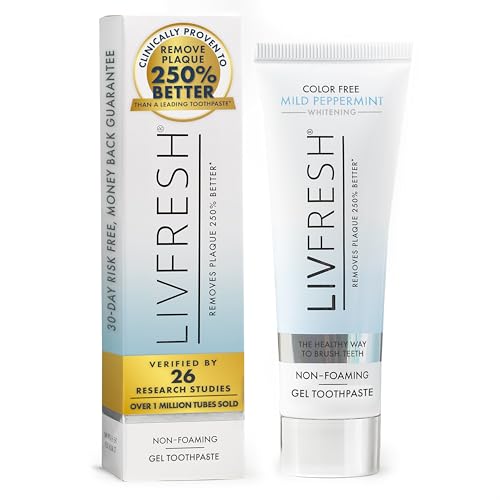
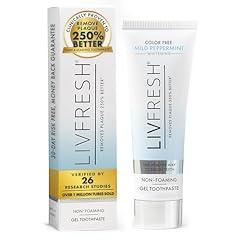
LIVFRESH Toothpaste Gel Peppermint
Overview
This is a 1.75-ounce mild-peppermint toothpaste gel, not a whitening-strip treatment. It is used as a pea-sized amount on a toothbrush, with the manufacturer directing twice-daily, two-minute brushing. The formula is fluoride-free, non-foaming and color-free. The manufacturer identifies activated edathamil as its active plaque-control ingredient and lists no peroxide whitening agent. There is published human research on a 2.6% edathamil dental gel. One double-blind randomized crossover trial found lower plaque reaccumulation and less residual plaque after brushing, but it included only 10 participants and did not measure tooth color. A separate small enamel-chip study found no difference from a control gel after an acid challenge. These studies support limited plaque and enamel observations, not proven whitening for this specific retail tube.
What works
- A PubMed-indexed randomized crossover study found improved plaque outcomes with a 2.6% edathamil test gel, although it was small.
- The mild peppermint version is manufacturer-stated to be non-foaming and color-free, which can matter for people avoiding foam or dye.
- The listed mild formula contains no peroxide, so it does not add peroxide bleaching exposure.
- A small in vivo enamel-chip study found enamel-surface recovery similar to a control dentifrice after an acid challenge.
What does not
- This is not a whitening-strip product, and no human color-change trial was located for this toothpaste formula.
- The product does not list fluoride, so it is not a substitute for a fluoride toothpaste when cavity prevention is a priority.
- No ADA Seal acceptance, public lot-specific third-party test report, or independent certificate of contents was located for this variant.
- Current manufacturer ingredient disclosures are inconsistent across page sections, and the listed edathamil concentration for this retail variant is not clearly stated.
- The manufacturer gives conflicting age messaging, stating both ages 6 and older and safe for all ages with supervision.
Who is it for
This product suits an adult who specifically wants a mild, color-free, non-foaming toothpaste gel and is focused on daily plaque control rather than bleaching. It may be especially relevant for a person who dislikes detergent foam or strongly flavored conventional pastes. The small 1.75-ounce tube is also better matched to a trial period than to a household seeking a large, economical toothpaste supply. Because it is fluoride-free, it is most appropriate for someone who has already discussed their cavity-prevention routine with a dental professional.
Who is it not for
It is not for someone seeking whitening strips, peroxide bleaching, or clinically demonstrated shade change. It is also not a straightforward choice for people at elevated cavity risk who rely on fluoride toothpaste, including those with frequent decay, dry mouth, exposed roots, or orthodontic treatment, unless their dentist has planned an alternative fluoride routine. Children younger than 6 should not use it based on the manufacturer’s current age guidance. People with active gum disease, painful sensitivity, mouth sores, ingredient allergies, or unresolved dental pain should seek dental assessment rather than rely on plaque-control marketing.
Integrity
The mild peppermint version is manufacturer-stated to be fluoride-free, non-foaming, color-free, and free of peroxide, abrasives, SLS, triclosan, parabens and phthalates. The formula does include edathamil, peppermint, menthol, propylene glycol, gums and stabilizers. A small clinical enamel study did not find worse enamel-surface recovery than a control gel after an acid challenge, but that is not proof that restorations such as crowns, veneers or fillings will respond the same way. No ADA Seal, public accredited laboratory report, lot-specific certificate of analysis, or package-material disposal guidance was located for this variant. The brand’s cruelty-free statement is its own declaration, not a public certification located in a certifier registry. A 2025 FDA warning letter concerned a university investigator’s unsubmitted investigational-drug application for a Livionex dental-gel study, not a retail recall of this toothpaste. It nevertheless limits confidence in using that study as regulatory-grade substantiation for disease-treatment claims.

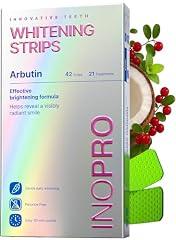
InoPro Teeth Whitening Strips Kit
Overview
This is a peroxide-free whitening-strip kit sold as 42 strips for 21 treatments, with one longer upper strip and one shorter lower strip per use. The manufacturer’s current product page describes a green gel formula containing glycerin, water, cellulose gum, sodium chlorite, disodium EDTA, chlorophyllin-copper complex, coconut oil, arbutin, menthol, and citric acid. Its directions call for drying teeth, applying the strips, wearing them for 30 minutes, then rinsing. The key limitation is evidence. No product-specific randomized human trial, independently published laboratory report, ADA Seal listing, or disclosed active concentration was located. A human trial of a different sodium chlorite whitening gel found only small color improvement, so it does not establish meaningful whitening for this strip formula or its regimen. The current manufacturer page also states 14 applications, which conflicts with this product’s listed 21-treatment count.
What works
- The manufacturer publishes a complete ingredient list and a clear 30-minute application method.
- The formula is explicitly stated to contain no hydrogen peroxide, alcohol, or SLS.
- The strips are designed for surface discoloration from foods and drinks, a narrower claim than deep intrinsic whitening.
- A named U.S. manufacturer and customer support contact are publicly identifiable.
What does not
- No product-specific clinical trial or independently reviewable test report was located, so whitening performance at the sold dose is unproven.
- Active concentrations, gel amount per strip, storage conditions, expiration information, and lot-level quality documentation are not publicly disclosed.
- The stated treatment count conflicts across sources, with this product listed as 21 treatments and the current manufacturer page stating 14 applications.
- In December 2025, the manufacturer permanently discontinued challenged claims including clinically proven, instant whitening, enamel safe, and no sensitivity after an advertising review.
Who is it for
This product is most suited to an adult who wants a short, peroxide-free home routine for mild, visible surface staining from coffee, tea, wine, or food and who can accept uncertain whitening results. It may be practical for someone who prefers strips over trays and wants a published ingredient list to screen for known sensitivities. The buyer should be comfortable following the 30-minute instructions exactly and should treat the product as a cosmetic surface-brightening routine, not as a proven treatment for dark or internal discoloration.
Who is it not for
It is not well suited to people seeking clinically demonstrated shade change, predictable results, or an independently verified enamel-safety claim. People with tooth pain, untreated cavities, gum disease, cracked teeth, oral sores, substantial sensitivity, or allergy concerns should consult a dental professional before using an oral whitening product. It is also unsuitable for people expecting crowns, veneers, fillings, implants, or other tooth-colored dental work to whiten. Whitening changes natural teeth, not restorations, which can create a color mismatch.
Integrity
The manufacturer identifies sodium chlorite and arbutin in the peroxide-free formula, but does not disclose their concentrations or provide product-specific clinical safety data. Peroxide-free does not itself establish that the product causes no sensitivity or is enamel-safe. Menthol, citric acid, and the other ingredients are also relevant for users with known oral sensitivities. Current directions explain placement, 30-minute wear, and rinsing, but publicly available instructions do not provide robust screening guidance for dental disease, restorations, or other higher-risk situations. A December 4, 2025 National Advertising Division case records that Smile&Shine permanently discontinued challenged INOPRO claims concerning instant whitening, clinical proof, enamel safety, and absence of sensitivity. No product-specific recall or FDA warning was located in the reviewed sources. Each treatment uses disposable strips and individual packaging. The brand has used eco-conscious language, but no product-specific material breakdown, recycling route, recycled-content certification, compostability evidence, or packaging reduction documentation was located.

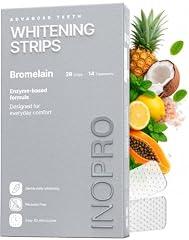
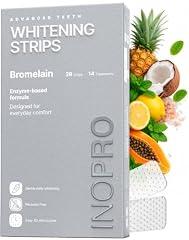
InoPro Teeth Whitening Strips Kit
Overview
This product is a box of 28 peroxide-free whitening strips, arranged as 14 upper-and-lower treatments. The manufacturer directs users to dry teeth, apply the gel side of each strip, leave them on for 30 minutes, then remove and rinse. Its disclosed formula includes glycerin, water, cellulose gum, carbomer, sea salt, coconut oil, lemon peel oil, menthol, papain, and bromelain. The defining evidence limitation is that the brand identifies the enzymes but does not disclose their concentrations or publish a human clinical trial of this exact strip formula and regimen. Research on papain and bromelain includes laboratory work on extracted teeth, not confirmation that this product produces a measurable shade change in people. No ADA Seal, product-specific independent lab report, or publicly located clinical registration was found.
What works
- The manufacturer provides a complete ingredient list, treatment count, and clear 30-minute application steps.
- The formula is explicitly peroxide-free, which may suit users seeking to avoid peroxide-based bleaching products.
- Papain and bromelain are named rather than hidden behind a generic whitening blend.
- The product has a named manufacturer and a direct manufacturer product page with matching use directions.
What does not
- No human clinical trial was located for this exact formula, strip contact time, or 14-treatment regimen.
- The active enzyme concentrations are not disclosed, so the actual whitening exposure cannot be compared reliably.
- The "sensitivity-free" positioning is not supported by product-specific human safety data, and the manufacturer itself notes that sensitivity varies by person.
- Available directions do not clearly state age limits, stop-use instructions, or cautions for cavities, gum disease, braces, restorations, pregnancy, or ongoing dental treatment.
- The strips are single-use and individually packaged, with no material specification or disposal guidance located.
Who is it for
This product is most suited to an adult who wants a peroxide-free, at-home strip routine for possible reduction of everyday surface staining from drinks such as coffee or tea, and who values having the ingredient list and a simple 30-minute protocol available before use. It may also fit someone who has avoided peroxide products because of prior discomfort, provided they understand that the gentler positioning is manufacturer-stated rather than confirmed in a product-specific clinical safety trial. A dental check is sensible before starting if there is any uncertainty about tooth or gum health.
Who is it not for
It is not well suited to anyone seeking clinically demonstrated shade change, a disclosed active dose, or independent certification of whitening performance. People with untreated cavities, cracked teeth, gum inflammation, mouth sores, persistent sensitivity, braces, veneers, crowns, fillings, or other visible dental work should not treat this as a routine cosmetic strip without dental guidance. Whitening changes natural tooth color, not the color of restorations. It is also a poor fit for buyers who need explicit child or teen directions, pregnancy-related guidance, robust stop-use instructions, or low-waste refillable packaging.
Integrity
The health-relevant positive is transparency at the ingredient-name level. The manufacturer lists a peroxide-free formula containing papain and bromelain, plus coconut oil, lemon peel oil, menthol, sea salt, and gel-forming ingredients. It also provides a defined 30-minute wear time and 14-treatment format. However, it does not disclose the enzyme concentrations, publish a product-specific human whitening or sensitivity study, or show an ADA Seal or public third-party laboratory report. Laboratory research on papain and bromelain cannot establish the result or safety profile of these strips in people. No product-specific FDA recall, warning letter, or adverse-event record was located in the searches performed. That is not proof of safety. The publicly available instructions lack several useful screening cautions, including guidance for dental disease, restorations, braces, and stopping after irritation. Each treatment uses disposable strips and individual packets. No verified recycled-content, recyclability, compostability, or material-reduction claim was found.

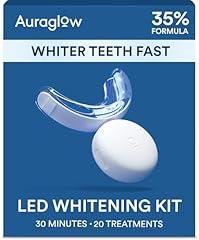
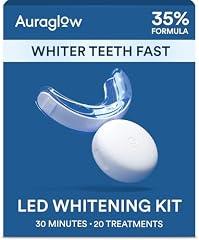
AURAGLOW Teeth Whitening Kit with LED Light
Overview
This is a tray-based home whitening product, not a whitening-strip product. It combines a rechargeable LED mouth tray with two syringes of 35% carbamide peroxide gel. The manufacturer states that the kit supplies 20 treatments. Directions call for a thin line of gel in the upper and lower tray sections, followed by a 30-minute session daily for 7 to 14 days. The tray is rinsed after use and stored in its case in a cool, dry place. The defining efficacy evidence is a manufacturer-published, 27-adult study of its 35% gel over seven days. It reports an average 7.11-shade improvement, measured with a Vita Easyshade device, and up to 10 shades for some participants. This is product-specific evidence, but it is not a peer-reviewed independent trial. No public ADA Seal listing, accredited lab report, or independently reviewable product testing was found.
What works
- The active concentration, ingredient list, 30-minute contact time, treatment count, and storage directions are clearly disclosed by the manufacturer.
- A manufacturer-published 27-person study used instrumental tooth-shade measurement and reported an average 7.11-shade improvement after seven days.
- The rechargeable tray is intended to be reused across the stated 20 treatments, rather than discarded after every application.
- The brand gives useful exclusions for children under 14, pregnancy or nursing, braces, and dental restorations, plus advice to pause or shorten use if discomfort occurs.
What does not
- The product-specific whitening study is manufacturer-published and lacks a peer-reviewed publication, independent sponsor, and control group disclosed to buyers.
- The brand's no-sensitivity and no-irritation marketing is too absolute. Its own study recorded very mild reversible gum blanching in about 5% of participants.
- Claims that the LED speeds whitening, including a claim of up to 10 times faster whitening, are not supported by product-specific independent human evidence. Broader clinical reviews generally do not show a consistent added whitening benefit from light activation.
- Claims that the product is safe for caps, crowns, and veneers need more qualification. Bleaching does not lighten restorations, and the brand elsewhere advises against use with dental restorations.
Who is it for
This product fits an adult with healthy natural front teeth, surface or age-related staining, and enough time for a daily 30-minute routine for up to two weeks. It is most relevant for someone who prefers a reusable tray format and wants the exposure details stated clearly, including 35% carbamide peroxide and 20 planned treatments. The manufacturer-published study offers some product-specific support for visible short-term whitening, but the buyer should understand that its findings have not been independently published or replicated.
Who is it not for
It is not suited to children under 14, people who are pregnant or nursing, or anyone wearing braces, consistent with the brand's own exclusions. People with tooth pain, active gum disease, cavities, cracked teeth, marked sensitivity, recent dental work, crowns, veneers, fillings, or implants should consult a dentist before bleaching. It also does not suit someone seeking a sensitivity-free guarantee or independently proven LED acceleration. Restorations will not whiten with the surrounding natural teeth, which can leave uneven color.
Integrity
The whitening active is 35% carbamide peroxide. The manufacturer lists glycerin, urea peroxide, propylene glycol, xylitol, carbomer, peppermint oil, triethanolamine, and water. Its guidance says to keep the gel cool and dry, notes an expiration date of generally two years, and says refrigeration is an option. The brand also advises stopping for 24 hours or shortening sessions if sensitivity or discomfort occurs. The manufacturer reports that its products are cruelty-free, but no product-specific independent cruelty-free certification was confirmed in a public registry. The rechargeable tray can be reused for the stated 20 treatments, which avoids the repeated disposal associated with single-use whitening strips. However, the product information does not provide material specifications, recycling instructions, recycled-content details, or independently verified environmental packaging claims. The charging cable is included without a wall plug, which the brand presents as a waste-reduction measure.

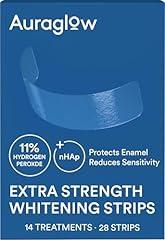
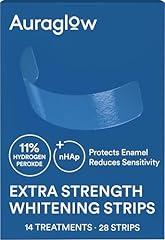
Auraglow Extra Strength Whitening Strips
Overview
This is a home-use whitening-strip set with 14 treatments, each using one upper and one lower strip. Auraglow states that the strips contain 11% hydrogen peroxide and should be worn for 30 minutes daily. It also identifies nano-hydroxyapatite and potassium nitrate as sensitivity-focused additions. The peroxide concentration, treatment count, and 30-minute routine are manufacturer-stated. Hydrogen peroxide strips as a category have human trial support for tooth-color change, but no peer-reviewed trial, posted clinical-trial result, ADA Seal listing, or independently reviewable laboratory report was located for this exact product. Auraglow's claims of up to 10 shades in seven days, enamel safety, and sensitivity-free use therefore remain unverified for this formula.
What works
- The active whitening concentration, treatment count, and standard 30-minute daily wear time are clearly stated by the manufacturer.
- The formula identifies nano-hydroxyapatite and potassium nitrate in addition to hydrogen peroxide, rather than leaving the sensitivity-focused ingredients unnamed.
- Human clinical research supports peroxide-strip whitening generally, and separate clinical studies suggest nano-hydroxyapatite can reduce bleaching-related sensitivity in other formulations.
- Auraglow publicly identifies a US business contact and offers a stated 60-day return policy.
What does not
- No product-specific randomized human trial or independently reviewable color-measurement data was located for the 11% strip formula.
- No ADA Seal listing, accredited third-party laboratory report, or public lot-specific certificate of analysis was located.
- The amounts of nano-hydroxyapatite and potassium nitrate, full inactive-ingredient list, storage conditions, and publicly verifiable expiry or batch information were not located.
- The manufacturer's own sales materials conflict on maximum contact time, with its main site stating 30 minutes daily while another Auraglow sales listing says wear may be extended to one hour.
- Claims such as sensitivity-free, enamel safe, clinically proven, and up to 10 shades in seven days are not backed by publicly located product-specific evidence.
Who is it for
This product fits an adult with natural-tooth surface staining from coffee, tea, wine, soda, or smoking who wants a defined two-week strip routine and accepts a higher-strength peroxide exposure. It is most relevant for someone who can follow the manufacturer's stated 30-minute daily use and who understands that the sensitivity-focused ingredients are manufacturer-stated rather than independently verified for this specific strip. A recent dental examination and no active oral symptoms make the use case more appropriate.
Who is it not for
It is not well suited to people with untreated cavities, active gum disease, gum recession, cracked teeth, oral sores, or a history of substantial whitening sensitivity without first speaking with a dentist. It is also a poor fit for people with visible crowns, veneers, implants, or tooth-colored fillings who need matched color, because bleaching changes natural teeth rather than restorations. Children and adolescents, people unable to follow timed use, and households seeking comprehensive public safety warnings and lot-level traceability should choose a product with clearer documentation.
Integrity
Hydrogen peroxide is a well-established whitening active, but temporary tooth sensitivity and gum irritation are known effects of bleaching and can be more likely with stronger exposures. The manufacturer adds nano-hydroxyapatite and potassium nitrate, and human studies of other bleaching regimens suggest nano-hydroxyapatite may reduce sensitivity. That evidence does not validate the amount, strip delivery, or safety outcome of this exact product. The stated sensitivity-free and enamel-safe claims are therefore not independently confirmed. No active FDA recall, warning letter, or product-specific adverse-event pattern was located in the public sources reviewed. That is not equivalent to independent safety clearance. The product uses 28 disposable strips, normally supplied in individual treatment packaging, and no material specification, recycled-content statement, disposal instruction, or independently verified environmental certification was located. Cruelty-free and vegan language appears in marketplace material, but no certifier registry evidence was located for this product.
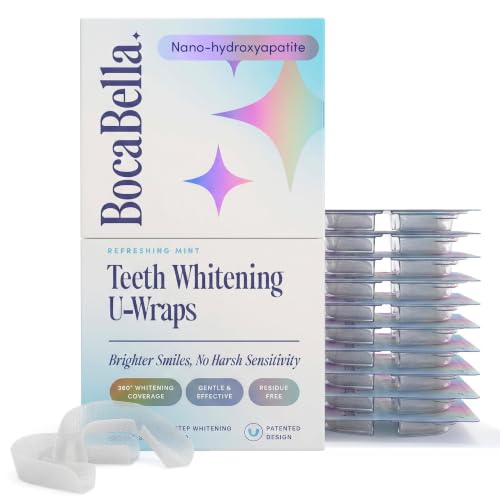
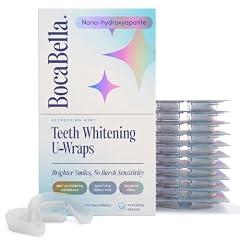
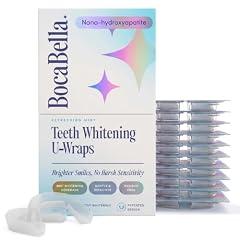
Boca Bella Teeth Whitening Wraps
Overview
Boca Bella U-Wraps are single-use upper and lower whitening wraps for adults. The manufacturer states that each box supplies 10 treatments, used once daily for 30 minutes, and lists 15% hydrogen peroxide as the whitening active. Its published ingredient list also includes hydroxyapatite, strontium acetate, aloe, calendula extract, peppermint oil, alcohol, and several film-forming and flavoring ingredients. The defining evidence limitation is that no public randomized human trial was located for this exact formula, wear time, and 10-day regimen. Boca Bella cites Intertek testing and a third-party consumer study, but does not publish a product-specific laboratory report, protocol, or human clinical data. Its own description of laboratory support identifies an in vitro bovine-enamel test, which cannot establish the claimed degree of whitening or low-sensitivity result in people.
What works
- The manufacturer provides a full ingredient list, peroxide concentration, 30-minute contact time, and 10-treatment regimen.
- The wrap format supplies both upper and lower pieces for each stated treatment.
- Hydrogen peroxide is an established tooth-whitening active, and the stated concentration and exposure schedule make the product's chemical exposure easier to compare than products that omit these details.
- A named manufacturer website and customer-service contact provide a practical point of contact for product questions.
What does not
- No public randomized human trial was found for the exact U-Wrap formula, 15% peroxide dose, 30-minute use, or 10-day course.
- The stated Intertek validation is not publicly reviewable as a product-specific report with methods, lot information, and results. Boca Bella's own account describes in vitro testing on bovine enamel, not a human clinical trial.
- The claims of up to 23 shades whiter, no harsh sensitivity, enamel strengthening, and gum comfort exceed the publicly available product-specific evidence.
- Public directions do not clearly set out screening for cavities, cracked teeth, gum disease, restorations, braces, pregnancy, or when to seek dental advice. Temporary sensitivity and gum inflammation remain known effects of peroxide whitening.
- Single-use wraps and protective backings create recurring waste, with no package-material or disposal details found.
Who is it for
This product is most suitable for an adult with natural teeth who wants a defined, short home-whitening course and can follow a 30-minute daily routine for 10 days. It is better suited to someone who has recently had a dental examination, has no current tooth pain or gum inflammation, and understands that the stated results are manufacturer claims rather than outcomes proven in a public human trial. The disclosed peroxide strength and full ingredient list may also help people who need to avoid a known ingredient.
Who is it not for
It is not a good fit for children, people in mixed or primary dentition, or anyone who is pregnant without individualized dental guidance. People with tooth sensitivity, exposed roots, untreated cavities, cracked teeth, active gum disease, mouth sores, braces, or recent dental work should ask a dentist before using a 15% hydrogen peroxide product. It is also unsuitable for buyers expecting crowns, veneers, fillings, implants, or other restorations to whiten, because bleaching changes natural tooth color rather than restoration color.
Integrity
The product uses 15% hydrogen peroxide, a recognized bleaching active, but peroxide can permeate tooth tissues and temporary sensitivity and gingival inflammation are common whitening effects. The American Dental Association notes that sensitivity risk can increase with peroxide concentration and contact time. Boca Bella adds hydroxyapatite and strontium acetate, but public evidence was not found showing that these ingredients prevent sensitivity or protect enamel in this exact product and regimen. Boca Bella states that the wraps are lab tested and cruelty-free, but no publicly reviewable certification, lot-specific test report, or certifier registry entry was located for this product. No product-specific FDA recall, warning letter, or adverse-event record was located in the reviewed public sources. The product is a disposable wrap system, and no verified recycled-content, recyclability, compostability, or disposal guidance was found for the wraps, backing films, or outer packaging.
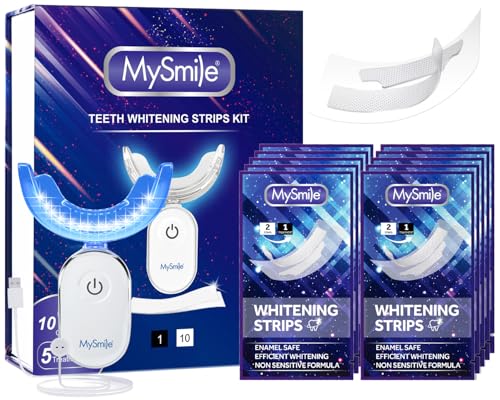
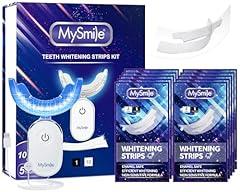
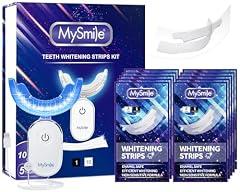
MySmile Teeth Whitening Strips Kit with LED Light
Overview
This is an at-home whitening kit with peroxide-coated upper and lower strips and a rechargeable blue LED mouth light. Current manufacturer directions describe applying the strips, avoiding the gumline, then using the light for 10 minutes. An independent retailer lists a 30-minute strip wear period, with the light used for the first 10 minutes. The manufacturer describes 14 strip sets, although the supplied marketplace record describes a 10-count pack, so the treatment quantity should be checked on the received package. The ingredient list is independently corroborated by a retailer and includes hydrogen peroxide, glycerin, water, polyvinylpyrrolidone compounds, hydroxypropyl cellulose, and menthol. The peroxide concentration is not disclosed. Human evidence supports peroxide whitening strips as a product category, but no published randomized trial was located for this exact formula, concentration, schedule, or LED combination. The light's claimed accelerating effect is not supported by the broader clinical evidence reviewed.
What works
- The peroxide-based ingredient list is available from both the product manual and an independent retailer.
- The manual gives a defined 10-minute LED cycle with automatic shutoff.
- Directions tell users to keep strips away from the gumline and to pause or stop use if significant sensitivity or gum discomfort persists.
- Peroxide whitening strips have human clinical evidence as a broader product category, although not for this exact undisclosed concentration.
What does not
- The hydrogen peroxide concentration, per-strip dose, expiry information, and lot-specific testing are not publicly disclosed.
- No product-specific clinical trial, independent laboratory report, or ADA Seal listing was located.
- The manufacturer makes broad non-sensitive, enamel-safe, dentist-developed, and FDA-approved claims without public product-specific substantiation.
- The LED accelerator promise is a concern, not merely an evidence gap. Systematic-review evidence generally finds light activation does not improve bleaching efficacy and may increase sensitivity.
- The kit uses disposable strips and individual packaging, with no verified recycling or material-reduction instructions located.
Who is it for
This format may suit an adult with intact natural teeth who wants a short, at-home strip routine for ordinary coffee, tea, wine, or tobacco staining and is prepared to follow the timing instructions closely. It is especially relevant for someone who values a disclosed peroxide ingredient list and a timed light cycle, but does not require independently proven results for the exact product. Buyers should inspect the package for the actual number of treatments, lot code, expiration date, and peroxide concentration before beginning.
Who is it not for
It is not well suited to people with current tooth sensitivity, inflamed or injured gums, untreated cavities, oral ulcers, or unresolved dental pain. Bleaching does not whiten crowns, veneers, fillings, bridges, dentures, or other restorations, and color mismatch can result. Children and adolescents, pregnant people seeking precautionary guidance, and people undergoing dental treatment should consult a dental professional first. Avoid the light if photosensitive, receiving photodynamic therapy, or affected by oral cancer, as the manual specifically cautions.
Integrity
Hydrogen peroxide is the listed whitening active, but the product does not publicly state its concentration or dose per strip. The instructions acknowledge that sensitivity and gum discomfort can occur, and recommend pausing use for two to three days or stopping if symptoms persist. The manual also warns against looking directly into the blue light and advises against light use for people who are photosensitive, receiving photodynamic therapy, or affected by oral cancer. No product-specific ADA Seal, public clinical trial, third-party lot report, or verified recall notice was located in the reviewed sources. The manufacturer calls the formula enamel-safe and non-sensitive, but those claims are not backed by public product-specific evidence. The pack relies on disposable strips and an electronic light. No verified recycled-content, recyclability, compostability, or disposal guidance was located, so users should treat the strips and their packaging as ordinary household waste unless their local rules say otherwise.