
10 Best Knee Brace for Bone on Bone
 Lauren Wilson
Please note that we participate in affiliate marketing programs. When you purchase through links on our site, we may earn a commission. As an Amazon Associate we earn from qualifying purchases. This comes at no additional cost to you and helps support the resources required to provide valuable content.Advertising Disclosure
Top-rated Knee Brace for Bone on Bone Comparison
1

2
4
5
6
7
8
9
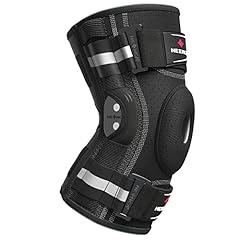
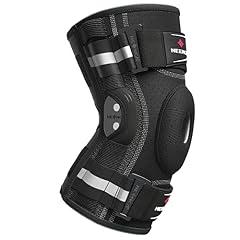
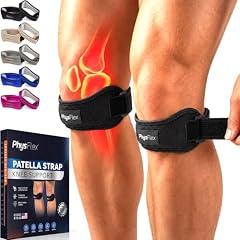
Knee braces for bone-on-bone arthritis
A knee brace cannot rebuild cartilage or reverse bone-on-bone arthritis. Its useful role depends on what is causing pain and whether the brace’s design matches that problem. General compression sleeves and stabilizing braces may provide comfort, kneecap cushioning, or a feeling of support. An unloading brace is different: it is intended to shift force away from one painful knee compartment during walking. That distinction is central when arthritis is concentrated on the medial, or inner, side, or the lateral, or outer, side.
The first buying question is therefore not how much compression a brace claims to provide, but whether a clinician has identified a single painful compartment and whether the brace has a matching left-or-right and medial-or-lateral configuration. Look for a three-point leverage system, valgus or varus adjustment, a side-specific model, and instructions that explain which direction unloads which compartment. A hinge or dial alone does not prove unloading. The strongest mechanical evidence would be a model-specific walking study reporting a knee-adduction-moment or compartment-load result, with the tested model, method, laboratory, date, and pass criteria identified. Category-level evidence that unloader braces can help osteoarthritis symptoms does not prove that a particular product shifts load effectively.
Fit is equally important. Measurement-based sizing should state where to measure the thigh, knee, or calf and provide a usable range. Straps, uprights, buckles, anti-slip features, and hinge alignment should keep the brace positioned without bunching, migration, concentrated pressure, or circulation restriction. A product that is difficult to align can deliver the wrong corrective force even if its design is mechanically plausible. Look for fitting instructions, a gradual break-in plan, walking checks, skin checks, and clear directions to loosen or remove the brace for numbness, tingling, increasing pain, unusual swelling, discoloration, or irritation.
Materials deserve specific scrutiny. A meaningful disclosure identifies the skin-contact fibers, padding, liner, rubber, silicone, metal, and plastics, and clearly states whether natural-rubber latex is present. An OEKO-TEX STANDARD 100 claim is more useful when the exact certificate or label number can be checked in the OEKO-TEX register. A general phrase such as “medical grade,” “skin friendly,” or “breathable” is not a skin-safety test. Also check care instructions: hand washing, air drying, removable pads, or replaceable straps can matter for hygiene and service life.
Headline figures often mislead. A high customer rating does not establish clinical benefit, unloading magnitude, durability, or allergy safety. “FDA registered” or a Class I device description is not the same as FDA approval or product-specific clinical validation; the supplied reviews describe external knee braces as a Class I, generally 510(k)-exempt category. A manufacturer’s “instant relief,” “cartilage repair,” “bone recovery,” “delay surgery,” or “perfect recovery” language should not be treated as evidence unless supported by product-specific human research. Even an independent study of a materially similar design may support only the mechanism, not the exact product or a guaranteed result.
Across the supplied products, recurring concerns include the absence of model-specific clinical, gait, durability, and skin-contact testing; unclear or incomplete material and latex disclosure; broad claims extending beyond symptom support; and the need for professional assessment when the compartment or fitting direction is uncertain. Do not self-treat a hot or markedly swollen knee, fever, suspected fracture or infection, locked knee, inability to bear weight, major new instability, calf pain, numbness, color change, or rapidly worsening pain. Recent surgery, significant ligament injury, impaired sensation, circulation problems, fragile skin, or a latex, neoprene, rubber, silicone, textile, or adhesive sensitivity also warrant clinician guidance before use.
Integrity
For this category, a useful brace is one whose mechanism, fit, materials, instructions, and maker can be checked against the problem being treated. The supplied reviews consistently show stronger scores for products with specific sizing and stop-use guidance, while exact-product unloading and independent testing remain uncommon.
HHealth & Safety
Meaningful relief for the right knee problem
This measures whether human evidence supports the brace type for the stated osteoarthritis problem and compartment, rather than merely showing generic support claims. A higher-scoring product is tied to osteoarthritis guidance or relevant brace-type evidence and limits its claims; lower-scoring products extend claims to recovery, ligament tears, cartilage repair, or instant relief without product-specific evidence.
Proven bone-on-bone unloading
This asks whether the brace demonstrably shifts load away from the affected medial or lateral compartment during walking. The better-scoring products have a side-specific or adjustable unloading mechanism and some biomechanical support, although exact-product testing is still often absent. Lower-scoring sleeves and general stabilizers have no varus or valgus setting, compartment indication, or measured load shift.
Fit that stays correctly positioned
A high score means the product provides measurement-based sizing, understandable strap or hinge adjustment, anti-slip features, and alignment guidance that help prevent migration, bunching, or pressure concentration. Among the supplied products, the strongest fit scores belong to products with detailed measurement points and multi-zone adjustment. Lower scores reflect sliding reports, unclear sizing, or no usable fitting documentation.
Low skin and allergy risk
This measures disclosure and testing for materials touching the skin, including latex, padding, textiles, silicone, and rubber. Higher-scoring products identify important materials and provide allergy warnings; one supplied sleeve clearly discloses natural-rubber latex, while another identifies itself as latex-free. Lower scores reflect incomplete composition, no certificate or skin-contact test, or unclear latex status.
Hinges and straps that hold up safely
This covers resistance to failure of straps, buckles, hinges, uprights, stitching, and fasteners during intended use. The supplied products cluster around moderate scores because warranties, washable construction, or inspection advice are more common than independent fatigue and load testing. A lower score reflects no durability report, no replacement-parts policy, or unresolved uncertainty about long-term support.
Clear safe-use instructions
High-scoring products explain measurement, fitting, gradual wear, cleaning, skin checks, circulation warnings, and when to stop or seek care. The supplied products with the clearest stop-use advice mention numbness, tingling, irritation, restricted circulation, increased pain, or unusual swelling. Lower scores lack wear-time limits, escalation guidance, or prominent warnings for worsening symptoms.
EEvidence
Claims that match the evidence
A higher score means the product distinguishes symptom support from cartilage repair, cure, regeneration, guaranteed recovery, or avoiding surgery. The supplied reviews mark down products whose listings make broad bone-recovery, FDA-approved, instant-relief, or surgery-delay claims without supporting product-specific evidence. More careful wording stays within general support or a clinician-guided brace trial.
Independently checked, not just marketed
This measures whether important clinical, mechanical, material, or safety claims are supported by an identified third party using a named model, method, laboratory, date, and criteria. Most supplied products scored only moderately because independent exact-product reports were not found. The clearest evidence was a published biomechanics study involving an Orthomen valgus brace and a carbon-footprint report for an Orthomen brace, though neither proves every claim for every model.
Traceable maker and safety record
A high score requires a legal maker, model identity, device status, and public records that can be checked for recalls or adverse events. The supplied products vary widely: one Copper Fit product has a public device record identifying its U.S. company and model, while several others lack a matched public device record. Registration or Class I status remains accountability information, not proof of clinical effectiveness.
Claims that match the evidence
This topic is distinct from independent verification: it evaluates the scope and honesty of the listing and manufacturer language itself. A product may have a plausible brace design yet still overstate cartilage repair or surgery avoidance. Higher scores go to narrower symptom-support claims; lower scores reflect promises that exceed the available human, biomechanical, or regulatory evidence.
EEcology
Less waste over its useful life
This measures whether washable care, durable construction, replaceable pads or straps, material disclosure, warranty, and restrained packaging could reduce premature replacement. Higher-scoring products offer reusable components, removable or washable parts, replacement straps, or a useful life disclosure. Lower-scoring products provide no repair pathway, replacement parts, packaging information, recycled content, or verified environmental certification.
Full reviews

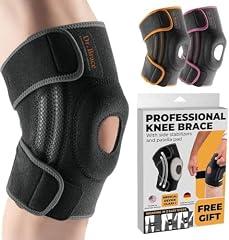
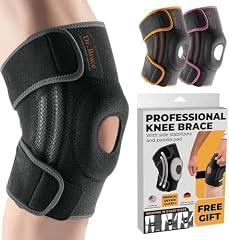
DR. BRACE ELITE Knee Brace Mercury Large
Overview
This is a wrap-style adult knee brace in Large, with an open patella gel pad, side stabilizers, silicone anti-slip elements, and four hook-and-loop adjustment straps. It is intended for daily activity and exercise, and can be worn on either knee. The manufacturer provides a measurement-based sizing process and says the brace can be machine washed on a gentle cycle at no more than 86°F. For knee osteoarthritis, clinical guidance supports knee bracing in general as one option that may improve pain, function, and quality of life. That evidence does not validate this specific product for bone-on-bone disease. This brace has no stated medial or lateral unloading configuration, and no located independent walking study or biomechanical test showing that it shifts load away from an affected compartment. Its most concrete role is adjustable compression and side-to-side support, not proven compartment unloading or cartilage recovery.
What works
- Four adjustable straps, side stabilizers, and silicone anti-slip components are manufacturer-stated features that can support individualized compression and positioning.
- The manufacturer provides a size-selection method, says the brace fits either knee, and offers a stated 180-day return period and one-year warranty.
- Wash instructions are specific, including gentle machine washing, mild detergent, no fabric softener, and air drying.
- The manufacturer states the product is 100% latex free, which is relevant to people avoiding natural rubber latex.
What does not
- There is no located independent clinical study, gait analysis, or durability report for this specific brace.
- It is not configured as a medial or lateral unloader, so bone-on-bone compartment pressure relief is unproven.
- The product materials include neoprene, silicone, synthetic fibers, and metal springs, but no independent skin-contact textile certification or full allergen testing was located.
- Manufacturer marketing promises immediate pain relief, fast recovery, reduced inflammation, and healing support that go beyond the product-specific evidence located.
- Published product information provides care and sizing guidance, but lacks clear circulation warnings, skin-check instructions, wear-time limits, and stop-use or clinical-escalation guidance.
Who is it for
This product fits an adult seeking an adjustable, lower-cost compression brace for nonspecific knee discomfort, mild perceived instability, or patella-area comfort during walking and routine exercise. It is most suitable for someone who can measure carefully, check the fit during movement, and use the four straps to avoid excessive compression. It may also suit a buyer who values machine-washable care and needs a brace that the manufacturer says can be used on either knee. It is not evidence of targeted treatment for a particular damaged knee compartment.
Who is it not for
It is not suited to a buyer whose main need is medically directed unloading for confirmed medial or lateral bone-on-bone osteoarthritis, varus or valgus malalignment, or a clinician-prescribed unloader brace. This product gives no medial versus lateral configuration, and no product-specific load-shifting test was found. People with a new traumatic injury, major swelling, locking, inability to bear weight, numbness, color change, circulation problems, open skin, or a suspected severe ligament injury should seek clinical assessment rather than rely on compression support. Those with prior reactions to neoprene, silicone, adhesives, or synthetic textiles should use particular caution.
Integrity
The manufacturer identifies side stabilizers, a patella gel pad, silicone anti-slip elements, four adjustable straps, and machine-washable care. A separate retailer listing corroborates that this product is made primarily from nylon, neoprene, polyester, spandex, silicone, and spring material. Dr. Brace also states that the brace is 100% latex free. No exact-product OEKO-TEX certificate, skin-sensitization testing, or other third-party skin-contact certification was located, so the latex statement should not be read as proof that every user will tolerate its materials. The design is washable and the manufacturer states a one-year warranty, both of which can help extend use. No replacement straps, pads, stabilizers, packaging details, recycled-content claim, life-cycle assessment, or independent mechanical durability report was located. The seller identity is publicly traceable as DR BRACE LLC. FDA classifies external knee braces under the Class I limb-orthosis category, but no matching public device listing or unique-device record was located for this product, and no product-specific recall or warning was found in the searches performed.
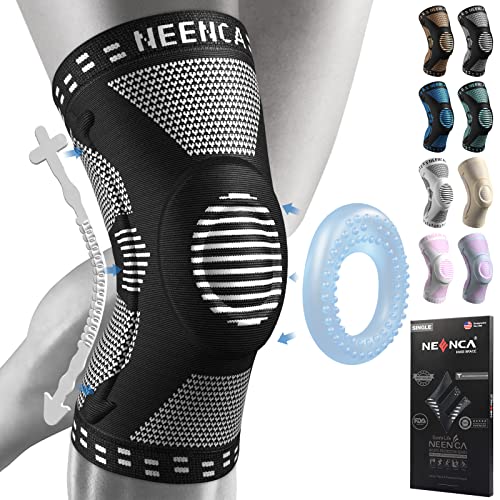
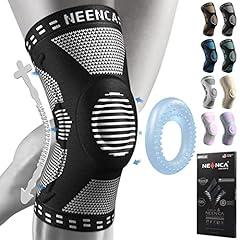
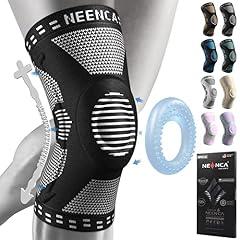
NEENCA Knee Brace with Patella Pad & Stabilizers
Overview
This is a single pull-on compression knee brace for either knee. The listed large size is one of seven size options. It uses a contoured gel pad around the kneecap, flexible side stabilizers, anti-slip strips, and a thicker knit intended for walking, standing, exercise, and recreational sport. The manufacturer specifies 64% nylon, 21% natural-rubber latex, 14% polyester, and 1% spandex. Its strongest documented unit-specific details are its measurement-based fit guidance and safety instructions. The manufacturer directs users to measure 5.5 inches above the kneecap, center the pad on the kneecap, begin with shorter wear periods, and stop for circulation or skin symptoms. It is not a rigid hinged or compartment-unloading brace. Human evidence supports some braces for knee osteoarthritis generally, but no independent clinical or walking-load study was located for this product.
What works
- The maker gives a specific thigh-measurement method, seven size choices, and troubleshooting for rolling or slipping.
- Material composition is fully stated, including the natural-rubber latex content and a direct latex-allergy warning.
- Instructions address fit, hand washing, skin checks, restricted circulation, sleep use, and when to stop wearing it.
- The product can be worn on either knee and has flexible TPEE side stabilizers rather than metal hinges, according to the manufacturer.
What does not
- It is not configured to unload either the medial or lateral knee compartment, so it is not evidenced for bone-on-bone compartment offloading.
- No independent clinical study, gait analysis, mechanical durability report, or ISO 22523 test report was located for this exact product.
- The marketplace presentation describes instant pain relief and FDA approval. This brace category is generally a Class I, premarket-exempt device, so FDA approval is not an appropriate substantiated product claim.
- Natural-rubber latex is a meaningful allergy concern for a brace intended to contact bare skin.
- The brand makes a broad OEKO-TEX statement, but no certificate or label number was supplied for this specific product, and no exact-product verification was located.
Who is it for
This product suits an adult who wants a pull-on sleeve for short periods of walking, standing work, gym activity, or recreational exercise, and who prefers more compression and kneecap cushioning than a very thin sleeve provides. It is most appropriate where the goal is a supported feel during ordinary movement, not correction of knee alignment. Users should measure 5.5 inches above the kneecap rather than select by clothing size, center the gel pad carefully, and have no latex allergy or sensitivity.
Who is it not for
It is not suited to someone seeking a brace for medial or lateral bone-on-bone osteoarthritis that needs proven compartment-specific unloading. This product has flexible bilateral stabilizers, no medial or lateral setup, and no product-specific walking-load evidence. It is also unsuitable for anyone with latex allergy or latex sensitivity because the knit contains natural-rubber latex. People with a recent operation, substantial swelling, suspected ligament rupture, locked knee, worsening pain, numbness, circulation symptoms, or unexplained instability should seek clinician assessment rather than self-manage with this sleeve.
Integrity
The useful health disclosure is unusually specific for this type of sleeve. The manufacturer identifies the textile blend as 64% nylon, 21% latex, 14% polyester, and 1% spandex, and warns people with latex allergy or sensitivity not to use it. It also gives practical stop-use guidance for numbness, tingling, sharp pain, skin irritation, restricted circulation, increased discomfort, and unusual swelling. The product should not be used as a substitute for professional diagnosis or treatment. The brand website makes a broad claim that its knit products are OEKO-TEX STANDARD 100 certified, but the product page provides no certificate number or label number for this brace. Its hand-wash and air-dry instructions may help extend service life. However, no verified recycled-content, packaging, replacement-part, repair, or product-specific environmental certification information was located. Public FDA classification information confirms that external knee braces fall within a Class I limb-orthosis category, not an FDA-approved product category.
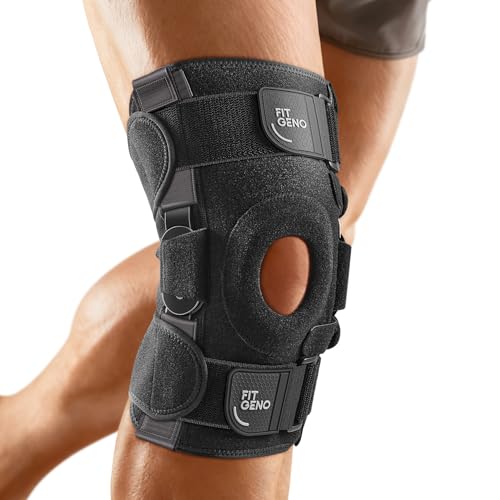
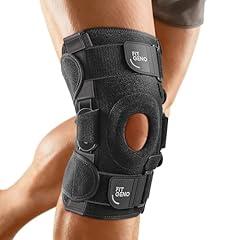
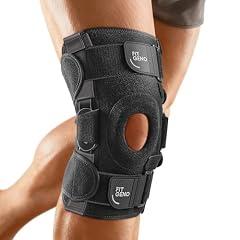
Fit Geno Hinged Knee Brace
Overview
This is an open-patella, open-back knee brace with four hook-and-loop straps, dual removable aluminum hinges, double-spring side stabilizers, silicone anti-slip strips, and a gel patellar cushion. Fit Geno directs buyers to size it from thigh circumference measured about 4 inches above the kneecap. The listed medium range is 12.9 to 21.6 inches and large is 19.6 to 27.5 inches, manufacturer-stated. It is a neutral hinged support intended to add side-to-side stability during activity. It is not described as a medial or lateral compartment unloader, and no product-specific walking-load or knee-adduction-moment testing was located. For knee osteoarthritis generally, AAOS says bracing may improve pain, function, and quality of life, but that category-level evidence does not establish bone-on-bone unloading or a clinical benefit for this specific product.
What works
- Four adjustable straps, silicone grip strips, and measurement-based sizing give a plausible route to more stable positioning, manufacturer-stated.
- Removable aluminum hinges and side stabilizers are concrete structural support features, manufacturer-stated.
- The maker states that its wearable products are latex-free and should be hand-washed and air-dried.
- AAOS supports brace treatment as an option that may improve pain, function, and quality of life in knee osteoarthritis.
What does not
- This brace has no stated medial or lateral unloading setting, so it is not evidenced for shifting load away from a bone-on-bone compartment.
- No independent clinical study, gait analysis, ISO 22523 report, or accredited laboratory durability report tied to this product was located.
- The maker does not publish a full skin-contact material breakdown, latex test record, or OEKO-TEX certificate for this brace.
- Available product guidance focuses on sizing and features, not detailed circulation checks, wear-time limits, stop-use criteria, or escalation for worsening pain, swelling, numbness, or skin injury.
- Claims about recovery from meniscus tears, arthritis, and injury prevention extend beyond the product-specific evidence located.
Who is it for
This product suits an adult who wants an adjustable, non-rigid hinged brace for short-term side-to-side knee support during walking or light activity, and who can carefully measure the thigh 4 inches above the kneecap. It is most relevant when a clinician has suggested a basic hinged support for mild instability, ligament irritation, or symptom management alongside rehabilitation. It may also suit someone who values an open back and open patella design, but accepts that the product is bulky and has no independently published performance testing.
Who is it not for
It is not the right evidence match for a buyer with medial or lateral bone-on-bone osteoarthritis seeking compartment-specific unloading. The product has no stated valgus or varus adjustment, side-specific configuration, or product-specific evidence that it reduces compartment load while walking. It is also unsuitable as a substitute for assessment after an acute traumatic injury, a locked knee, major swelling, inability to bear weight, deformity, numbness, color change, or worsening pain. People with fragile skin, adhesive sensitivity, or unexplained rashes should seek individualized fitting and material advice first.
Integrity
Fit Geno states that its wearable products are latex-free and spandex-based, and this brace is described as having aluminum hinges, breathable perforated fabric, silicone grip strips, and a gel patellar cushion. That may matter for people avoiding natural-rubber latex, but the company does not publish a complete fabric composition, skin-contact testing, or an independently verifiable textile certification for this product. Heat, sweat, pressure, and friction can still matter with any snug brace. The brace is hand-wash and air-dry only, which can support reuse if the straps and stitching remain sound. Fit Geno also offers a 45-day refund window. No replacement-strap, pad, hinge, repair, packaging-material, lifecycle, or third-party durability disclosure was located. FDA classifies external knee braces in this category as exempt Class I devices, but no product-specific public UDI or independent test documentation was located.

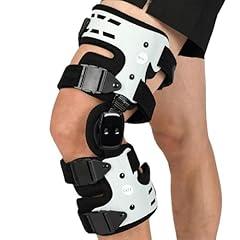
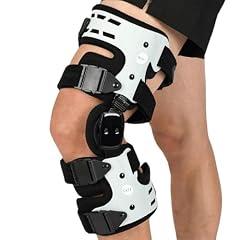
Orthomen OA Unloader Knee Brace
Overview
This is a left-leg, single-upright unloader knee brace with quick-release straps, a mechanical adjustment dial, and removable range-of-motion limit inserts. It is intended to support a knee with single-compartment osteoarthritis during walking and light activity. Orthomen states that its unilateral design targets medial, or inner-compartment, osteoarthritis and uses a three-point unloading arrangement. The manufacturer also says it includes 13 motion-limit inserts and an extended thigh strap. Human evidence supports knee bracing as an option that can improve pain, function, and quality of life in knee osteoarthritis, although results vary and the AAOS calls for more high-quality unloader-brace research. No independent clinical trial, walking-load study, or laboratory durability report was located for this particular Orthomen product. Its claimed fit, offloading magnitude, and all-day comfort therefore remain manufacturer statements rather than product-specific verified performance.
What works
- Knee braces have moderate AAOS guideline support for improving pain, function, and quality of life in knee osteoarthritis.
- The manufacturer identifies the brace as a medial single-compartment unloader, which is a clinically coherent use case for a valgus-style unloading design.
- Manufacturer-stated motion control includes 13 flexion and extension inserts, useful when a clinician has set movement limits.
- A 2025 FDA establishment record identifies Putian Orthomen Rehabilitation as a foreign manufacturer and exporter with a listed knee-brace category.
- The brand publishes a product carbon-footprint report for an Orthomen OA knee brace, including a cradle-to-grave estimate.
What does not
- No independent biomechanical study was located to show that this product unloads the advertised compartment during walking, or by how much.
- Orthomen promotes medial and lateral instability, rheumatoid arthritis, post-surgical recovery, and delaying surgery, but no product-specific human evidence was located for those broader claims.
- The public material specification is incomplete for skin-contact safety. No model-specific latex declaration, textile biocompatibility result, or OEKO-TEX certificate was located.
- The site shows generic ISO 13485, ISO 9001, and CE graphics, not certificate numbers or issuing-body records that can verify certification for this product.
- No independent fatigue, buckle, hinge, stitching, or strap-retention test report was located.
Who is it for
This product is most suited to an adult who has been assessed as having symptomatic medial, single-compartment knee osteoarthritis and has been advised to try an unloading brace alongside exercise, weight management where appropriate, and other care. It may fit someone who needs a left-specific brace with adjustable straps, a unilateral frame, and clinician-directed range-of-motion limits for walking or low-impact rehabilitation. Professional fitting is particularly useful because unloading direction and hinge limits need to match the affected compartment and knee alignment.
Who is it not for
It is not appropriate as a self-directed solution for a newly swollen, hot, locked, unstable, acutely injured, or repeatedly dislocating knee. People with lateral-compartment disease should not infer suitability from broad medial-and-lateral marketing, because the manufacturer’s own FAQ describes this unilateral version as designed for medial osteoarthritis. Those with poor leg sensation, circulation concerns, fragile skin, an active rash, material allergies, or wounds near the brace should seek clinician advice first. It is also not intended for high-impact competitive sports.
Integrity
The maker provides a 2025 FDA registration and device-listing notice for Putian Orthomen Rehabilitation, including the external knee-brace device category. This supports traceability of the manufacturing facility, but it is not FDA clearance, approval, or independent confirmation of this brace’s clinical performance. Public searches did not identify a product-specific recall, warning letter, or adverse-event pattern, although passive reporting systems cannot establish that no problems have occurred. Material safety remains only partly documented. Orthomen describes breathable and anti-slip components, but no verifiable model-specific latex statement, skin-contact textile certificate, or independent biocompatibility testing was found. A ClimatePartner report for an Orthomen OA knee brace estimates 10.96 kg CO2e cradle-to-grave and assumes a three-year use life. It identifies steel, EVA, and processed aluminum, but uses first-party assurance and does not establish the exact material build of this unit. The included extended replacement strap may help avoid replacing the whole brace when extra length is needed.

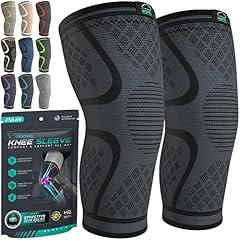
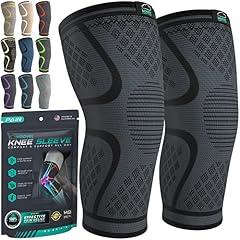
Modvel Compression Knee Brace 2 Pack
Overview
This product is a pair of pull-on compression knee sleeves, not a hinged or compartment-unloading brace. It is sold for everyday activity and sports use, with a measurement-based fitting guide that places the thigh measurement 4 inches above the kneecap. The published safety material identifies nylon, spandex, and latex in the skin-contact construction. For knee osteoarthritis, AAOS says brace treatment can improve pain, function, and quality of life, although that is brace-category evidence rather than a clinical study of this sleeve. This product has no medial or lateral unloading mechanism, no side-specific setup, and no stated load-shifting specification, so it is not designed to take pressure off a bone-on-bone compartment. Its most concrete role is general compressive support during activity, with fit and comfort dependent on accurate sizing.
What works
- AAOS supports brace treatment as one option that can improve pain and function in knee osteoarthritis, although this evidence is not specific to this sleeve.
- The supplied fitting guide uses a defined thigh-circumference measurement, rather than asking buyers to select a size without a measurement.
- The manufacturer provides care instructions for cold washing and hang drying, which can support continued use of the two included sleeves.
- The safety material discloses nylon, spandex, and latex, allowing people with known latex sensitivity to identify a relevant material before use.
What does not
- This is not an unloader brace. It has no hinges, uprights, corrective straps, or medial versus lateral configuration to shift load away from a bone-on-bone compartment.
- No independent gait study, compartment-load test, clinical trial, durability report, or identified third-party laboratory report was located for this product.
- The manufacturer claims FDA approval in its safety material. Knee external braces in this device category are generally Class I and exempt from premarket clearance, so that wording is inaccurate.
- Latex is listed in the materials, but no verified OEKO-TEX certificate number, skin-contact test report, or detailed latex-allergy warning was located.
- Instructions say to remove the sleeve for discomfort and consult a professional, but they do not provide detailed circulation, numbness, skin-check, or wear-time guidance.
Who is it for
This product suits an adult seeking a low-profile, pull-on sleeve for mild knee symptoms during walking, gym work, running, cycling, or daily tasks, especially if they can measure their thigh accurately and want two sleeves to rotate through washing. It may also fit someone with knee osteoarthritis who wants general compression as one conservative measure and understands that any symptom benefit is supported by evidence for braces as a category, not by a study of this exact sleeve. Latex tolerance is necessary.
Who is it not for
It is not suited to a buyer with medial or lateral bone-on-bone osteoarthritis who needs compartment-specific unloading. This sleeve lacks the corrective frame, straps, and side-specific configuration needed to demonstrably shift knee load. People with known latex allergy, unexplained rash, poor sensation, circulation concerns, marked swelling, or pain that is worsening should not rely on it without clinical advice. It is also not a substitute for assessment of a new locking knee, inability to bear weight, major instability, fever, or suspected acute ligament injury.
Integrity
The most important health disclosure is that the manufacturer’s safety material lists nylon, spandex, and latex. That makes latex sensitivity a practical concern for a product worn tightly against skin. The same material gives basic removal advice for discomfort, but the reviewed instructions do not provide comprehensive circulation or skin-monitoring guidance. No independently verifiable skin-textile certificate, laboratory material test, or exact-product clinical study was located. The sleeves are washable and supplied as a pair, and the manufacturer directs cold washing and hang drying. Those practices can extend usable life by allowing rotation while one sleeve dries. However, no detailed bill of materials, replaceable-component program, packaging disclosure, or independently verified environmental certification was found. The manufacturer’s statement that the sleeve is FDA-approved should not be treated as evidence of FDA premarket approval for this Class I exempt brace category.

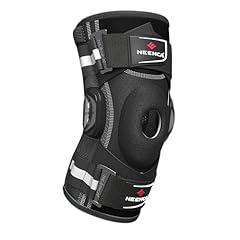
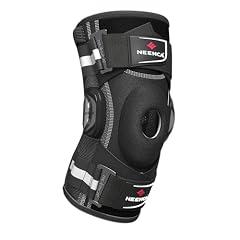
NEENCA Professional Hinged Knee Brace for Pain Relief
Overview
This is a single, black, pull-on knee support with an open patella, front-crossing X-straps, adjustable hook-and-loop closures, and removable side stabilizers. It is sold in seven sizes, with sizing based on thigh circumference about 6 inches above the kneecap. The brand states that it fits either the left or right knee and is intended for walking, training, standing work, and court sports. The material composition is manufacturer-stated as 50% SBR, 20% nylon, 10% spandex, and 20% polyester. A key listing conflict needs attention. The Amazon title describes a hinged brace, but the current brand page says this model uses side spring stabilizers and is not a rigid hinged knee brace. It is not presented by the brand as a medical treatment product or as a compartment-specific bone-on-bone unloader.
What works
- Manufacturer provides a measurement-based size system and adjustable upper and lower X-straps.
- The support is stated to fit either knee, which simplifies ordering when only one brace is needed.
- Current brand instructions include useful pressure warnings, including numbness, tingling, pinching, and unusual discomfort.
- Hand-wash and air-dry instructions may help preserve elasticity and hook-and-loop closure performance.
What does not
- No independent clinical, gait, or biomechanical test was located for this product, including no evidence that it unloads the medial or lateral bone-on-bone compartment.
- The current material disclosure identifies SBR, nylon, spandex, and polyester, but does not provide a latex declaration or verified skin-contact textile certification.
- No identified independent fatigue or load testing, replacement-parts program, or model-specific durability report was located.
- The Amazon medical and injury-relief framing is broader than the current brand page, which says the support is not a medical treatment product and advises professional guidance for diagnosed conditions or recent surgery.
Who is it for
This support suits an adult who wants adjustable compression and side support for ordinary walking, standing work, gym activity, or noncontact sport, and can take a thigh measurement before ordering. It may be practical for a person seeking a more structured option than a basic sleeve without a rigid immobilizer. The best use case is short-to-moderate activity with regular fit checks, especially if the wearer can loosen the straps promptly if pressure, tingling, or pinching develops.
Who is it not for
It is not the right product for a buyer specifically seeking proven unloading for medial or lateral bone-on-bone osteoarthritis. The product has no identified compartment-specific valgus or varus adjustment, nor model-specific walking data showing load reduction. People with a recent operation, a diagnosed ligament injury requiring a prescribed rehabilitation brace, severe swelling, circulation concerns, numbness, unexplained knee locking, or worsening pain should seek clinician assessment rather than rely on this support. People with rubber or textile sensitivities should also obtain a clear materials and latex answer first.
Integrity
The current brand page gives a more complete composition than the marketplace record, listing SBR, nylon, spandex, and polyester. SBR is a synthetic rubber material, and no verified latex declaration or skin-contact textile certification was located for this product. The brand does provide practical safety language, telling users to loosen or remove the brace for numbness, tingling, pinching, unusual pressure, irritation, or persistent discomfort, and to consult a health professional for diagnosed conditions, recent surgery, or severe symptoms. No product-specific independent clinical, mechanical, or materials test report was located. The product falls within the FDA's exempt Class I external knee-brace category, which does not itself establish product performance. No product-specific recall or public safety alert was identified in the searches performed. Hand washing and air drying can help retain the brace, but no replaceable straps, pads, repair program, packaging disclosure, or verified environmental certification was found.
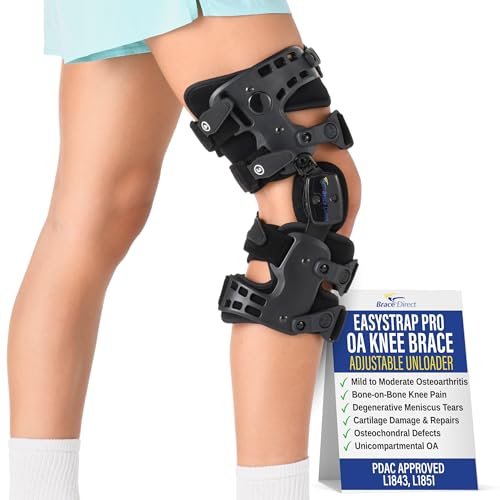
Brace Align EasyStrap Pro OA Unloader Knee Brace
Overview
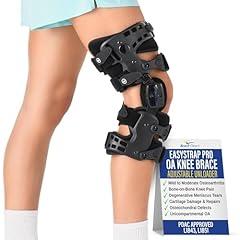
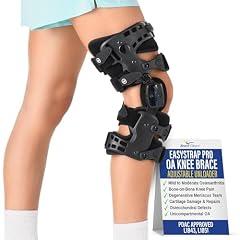
This is a right-leg, single-upright osteoarthritis unloading knee brace with four straps, quick-release snaps, a crank-style unloading adjustment, and optional range-of-motion stops. Its instructions label it for mild to moderate unicompartmental knee osteoarthritis, degenerative meniscal tears, osteochondral defects, and cartilage defects or repairs. It is hand-washable and is intended to be worn during weight-bearing activity after a gradual break-in period. The manufacturer provides specific thigh and calf measurements, plus fitting instructions that direct the user to adjust unloading in small increments and walk to check comfort. FDA device-listing records identify this exact model under Brace Align, while FDA classifies external knee braces as Class I, 510(k)-exempt devices. There is credible clinical evidence for knee bracing generally in diagnosed knee osteoarthritis, but no independent clinical or gait study located for this exact product.
What works
- The product has a traceable U.S. device-listing record that names this exact knee brace model.
- Its instructions provide a concrete fitting sequence, four strap positions, gradual wear-in guidance, and a clinician role for optional motion-stop settings.
- The labeled use is focused on unicompartmental osteoarthritis, the knee pattern for which unloading braces are most biologically plausible.
- A 12-month limited warranty covers defects in materials and workmanship, according to the manufacturer.
- Hand washing with mild detergent and air drying is specified, which can support reuse when the brace remains serviceable.
What does not
- No independent clinical trial, gait-analysis report, ISO 22523 test report, or laboratory durability report was located for this exact brace.
- The maker does not publicly disclose the skin-contact material composition, latex status, textile biocompatibility testing, or an OEKO-TEX certificate for this product.
- The product page calls its three-point system clinically proven, but the located human evidence supports unloader braces as a category rather than this exact model.
- Instructions give useful fitting and wear-time steps, but do not clearly set out skin-check, numbness, circulation, pressure-injury, or stop-use warnings.
- No replacement-strap, pad, hinge, or buckle parts program was identified, limiting repairability information.
Who is it for
This product is most suited to an adult with clinician-diagnosed mild to moderate osteoarthritis concentrated in one knee compartment, or a degenerative meniscal condition being managed nonoperatively. The right-leg format, thigh range of 17 to 30 inches, and calf limit of 26 inches should fit the buyer before ordering. It also suits someone able to follow the staged fitting process, make small unloading adjustments, and use the offered fitting support or a clinician’s guidance. It is a brace for symptom management during walking and other weight-bearing activity, not a cartilage-restoration treatment.
Who is it not for
It is not well suited to someone with unexplained knee pain, a newly locked knee, marked swelling, fever, suspected fracture, acute infection, or symptoms of impaired circulation, because those situations need prompt clinical assessment rather than brace adjustment. It is also a weak match for rheumatoid or other inflammatory arthritis, diffuse pain across all knee compartments, or people seeking proof that this exact product unloads a specified compartment by a measured amount. Buyers with latex, textile, adhesive, or foam sensitivities should seek material disclosure first, since none was located for this product.
Integrity
The health case is strongest for clinician-directed use in diagnosed unicompartmental knee osteoarthritis. AAOS states that bracing could improve pain, function, and quality of life in knee osteoarthritis, and systematic review evidence indicates that many valgus unloader braces reduce the knee-adduction moment. Those findings support the brace category, not a model-specific performance claim for this unit. The maker supplies care, fitting, intended-use, and gradual wear instructions, and offers a one-year limited defect warranty. However, the public materials located do not name the fabrics, foams, metals, coatings, or natural-rubber-latex status. No verified OEKO-TEX certification, independent mechanical testing, or replacement-parts program was located. Hand washing and air drying may extend usable life, but the absence of component and packaging disclosure prevents a confident assessment of its material footprint.

EXOUS BODYGEAR Knee Brace for Stability
Overview
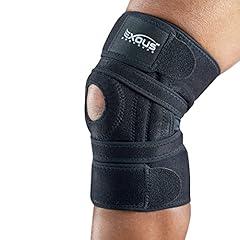
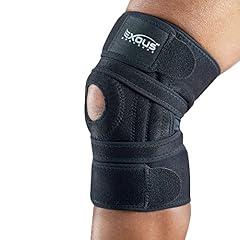
This is a one-size, wraparound open-patella knee support for adults. It uses four adjustable hook-and-loop straps, an optional inner sleeve, and flexible coils on both sides of the knee. The maker says it fits either knee, with a minimum 13-inch knee circumference and an upper-thigh limit around 20 to 21 inches when measured above the kneecap. It is intended for activity-related support and compression, rather than immobilization. Its defining limitation for bone-on-bone arthritis is design-specific. This is a bilateral support brace, not a medial or lateral unloading brace. No model-specific gait study or independent test was located showing that it shifts load away from a worn knee compartment. Clinical guidance supports bracing for knee osteoarthritis in general, but that does not establish compartment unloading by this product.
What works
- Clear measurement-based fitting instructions, plus an alternate setup without the inner sleeve if that sleeve feels too tight.
- Wraparound straps allow the same product to be fitted on either the left or right knee, according to the manufacturer.
- Hand-wash instructions and a defective-product replacement process support routine care and limited service continuity.
- The open back gap and bilateral flexible coils are concrete support features, although their comfort and stability benefits are manufacturer-stated rather than independently tested.
What does not
- It is not shown to unload the medial or lateral compartment, the key mechanism usually sought for bone-on-bone arthritis on one side of the knee.
- No independent clinical study, gait analysis, ISO 22523 test report, or third-party durability report tied to this product was located.
- Neoprene and an inner textile lining are described, but a full skin-contact material breakdown, latex declaration, and skin-safety certification were not located.
- The fitting material provides cleaning and placement instructions, but lacks clear circulation, skin-check, stop-use, and clinician-escalation warnings.
Who is it for
This product suits an adult with a knee circumference within the stated range who wants adjustable compression and side-to-side support during walking, exercise, or sports. It is most relevant where the goal is a flexible open-patella support that can be moved from one knee to the other, and where the user can follow the multi-strap fitting process. It may also suit someone who prefers hand-washable equipment and can periodically inspect the hook-and-loop tabs for wear.
Who is it not for
It is not the right product for someone specifically seeking compartment unloading for medial or lateral bone-on-bone osteoarthritis. The manufacturer does not provide a left or right unloading configuration, and no evidence shows this design shifts compartment load during walking. People with a suspected fracture, locked knee, major acute swelling, inability to bear weight, postoperative restrictions, numbness, circulation problems, or a history of reactions to neoprene or textile contact materials should seek clinical guidance instead of relying on this support. It is also unsuitable for children.
Integrity
The product is described by the maker as neoprene with an inner jacquard-style lining, plus flexible side coils and hook-and-loop straps. Neoprene can retain heat, and prolonged skin contact under a tight brace can increase sweat, friction, and irritation. The available materials information does not provide a full fiber and chemical breakdown, a natural-rubber-latex declaration, or a verified skin-contact textile certification. Sensitive users should treat the lining and neoprene as unverified for allergy purposes. The maker provides hand-wash care and says machine washing can shorten hook-and-loop performance. It also offers replacement for defective items after registration, which may avoid some premature disposal. No verified recycled-content claim, packaging disclosure, replacement strap program, or third-party environmental certification was located. FDA classifies the general category of external knee braces as Class I, but an exact public device listing or unique device record for this product was not located.

NEENCA Professional Adjustable Hinged Knee Brace
Overview
The NEENCA HX043 is a single open-patella knee wrap for either knee, offered in sizes S through 4XL. The manufacturer lists 50% SBR, 20% nylon, 10% spandex, and 20% polyester. It uses upper and lower wrap straps, a gel patella surround, and removable side supports for adjustable compression during walking, exercise, standing work, and sports. The manufacturer provides thigh and calf measurements, fitting steps, hand-wash care, and guidance to loosen the brace for numbness, tingling, pinching, or unusual pressure. Its current product page also creates an important specification conflict. The descriptive material calls the side pieces copper hinges, while the FAQ says this model is not a rigid hinged brace and instead uses side spring stabilizers. No independent clinical, biomechanical unloading, materials-certification, or durability report tied to this product was located. It is therefore a general support wrap, not a demonstrated medial or lateral bone-on-bone unloading brace.
What works
- Manufacturer provides measurement-based thigh and calf sizing, adjustable upper and lower closures, and positioning instructions.
- The official fit guidance specifically tells users to loosen or resize for numbness, tingling, pinching, or unusual pressure.
- Materials are disclosed and the brace has hand-wash, air-dry care instructions, which can support repeated use.
- The single brace is manufacturer-stated to fit either the left or right knee.
What does not
- No product-specific human study was found showing pain or function benefits for bone-on-bone knee osteoarthritis.
- No independent walking test was found showing medial or lateral compartment unloading, knee-adduction-moment reduction, or a measurable load shift.
- The manufacturer's current page conflicts on the support structure, describing copper hinges in one area but calling them spring stabilizers rather than rigid hinges in the FAQ.
- No exact-product third-party material testing, latex declaration, OEKO-TEX record, ISO 22523 test report, replacement-parts policy, or public U.S. device record was located.
Who is it for
This product suits an adult who wants adjustable, wrap-style compression and general side support for routine walking, gym activity, standing work, or a mild sense of knee instability. It is most appropriate for someone able to measure both thigh and calf, center the patella opening, and adjust the straps after movement. The manufacturer offers a broad size range and instructions for avoiding overly tight compression. Its listed materials and hand-wash care may also suit users seeking a reusable fabric support rather than a disposable wrap.
Who is it not for
It is not suited to a buyer with medial or lateral bone-on-bone osteoarthritis who specifically needs documented compartment unloading. This product has no stated valgus or varus configuration, no side-specific unloading setup, and no exact-product gait evidence showing load reduction while walking. People with a new traumatic injury, suspected fracture, locked knee, major swelling, calf pain, progressive weakness, numbness, circulation concerns, or worsening post-surgical symptoms need clinical assessment rather than relying on a general support wrap. Anyone with rubber or textile sensitivities should seek fuller allergen disclosure first.
Integrity
The disclosed fabric blend includes SBR, nylon, spandex, and polyester. SBR is a synthetic rubber material, but the manufacturer does not provide a natural-rubber-latex declaration or an independently verifiable skin-contact textile certification for this product. Users should keep the brace clean and dry, avoid excessive strap tension, and stop or adjust use if it causes persistent skin irritation, numbness, tingling, or unusual pressure. The brace is designed to be hand washed and air dried, which can extend its usable life compared with single-use supports. However, no independent durability testing, repair instructions, replaceable strap or pad program, packaging disclosure, or product-specific environmental certification was found. Searches also did not identify a product-specific FDA recall, warning letter, adverse-event pattern, or publicly traceable U.S. device listing, but the lack of a located record is not proof of long-term safety or regulatory status.

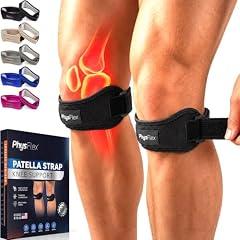
PhysFlex Patellar Tendon Knee Support Strap
Overview
This is a two-strap, below-the-kneecap patellar tendon support for adults. It wraps around the upper shin beneath the patella and uses an adjustable closure and padded contact area. The maker states that the universal fit covers knee circumferences from 13 to 19 inches, with an anti-slip design intended for running, jumping, hiking, cycling, and court sports. The product is a patellar-tendon strap, not a hinged medial or lateral unloader brace. Human studies of materially similar straps support short-term pain reduction during sport or loading tasks in people with patellar tendinopathy. That evidence does not establish relief for bone-on-bone tibiofemoral osteoarthritis. The retailer lists polyester and hand washing, while the maker's page confirms hand wash care but does not give a full skin-contact material or latex disclosure. No product-specific clinical, biomechanical, or durability report was located.
What works
- Category-level randomized evidence supports short-term symptom relief from patellar straps in athletes with patellar tendinopathy.
- The maker provides a concrete 13 to 19 inch knee-circumference range and adjustable design, rather than offering only a generic one-size claim.
- The compact infrapatellar format may be practical for activity-related patellar tendon symptoms and does not restrict the whole knee.
- Hand-wash care is stated by both the manufacturer page and retailer listing.
What does not
- It cannot be treated as a bone-on-bone knee brace. There is no medial or lateral unloading mechanism, configuration, or walking-load evidence for this product.
- The listing extends pain-relief claims to arthritis, stress fractures, and meniscus tears, conditions not substantiated by the identified patellar-strap evidence.
- No product-specific independent clinical study, biomechanical test, ISO durability report, or third-party materials test was located.
- Skin-contact materials, natural-rubber-latex status, wear-time limits, circulation warnings, and stop-use guidance are not clearly disclosed.
Who is it for
This product most closely suits an adult with pain localized directly below the kneecap that has been assessed as patellar tendinopathy, often called jumper's knee. It is particularly relevant for a runner, court-sport participant, or active person seeking an adjustable, low-profile strap for temporary symptom management during a specific activity. The stated 13 to 19 inch circumference range matters, so users should measure before relying on its universal-fit label. It is not evidence of tendon healing or a replacement for a progressive rehabilitation plan.
Who is it not for
It is not designed for medial or lateral bone-on-bone osteoarthritis, especially when a clinician has recommended compartment unloading. Buyers needing a valgus or varus corrective brace, hinged instability support, postoperative protection, or protection after an acute fracture, rupture, or major ligament injury need a different device and clinical guidance. People with unexplained swelling, locking, inability to bear weight, numbness, color change, worsening pain, or a suspected blood clot should seek prompt medical assessment rather than tighten a strap and continue activity.
Integrity
The useful health evidence is narrow but relevant. Randomized research on patellar straps found short-term pain reductions in people with patellar tendinopathy during sports and loading tasks. That supports use for a defined tendon-pain pattern, not cartilage loss, meniscal injury, stress fracture, or broad arthritis claims. A patellar strap also does not deliver the compartment-specific valgus or varus force used by true osteoarthritis unloading braces. The retailer lists polyester and hand-wash care. The manufacturer confirms hand washing but does not publish a complete fiber breakdown, latex declaration, skin-sensitization testing, or an identifiable textile certification. No replaceable straps, pads, repair program, warranty details, packaging information, or product-specific independent durability testing were located. Washing by hand may extend usable life, but a lower material footprint cannot be verified from the available disclosures.