
10 Best Ultra Short Throw Projector
 Daniel Kenitz
Please note that we participate in affiliate marketing programs. When you purchase through links on our site, we may earn a commission. As an Amazon Associate we earn from qualifying purchases. This comes at no additional cost to you and helps support the resources required to provide valuable content.Advertising Disclosure
Top-rated Ultra Short Throw Projector Comparison
1

2
4
5
6
7
8
9
Ultra-short-throw projectors
An ultra-short-throw (UST) projector creates a large image while sitting close to the wall or screen. That makes it useful in rooms without several feet of clear throw distance, but close placement also makes alignment errors more visible. A product can be marketed as “short throw” or “4K compatible” without being UST or displaying a native 4K image, so the first checks are the throw-distance chart, supported image-size range, native resolution, and the distance required for a stated image size.
A credible UST setup should document its throw ratio and placement conditions in an installation guide or manufacturer chart. Independent checks of focus uniformity, geometry, usable screen size, and compatibility with an ambient-light-rejecting screen add confidence. Digital keystone and four-corner correction can make an imperfect temporary setup easier, but they do not replace a level, square installation and can reduce image integrity. A UST screen may be necessary in rooms with ambient light; manufacturer claims such as “95% light rejection,” contrast improvement, or viewing angle should be treated as claims unless a test method and independent measurement are provided.
Brightness figures need similar caution. Look for a stated measurement method and unit, such as ANSI or ISO 21118 lumens, then compare it with an independent measurement in a named picture mode. The supplied reviews include products whose measured brightness was materially below the headline figure, as well as products whose independent measurements closely matched or exceeded the claim. “4K support” usually means the projector accepts a 4K signal; it does not necessarily mean native 4K panels. Some products use 1080p imaging with pixel shifting, while others are documented as displaying 4K through that process. Contrast figures are often dynamic rather than native contrast, and HDR support does not guarantee convincing HDR tone mapping or dark-scene performance.
For laser models, look for model-specific Class 1 or IEC laser-safety labeling, enclosure and beam warnings, and traceable IEC 60825-1 or IEC 62471-5 documentation where applicable. A Risk Group 2 label is not the same as a Class 1 classification. Electrical safety is a separate question: a radio authorization or FCC filing does not prove protection from shock, overheating, or fire. The strongest evidence is an exact-model listing in a public OSHA-recognized NRTL directory, such as UL Product iQ, Intertek’s ETL directory, or CSA’s listing database, to UL 62368-1 or an equivalent standard. Wireless models should also have an exact-product FCC authorization or a matching supplier’s declaration.
Finally, check fan-noise, flicker, color-breakup, light-leakage, input-lag, operating-power, and standby measurements rather than relying on feature labels. A documented warranty, firmware policy, service route, parts access, and U.S. recycling or take-back route can reduce premature replacement and waste. Across the supplied products, recurring cautions are that many models are not actually UST, several lack independent electrical listings, and laser products require users to prevent direct viewing of the beam especially by children. Bright rooms, uneven screens, DLP rainbow artifacts, fan noise, and unverified HDR or gaming claims also repeatedly limit suitability.
Integrity
For this category, a reassuring feature label is not enough. The scores reward exact-model documentation, independent measurement, and practical instructions that match how a UST projector is installed and viewed.
HHealth & Safety
Laser and eye-exposure safety
This measures whether a laser UST has traceable Class 1 or IEC labeling, a protective enclosure, and clear beam warnings. It matters because UST units sit near viewers and children. Higher-scoring products supplied Class 1 or detailed beam guidance; lower-scoring products had only general warnings, Risk Group 2 labeling, or no located optical-safety documentation.
Electrical and heat safety
This measures protection against shock, overheating, and fire for the projector and included power supply, with emphasis on an exact-model U.S. safety listing. It matters because high-output projectors can draw substantial power and need ventilation. Higher scores were supported by documented cTUVus or UL 62368-1 evidence; lower scores had no public UL, ETL, or CSA listing located.
Viewing comfort
This covers fan noise, flicker, DLP color breakup, distracting light leakage, and other foreseeable annoyances at the intended image size. It matters because UST projectors are often close to seating and may run during quiet scenes. Higher-scoring products had independent comfort findings or useful noise information; lower-scoring products lacked measurements or had reported rainbow effects or intrusive high-power fan noise.
EEvidence
Real image quality and brightness
This measures independently usable brightness, black level, contrast, color, resolution, and HDR performance. It matters because UST images magnify both strengths and defects, especially on large screens. Higher-scoring products had independent measurements close to or supporting their claims; lower-scoring products had only headline lumens or showed weak blacks, inaccurate color, or limited HDR.
UST fit, placement and image geometry
This measures whether the product actually produces its stated image size at its stated wall distance, with acceptable focus and geometry. It matters because small placement errors are highly visible in UST installations. Higher scores came from documented throw charts plus independent confirmation; lower scores reflected missing charts, incompatible screens, or products that were only short throw.
Honest specifications and marketing
This measures whether claims about brightness, resolution, contrast, HDR, gaming, streaming, laser life, and eye comfort are qualified and consistent with documented limits. Higher-scoring products clearly separated native resolution from accepted input and matched claims to testing. Lower-scoring products had conflicting brightness figures, dynamic-contrast marketing, or feature wording that exceeded the evidence.
Independent proof, not seller assertions
This measures whether meaningful safety, optical, environmental, and performance claims can be checked through a public registry, named laboratory, or reproducible method. It matters because marketplace listings can repeat manufacturer figures without validation. Higher-scoring products had independent instrumental reviews, FCC records, or safety documentation; lower scores reflected seller assertions and missing public records.
Wireless and U.S. market compliance
This measures whether Wi-Fi, Bluetooth, and other radios have traceable U.S. authorization and whether the exact product has unresolved safety actions. It matters because smart UST projectors commonly include several radios. Higher scores had model-linked FCC records or declarations; lower scores had only generic Part 15 language, mismatched filings, or no identifiable authorization.
EEcology
Power and standby efficiency
This measures electricity used while operating and in network standby relative to the brightness delivered. It matters because a bright projector may draw hundreds of watts, while smart features can keep using power after viewing. Higher scores combined measured or clearly disclosed operating use with low standby figures; lower scores left typical, Eco, or network-standby consumption undocumented.
Durability, repair and support life
This measures documented light-source life, warranty coverage, service or parts access, and software support. It matters because a durable laser or LED unit can avoid lamp replacement and premature e-waste, but a long life claim alone is not proof. Higher-scoring products combined warranties, support, firmware or repair routes; lower scores lacked parts, repair, or support-life commitments.
Responsible end-of-life plan
This measures whether the brand provides a practical U.S. take-back, reuse, or recycling route and avoids unsupported environmental claims. It matters because projectors contain electronics, power components, and sometimes lamps or batteries. Higher scores were associated with documented manufacturer recycling or take-back programs; lower scores had only generic claims or no product-specific route.
Full reviews

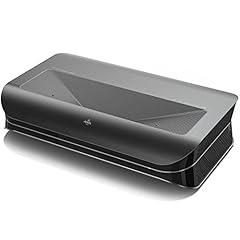
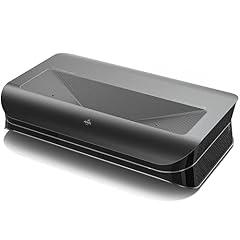
AWOL VISION LTV-2500 4K UHD Triple Laser Projector
Overview
This is a fixed-installation 4K ultra-short-throw DLP projector with an RGB triple-laser light source, built-in 36 W stereo audio, three HDMI 2.0b inputs, eARC, Wi-Fi, Bluetooth, and an included Fire TV streaming stick. It is designed to sit directly below a wall or compatible ultra-short-throw screen, rather than across the room. Independent testing reported 1,682 ISO 21118 lumens at maximum across five samples, while AWOL now specifies 1,700 ISO lumens. The same review measured 94.44% Rec. 2020 coverage and 1,314:1 native contrast. AWOL documents an 80 to 150 inch range, 0.25:1 throw ratio, 25,000-plus-hour laser life, laser outlet obstruction detection, and Class 1 laser-product labeling. Accurate color requires adjustment, and the largest image size is better suited to controlled light.
What works
- Independent measurements support useful light output near the current 1,700 ISO-lumen specification.
- The measured Rec. 2020 gamut was 94.44%, providing unusually broad color coverage for compatible HDR material.
- Its documented 0.25:1 ultra-short throw supports a very large image from a low cabinet close to the screen.
- The manual identifies it as a Class 1 laser product, includes direct-viewing warnings, and documents outlet obstruction detection.
What does not
- AWOL previously settled a brightness-marketing dispute and revised this model from 2,600 peak lumens to 1,700 ISO lumens. Peak lumens was not a comparable industry standard.
- Independent testing found 1,314:1 native contrast, below the 2,500:1 claim, and found blue-biased, inaccurate factory picture modes.
- Measured fan noise reached 34.8 dBA at roughly three feet, above the manufacturer's 27 dB claim.
- No public UL, ETL, or CSA listing for this exact projector was identified, and the brand does not publish a U.S. take-back plan or parts catalog.
Who is it for
This product suits a home-theater user who wants a 100 to 120 inch image from a cabinet placed close to a properly aligned ultra-short-throw screen. It fits viewers willing to use a darkened or carefully light-controlled room, adjust picture settings or arrange calibration, and accept a separate sound system if desired. It also suits console users whose games run at 4K and 60 Hz or 1080p and 120 Hz, since independent testing confirmed low-latency modes close to the stated performance.
Who is it not for
It is not suited to households where children or visitors may look into the operating lens, block its outlet sensor, or where its ventilation clearances cannot be maintained. The manual says not to stare into the beam, despite its Class 1 normal-use labeling. It is also a poor fit for bright, uncontrolled rooms, users expecting accurate color without setup, or buyers who need verified electrical certification, a documented repair-parts pathway, or clear end-of-life take-back arrangements.
Integrity
The manual carries concrete laser-safety information rather than unsupported eye-health language. It labels the unit a Class 1 laser product, cites IEC 60825-1 and IEC 62471-5, identifies the laser wavelength ranges, warns against direct viewing, and says the housing must not be opened or modified. It also gives 20 cm side and 15 cm rear ventilation clearances, warns that vents can become hot, and says obstruction or excess heat can lead to shutdown or component failure. The product has a manufacturer-stated 25,000-plus-hour laser life and a rated 0.5 W standby mode, which could reduce replacement and idle electricity use if achieved in normal operation. Those figures were not independently power-tested. AWOL documents firmware updates and a warranty-claim process, but its current warranty page does not specifically name this older model, and no public U.S. recycling or take-back program, service manual, or parts catalog was identified. No CPSC recall was identified in the public recall search.

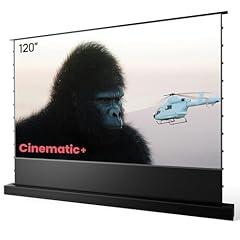
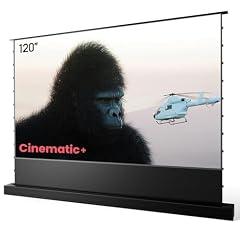
AWOL VISION 120" Motorized Floor Rising Projector Screen
Overview
This is a motorized, floor-rising 120-inch, 16:9 projection screen for ultra-short-throw projectors, not a projector. Its documented screen material is Premium HBSI TPU, and its enclosure is a substantial floor case. The product is intended to rise by remote or a supplied USB trigger, then retract for storage after viewing. The manufacturer manual for this exact 120-inch model lists 0.8 peak gain, 95% ambient-light resistance, a 160-degree viewing angle, UST-only use, and 100 to 120 V or 200 to 240 V input. Those are manufacturer specifications, not independent optical measurements. The published current product page also promotes 95% ceiling-light rejection, but the catalog's 170-degree viewing-angle claim conflicts with the 160-degree figure in the model manual. No independent instrumented test or public electrical safety listing for this screen was located in the verification work.
What works
- The passive screen itself has no laser light source, so it does not create projector-style laser eye exposure.
- The model manual documents UST-specific use, a 120-inch 16:9 image area, remote control, and a USB synchronized trigger.
- The manual specifies a retractable shell for storage and advises retracting the surface after use to protect it from dirt and damage.
- AWOL Vision currently states a two-year total warranty for screens, with one limited year plus one free extended year.
What does not
- No public UL, ETL, or CSA listing for the exact motorized screen or its supplied power equipment was located.
- No independent instrumental review was located to verify gain, light rejection, viewing angle, color neutrality, or claimed 4K and 8K performance.
- The catalog states a 170-degree viewing angle, while the exact-model manual lists 160 degrees. This is a documented specification conflict.
- The manual warns of hazardous internal voltage, strong spring tension, a potential tip-over hazard if placed upright, and a coin-cell battery hazard in the remote.
Who is it for
It suits a home-theater user who already owns a compatible ultra-short-throw projector, wants a fixed 120-inch 16:9 image, and needs the screen to disappear into a floor case between uses. It is particularly relevant where a wall-mounted screen is impractical and the buyer can accommodate a roughly 61-pound screen assembly plus its large shipping carton. The user should be comfortable following the manual's placement, power, and retraction instructions, and should treat the stated optical performance as manufacturer-provided rather than independently measured.
Who is it not for
It is not for buyers seeking independently measured proof of ambient-light rejection, gain, contrast, color behavior, or off-axis performance. It is also unsuitable for anyone without a UST projector, because the manual specifies UST use. Households with young children should account for the remote's coin-cell battery and keep the screen stable, not upright or unsecured. People who need a publicly traceable U.S. electrical safety certification, low standby-power data, repair parts information, or a manufacturer recycling route should select a product with that documentation available.
Integrity
The main health consideration is mechanical and electrical, not light exposure. This product is a passive projection surface and has no laser emitter. Its manual directs users to use the supplied cable, match local input voltage, keep the unit dry, avoid self-disassembly because of dangerous internal voltage, and allow the motor to cool after continuous operation. It also identifies strong spring tension, tip-over risk from upright placement, and the remote's coin-cell battery ingestion hazard. AWOL Vision states a two-year total screen warranty and lifetime customer support. The manual's recommendation to retract the surface after use may help protect it from scratches, debris, and folds. However, no public NRTL listing for the exact screen or power equipment was located, and no U.S. take-back, recycling, parts catalog, or service-manual program was located. No product-specific CPSC recall or warning was found in the checks performed.

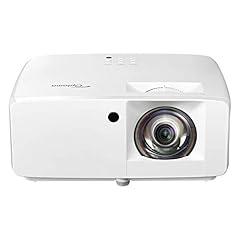
Optoma GT2000HDR Short Throw Laser Projector
Overview
This is a compact, fixed-lens 1080p DLP laser projector for gaming, TV, sports, and casual home cinema. It accepts 4K and HDR signals, but its native image is Full HD rather than 4K. It has two HDMI 2.0 inputs, a 15 W speaker, and an external power supply. Optoma states 3,500 lumens, a 0.496:1 short-throw ratio, and a 100-inch image from just over three feet away. Independent testing supports strong light output and sharp native 1080p detail, while also finding inaccurate out-of-box color, limited effective contrast for dark movie scenes, and poor HDR tone mapping. The product is short throw, not an ultra-short-throw design, so placement still needs roughly three feet for a 100-inch 16:9 image.
What works
- Independent testing found low 16.4 ms input lag at 1080p60 with Gaming mode enabled.
- Independent testing measured 86.8 W in eco mode and 102 W at full power, modest consumption for a bright laser projector.
- The manufacturer documents a 0.496:1 fixed short-throw lens, allowing a 100-inch image from just over three feet away.
- The published safety instructions classify it as a Class 1 laser product with IEC 62471-5 Risk Group 2 guidance, including warnings not to stare into the beam.
- Optoma provides a one-year projector warranty and a five-year or 12,000-hour light-source warranty, whichever comes first.
What does not
- The product has no publicly traceable UL, ETL, or CSA listing located for the exact projector and included external power supply. This is missing verification, not evidence of an electrical defect.
- Independent reviewers found overly cool, inaccurate color, uneven color performance toward image corners, and weak HDR tone mapping. These are observed picture-quality problems.
- The listed 300,000:1 contrast figure is not a useful indicator of native movie contrast. Independent testing found dynamic laser behavior affects contrast results.
- It is marketed in the page context as ultra short throw, but Optoma itself identifies it as short throw. A 100-inch image still needs just over three feet of projection distance.
- The 15 W built-in speaker was judged poor by independent review, so external audio is appropriate for serious viewing.
Who is it for
It suits a gamer, sports viewer, classroom, or casual family entertainment setup that needs a large 1080p image from a relatively short distance, but has room for about three feet between lens and screen for a 100-inch image. It is especially relevant where gaming responsiveness, strong light output, and lower operating power matter more than accurate film color or refined HDR. It also fits users who will connect consoles, streaming sticks, or other HDMI sources and already have, or plan to use, external speakers.
Who is it not for
It is not suited to color-critical movie viewing, HDR enthusiasts, or anyone expecting true 4K detail, because it is a native 1080p product and independent tests identified inaccurate color and weak HDR mapping. It is also unsuitable where an actual ultra-short-throw setup is required, such as placement inches from the wall. Households with young children need to position it so children cannot look into the direct beam, consistent with the published Risk Group 2 laser warning. Buyers requiring publicly verifiable NRTL electrical certification should seek documented listing evidence first.
Integrity
The published product manual identifies a Class 1 laser product classification under IEC 60825-1 and a Risk Group 2 laser-illuminated-projector classification under IEC 62471-5. That supports normal projected-image viewing when used as instructed, but it is not an eye-health claim. The manual specifically says not to stare into the direct beam, to supervise children, and to avoid optical aids. No model-specific CPSC recall or safety warning was identified in the public recall sources searched. Optoma states a 30,000-hour laser life, mercury-free light source, and packaging containing up to 97% recyclable material. The more concrete ownership protection is shorter, a five-year or 12,000-hour light-source warranty. Independent testing confirmed low operating power, including 86.8 W in eco mode. Optoma publishes repair and return procedures and a general recycling policy, but it does not provide a clear product-specific U.S. take-back route for this projector.

Optoma ML1080UST Photon Go Projector
Overview
This is a 3.8-pound portable ultra short throw DLP projector with native 1920 x 1080 resolution, triple RGB laser illumination, Google TV, dual 10W speakers, Wi-Fi, Bluetooth, and a built-in 15,000 mAh battery. It is intended to sit directly in front of a wall or screen, rather than across a room. Optoma specifies a 60 to 100-inch image range, 1.5 hours of battery runtime, and 20,000-hour light-source life. The central performance claim holds up well. An independent review measured 653 lumens on AC power, essentially matching the 650-lumen specification. The same review found a sharp, colorful 80-inch image, reliable autofocus, and workable 100-inch SDR viewing in a darkened room. It also found grayish blacks, limited HDR impact at larger sizes, and audible fan noise at high brightness.
What works
- Independent testing measured 653 lumens, closely matching the 650-lumen claim.
- The 0.18:1 lens can produce a 100-inch image from under 10 inches away, and independent testing found autofocus effective.
- Native 1080p resolution remained sharp at 80 inches, with good text clarity and color reproduction in independent testing.
- The manual documents ventilation, overheating, battery, electrical, and laser-beam precautions for normal household use.
What does not
- The 2,500,000:1 contrast figure is dynamic contrast. Independent testing found real blacks closer to dark gray.
- HDR is supported, but independent testing found its brightness limits more apparent above about 80 inches.
- Fan noise was audible from about eight feet during quiet scenes at maximum light output.
- No public exact-model UL, ETL, CSA, FCC equipment-authorization record, or IEC laser-class test report was located. The manual's compliance and safety statements are manufacturer documentation.
- The one-year projector warranty is modest, and Optoma does not publish a product-specific U.S. take-back route or integrated-battery removal instructions.
Who is it for
This product suits apartment, dorm, bedroom, temporary outdoor, or travel users who need a large image without placing a projector across the room. Its practical strength is compact UST placement. Independent testing supports a sharp 80-inch image and usable 100-inch SDR image in a darkened room. It also fits casual streaming and console play at 1080p60, where the independently reported roughly 27 ms input lag is reasonable. It is most practical where AC power is available for longer sessions.
Who is it not for
It is not suited to critical dark-room cinema use, brightly lit daytime rooms, or anyone expecting television-like HDR impact at 100 inches. Independent testing found black levels gray rather than deep, and HDR works better on smaller images. Avoid relying on the internal battery for feature-length movies because Optoma rates it for only 1.5 hours, depending on settings and content. Households with young children should supervise use and prevent anyone from looking into the laser beam. Noise-sensitive viewers may also object to the fan at maximum brightness.
Integrity
The manual gives meaningful household safety directions. It instructs users not to stare into the beam, to supervise children, to avoid optical aids in the beam, not to disassemble the enclosure, and to leave 15 cm of ventilation clearance. It also documents battery hazards and an automatic overheating warning. These are useful safeguards, but no public exact-model IEC laser classification report or public exact-model NRTL electrical-safety listing was found during this review. Optoma states a 20,000-hour light-source life, while its U.S. warranty lists one year for this model and its LED light source. The product's stated standby draw is at most 0.5 W, with 60 W Eco and 85 W Bright operating figures. Optoma publishes broad environmental and WEEE commitments, but no product-specific U.S. take-back program or user-accessible plan for removing the sealed battery was located.

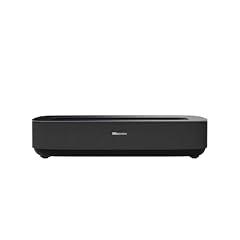
Hisense Laser Cinema PL2 4K Projector
Overview
This is a stationary ultra-short-throw, single-laser DLP projector for an 80 to 150 inch home-theater image. It has a 0.22:1 throw ratio, two HDMI 2.1 inputs, 30 W stereo audio, and a Google TV platform. ProjectorCentral lists 2,700 ANSI lumens, 4K output at 60 Hz, and a claimed laser life of more than 25,000 hours. Independent testing provides useful substance behind its image claims. ProjectorScreen measured up to 3,500 lumens in its brightest modes, about 2,400 lumens in Theater mode, and more than 3,100:1 contrast after calibration on a 0.6-gain ambient-light-rejecting screen. The same review found good color accuracy and quiet operation, but visible DLP rainbow effect can occur. Hisense states that the unit has an eye-protection feature, and an independent review reports that its sensor dims then stops the image when an object is detected close to the projection path.
What works
- Independent testing found brightness above the 2,700-lumen claim in the brightest modes, with roughly 2,400 lumens measured in Theater mode.
- A 0.22:1 throw ratio and 80 to 150 inch stated range make genuinely large images possible from a very short cabinet-to-wall distance.
- Independent testing found more than 3,100:1 calibrated contrast on a 0.6-gain ambient-light-rejecting screen, with quiet fan operation.
- The tested eye-protection sensor reportedly dims and then stops the image when an object comes close to the light path.
- Hisense provides a two-year parts-and-labor limited warranty for eligible Laser TV products sold in the United States and Puerto Rico.
What does not
- No public exact-model UL, ETL, CSA, FDA laser-classification, or FCC authorization record was located during this review, so key U.S. safety and radio compliance evidence remains unverified.
- The independent review observed visible DLP rainbow effect, which can be distracting for viewers sensitive to sequential-color projectors.
- The most accurate color-temperature setting reduces brightness, according to independent testing.
- A large, bright image in moderate ambient light was demonstrated with a 0.6-gain ambient-light-rejecting screen. That screen is not included, and wall quality, screen choice, and precise alignment materially affect results.
- Hisense and ProjectorCentral publish rated power and standby figures, but no independent measurement of this product's operating or network-standby power was located.
Who is it for
It suits a home-theater user who wants an 80 to 120 inch image without a long projector throw, can place a 20.9-inch-wide unit on a stable low cabinet, and is prepared to align it carefully with a suitable ultra-short-throw screen. It is especially appropriate for film, streaming, sports, and casual console use in a room where lighting can be controlled. The independently measured light output and contrast support a large image, while the short-throw format avoids running a projector across the room.
Who is it not for
It is not well suited to households with viewers who are sensitive to DLP rainbow artifacts, because independent testing observed color breakup. It also is not a simple substitute for a television in a sunlit room or on an uneven painted wall. Expect the best results to depend on careful placement and an ambient-light-rejecting screen. Buyers who require public, exact-model proof of NRTL electrical listing, laser classification, or FCC authorization before installation should seek documentation from the seller or manufacturer first.
Integrity
The most relevant health safeguard is the object-detection eye-protection feature. An independent review reports that it dims and then shuts off the image when something enters the area near the projection path. That is useful around children and pets, but it does not replace normal laser-product precautions. Public, exact-model Class 1 or IEC laser documentation was not located, so the underlying laser classification remains unverified. The unit also produces heat at a manufacturer-listed 300 W rated draw, so ventilation clearance and unobstructed airflow matter. For service life, Hisense states more than 25,000 hours of laser life, and its U.S. limited warranty states two years of parts and labor for eligible Laser TV products. Hisense provides U.S. recycling information and links to parts and accessories, but no product-specific take-back program, replacement laser-engine policy, or independently measured power-use record was located. No exact-model U.S. recall or safety warning was identified in the review.

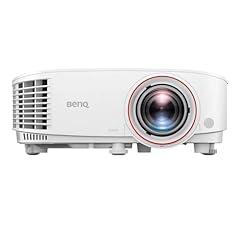
BenQ TH671ST Short Throw Gaming Projector
Overview
This is a compact, corded 1080p DLP projector with a conventional replaceable lamp, not a laser projector and not an ultra short throw model. It uses a short-throw lens and a 1.2x optical zoom to make a 100-inch image from about 5 feet. It has two HDMI 1.4 inputs, a 5W mono speaker, vertical keystone correction, and a 5.9-pound body for tabletop or ceiling use. BenQ states 3,000 ANSI lumens, 16.7 ms input lag, 320W typical power draw, and up to 15,000 lamp hours in LampSave mode. Independent testing measured 2,638 ANSI lumens in Bright mode and about 16.4 ms lag with Fast Mode enabled. Tests also found accurate SDR color, but modest black depth, no HDR support, and visible DLP rainbow artifacts for susceptible viewers.
What works
- Independent testing measured 2,638 ANSI lumens, or about 86% of the stated 3,000-lumen rating.
- The short-throw lens produced a 100-inch image from 5 feet in independent testing, with 1.2x optical zoom for some placement adjustment.
- Fast Mode measured about 16.4 ms input lag, suitable for responsive 1080p, 60Hz casual and single-player gaming.
- Independent testing found accurate out-of-box SDR color, reducing the need for immediate calibration.
- The lamp is replaceable, and the manufacturer documents 4,000-hour Normal, 10,000-hour Eco and SmartEco, and 15,000-hour LampSave operating modes.
What does not
- This is short throw, not ultra short throw. A 100-inch image still needs roughly 5 feet of lens-to-screen distance.
- Independent testing found shallow blacks, muted light color shades, no HDR support, and limited 1080p, 60Hz input capability.
- Rainbow color breakup is very noticeable for some DLP-sensitive viewers, which is a confirmed viewing-comfort issue rather than merely missing evidence.
- The manufacturer rates fan noise at 33 dB in normal operation and 29 dB in Eco mode. Independent testing found it audible during quiet scenes.
- No exact-model UL, ETL, or CSA public listing was located during verification, despite the manual providing conventional grounding, ventilation, and overheating instructions.
Who is it for
It suits a buyer who needs a large SDR image in a shallow but not ultra-short room, such as a den, bedroom, apartment gaming space, or occasional portable movie setup. The most fitting setup has a screen or clear wall about 5 to 9 feet from the projector, controlled lighting, and an HDMI source. It is particularly practical for 1080p, 60Hz console or PC games where responsive input matters more than 4K, HDR, high refresh rates, or deep cinema blacks.
Who is it not for
It is not suited to a true ultra short throw installation, where the projector must sit inches from the wall or screen. People sensitive to DLP rainbow artifacts should avoid using it without seeing this display type first. It is also a poor fit for brightly lit daytime rooms, HDR movies, competitive high-refresh gaming, or households that need very quiet operation. Keep it away from enclosed cabinets and follow the required ventilation clearance because it is a high-heat lamp projector.
Integrity
The light source is a mercury-containing projector lamp, rather than a laser. The manual instructs owners to provide at least 50 cm of clearance, keep ventilation paths open, use an earthed outlet, and let the projector cool before lamp service. If a lamp breaks, the manual calls for ventilation and protective measures. Its disposal instructions direct owners to manage the mercury lamp under local hazardous-waste rules rather than put it in ordinary trash. BenQ documents a replaceable lamp and multiple lamp-saving modes, which can extend service life if image brightness remains acceptable. The manufacturer also published a model-specific cradle-to-grave carbon-footprint estimate of 290.52 kg CO2e using an ISO 14067-based methodology, while noting that it is an estimate. Most of that stated footprint is assigned to use, consistent with its 320W typical draw. No recall specific to this model was identified. A 2026 BenQ recall applies to the battery-powered GV31, not this product.

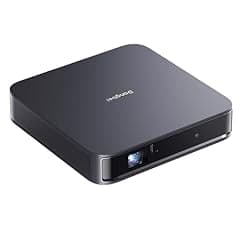
Dangbei Atom Laser Projector 1080P 1200 Lumens
Overview
The Dangbei Atom is a mains-powered portable DLP laser projector with native 1080p resolution, Google TV, Netflix support, a 10 W speaker system, Bluetooth, Wi-Fi, HDMI ARC, USB, autofocus, and automatic keystone tools. It uses a 1.20:1 standard throw lens, not an ultra short throw lens. Its documented 40 to 180-inch range requires roughly 3.6 to 15.7 feet from the projection surface, so placement needs real room depth. Its 1,200 ISO-lumen rating is manufacturer-stated, but several independent tests measured about 1,009 to 1,331 lumens in maximum-output conditions. Independent testing also finds it practical in dim rooms, while ambient light quickly washes out the image. The native panel is Full HD. It accepts some 4K signals but does not create a native 4K image.
What works
- Independent measurements broadly support the stated high-output brightness, with results around 1,009 to 1,331 lumens in maximum modes.
- The compact 2.82-pound, 1.87-inch-high chassis is genuinely portable, although it still needs its external power supply.
- Google TV, officially licensed Netflix, Chromecast, Bluetooth, HDMI ARC, and a 10 W speaker make it usable without an extra streaming stick.
- The exact wireless product has an FCC equipment authorization for its Wi-Fi and Bluetooth radios.
What does not
- This is not an ultra short throw projector. A 1.20:1 throw ratio means a large image needs several feet of clear space in front of the wall or screen.
- Independent reviews report washed-out pictures with room lights, raised blacks in dark scenes, limited color gamut, and a pink cast on pale images.
- The brightest laser setting increases fan noise substantially. Manufacturer noise data applies only to standard mode.
- The manual identifies the projected beam as Risk Group 2 and warns against direct eye exposure. Public documentation reviewed did not establish a Class 1 laser classification or an NRTL electrical-safety listing for the exact projector and adapter.
Who is it for
It suits a viewer who needs a compact, plug-in projector to move among bedrooms, dorms, small living spaces, or occasional presentation locations, and who can control the room lighting. The practical use case is streaming or casual movie viewing on a roughly 80 to 120-inch screen, with several feet available between the projector and wall. It also fits someone who values Google TV and licensed Netflix in the projector itself, rather than connecting a separate streamer.
Who is it not for
It is not suited to an ultra short throw installation, because it cannot form a large image from inches away from the wall. It is also a poor fit for bright living rooms, daylight viewing, dedicated dark-room movie setups that demand deep blacks and accurate color, or competitive gaming. Households with young children should place it where children cannot access or stare into the beam, keep ventilation openings clear, and use the supplied power equipment as instructed.
Integrity
The manual gives meaningful beam-safety instructions. It labels the projection beam Risk Group 2 under IEC 60825-1:2014, says not to look directly into it, and says children should not handle the product without supervision. This is not an eye-comfort claim. It is a practical reason to avoid eye-level placement and direct beam exposure. The manual also requires unobstructed ventilation, use within 5 to 35°C, and use of the supplied or specified power adapter. The exact wireless model has an FCC authorization, which provides traceable U.S. radio compliance. The manufacturer states an 80 W power rating and a 30,000-hour light-source life, but does not clearly publish typical, standby, or network-standby consumption. It provides a one-year limited warranty. A product-specific U.S. take-back, recycling, parts catalog, or long-term firmware-support policy was not located in the reviewed materials, so eventual repair and end-of-life planning remain limited.

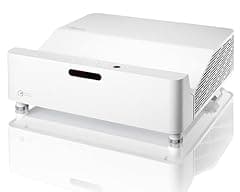
Optoma GT3500HDR Ultra Short Throw Projector
Overview
This is a compact, single-chip DLP ultra-short-throw home projector with native 1920 x 1080 resolution, two HDMI 2.0 inputs, a 15W speaker, wired LAN control, and no built-in wireless or streaming platform. It is intended to sit close to a wall or screen rather than across the room. Optoma specifies an 80 to 130-inch image range, 0.253:1 throw ratio, and 7.95 to 15.67 inches of projection distance. The 3,800-lumen rating, HDR10 and HLG input support, 1080p at 120Hz gaming mode, 30,000-hour laser-life claim, and 27 to 34dB noise figures are manufacturer-stated. ProjectorCentral independently confirms the core format and connections, but no current instrumental review with measured brightness, color, contrast, input lag, or HDR performance was located. The product is native 1080p, not a native 4K projector, although it accepts 4K signals.
What works
- The documented ultra-short-throw geometry can produce a 100-inch image at roughly 11.3 inches from the projection surface.
- The manual identifies it as an IEC Class 1 laser product and IEC 62471-5 Risk Group 2 laser illuminated projector, with explicit direct-beam and child-supervision warnings.
- Wired-only connectivity avoids built-in Wi-Fi and Bluetooth radio compliance concerns, while the manual includes FCC Part 15 Class B compliance statements.
- The manufacturer specifies standby power below 0.5W and an external 180W power supply.
- Optoma provides a one-year product warranty and a five-year or 12,000-hour light-source warranty, whichever comes first.
What does not
- No public UL, ETL, or CSA listing for the exact projector and included external power supply was located, so independent U.S. electrical-safety listing could not be confirmed.
- No current independent instrumental review was located with measured brightness, color accuracy, black level, HDR performance, noise, or gaming latency. The headline optical claims remain largely unverified.
- Risk Group 2 classification means viewers, especially children, must not stare into the lens or use optical aids in the beam. Class 1 does not make direct-beam viewing appropriate.
- The lights-on claim is qualified by Optoma to exclude direct sunlight and lights aimed at the screen. A suitable flat wall or purpose-built screen remains important for usable contrast.
- Optoma gives a general instruction to recycle the product, but a model-specific U.S. take-back or recycling route was not located.
Who is it for
This product suits a buyer who needs a very large 1080p image in a small living room, game room, classroom, or multipurpose space where placing a conventional projector several feet away is impractical. Its documented 80 to 130-inch range and close placement are useful when people would otherwise walk through the light path. It also fits users with consoles, streaming sticks, cable boxes, or computers that connect by HDMI, and who can control room light and take time to align a screen or flat wall carefully.
Who is it not for
It is not suited to households where children may regularly approach or look into the lens, unless an adult can supervise operation and placement. It is also a poor fit for shoppers who require a publicly traceable UL, ETL, or CSA listing for the exact projector and power supply. Users expecting independently measured HDR, color accuracy, dark-scene performance, or verified gaming latency will lack that evidence. It also does not suit buyers wanting native 4K resolution, built-in streaming, HDMI ARC, Wi-Fi, or Bluetooth.
Integrity
The manual gives unusually specific laser-safety information. It identifies the product as an IEC Class 1 laser product and a Risk Group 2 laser illuminated projector under IEC 62471-5, with stated compliance to the applicable U.S. laser-product rules. This supports normal projected-image viewing when used as directed, but the direct beam remains an eye hazard. The manual says not to stare into the lens, supervise children, avoid optical aids, keep reflective objects out of the beam, maintain ventilation clearance, and use a grounded outlet. No active U.S. CPSC recall or product-safety warning for this product was located in the checked records. Optoma states that the laser source is mercury-free, the chassis contains up to 50% post-consumer recycled plastic, and packaging is up to 97% recyclable. Those environmental material claims are manufacturer-stated, not independently audited here. The long stated laser life, low specified standby draw, and light-source warranty may reduce replacement demand, but the available disposal guidance is limited to a general instruction to recycle electronics.
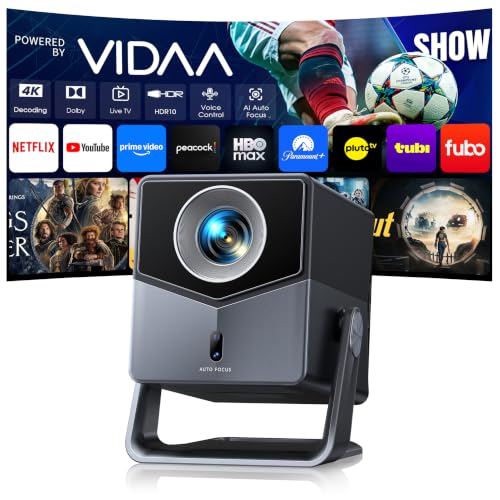
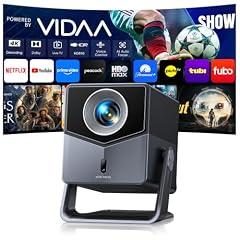
TOPTRO Smart 4K Projector with WiFi6 & Bluetooth
Overview
The TOPTRO A2 is a compact, mains-powered LED LCD home projector with a 1920 by 1080 native panel, Wi-Fi, Bluetooth, HDMI, USB, a 3.5 mm audio output, and built-in VIDAA streaming software. Its manual confirms the LED light source, LCD display technology, 60 Hz refresh rate, and native Full HD resolution. It can accept 4K content, but it displays that content at 1080p rather than as native 4K. TOPTRO states that it has 36 W speakers, HDR10 support, automatic focus and geometry tools, and a 1.0:1 throw ratio that produces a 100-inch image from 2.2 meters away. That makes it a short-throw model, not an ultra-short-throw product. No independent instrumental test was located for brightness, color accuracy, contrast, input lag, noise, or power consumption on this exact product.
What works
- The manual documents a native 1080p LCD image, LED light source, 60 Hz refresh rate, HDMI, USB, and 3.5 mm audio output.
- TOPTRO states that built-in VIDAA software provides major streaming apps, potentially avoiding a separate streaming stick.
- TOPTRO states that a 1.0:1 ratio can create a 100-inch image at 2.2 meters, useful where a conventional projector cannot sit across the room.
- The manual provides an online update function and describes a three-year warranty activation process.
What does not
- This is not an ultra-short-throw projector. Its stated 1.0:1 ratio requires the unit about 2.2 meters from the screen for a 100-inch image.
- No independent measurements were found for actual brightness, black level, color accuracy, HDR performance, image uniformity, fan noise, or gaming latency.
- No public exact-model NRTL electrical-safety listing or FCC equipment authorization was located during this review.
- The manual describes an open optical system and instructs internal cleaning while powered on. Do not attempt internal cleaning while energized.
- TOPTRO makes broad claims about ISO ANSI brightness, color gamut, app stability, and comparative performance without a named third-party test report.
Who is it for
This product suits a renter, student, or home viewer who wants a portable Full HD streaming projector for dim-room movies, casual sports, or occasional backyard use, and can place it roughly 2.2 meters from the screen or wall for a 100-inch image. It is also suited to users who value built-in streaming, HDMI ARC, Bluetooth, and a rotating stand over calibrated picture performance. The buyer should be comfortable treating the listed brightness and automatic setup claims as manufacturer statements rather than independently measured results.
Who is it not for
It is not suited to buyers specifically seeking an ultra-short-throw projector that sits inches from an ambient-light-rejecting screen or entertainment cabinet. A 1.0:1 throw ratio needs substantially more room. It is also unsuitable for critical home theater, bright daytime viewing, competitive gaming, or anyone needing independently verified brightness, color, noise, electrical certification, or radio-compliance documentation. Households with children should keep eyes away from the operating lens and should not follow the manual's powered-on internal-cleaning instruction.
Integrity
The product uses an LED light source rather than a laser, so the laser-class and laser-eye-exposure issues associated with laser ultra-short-throw products do not apply. The manual nonetheless documents a bright optical system and the sensible practical precaution is not to look into the lens while it is operating. The manual specifies AC 100 to 240 V input and ventilation-dependent operation, but no exact-model UL, ETL, or CSA listing was found in public registers reviewed for this assessment. The manual says the optical system is open and may require dust cleaning. Its instruction to clean inside the projector while powered on is a poor safety practice. Disconnect mains power and use qualified service where internal access is needed. TOPTRO documents online updates and a registration-based three-year warranty, which may support continued use. No public U.S. take-back program, repair-parts catalog, standby-power figure, or exact-product recycling plan was located. No matching U.S. recall or public safety warning was located in the searched sources.
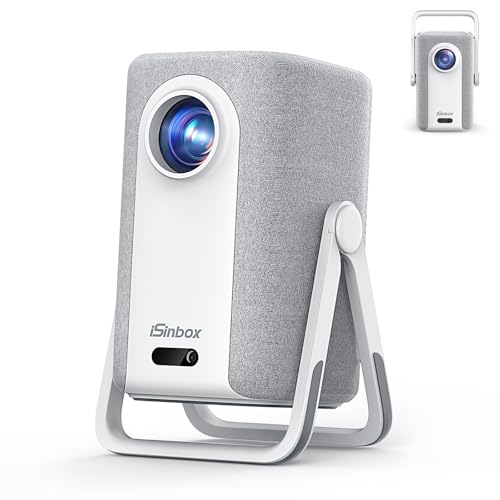
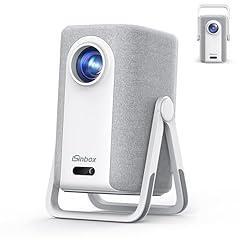
iSinbox 4K Smart Outdoor Projector
Overview
This is a compact, mains-powered LCD projector with an integrated adjustable stand that also functions as a carry handle. It is intended for tabletop, wall, or ceiling movie viewing, with HDMI, USB, Wi-Fi 6, Bluetooth 5.4, built-in streaming apps, and built-in speakers. The available product manual identifies native 1920 x 1080 resolution and 4K input support, so it is not a native 4K projector. A model database reproduces a manufacturer data sheet specifying a 1.1:1 throw ratio, 1,200 ANSI lumens, LED illumination, and a claimed 30,000-hour light-source life. Its calculation indicates that ambient light should be very low for larger images. No independent instrumental review was located that measures brightness, contrast, color accuracy, HDR, fan noise, input lag, or focus uniformity. Specifications also conflict across public materials, including brightness, weight, power, and speaker output.
What works
- Native 1080p resolution and 4K input support are consistently documented in the available product manual.
- The documented 1.1:1 throw ratio can produce a 100-inch image from about 7.9 feet, which is practical for some small rooms.
- The built-in adjustable stand supports wall and ceiling projection without a separate mount, according to the product manual.
- The manual includes basic fire, shock, ventilation, moisture, and direct-lens-viewing precautions.
What does not
- There is no located independent measurement of the claimed 1,200 ANSI lumens, black level, color accuracy, HDR performance, fan noise, or gaming latency.
- The product is marketed as 4K, but its documented native panel resolution is 1080p. It supports 4K input rather than displaying native 4K detail.
- Public specifications conflict. Sources variously state 500, 1,000, or 1,200 ANSI lumens, and list differing weights, power use, and audio specifications.
- No exact-model UL, ETL, CSA, FCC equipment authorization, laser classification record, or public safety-test listing was located.
- No public U.S. take-back, parts catalog, repair network, or software-support schedule was located.
Who is it for
This product fits a buyer who wants a portable 1080p projector for occasional movies, casual streaming, or presentations in a dark bedroom, apartment, or temporary viewing space. The useful condition is having roughly 7.9 feet between projector and screen or wall for a claimed 100-inch image, plus room to position the adjustable stand. It is better suited to viewers who accept manufacturer-stated brightness and automatic-adjustment features rather than requiring measured picture, noise, or latency results.
Who is it not for
It is not suited to a buyer who needs a verified native 4K image, reliable daytime or bright-room viewing, calibrated HDR, quiet operation, or competitive gaming performance. Those uses depend on measurements that were not located for this product. It is also not the right choice for households that require a publicly traceable U.S. electrical-safety listing or radio authorization before use. Do not treat the 4K marketing language as evidence of a native 4K panel.
Integrity
The available documentation identifies an LED LCD projector, not a laser projector. That avoids the specific laser-light-source classification question, but it does not remove ordinary optical safety considerations. The manual tells users not to look directly into the active lens, to keep ventilation openings clear, keep the unit dry, use its supplied power adapter, and avoid disassembly. No exact-model public UL, ETL, CSA, FCC, FDA laser, or IEC photobiological-safety record was located. No product-specific U.S. recall or regulator warning was found in the searches performed. The listed LED light-source life is 30,000 hours, but this is manufacturer-stated and lacks conditions or independent endurance evidence. Public materials do not provide measured operating or standby power, repair parts, a service manual, a U.S. repair network, or an end-of-life take-back program. The connected-product disclosure identifies cloud handling of activation data and an email address entered during setup, with stated cloud storage up to five years.