
10 Best Tire Inflator
 Daniel Kenitz
Please note that we participate in affiliate marketing programs. When you purchase through links on our site, we may earn a commission. As an Amazon Associate we earn from qualifying purchases. This comes at no additional cost to you and helps support the resources required to provide valuable content.Advertising Disclosure
Top-rated Tire Inflator Comparison
1

2
4
5
6
7
8
9
10
Tire inflators: what matters
A tire inflator adds air to a tire or other inflatable, usually through a hose and valve connector. Portable models may run from an internal rechargeable battery, a vehicle’s 12V outlet, household AC power, or an external compressor. The useful question is not whether a product says “150 PSI” or “fast inflation,” but whether it can safely complete the job your tires require, stop near the selected pressure, and remain usable without overheating.
Start with the vehicle’s Tire and Loading Information placard or owner’s manual. That cold-pressure number not the tire sidewall maximum is the target. Compatibility also depends on tire size, width, starting pressure, power source, operating temperature, and whether the product is intended for occasional top-ups or repeated inflation. A maximum-pressure figure describes a limit, not the speed, accuracy, or suitability of the inflator for a large or fully flat tire.
Pressure accuracy and automatic shut-off are separate questions. A preset can reduce the need to watch the display, but it does not prove that the final pressure is correct. Stronger evidence compares the exact product with a separate or calibrated reference gauge and reports the difference, target pressure, tire size, and test conditions. A manufacturer claim such as ±1 PSI is useful only when supported by a calibration specification, manual, or model-specific comparison test. One supplied product explicitly says its gauge is uncalibrated and must be checked with a reliable gauge.
Output claims also need conditions. “L/min,” “7X faster,” a one-minute fill, or a stated number of tire top-ups can change substantially with tire volume, starting and ending pressure, ambient temperature, battery charge, and whether airflow is measured freely or through a tire. Look for a disclosed tire size, pressure change, elapsed time, power state, and cooldown behavior. A clear duty cycle such as a defined operating interval followed by cooling is more useful than a broad “heavy-duty” label. Thermal shutdown, hot hoses, hot nozzles, and burn warnings are recurring practical concerns.
For powered products, an exact finished-product listing from an OSHA-recognized Nationally Recognized Testing Laboratory is stronger evidence than a logo or a claim that a component is certified. Relevant public records may be checked through UL Product iQ, Intertek’s ETL directory, or the CSA listing database; the model and certification record must match the complete product. Battery products also raise charger and battery-pack questions, including applicable UL 1450, UL 2054, IEC 62133-2, and UN 38.3 documentation. A CPSC recall search and SaferProducts.gov reports provide additional safety context, but a lack of a listed recall is not proof of safety.
Across the supplied reviews, the recurring cautions are clear: most products lack publicly verifiable UL, ETL, CSA, or equivalent finished-product certification; many have no independent gauge, runtime, airflow, or thermal test; and several have built-in batteries with no removal, replacement, repair, or take-back pathway. Conflicting airflow, pressure, runtime, and duty-cycle claims also occur. Compact cordless inflators commonly are not suitable for trucks, RVs, tractors, large off-road tires, or repeated full-flat recovery. Corded models require the correct vehicle or household power source. Do not use any inflator as a repair for a puncture, operate hot equipment without cooling, or rely on an unverified display without checking the finished cold pressure.
Integrity
These topics assess the parts of an inflator that affect pressure control, safe operation, compatibility, traceability, waste, and the strength of the evidence behind its claims. Scores distinguish products with documented limits and model-specific testing from products supported mainly by manufacturer statements or broad listings.
HHealth & Safety
Accurate pressure and shut-off
This measures whether the display and preset stop near the selected tire pressure without meaningful overinflation. It matters because an incorrect target can leave a tire underinflated or overinflated. Among these products, higher scores are supported by independent gauge checks and observed shut-off; lower scores rely on unverified claims, conflicting readings, or explicit warnings that the gauge is not calibrated.
Inflates a real tire without overheating
This measures real tire fill time, air delivery, and safe duty cycle rather than a free-air flow figure. It matters because a compressor can reach a headline PSI yet fail on a large or fully flat tire, overheat, or require an unclear cooldown. Higher-scoring products have disclosed tire tests or concrete heat limits; lower-scoring ones lack repeatable conditions or struggle with larger tires.
Safe power and charging system
This covers protection from shock, short circuit, overcharge, overheating, and lithium-battery fire, including the supplied charger. It matters especially for cordless products stored and charged in vehicles. Higher scores reflect clearer operating warnings and described protections, while lower scores reflect missing battery or charger records. No supplied product had a publicly verified exact-product UL, ETL, or CSA listing.
Secure hose, valve, and pressure handling
This measures whether the hose, chuck, adapters, seals, and pressure path remain connected and intact during inflation. Leaks, detachment, hot fittings, or sudden release can produce an incorrect reading or injury. Higher scores are associated with tested or clearly specified connectors, hoses, and secure attachment. Lower scores reflect short or awkward hoses, limited pressure-retention evidence, or reports of connection difficulty.
Clear limits for the tires you actually have
This measures whether the product clearly states compatible tire types, pressure range, power source, temperature limits, runtime, and prohibited uses. It matters because a compact pump may suit passenger-car top-ups but not trucks, RVs, tractors, or large off-road tires. Higher-scoring products give concrete exclusions or size limits; lower-scoring listings use broad vehicle claims without a defined duty cycle or tire boundary.
Traceable maker and recall readiness
This measures whether the exact product can be linked to a responsible business, model information, support, warranty, and recall response. That matters when a battery, hose, charger, or compressor develops a safety problem. Higher scores in this group generally include named support, model-specific documentation, and warranty terms. Lower scores have less complete maker or service information. A clean recall search is context, not proof of safety.
EEcology
Lower waste and safer end of life
This measures whether the inflator can remain useful through battery replacement, repair, spare parts, restrained packaging, and clear recycling guidance. A removable battery, as documented for the AVID POWER product, can avoid discarding the whole inflator when capacity declines. Most supplied cordless products have built-in batteries and no removal or take-back instructions. Higher scores therefore reflect a more manageable service path, while all lithium-ion devices need dedicated recycling rather than household trash or curbside bins.
EEvidence
Claims that match the evidence
This measures whether speed, PSI, runtime, battery, compatibility, and safety claims include conditions and agree with the manual and product page. Higher scores go to specific, qualified claims supported by reproducible tests. Lower scores appear where airflow, pressure, runtime, or tire-size claims conflict across documents, or where impressive figures omit tire size, pressure change, temperature, battery state, or test duration.
Independently certified electrical safety
This asks whether a qualified independent laboratory certified the exact finished product under an applicable standard, with a public record matching the model and mark. It matters because FCC compliance, a component logo, or a self-issued “UL” statement is not the same assurance. Scores are relatively limited across the supplied set because reviews repeatedly found no public exact-product UL, ETL, CSA, or other OSHA-recognized certification record.
Independently tested real-world performance
This measures whether the exact product has model-specific, repeatable testing of pressure accuracy, shut-off, inflation rate, runtime, and overheating behavior. Higher scores are supported by disclosed tire size, starting and ending pressure, ambient conditions, power state, elapsed time, and instruments. Lower scores rely on a manufacturer report, a single informal review, or no test. The strongest supplied performance evidence still did not establish every one of those measures.
Full reviews
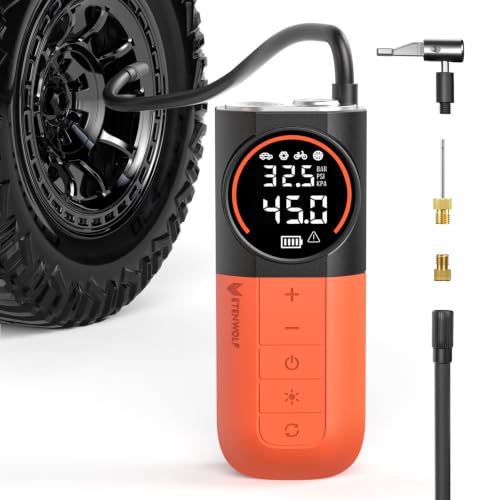
ETENWOLF S1 Portable Tire Inflator
Overview
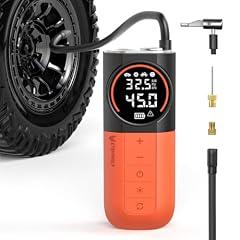
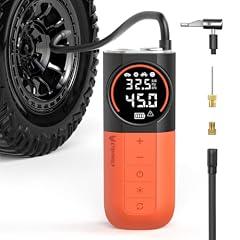
This is a cordless, rechargeable tire inflator for car, SUV, motorcycle, bicycle, and ball top-ups. It has a stated 5,200 mAh lithium battery, USB-C charging input, a digital pressure display, preset modes, automatic shut-off, LED light, air chuck, ball needle, Presta adapter, cable, and storage bag. The manufacturer lists a 160 PSI maximum, 20 L/min airflow, 1.35 lb weight, and dimensions of 6.7 by 2.1 by 2.6 inches. A published hands-on test of this exact product reported a 195/65R15 tire increased from 30 to 35 PSI in just over a minute and found shut-off typically within 0.5 PSI of the target when checked with a separate digital gauge. That is useful model-specific performance evidence, though it is not an accredited laboratory report. The manufacturer also claims continuous operation without overheating, but its public specifications do not give a detailed duty-cycle test method or temperature limit.
What works
- A published hands-on test found automatic shut-off typically landed within 0.5 PSI of the selected pressure.
- A published test timed a 5 PSI top-up on a 195/65R15 tire at just over one minute.
- The stated package is self-contained, with an air chuck, ball needle, Presta adapter, charging cable, storage bag, display, and work light.
- The manufacturer provides identifiable customer support, a 90-day return policy, and a stated two-year extended warranty after registration.
What does not
- No publicly verifiable UL, ETL, or CSA listing for the exact finished product was found, so independent electrical-safety certification remains unconfirmed.
- The public product page does not state supported tire-size limits, operating-temperature limits, or a detailed cooldown procedure, despite broad vehicle compatibility claims.
- Manufacturer claims are not fully consistent across its web materials. Public S1 pages variously state 150 or 160 PSI, 20 or 22 L/min, and differing noise figures.
- The battery appears built in, and no battery-removal instructions, replacement battery, spare-parts catalog, or product-specific recycling guidance was located.
Who is it for
This product suits a driver, rider, or cyclist who mainly needs a compact cordless tool for routine pressure corrections rather than repeated recovery from fully flat large tires. The independently described one-minute, 5 PSI car-tire top-up and close shut-off behavior are relevant for keeping a passenger vehicle near its door-placard cold pressure. It also suits someone who values keeping the chuck and small adapters together in a car, motorcycle storage compartment, or bike bag. Check the vehicle placard, not the inflator preset, before setting pressure.
Who is it not for
It is not well documented for owners who need an inflator for commercial vehicles, dual-wheel setups, large RV tires, or repeated inflation of fully deflated large tires. The manufacturer broadly lists trucks, trailers, small RVs, and other vehicle types, but does not publicly provide tire-volume limits or a tested duty-cycle procedure for those uses. It is also not the right fit for buyers who require a publicly verifiable North American electrical-safety listing, a replaceable battery, or published battery recycling and repair instructions. Do not use it to choose tire pressure instead of following the vehicle placard.
Integrity
The main health and safety benefit is pressure control. A published hands-on test found the digital shut-off typically finished within 0.5 PSI of the selected target, but users should still set the target from the vehicle Tire and Loading Information placard and periodically cross-check it with a known gauge. The product is specified as a lithium-battery device charged by USB-C. No publicly verifiable UL, ETL, or CSA certification record for the exact finished product was located. The manufacturer has a support channel, return policy, and stated two-year extended warranty, which improves traceability if a problem occurs. No matching CPSC recall or public safety warning was identified in the checked sources. From a waste perspective, the built-in lithium battery has no located removal procedure or replacement-part listing. Keep damaged or end-of-life lithium products out of household trash and use an appropriate battery or electronics collection program.

Etenwolf Vortex S6 Portable Tire Inflator
Overview
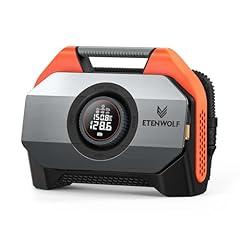
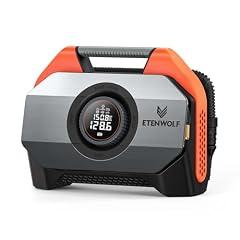
This is a rechargeable, cordless dual-cylinder tire inflator with a stated 19,200 mAh lithium battery, 160 PSI maximum setting, digital target-pressure control, auto-stop, LED work light, USB charging ports, and separate high-pressure and high-volume hoses. It is intended for cars, pickups, SUVs, motorcycles, bicycles, balls, and low-pressure inflatables. The manufacturer specifically excludes stand-up paddleboards. ETENWOLF states 42 L/min airflow at zero pressure, ±1 PSI sensor accuracy, and continuous operation between tire fills through active cooling. These are manufacturer claims, rather than results from a public accredited laboratory report. An independent hands-on review confirmed the product’s included accessories, cordless operation, working auto-stop, and use on a full-size pickup, but did not publish calibrated pressure, temperature, or airflow measurements. The product has a stated two-year extended warranty and identifiable support channels.
What works
- The product includes both high-pressure and high-volume hoses, plus an air chuck, tapered nozzles, ball needle, and Presta adapter.
- A hands-on independent review reported that its auto-stop, controls, light, included nozzles, and large-vehicle inflation functioned in ordinary use.
- The manufacturer gives concrete operating specifications, including 160 PSI maximum pressure, 42 L/min at zero pressure, ±1 PSI sensor accuracy, and a stated 19,200 mAh battery.
- The maker provides model-specific support, warranty registration, a stated two-year extended warranty, and a 90-day money-back policy.
What does not
- No public UL, ETL, or CSA listing for the finished product was located. A Chinese electrical safety test report is not equivalent to a publicly verifiable US NRTL certification.
- No accredited, model-specific public test report was found for gauge accuracy, shut-off error, battery protection, hose pressure retention, or heat during sustained tire inflation.
- The stated 42 L/min rating applies at zero pressure. Actual output necessarily declines as tire pressure rises, and the manufacturer does not publish a complete flow-versus-pressure curve.
- The internal lithium battery is not described as user-replaceable, and no model-specific battery-removal instructions, spare battery program, or take-back program were located.
Who is it for
This product suits a driver or household that wants a self-contained inflator for regular cold-pressure top-offs on passenger vehicles, pickups, SUVs, motorcycles, bicycles, and common inflatables. It is particularly relevant where access to a 12-volt outlet is inconvenient, since it has an internal rechargeable battery and includes the required tire and inflatable accessories. Users should know their vehicle placard pressure, check pressure when tires are cold, set the target accordingly, and verify final pressure with a separate dependable gauge when precision matters.
Who is it not for
It is not for buyers who require a publicly verifiable UL, ETL, or CSA certification for an inflator with an integrated lithium battery and supplied charger. It is also not suitable for stand-up paddleboards, which the maker excludes. Commercial fleet users, people airing up large dual-rear-wheel setups, or anyone routinely recovering severely deflated heavy tires should treat the stated battery runtime and continuous-duty claims cautiously, because no public independent endurance protocol confirms those conditions. Do not use it to select tire pressure, use the vehicle placard.
Integrity
For safe tire use, the key control is the vehicle Tire and Loading Information placard, not the inflator’s maximum pressure or a preset carried over from another vehicle. The product offers digital targeting and automatic stop, and the maker states ±1 PSI sensor accuracy. Those claims were not independently confirmed with a published calibrated-gauge comparison. A separate gauge check is prudent after inflation, especially for load-sensitive tires. The product contains a large integrated lithium battery. The maker provides a warranty and support route, but public evidence of a replaceable battery, repair parts catalog, battery-removal procedure, or recycling take-back program was not located. At end of life, the complete product should be routed through an appropriate lithium-ion battery or electronics collection program rather than household trash. Searches of US consumer-product recall resources did not identify a matching recall or published safety warning for this model.

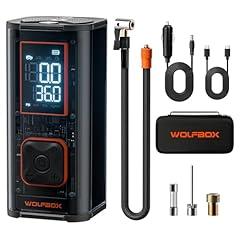
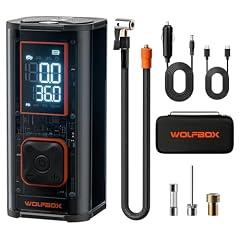
WOLFBOX Portable Tire Inflator
Overview
This is a rechargeable, dual-cylinder portable tire inflator with a built-in 43.2Wh, 12,000mAh battery, 12V vehicle-power option, 20-inch hose, LED light, USB-C power-bank function, and storage case. It is intended for car, motorcycle, bicycle, and ball inflation, not mattresses. The manufacturer documents a 150 PSI maximum, 58 L/min claimed airflow, a 15-minute continuous-use interval followed by 5-10 minutes of cooling, and an operating range of -4 to 122 F. The manual documents selectable pressure presets and automatic shut-off at the set pressure, but no calibration tolerance or independent gauge-comparison result was located. The company also claims one charge can top up four 185 to 225-size tires from 29 to 36 PSI, but this is manufacturer-stated rather than independently tested.
What works
- The manual gives concrete operating limits, including temperature range, preset ranges, a 15-minute use interval, and a recommended cooldown period.
- It can run from its internal battery or the included 12V vehicle cord, which provides a practical fallback when battery charge is low.
- The pressure control is clearly described, with Car, Motorcycle, Bicycle, Ball, and Custom modes plus automatic shut-off.
- Model-specific support documentation, customer-service email, telephone support, and a product manual are publicly available.
- The manual includes hose heat warnings and tells users to wait two minutes before removing the hose after inflation.
What does not
- Pressure accuracy and shut-off accuracy are not independently validated, and the manual gives no gauge calibration tolerance.
- The claimed airflow, tire fill times, and one-charge capacity were not supported by a disclosed independent test using a defined tire, temperature, and measuring instrument.
- No public exact-product NRTL certification file, battery certification record, or certification mark was identified in the available product documentation.
- The battery is built in and described as non-replaceable, with no model-specific removal, spare-battery, or take-back instructions located.
- A 45W USB-C wall charger is needed for the stated charge time, but is not included.
Who is it for
This product fits a driver, cyclist, or household that wants a compact emergency inflator for routine cold-pressure top-ups on passenger-car tires, motorcycles, bicycles, or balls. It is most suitable for someone willing to follow the manual's 15-minute use interval and cooldown guidance, use the vehicle door-placard pressure rather than the tire sidewall number, and verify final pressure with a separate accurate gauge. The 12V vehicle-power mode is useful for roadside use when the internal battery is depleted.
Who is it not for
It is not suited to buyers who need a verified, calibrated pressure instrument for precise inflation, because no independent accuracy or auto-stop comparison was located. It is also a poor fit for frequent commercial tire service, extended continuous operation, or users who cannot allow cooling time. Avoid using it for mattresses, near fuel or flammable vapors, while USB-C charging, or in wet conditions. Buyers needing a replaceable battery or established end-of-life service path should choose a serviceable design.
Integrity
The main user-safety positives are documented operating instructions. The manual warns against use near flammable liquids or gases, water exposure, unauthorized disassembly, charging while inflating, and contact with the hot hose. It specifies a 15-minute continuous-use interval, recommends 5-10 minutes of cooling afterward, and says to wait two minutes before removing the hose. NHTSA guidance remains important, use the vehicle's cold-pressure placard or owner's manual target, not the maximum pressure printed on the tire. The product contains a built-in rechargeable battery that the manufacturer says is not replaceable. No product-specific take-back or battery-removal guidance was located. At end of life, do not place the product in household trash or curbside recycling. EPA guidance says lithium-ion battery devices should go to a dedicated battery recycler, electronics recycler, or household hazardous-waste collection point. No product-specific CPSC recall was located in the searched public recall records.
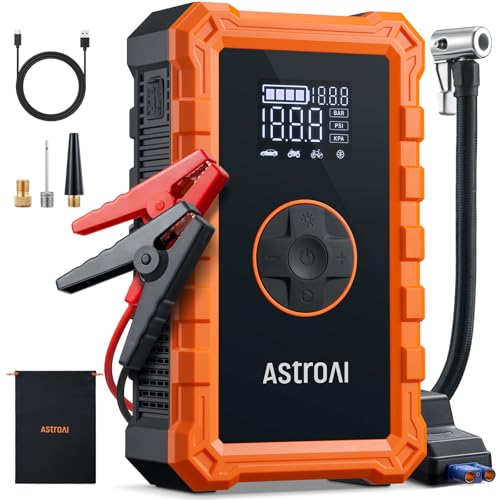
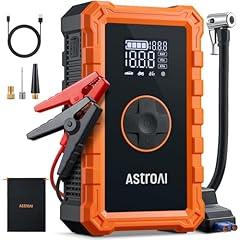
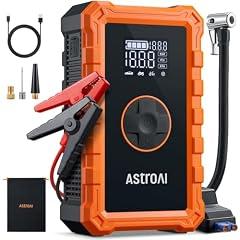
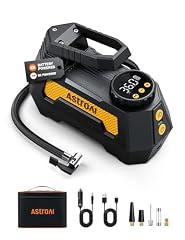
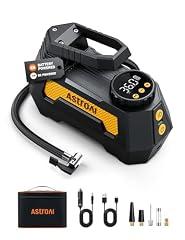
AstroAI S8 Air Jump Starter & Tire Inflator
Overview
This is a 2.4-pound rechargeable 12V roadside tool that combines a tire inflator, jump starter, USB power bank, and LED light. Its internal battery is manufacturer-listed as 37Wh, or 10,000mAh at 3.7V. The pump has selectable car, motorcycle, bicycle, ball, and custom modes, with a 3 to 150 PSI range and automatic shut-off. AstroAI states gauge accuracy of ±1 PSI. A published hands-on test reported inflating a 225/65R17 tire from 15 to 35 PSI in 5 minutes 42 seconds and checking the display against another gauge, though it was not an accredited laboratory report. The manual sets a 10-minute continuous-use limit followed by at least 10 minutes of cooling. Published specifications are inconsistent, with peak-current and engine-size claims differing across official materials.
What works
- The manual gives a specific pressure range, ±1 PSI gauge claim, and auto-stop operation.
- A model-specific hands-on test documented a 15 to 35 PSI SUV-tire fill in 5 minutes 42 seconds.
- The manual provides useful operating limits, including 12V-only jump starting, temperature ranges, and a 10-minute cooling interval.
- A named U.S. support channel and a two-year limited warranty are published by AstroAI.
What does not
- The pressure accuracy and shut-off performance have not been verified by an accredited laboratory report.
- The hose gets hot during inflation, and the manual requires a 10-minute cooldown after 10 minutes of continuous operation.
- No public UL, ETL, or CSA record was located for the finished product, despite UL and FCC language appearing in marketplace materials.
- Official product information conflicts on peak current and supported engine size, which makes the largest capability claims difficult to interpret.
- The battery is not presented as user-replaceable, and no product-specific take-back or spare-parts program was found.
Who is it for
This suits a driver who wants a compact emergency tool for routine passenger-vehicle tire top-offs, a low 12V battery, phone charging, and roadside lighting. It is most appropriate when the buyer will check tire pressure cold against the vehicle door-placard target, then use the pump for modest pressure corrections. It also fits someone prepared to keep the unit above 75 percent charge, recharge it about every three months during storage, and let the compressor cool as instructed.
Who is it not for
It is not suited to users who need independently certified electrical safety, documented battery transport testing, or an accredited performance report before relying on a lithium-powered emergency device. Avoid treating it as a shop compressor, a continuous-duty inflator, or equipment for large-volume tire work. It is also not appropriate for 24V vehicles, aircraft, or boats, which the manual prohibits. Buyers should not rely on the highest published engine-size claim until AstroAI resolves its conflicting specifications.
Integrity
The product uses a sealed lithium battery pack, listed by AstroAI as four series-connected 3.7V cells with 37Wh capacity. The manual includes warnings about overheating, smoke, burning, hot inflation hardware, damaged clamps, and use near flammable materials. It also describes reverse-polarity indication and thermal shutdown behavior. No matching CPSC recall was located in the searched U.S. recall sources. The marketplace record claims UL and FCC compliance, but a public certification record for this finished product was not located. That matters because a component mark or a self-issued claim is not the same as independent certification of the complete tool. At end of life, do not place the product in household trash or curbside recycling. The sealed lithium battery needs a battery or electronics recycler that accepts the whole device. AstroAI gives only general local-recycling guidance and does not publish battery-removal instructions or a product-specific take-back program.

AstroAI H2 Pro Cordless Tire Inflator
Overview
The AstroAI H2 Pro is a portable tire inflator with an internal 11.1V, 2000mAh lithium battery and a separate 12V vehicle-power cord. It uses a quick connector for standard Schrader valves, supports Presta valves through the included adapter, and has ball and air-nozzle accessories. The manufacturer specifies 23 L/min airflow, 150 PSI maximum working pressure, a 0.55 m inflation hose, and a 3 m vehicle-power cord. Its defining convenience is dual power, battery for untethered top-offs and vehicle DC power for longer work. The manual documents auto shut-off at a preset pressure, current and voltage protections, plus battery temperature protections. However, no public calibration tolerance, accredited gauge comparison, finished-product electrical safety listing, or independently reproducible test report was located. The catalog's 35 L/min airflow claim also conflicts with the manufacturer's 23 L/min manual specification.
What works
- Dual-power operation is documented, with internal battery use and a 12V vehicle-power option.
- The manufacturer provides concrete operating limits, including 150 PSI maximum pressure, 23 L/min stated airflow, temperature ranges, and a 10-minute rest instruction after prolonged use.
- The manual documents automatic stop at the selected pressure and permits manual stopping at any time.
- The package includes a replacement 15A fuse, 12V cord, charging cable, storage bag, and common inflation adapters.
- A two-year manufacturer warranty, support contact details, and an exact product model are published.
What does not
- Pressure accuracy and auto-stop precision are unproven. The manufacturer gives no calibration tolerance and no independent gauge comparison was located.
- The stated 23 L/min airflow and published fill times are manufacturer-supplied, not independently validated under a disclosed test method.
- No public UL, ETL, CSA, or other NRTL certification record was located for the finished product or its battery pack.
- The manual describes a built-in lithium battery, but provides no battery-removal, replacement-part, or dedicated battery recycling instructions.
- The catalog lists 35 L/min airflow, while the manufacturer manual lists 23 L/min. That unresolved specification conflict weakens claim reliability.
Who is it for
This product suits a driver who wants a compact unit for routine cold-pressure top-offs on a passenger car, SUV, motorcycle, or bicycle, especially where a 12V outlet may not always be convenient. The battery can make a short top-off easier away from the vehicle, while the 12V cord provides a fallback when battery charge is limited. It is most appropriate for users willing to read the manual, set pressure from the vehicle door-placard guidance, monitor heat, and verify the finished pressure with a separate trusted gauge.
Who is it not for
It is not suited to people who need independently certified electrical safety, verified gauge accuracy, or an independently tested duty cycle for workplace or fleet use. It is also a poor fit for repeated recovery of very low large-truck, RV, trailer, or other high-volume tires. The manual limits use to 12V vehicle outlets, requires cooling after prolonged operation, and says the accessories are not for large-capacity inflatables. Households needing a replaceable battery or detailed end-of-life service instructions should also look for a product with those documents.
Integrity
The safety documentation is more substantial than a feature list. The manual warns against rain, exposed wires, charging while hot, using 24V vehicle power, and touching the hot pump body. It also describes fuse protection, instantaneous-current protection, DC overvoltage and undervoltage protection, and high-temperature protections during charging and battery discharge. These are manufacturer statements, not independently certified findings. No public finished-product electrical safety listing or battery certification record was located. The product contains a built-in lithium battery and plastic housing. AstroAI supplies a replacement fuse and reusable accessories, but does not publish battery-removal instructions, a replacement battery option, or product-specific lithium-battery recycling directions. Its manual only gives a general instruction to recycle recyclable parts locally. A CPSC recall announced June 18, 2025 involved AstroAI minifridges, not this inflator, but it shows the brand has an identifiable U.S. importer and recall contact process.

WOLFBOX 4000A Jump Starter and Air Compressor
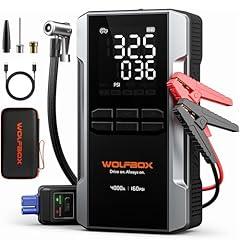
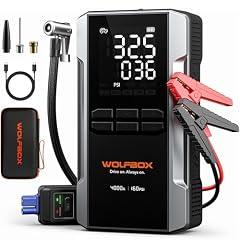
Overview
This is a rechargeable lithium-ion roadside tool that combines a 12V jump starter, cordless tire inflator, USB power bank, and LED light. The manufacturer states 88.8Wh or 24,000mAh capacity, 4,000A peak starting current, 45 L/min airflow, 160 psi maximum pressure, and 65W USB-C input and output. It has a 20-inch inflation hose, smart battery clamps, three inflation nozzles, and an EVA storage case. Independent testing confirms meaningful real-tire inflation performance. Car and Driver tested this exact model on a 245/50R20 tire from 10 psi, recording 3 minutes 12 seconds to 30 psi and 6 minutes 10 seconds to 45 psi. That test also evaluated gauge accuracy, but did not publish the measured pressure-error result or auto-stop error. The manual describes thermal, short-circuit, over-current, reverse-polarity, and low-temperature protections, but these safeguards were not independently certified in a public product record located for this review.
What works
- Independent testing recorded 3 minutes 12 seconds from 10 to 30 psi on a 245/50R20 tire.
- The manual provides concrete 12V-only use limits, charge-temperature limits, clamp instructions, and overheating precautions.
- Manufacturer-stated 88.8Wh capacity, USB-C PD 65W input and output, USB-A output, lighting, and inflation functions make the unit broadly useful for roadside storage.
- The manual lists a two-year limited warranty and named customer support contact details.
What does not
- The independent test did not publish the exact gauge deviation, auto-stop overshoot, runtime, or compressor cooldown result.
- The 20-inch hose was independently found to be short for some larger wheel and valve-stem positions.
- The manufacturer claims UL and FCC certification, but a public listing, applicable safety standard, and file number for this finished product were not located.
- The lithium-ion battery is not presented as user-replaceable, and no product-specific take-back program or spare-parts catalog was located.
- A compatible 65W USB-C wall adapter is needed for the stated fastest recharge time, but the manual says no adapter is included.
Who is it for
This product suits a driver who wants one stored emergency device for occasional passenger-car tire top-offs, a 12V battery jump start, phone charging, and night visibility. It is particularly practical for a sedan, crossover, pickup, or motorcycle owner who can keep a 5.3-pound unit charged and has room for its case. Its independently timed tire inflation supports low-pressure correction and routine top-offs. Users should set pressure from the vehicle door-placard value, not the tire sidewall maximum.
Who is it not for
It is not suited to someone who needs documented gauge calibration, a published auto-stop tolerance, independently proven thermal duty limits, or a publicly verifiable electrical safety certificate for the finished product. It is also a poor fit for frequent airing-up of multiple large off-road tires, commercial service use, or wheel layouts where a 20-inch hose will not comfortably reach. Do not use it on vehicles with battery systems other than 12V, as the manual specifically limits starting use to 12V vehicles.
Integrity
The relevant health issue is electrical and pressure safety, not chemical exposure during normal use. The manual gives useful protections and warnings, including reverse-polarity guidance, short-circuit and over-current error handling, battery temperature protection, a 12V-only limit, and instructions not to use damaged clamps or cables. It also warns against charging outside 32°F to 113°F, immersion, modification, explosive environments, and handling leaked battery fluid without care. The manufacturer advertises UL and FCC certification, but this review did not locate a public certification entry tying the finished product to a file number and applicable standard. The product contains a non-user-serviceable lithium-ion battery. The manual directs disposal under local rules, but does not identify a take-back route or replacement battery option. At end of life, keep the device out of household trash and curbside recycling, and use a battery or electronics collection program because damaged lithium-ion batteries can start fires.

Gooloo GT160 Dual Tire Inflator Compressor
Overview
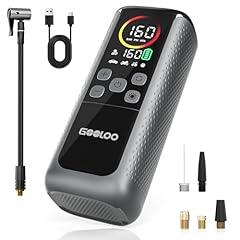
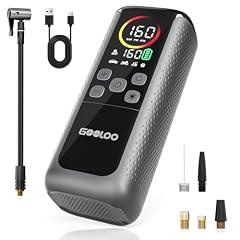
The GOOLOO GT160 Dual is a cordless, dual-cylinder tire inflator with a rechargeable 37 Wh lithium-polymer battery, digital preset pressure control, automatic shut-off, USB power-bank output, LED light, carry bag, and multiple inflation adapters. It is intended mainly for routine inflation of car, motorcycle, bicycle, and sports-equipment valves, rather than continuous compressor work. The manufacturer states a 4 to 160 PSI range, ±1 PSI sensor accuracy, 25-minute runtime, and 10,000 mAh battery. An independent editorial test of this exact product measured a small car-tire pressure increase in roughly 55 seconds, slower than the brand's advertised 27-second scenario but still practical for top-offs. The available independent coverage confirms basic real-world operation, but does not provide calibrated gauge testing, a documented thermal duty-cycle protocol, or a safety-lab report.
What works
- Independent editorial testing found it completed a small car-tire pressure increase in about 55 seconds.
- The 4 to 160 PSI stated range, preset targets, and automatic shut-off support routine top-offs when the vehicle placard pressure is used.
- Cordless operation, compact sub-1 kg weight, carrying case, light, and adapters make it suitable for storage in a vehicle emergency kit.
- The manufacturer provides a model-specific product page, support channel, money-back period, and stated warranty coverage.
What does not
- Pressure accuracy is manufacturer-stated at ±1 PSI, not independently verified against a calibrated reference gauge.
- No public UL, ETL, CSA, or other OSHA-recognized certification record for this exact finished product was located.
- The short hose is a practical limitation. Independent reviewers found that some wheel positions may require holding the unit during inflation.
- The internal lithium battery has no located user-replacement instructions, spare-battery listing, take-back program, or product-specific recycling guidance.
- The fast-inflation marketing is condition-sensitive. One editorial test took about twice the brand's claimed 27-second interval for a comparable small top-off.
Who is it for
This product suits a driver, motorcyclist, or cyclist who wants a rechargeable inflator for periodic pressure checks and modest top-offs away from an outlet. It is especially relevant for people who can store it charged in a trunk, saddlebag, or roadside kit and who will set pressure from their vehicle's Tire and Loading Information placard. The compact format, automatic shut-off, adapters, and light are useful for occasional maintenance and minor roadside needs. Check pressure afterward with a separate quality gauge if precise adjustment matters.
Who is it not for
It is not the right tool for fleet work, repeated all-day use, commercial tire service, or regularly inflating large truck, RV, or off-road tires from very low pressure. The short hose can force the user to hold the product at some wheel positions, and the published evidence does not establish a rigorous heat-management duty cycle for prolonged use. It also does not suit buyers who require independently certified electrical safety, a removable battery, a public battery test summary, or independently calibrated pressure accuracy.
Integrity
The product uses a sealed rechargeable lithium-polymer battery and USB-C charging, avoiding disposable batteries but creating an end-of-life battery-recycling responsibility. EPA guidance is to keep lithium-ion batteries out of household trash and recycle them through an appropriate battery collection program. No product-specific battery removal procedure, replacement battery, parts catalogue, or take-back pathway was located, so the battery may limit the service life of an otherwise functional inflator. The manufacturer states overload and overheat protections, an operating range of -20°C to 60°C, and automatic pressure shut-off. Those safeguards have not been independently safety-certified in a public UL, ETL, or CSA record for this exact product. Searches of U.S. CPSC recall resources did not identify a recall or product-safety warning for this model as of August 16, 2026. The product is rated near 80 dB, so avoid prolonged close-range operation and allow it to cool if it becomes hot.

Airmoto Portable Tire Inflator Compressor
Overview
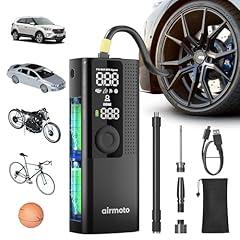
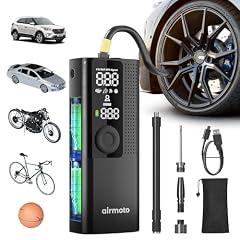
This is a compact, rechargeable cordless tire inflator with a screw-on Schrader hose, plus Presta, needle, and general-purpose adapters. The manufacturer lists a 120 PSI maximum, 2,000 mAh battery, USB charging, LED light, and preset automatic shut-off. Its manual identifies a 7.2 V, 14.4 Wh battery system, 20 L/min no-load flow, and a stated gauge accuracy of plus or minus 1 PSI. Independent bench testing on the exact product found a 4 minute 35 second median fill from 28 to 36 PSI in a 205/55R16 tire, four such top-ups per charge, and functioning auto-stop. The same test found up to plus or minus 2 PSI gauge deviation. That means it is a compact source of air for modest top-ups, but its displayed pressure should be checked against the vehicle placard target with a separate gauge.
What works
- Independent testing confirmed it completed four 28 to 36 PSI passenger-tire top-ups per charge.
- Independent testing found the preset auto-stop operated, within the unit's own gauge tolerance.
- The included screw-on chuck and supplied adapters sealed cleanly in an exact-model bench test.
- The manufacturer provides a named product model, support phone and email, a 90-day return policy, and a one-year warranty.
What does not
- Independent testing found gauge deviation up to plus or minus 2 PSI, while the manual states plus or minus 1 PSI accuracy.
- The manufacturer gives inconsistent charging claims, under one hour in product copy but two to three hours in its FAQ.
- Vehicle compatibility language is broad, yet the manufacturer excludes heavy-load tires and independent testing could not build pressure in a truck tire.
- No public NRTL listing for the finished product, battery pack, or supplied charger was located during verification.
- The battery is built in and not user-replaceable, with no verified spare-parts or take-back program located.
Who is it for
This product suits someone who wants a small cordless unit for occasional cold-pressure top-ups on a motorcycle, bicycle, ATV, or passenger car, and can keep it charged between uses. It is most appropriate where adding a few PSI is the normal task, not recovering from a fully flat tire. The buyer should set pressure from the vehicle's Tire and Loading Information placard, then verify the final cold pressure with a separate reliable tire gauge because the product's measured gauge error can reach 2 PSI.
Who is it not for
It is not suited to people who need dependable inflation of truck, large SUV, trailer, RV, or heavily loaded tires. The product's own guidance limits heavy-load use, and an independent truck-tire test did not build pressure after six minutes. It is also not suitable where exact pressure is safety-critical and no second gauge is available, including users setting a narrow motorcycle pressure target. Buyers requiring publicly verifiable electrical certification, replaceable batteries, or published service parts should choose a product with that documentation.
Integrity
Pressure control is the central safety issue. The manual instructs users to avoid prolonged contact with the hose and joints because they can become hot during extended operation. Independent testing also reported warming after consecutive tires. Use the vehicle maker's cold-pressure placard, not the pressure molded on the tire sidewall, and confirm the final result with a separate gauge because the product's measured display error reached plus or minus 2 PSI. The manual describes over-current and over-discharge protection, but no public UL, ETL, or CSA certification record was located for the finished inflator, its battery pack, or its supplied charger. No U.S. recall or regulator warning was identified in the public checks performed. The built-in battery is not replaceable, which increases end-of-life waste. Do not put the product in household trash or curbside recycling. EPA guidance directs consumers to battery or electronics collection programs for lithium-ion devices.

Powools Portable Air Compressor Tire Inflator
Overview
This is a small cordless tire inflator with an internal rechargeable lithium-ion battery, a digital display, a screw-on hose, LED light, USB-C charging, and adapters for Presta valves and balls. It is intended for topping up car, motorcycle and bicycle tires, plus small inflatables. The available product documentation states that it stops at a selected preset pressure, and its safety instructions say to secure both hose ends before use. The evidence is mostly manufacturer-supplied. A manual linked from the retailer specifies a pressure-measurement accuracy of plus or minus 1 PSI, but labels the unit with a different product designation and lists 60 W, three 2,500 mAh cells, and a 160 PSI range. Those specifications conflict with the advertised 50 W, two-cell, 150 PSI description. No model-specific independent gauge comparison, tire-fill test, or public electrical-safety certification record was located.
What works
- Manufacturer documentation describes selectable presets, live pressure display, and automatic shut-off at the chosen pressure.
- The manual gives practical connection guidance, including screw-fitting the hose and checking both ends before inflation.
- A 1-year manufacturer warranty and a support email are stated in the available manual.
- The manual limits use to tires at 50 PSI or below and 245 mm width or below, which helps define a basic passenger-tire use case.
What does not
- Pressure accuracy and auto-stop have not been independently tested for this product. Verify final cold pressure with a separate reliable gauge.
- No public UL, ETL, CSA, battery-pack, or transport-test record was located for the finished product.
- No independent, model-specific test was located for tire-fill speed, runtime, heat buildup, or cooldown behavior.
- The linked manual conflicts with the advertised battery count, wattage, and maximum-pressure specifications, reducing confidence in the claim details.
- The manual says to remove the battery before disposal but also says not to disassemble or repair the unit, with no battery-removal procedure or spare-parts program.
Who is it for
This suits a driver, cyclist, or motorcyclist who wants a compact cordless tool for occasional top-ups on smaller passenger-car tires, bicycle tires, motorcycle tires, or balls. It is most appropriate when the user knows the vehicle door-placard cold-pressure target, keeps the task within the manual's stated 50 PSI and 245 mm tire limits, and confirms the final result using a separate tire gauge. The supplied hose and adapters make it more practical for mixed household uses than a tire-only inflator.
Who is it not for
It is not appropriate for trucks, vans, buses, trailers, off-road tires, or tires above 50 PSI or wider than 245 mm, because the available manual expressly excludes those uses. It also is not a good fit for users who need demonstrated emergency reliability, a published continuous-duty rating, verified rapid inflation, or independently certified electrical safety. Do not rely on its display alone for a safety-critical pressure adjustment, especially before highway driving. Use a separate gauge and follow the vehicle placard pressure, measured cold.
Integrity
The available manual includes useful precautions. It tells users not to charge while inflating, not to leave the device running unattended, to keep it dry, to use a suitable USB power adapter, and to avoid touching the hose or joint after use because they can become hot. It also says the unit automatically stops after three minutes without operation. These are manufacturer instructions, not independently validated safety findings. The product contains rechargeable lithium-ion cells. The manual says the battery should be removed before disposal and recycled under local rules, but it gives no removal instructions while also warning against disassembly. No maker take-back program, replacement battery option, or public certification record for the complete electrical product was located. EPA guidance says lithium-ion batteries and battery-containing devices should not enter household trash or curbside recycling because they can create fire risks.
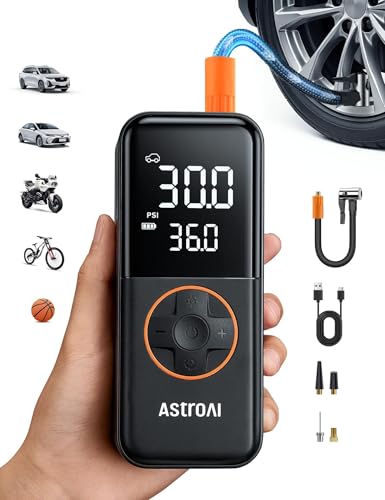
AstroAI L4 Portable Tire Inflator
Overview
This is a compact, rechargeable handheld tire inflator for routine pressure checks and top-offs on car, motorcycle, bicycle, and ball valves. Its manual lists a 150 PSI maximum working pressure, 19 L/min claimed inflation speed, three 2,200 mAh lithium battery cells, a 30 cm hose, USB-C charging, a light, and a USB output port. The pressure preset stops automatically, and one disclosed hands-on review found its readings stayed within 1 PSI of a separate manual gauge during repeated bike-tire tests. A separate field review ran it for about 20 minutes while filling motorcycle, SUV, and sedan tires from very low pressures. That same test found the SUV job strained the small compressor and battery, and the hose connector became hot after extended use. No public listing was found for independent electrical-safety certification of this finished product.
What works
- Hands-on testing found the automatic preset and displayed pressure stayed within 1 PSI of a separate gauge.
- A field test documented about 20 minutes of battery-powered inflation across several tire types.
- The manual specifies useful included adapters for Schrader, Presta, ball, and general inflatable use.
- The product has identifiable model information, a stated two-year limited warranty, and published support contact details.
What does not
- No public UL, ETL, CSA, or other NRTL certification record was located for the finished rechargeable inflator.
- The internal battery is not designed for consumer replacement, which limits repair and long-term service life.
- Extended inflation can heat the hose connector, and testing showed a near-flat SUV tire was demanding for the compressor and battery.
- The manual advises waiting for the unit to cool after continuous use, but does not provide a numeric duty cycle or cooldown interval.
Who is it for
This product suits a driver, rider, or cyclist who wants a small rechargeable tool for checking and correcting modest pressure loss, rather than regularly inflating large tires from flat. It is particularly practical for a car trunk, motorcycle luggage, or bike-trip kit because it includes a storage bag and valve adapters. Use the cold pressure printed on the vehicle Tire and Loading Information placard or in the owner’s manual, not the pressure molded into the tire sidewall, as the target setting.
Who is it not for
It is not suited to workshop-style use, repeated fleet service, bead seating, or frequent recovery of large SUV, truck, or trailer tires from very low pressure. Independent field testing found a near-flat SUV particularly demanding and depleted the battery after several substantial fills. It is also a poor fit for households that require a publicly verifiable electrical-safety certification, a replaceable battery, or a product with detailed published duty-cycle and charging-safety documentation. Do not use it unattended while charging or inflating.
Integrity
The key safety benefit is pressure control, not high output. Independent hands-on checks support the preset shut-off and gauge being close to a separate gauge, while another field test confirms the product can restore low tire pressure on its battery. Its manual also warns that continuous use heats the pump and instructs users to let it cool before using it again. The connector may become hot after longer inflation sessions. The battery is a built-in lithium pack, listed as three 2,200 mAh cells. The manual gives basic storage and local-recycling advice, but no battery-removal procedure, spare battery program, or detailed take-back route was found. No recall for this inflator was located. AstroAI did recall a different mini-fridge product in June 2025 for a short-circuit fire and burn hazard, which does not establish a defect in this inflator but makes model-specific verification important.