
10 Best Smart Locks for Home
 Daniel Kenitz
Please note that we participate in affiliate marketing programs. When you purchase through links on our site, we may earn a commission. As an Amazon Associate we earn from qualifying purchases. This comes at no additional cost to you and helps support the resources required to provide valuable content.Advertising Disclosure
Top-rated Smart Locks for Home Comparison
1

2
4
5
6
7
8
9
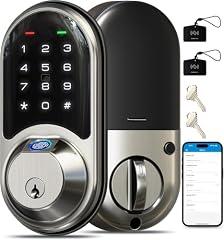
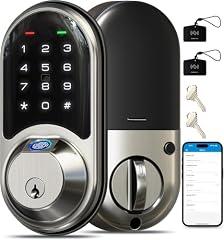
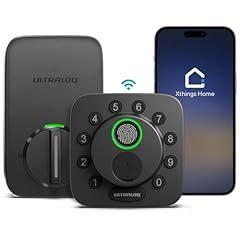
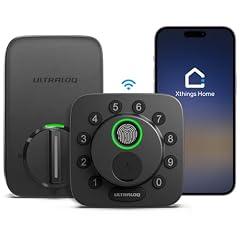
Smart locks for home: what to look for
A smart lock replaces or supplements a conventional deadbolt with electronic ways to unlock: a keypad, fingerprint reader, phone app, key fob, NFC credential, voice assistant, or connected-home platform. The useful question is not how many methods are advertised, but whether the lock remains safe and usable when a phone, battery, fingerprint reader, internet connection, account, or cloud service fails.
Start with the door. Check thickness, bore size, backset, handing, latch depth, strike alignment, and whether the door is single-cylinder, mortise, multipoint, sliding, or part of a fire-rated assembly. Supplied products commonly specify door ranges such as 35–55 mm or 1-3/8–1-3/4 inches and backsets of 60 or 70 mm. A motorized lock cannot compensate for a dragging door, weak frame, poor strike installation, or incorrect screws. Installation instructions should explain reinforcement, clearance, calibration, and testing with the door open.
Safe exit is more important than remote convenience. Look for a manual interior thumbturn or thumb latch that works without power, an app, a code, or an account. For outside recovery after a dead battery, prefer clearly documented mechanical keys and, where provided, temporary USB or 9V emergency power. Low-battery warnings and a specific replacement procedure matter. A lock that depends on a rechargeable pack, gateway, cloud service, or fingerprint reader should still have a practical non-electronic fallback.
Security grades and weather claims need traceable proof. An ANSI/BHMA Grade 1, 2, or 3 statement is not the same as an exact-model listing in the BHMA Certified Products Directory or a named independent forced-entry and durability test. Similarly, IP54, IP65, or a temperature range should be supported by exact-model documentation and, where claimed, an accredited test record. Radio approval from the FCC confirms radio compliance; it does not prove resistance to drilling, picking, burglary, weather, or cyberattack.
For connected locks, check whether Wi-Fi is built in or requires a bridge, whether local Bluetooth or keypad operation continues without internet, and which functions stop during an app or cloud outage. Matter or Thread claims should be checked in the Connectivity Standards Alliance directory; Apple Home, Alexa, and Google compatibility should be confirmed for the exact model. A credible security case also includes encrypted authenticated communications, account recovery and revocation controls, vulnerability reporting, firmware history, and a defined support period not simply language such as “hack-proof.”
Fingerprint and other biometric features add privacy questions. Look for clear statements about where templates are stored, how long they are retained, how they are deleted, and how guest access is revoked. App-store privacy disclosures may conflict with the manufacturer’s policy, and a claim that data is stored locally is still a manufacturer statement unless independently assessed. Entry logs, guest codes, identifiers, location data, and camera or doorbell footage can also become part of the household’s data footprint.
The supplied reviews reveal recurring cautions. Several products lack exact-model BHMA proof, independent forced-entry testing, NRTL electrical listings, cybersecurity certification, or defined firmware support. Battery and weather documentation sometimes conflicts, and one product warns that cold can prevent keypad entry. Remote access repeatedly depends on an app, account, gateway, internet, or cloud service. Fingerprint-template retention is often unclear. No supplied product should be assumed suitable for a fire door or code-controlled egress opening without confirmation, and no electronic method should be the only plan when occupants cannot use a key or manual interior release.
Integrity
For this category, health and environmental quality depends on more than electronic features. A sound choice preserves manual exit, offers recoverable backup entry, fits the door without weakening it, limits data exposure, and avoids unnecessary battery and hardware waste. The scores below compare the supplied products only; they are not certifications.
HHealth & Safety
Safe exit and backup entry
This measures whether occupants can leave manually and regain entry after battery, phone, network, account, or biometric failure. For a lock, an interior thumbturn or latch plus a physical key is stronger than app-only access; documented USB, 5V, or 9V emergency power adds recovery options. Supplied scores range from 76 to 82, with the higher-scoring products documenting several independent fallbacks.
Battery and electrical safety
This covers battery type, replacement, leakage and overheating precautions, charging, and electrical-failure behavior. Replaceable AA cells can be practical, while rechargeable products need clear charging and replacement instructions. Among these products, scores run from 70 to 77. Higher-scoring reviews generally specify approved batteries and emergency procedures; lower-scoring ones have conflicting battery counts or no publicly located NRTL listing for the lock or charger.
Privacy of entry and fingerprint data
This measures control over fingerprints, access logs, guest details, identifiers, location, and account data. A strong product explains local storage or protected transmission, retention, deletion, and guest revocation. Scores range from 55 to 78. The higher-scoring products include clearer local-storage or deletion controls, while lower scores reflect conflicting app disclosures or missing fingerprint-template retention and deletion details.
Works when conditions are imperfect
This measures operation during low battery, lost internet, app or cloud outages, weather exposure, door misalignment, and fingerprint failure. Local keypad, key, thumbturn, and status feedback matter more than remote features during an emergency. Supplied scores range from 54 to 82. Higher-scoring products document offline access and recovery behavior; lower scores reflect contradictory battery or door-status instructions and greater dependence on connected services.
Fits the door without creating a weak point
This covers door thickness, bore, backset, handing, latch and strike requirements, alignment, and fire-door or weather limits. A high score means the instructions allow a buyer to screen the installation before relying on the lock. Scores range from 72 to 80. The stronger products provide concrete measurements and calibration checks; weaker evidence leaves fire-door suitability, reinforcement, or unusual-door compatibility unresolved.
EEvidence
Resistance to break-in and wear
This measures independently demonstrated resistance to forced entry, drilling, picking, bolt or strike failure, and operating wear. The important distinction is an exact-model BHMA record or named independent test, not a retailer or manufacturer grade claim. Scores range from 68 to 78, but the reviews repeatedly say public exact-model certification or forced-entry results were not found, so a higher score does not prove burglary resistance.
Protection from digital break-ins
This covers remote, Bluetooth, keypad, biometric, guest-code, and account controls, including encryption, recovery, revocation, vulnerability response, and firmware handling. Scores range from 68 to 82. Higher-scoring products have stronger documented or traceable security and interoperability evidence, but the reviews still commonly found no exact-model ioXt or accredited cybersecurity certification, public penetration test, or defined update commitment.
Long-term support and dependable compatibility
This measures whether app, Wi-Fi, Bluetooth, Matter, Thread, voice, and bridge features are certified and likely to remain usable. Check the Connectivity Standards Alliance, Apple, Alexa, and Google listings for the exact model, plus firmware and end-of-support policies. Scores range from 68 to 82. Higher scores reflect verified platform records or published updates; lower scores reflect gateway dependence or unspecified support duration.
Claims match what the lock actually does
This tests whether battery life, grades, weather ratings, remote functions, subscription needs, biometric performance, and compatibility are specific and qualified. Scores range from 52 to 78. Higher-scoring products align their listings with manuals and disclose dependencies; lower-scoring examples contain conflicting battery, IP, connectivity, Matter, or door-status claims. A headline such as “Grade 1,” “IP65,” or “remote” is not enough by itself.
Proof beyond the brand's own word
This measures exact-model traceability across mechanical, electrical, radio, cybersecurity, compatibility, and environmental claims. Relevant records include BHMA, UL or another OSHA-recognized NRTL, FCC authorization, the Connectivity Standards Alliance, ioXt, and named independent laboratory reports. Scores range from 68 to 81. The strongest supplied evidence includes exact FCC or CSA records and, in one case, independent testing; many important security and durability claims remain unverified.
EEcology
Lower waste over the lock's life
This measures replaceable batteries and parts, repairability, software longevity, and end-of-life guidance. Replaceable AA cells avoid discarding a sealed rechargeable pack, while a removable rechargeable pack can reduce disposable-cell use but still needs a replacement and recycling path. Scores range from 69 to 76. Higher-scoring reviews note replaceable power systems; nearly all still lack a clear parts catalog, take-back program, or product-specific recycling instructions.
Full reviews
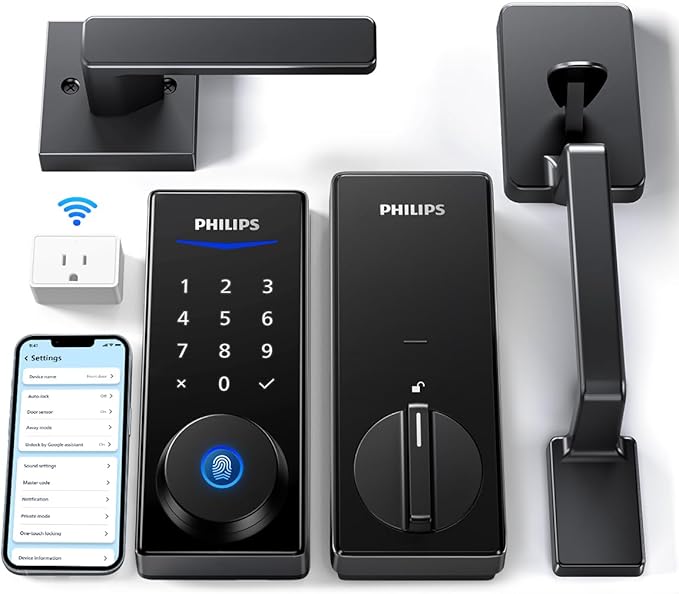
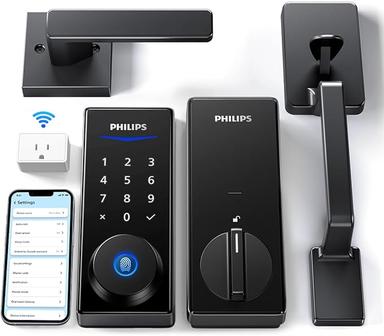
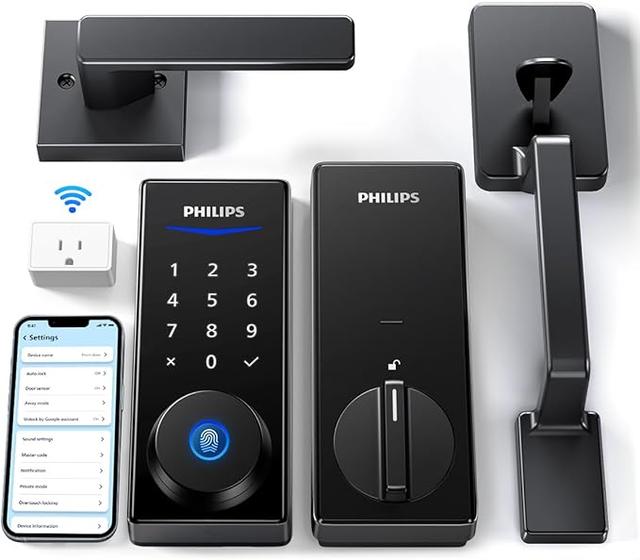
Philips Wi-Fi Smart Lock with Handle
Overview
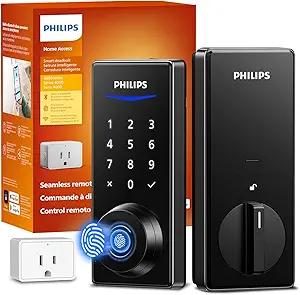
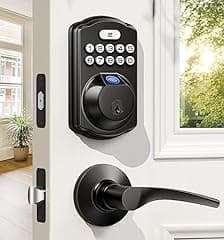
This product is a matte-black residential deadbolt and handleset bundle that uses four replaceable AA alkaline batteries. It provides fingerprint, PIN, mechanical-key, Bluetooth-app, and, through the included Wi-Fi bridge, remote app access. Philips states that it can store 50 fingerprints, 100 user PINs, and one-time guest codes, with a door-position sensor for auto-locking. The strongest practical safety feature is not digital. The closely related manufacturer manual documents an indoor thumb turn and two mechanical keys, so exit and backup entry do not depend on an app or network. Philips also provides specific fitting limits, including 1-3/8 to 2-inch door thickness, 2-3/8 or 2-3/4-inch backset, and two common bore sizes. Public evidence did not confirm an exact-product BHMA listing, NRTL electrical listing, cybersecurity certification, IP rating, or fire-door listing.
What works
- Indoor thumb-turn exit and mechanical-key entry remain available without the app or Wi-Fi bridge.
- Four AA alkaline batteries are user-replaceable, and the manual warns against rechargeables and mixing old with new batteries.
- The manufacturer gives concrete door-thickness, bore-hole, backset, handing, temperature, and humidity limits.
- Remote guest-code scheduling, activity records, and auto-lock are documented manufacturer functions when the bridge and app are configured.
What does not
- No public exact-product record was found for BHMA certification, despite Grade 2 language appearing for related 4000-series variants.
- No public exact-product NRTL electrical-safety listing, IP rating, fire-door listing, or accredited cybersecurity certification was identified.
- The lock has no emergency external power connection. A depleted battery therefore makes the mechanical key especially important for re-entry.
- Remote control, alerts, voice functions, and account-based guest management depend on the bridge, home network, cloud app, and account. Public app reviews report some login and pairing problems, though these do not remove thumb-turn exit or key access.
Who is it for
This product suits a household with a conventional outward-facing residential door that already has a compatible deadbolt bore and backset, and that wants a matching handleset rather than a deadbolt alone. It is particularly practical for residents who want local fingerprint or PIN access while retaining keys, and for hosts who can use scheduled or one-time codes through the bridge. The buyer should be comfortable maintaining four AA alkaline batteries, keeping spare keys accessible, and checking the door alignment during installation.
Who is it not for
It is not suited to a fire-rated door, a required egress door, or a door exposed to harsh weather unless the installer confirms that the complete door assembly remains code-compliant. Do not rely on remote unlocking as the sole access plan, because the product has no external emergency power and remote functions require the bridge, network, and account. It is also a poor fit for households needing independently verified Grade 1 or exact-model Grade 2 burglary performance, formal cybersecurity certification, or a documented long-term firmware-support commitment.
Integrity
For household safety, the useful resilience features are physical rather than cloud-based. The manufacturer manual documents a thumb turn for indoor unlocking, mechanical keys for outside entry, low-battery warnings, and instructions to use four new AA alkaline batteries. It also tells users not to use rechargeable batteries or mix batteries. The installation materials include an optional strike reinforcement plate, but correct screw selection, frame condition, latch alignment, and local code compliance remain essential. The product uses replaceable disposable cells rather than a sealed rechargeable pack, which can reduce premature electronic waste when batteries wear out. Philips provides a two-year warranty for electronic components and lifetime coverage for mechanical components and finish for the original resident at the original installation address. The manual asks users to follow local rules rather than discard used batteries with ordinary household waste. No independent environmental certification, recycled-content claim, repair-parts catalogue, or product-specific end-of-life recycling program was found.
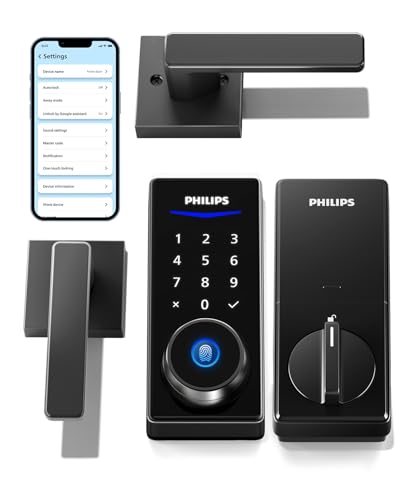
Philips Smart Lock with Handles
Overview
This product is a matte-black smart deadbolt and lever-handle set for a residential entry door. It uses four AA alkaline batteries and offers fingerprint, PIN, mechanical-key and Bluetooth app unlocking. The supplied product documentation confirms an inside thumb turn for manual exit, plus mechanical-key entry if the app, phone or fingerprint method is unavailable. Philips states that the deadbolt core is aluminum alloy, fits doors 1-3/8 to 2 inches thick, and accepts common 2-3/8 or 2-3/4 inch backsets. The manual documents up to 50 stored fingerprints, 100 user PINs, timed auto-lock settings, and optional remote functions through a separately sold Wi-Fi bridge. FCC Part 15 language and an associated radio authorization record were located, but no public exact-model BHMA durability certification, NRTL electrical listing, IP rating, or independent cybersecurity assessment was found.
What works
- A physical thumb turn provides direct inside unlocking without power, an app, a code, or a fingerprint.
- Mechanical keys provide a practical outside backup when batteries, Bluetooth, phone access, or fingerprint recognition fail.
- The manual gives specific battery precautions, low-battery replacement steps, factory-reset instructions, and disposal guidance.
- Door thickness, bore-hole, backset, handing, strike hardware, and alignment requirements are documented in the installation material.
- The deadbolt core has an associated FCC radio authorization record, and the manual includes FCC Part 15 operating information.
What does not
- No public exact-model BHMA certification or named independent forced-entry and durability test report was located. This is missing proof, not evidence that the bolt fails a security test.
- No public exact-model UL, ETL, or other NRTL electrical-safety listing was located. The battery guidance is detailed, but independent electrical listing evidence is absent.
- The manual states that emergency external powering is not supported. Keep the two mechanical keys accessible outside the home and replace low batteries promptly.
- The manufacturer makes broad claims about enhanced encryption and local storage, but public technical detail, independent cybersecurity certification, firmware-support duration, and product-specific security release notes were not found.
- The app privacy policy describes collection of device, usage, IP, diagnostic, and possible location data. Its app-store disclosures are more limited, so data handling and biometric storage details are not fully transparent.
Who is it for
This product suits a household using a standard-prepared, non-fire-rated residential entry door that wants several local entry options without relying solely on a phone. It is particularly practical for residents who can keep a backup key somewhere safely accessible, want direct thumb-turn exit from indoors, and value local PIN and fingerprint access. It also fits users prepared to maintain four AA alkaline batteries, test latch alignment after installation, and treat app access as a convenience layer rather than the only entry plan.
Who is it not for
It is not suited to any door that must retain a verified fire-door hardware listing, or to installations where the local code, landlord, or door manufacturer requires listed hardware. It also is a poor fit for households that cannot maintain an off-site mechanical key, because the product has no emergency external power connection. Buyers needing independently demonstrated ANSI/BHMA break-in performance, an IP weather rating, a published firmware-security support period, or independently assessed Bluetooth and biometric security need documentation that was not located for this product.
Integrity
The core safety advantage is straightforward emergency operation. The documented interior thumb turn allows exit without electronics, while mechanical keys provide a non-electronic re-entry route. The manual also requires AA alkaline batteries, warns against mixing old and new cells or battery types, and cautions against short circuits, fire exposure, water splashing, and non-approved parts. Low-battery alerts remain audible even when keypad sounds are muted. From a waste perspective, the use of user-replaceable AA batteries avoids a sealed rechargeable pack. The manufacturer instructs owners not to discard used batteries or the product with normal household waste, and states a two-year warranty for defects in materials and workmanship. No independent environmental certification, recycled-content claim, public spare-parts catalog, or detailed repair pathway was found. The manual directs replacement-component work to Philips, an authorized center, or a professional technician.

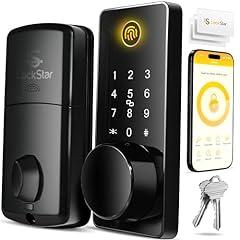
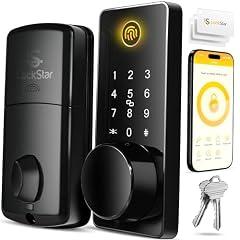
LOCKSTAR Smart Door Lock Keyless Deadbolt
Overview
This is a zinc-bodied electronic deadbolt for residential doors, with keypad, fingerprint reader, key fobs, a concealed mechanical key cylinder, app control and an included gateway for remote features. Its installation manual specifies four AA batteries, doors 1.5 to 1.9 inches thick, at least 4.3 inches wide, and a 60 mm or 70 mm adjustable backset. The most useful resilience feature is the manufacturer-documented physical key, keypad and fob access, alongside the interior lock body and knob. The exact radio design has an FCC equipment authorization for 13.56 MHz and 2.402 to 2.480 GHz operation. That confirms U.S. radio compliance, not resistance to forced entry, cybersecurity quality or fire-door suitability. No exact-model BHMA grade, UL or ETL safety listing, IP weather rating, independent attack test, or public cybersecurity certification was located.
What works
- Several local entry paths are documented, including a physical key, keypad and key fob, so app access is not the only route in.
- The manual specifies common replaceable AA batteries rather than a sealed rechargeable pack.
- Door thickness, minimum door width and adjustable 60 mm or 70 mm backset are stated in the installation instructions.
- The radio hardware has an FCC authorization covering NFC at 13.56 MHz and 2.4 GHz low-power communications.
- A two-year warranty is manufacturer-stated, subject to registration within 14 days of purchase.
What does not
- No exact-model ANSI/BHMA certification, independent forced-entry test, or published durability grade was found. This leaves break-in and wear resistance unproven.
- No exact-model UL or ETL electrical-safety listing, fire-door listing, or published weather protection rating was found.
- The available manual does not provide a clear low-battery warning threshold, emergency external-power procedure, operating-temperature range, or outage procedure.
- No security white paper, vulnerability-disclosure process, encryption details, firmware-support commitment, or third-party IoT security certification was located.
- Privacy disclosures need clarification. Google Play says no data are collected, while Apple lists a user identifier linked to identity for app functionality.
Who is it for
This product suits a homeowner or small rental host with a standard, non-fire-rated residential door that is 1.5 to 1.9 inches thick and accepts a 60 mm or 70 mm deadbolt backset. It is most practical for households wanting several everyday local entry methods, including PIN, fob, fingerprint and a physical key, while using the gateway and app as conveniences rather than the only way to regain access. Installation should include careful strike alignment and repeated testing of the indoor knob and mechanical key.
Who is it not for
It is not well suited to a fire-rated door, a door governed by a building or association rule requiring listed hardware, or any installation needing documented ANSI/BHMA forced-entry performance. It also does not fit households that require a published low-battery emergency plan, confirmed weather rating, formal cybersecurity certification, or a defined long-term firmware-support policy. People uncomfortable storing biometric templates or relying on an app whose cross-platform privacy disclosures are not fully consistent should avoid fingerprint enrollment and seek clearer data controls.
Integrity
The product uses four replaceable AA batteries, which avoids a sealed battery pack and permits routine replacement without discarding the lock. The installation manual identifies zinc as the housing material and documents silicone gaskets, but no recycled-content claim, repair-parts program, electronics take-back program, battery-recycling instructions, or independent environmental certification was located. Spent AA batteries should be handled through local battery collection guidance rather than household recycling where required. For household safety, the manual documents a physical key and an indoor lock body with a knob, plus keypad and fob access. The radio section has an FCC authorization for the identified Lockstar smart-lock model, which addresses lawful radio operation in the United States. It is not an electrical-safety, fire-door, forced-entry, weatherproofing, or cybersecurity certification. No product-specific CPSC recall or public safety warning was located in the verification work.

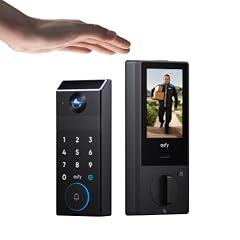
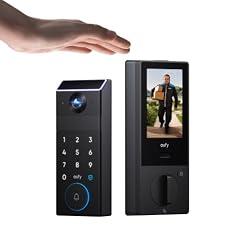
Eufy Security FamiLock S3 Max Smart Lock
Overview
This product is an aluminum, motorized exterior deadbolt that combines palm-vein unlocking, a keypad, physical keys, app and voice controls, a 2K doorbell camera, and a 4-inch interior video screen. It uses a removable 15,000mAh rechargeable battery plus four AAA backup batteries. The manufacturer specifies standard-door compatibility for 35 to 55 mm thicknesses and says a storm door can obstruct the camera view. The most important independently confirmed feature is Matter certification from the Connectivity Standards Alliance for this exact product. eufy also states that Matter does not carry the camera stream, so video functions remain dependent on the eufy app. The brand documents physical-key and emergency-power access, plus a low-power backup mode, but its Grade 1 and IP65 claims were not matched here to a public exact-model BHMA or ingress-test certificate.
What works
- Matter interoperability is independently listed by the Connectivity Standards Alliance for this exact product.
- Manufacturer documentation provides several fallback routes, including physical keys, external emergency power, AAA backup batteries, and PIN operation in low-power conditions.
- The 4-inch inside screen can show the front-door view without requiring a phone, according to the manufacturer.
- The manufacturer publishes concrete operating constraints for palm recognition, including sensitivity to direct light, contaminants, posture, and young children's smaller palms.
- eufy publishes a vulnerability-reporting process with stated triage and remediation targets, including over-the-air fixes.
What does not
- The manufacturer claims ANSI/BHMA Grade 1 and IP65 protection, but this review did not locate a public exact-product certificate in the relevant BHMA or ingress-test registries.
- Palm-vein unlocking is not a universal fallback. eufy says it is disabled in AAA backup mode and can be less reliable in direct light, with dirty hands, or for children under seven.
- The stated battery-life figure is conditional. A support article estimates about four months at ten unlocks per day, while the product page states up to five months.
- The product has a large rechargeable lithium battery, yet no public electrical-safety listing for the exact lock, battery pack, charger, or charging dock was identified in the checked NRTL directories.
- Matter support is narrower than the broad compatibility language may suggest, because camera streams are not available through Matter.
Who is it for
This product suits a household using a conventional, outward-facing residential entry door within the stated 35 to 55 mm thickness range, especially where several people need different local ways to enter. It is particularly relevant for users who value key backup, a PIN, and an interior screen alongside app controls. It also fits homes already using a compatible Matter platform, provided they accept that camera viewing and the fuller feature set remain centered on the eufy app rather than Matter.
Who is it not for
It is not well suited to doors with a storm door directly in front, or to nonstandard doors that fall outside the stated thickness range without a careful compatibility check. Households that need the camera feed in Apple Home, Google Home, Alexa, or Matter should not assume that feature is available. It is also a poor fit where children under seven must depend on palm entry, where strong direct light reaches the sensor, or where residents cannot reliably keep a physical key and emergency-power option available.
Integrity
The main safety positive is the documented fallback design. eufy says a physical key and emergency-power port remain usable when the main battery is depleted, while the four AAA batteries can run the product in reduced-power mode. The company also advises charging only through its specified method and using approved replacement lithium batteries. The backup mode disables the power-intensive palm scanner and camera, so it should be treated as access continuity rather than full security-camera continuity. Palm-vein templates are stated to stay locally on the product and not upload to the cloud. The broader privacy notice still covers account, device, network, event, and diagnostic data, while voluntary experience-improvement enrollment may collect camera footage and sensor triggers. The removable main battery and replaceable AAA cells are better for serviceability than a fully sealed power system, but no product-specific battery recycling or end-of-life electronics guidance was identified. No product-specific CPSC recall or safety warning was identified in the checks performed.
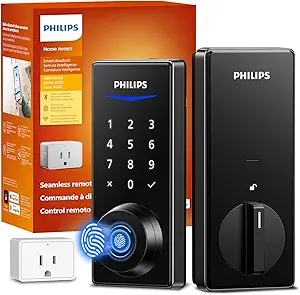
Philips Wi-Fi Smart Door Lock with App Control
Overview
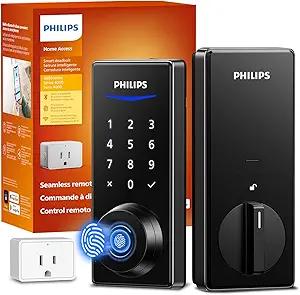
This is an aluminum-alloy touchscreen deadbolt for a standard residential door, supplied in the listed configuration with a Wi-Fi bridge. The lock itself uses Bluetooth, while the bridge enables remote access, real-time activity updates, voice-assistant links, and remote PIN management. It accepts up to 50 fingerprints and 100 user PINs, alongside a mechanical key. The strongest documented safety fallback is mechanical. The current manufacturer manual specifies an interior thumb turn for exit, and external entry by physical key, PIN, fingerprint, or app. It runs on four replaceable AA alkaline batteries, with low-battery warnings and instructions to replace the full set. The manufacturer provides detailed dimensional installation instructions, but no exact-model public BHMA certificate, NRTL safety listing, IP rating, operating-temperature range, or independent forced-entry report was located. The retail weatherproof and rapid fingerprint claims were not substantiated in the current official product documentation.
What works
- An interior thumb turn provides exit without an app, account, network, fingerprint, or battery power.
- A mechanical key provides a practical outside-entry fallback if batteries, phone access, or fingerprint recognition fail.
- The official manual gives specific door thickness, bore-hole, backset, strike-depth, alignment, and installation checks.
- Four standard AA alkaline batteries are replaceable, and the manual gives warnings against mixed, damaged, or rechargeable batteries.
- Fingerprints and user PINs can be deleted from the lock itself, without relying solely on the app.
What does not
- No exact-model BHMA directory certification, independent attack test, or public NRTL electrical-safety listing was found. This is missing verification, not evidence of a defect.
- The retail listing calls the product weatherproof, but the current official materials found do not state an IP rating, operating-temperature range, or exact weather test.
- The official privacy policy says the service may collect lock passwords, access logs, guest information, device data, and potentially location data. This conflicts with the app store's developer data-safety declaration of no data collected.
- No public firmware-security-update commitment, end-of-support date, vulnerability-disclosure policy, or exact-model cybersecurity certification was located.
- Remote controls and live activity updates depend on the bridge, home network, app account, and supported cloud service.
Who is it for
This product suits a household with a conventional single-cylinder exterior door that measures within the stated 1-3/8 to 2 inch thickness range and has a standard 2-3/8 or 2-3/4 inch backset. It is especially relevant where several residents, guests, or service workers need distinct PINs, while the household still wants a physical-key fallback. It also fits people who want local daily entry by key, PIN, or fingerprint rather than making remote control the only way to enter.
Who is it not for
It is not well matched to a fire-door assembly or any door where the hardware must carry a documented fire-door listing, because no such exact-product listing was found. It is also a poor fit for privacy-sensitive homes that do not want cloud-linked activity records, account information, guest data, or optional location-enabled app functions processed under the manufacturer policy. Homes with severe weather exposure should not treat the retail weatherproof wording as an IP-rated environmental specification. People requiring independently verified resistance to drilling, forced entry, or digital attacks need more exact-model evidence.
Integrity
The product uses replaceable AA alkaline batteries rather than a sealed rechargeable pack. The manufacturer manual gives useful battery safety instructions, including use of AA alkaline cells, correct polarity, full-set replacement, and no mixing of old and new batteries or types. It also instructs users not to place batteries near fire sources and to keep used batteries and the lock out of household waste streams. No exact-model NRTL electrical-safety listing was located, so those instructions should not be confused with independent electrical certification. The manufacturer warranty provides two years for electronic components and coverage for mechanical components and finish while the original purchaser remains at the original installation address. Its manual directs returns through authorized service and mentions disposal, but no public repair-parts catalog, recycling partnership, recycled-content claim, or third-party environmental certification was located. No product-specific CPSC recall or SaferProducts report was identified in the checks performed. The app privacy policy is important because it describes collection of access logs, lock status, credentials, guest information, device data, and potentially location information.

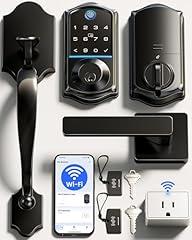
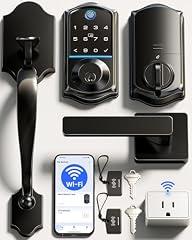
Veise Keyless Fingerprint Door Lock Set
Overview
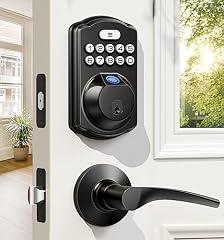
This is an offline electronic deadbolt and matching two-lever handle set for a standard residential door. It uses fingerprints, locally programmed keypad codes, one-time codes, or two mechanical keys for outside entry. The inside deadbolt uses a thumb turn, so exit does not require a battery, code, fingerprint, phone, or account. Veise states that the product runs on four non-rechargeable AA alkaline batteries, accepts doors 1-3/8 to 2 inches thick, and fits common 2-3/8 or 2-3/4 inch backsets. It also states IP54 weather resistance and ANSI/BHMA Grade 3 performance. The manufacturer describes no Wi-Fi, Bluetooth, app, or cloud dependency, which limits remote attack surface and lets local controls continue during an internet outage. However, public certification-directory confirmation and exact-model independent forced-entry testing were not located.
What works
- Local keypad, fingerprint, key, and interior thumb-turn operation avoid dependence on a phone, network, or account, according to the manufacturer documentation.
- Four AA alkaline batteries are replaceable from the interior, and the instructions say not to mix battery types or old and new cells.
- The stated door measurements, backsets, bore size, and minimum 1-inch frame hole give installers concrete compatibility checks.
- The product includes two zinc-alloy lever handles with the deadbolt, rather than requiring a separate matching handle purchase.
What does not
- The ANSI/BHMA Grade 3 and IP54 claims were found on Veise materials, but an exact-product listing or certificate in a public issuing-body registry was not located.
- No named independent forced-entry, drilling, picking, or long-term reliability test for this exact product was located.
- The documentation hosted by Veise links to a deadbolt installation guide labeled for a different KS02 variant, which weakens exact-product traceability.
- The programming documentation shows a factory master code and instructs users to change it before programming. Leaving it unchanged would create an avoidable access risk.
- The manufacturer gives differing fingerprint-speed statements, including 0.2 and 0.3 seconds, so the performance figures should be treated as marketing claims rather than verified measurements.
Who is it for
This product fits a household that wants local electronic entry without an app, Wi-Fi bridge, subscription, or cloud account. It is suited to a conventional wood door that already has the stated 2-1/8 inch bores, a 2-3/8 or 2-3/4 inch backset, and adequate frame depth. It can also suit users who want a physical key contingency and straightforward indoor manual exit. The household should be prepared to change the factory master code immediately, retain backup keys securely, and verify bolt alignment after installation.
Who is it not for
It is not a strong fit for a fire-rated door or any door where the hardware must be listed for a specific fire-door assembly, because no exact-product fire-door listing was located. It is also unsuitable for households needing verified Grade 1 or Grade 2 security, independently documented attack resistance, or audited biometric performance. Choose another setup if remote management, mobile credentials, activity logs, Matter, Apple Home, Alexa, or Google Home integration are required. Renters and owners of metal, fiberglass, storm, sliding, unusually thin, or unusually thick doors should confirm compatibility before altering the door.
Integrity
The direct household safety advantages are mechanical indoor egress and physical backup keys. Veise specifies four replaceable AA alkaline batteries and warns against rechargeable batteries and mixing old with new cells. This avoids a sealed lithium battery pack, but it still creates recurring disposable-battery waste. No public NRTL electrical listing for this exact product was located. Veise says fingerprints are stored on the lock rather than uploaded to a cloud service, consistent with this product's no-app design. Its broader privacy policy nevertheless describes collection of biometric, device, location, and usage data for applicable services, so households should avoid assuming that every Veise product has identical data practices. No product-specific CPSC recall or warning was located in the searched U.S. recall records. The technical page links an expired 2023 to 2024 carbon-offset certificate, not a current product-level environmental certification. Clear parts availability, recycling instructions, and end-of-life electronics guidance were not found.

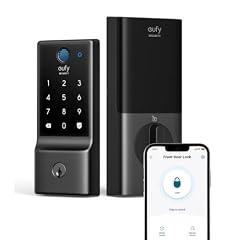
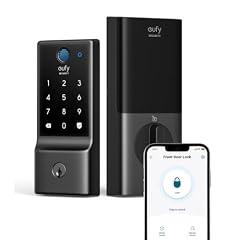
eufy Security Smart Lock C220 Fingerprint Wi-Fi Deadbolt
Overview
This is a Wi-Fi connected residential deadbolt with a fingerprint reader, touchscreen keypad, interior thumbturn, physical keyway, app control, and voice-control support. It uses eight replaceable AA batteries. The manufacturer says it can store up to 50 fingerprints and 100 passcodes, and says the stated battery life of roughly eight months assumes about 10 keypad or app unlocks daily. The manufacturer documents a physical keyway, an interior thumbturn, and an exterior USB-C emergency-power port, so app, network, fingerprint, and depleted-battery failures do not remove every access method. It also states compatibility with 35-55 mm doors and 60 or 70 mm backsets. FCC test records independently identify this model and document compliance testing for its 2.4 GHz Bluetooth and Wi-Fi radio emissions. The manufacturer claims BHMA Grade 3 certification and IP53 weather resistance, but an exact-model public certification record was not located in the assessed registries.
What works
- An interior thumbturn provides a direct mechanical way to exit without an app, account, network, or fingerprint.
- Physical keys and the documented USB-C emergency-power port provide practical backup entry routes after AA batteries are depleted.
- The installation guide gives concrete door thickness, bore, clearance, and backset measurements rather than relying only on a general compatibility claim.
- The exact model has FCC documentation for its Bluetooth and 2.4 GHz Wi-Fi radio functions.
What does not
- The manufacturer claims BHMA Grade 3 durability, but an exact-model record in the public BHMA certified-products directory was not located during this assessment.
- No exact-model public cybersecurity certification, independent penetration test, or specific firmware security-update commitment was located.
- IP53 weather resistance and the eight-month battery estimate are manufacturer-stated. No public third-party ingress test certificate or category reliability test for this product was located.
- Fingerprint templates are described by eufy as encrypted and local, but clear product-specific retention, deletion, and account-recovery documentation was not located.
Who is it for
This product suits a household with a standard single-cylinder exterior door that wants several local entry fallbacks, especially a thumbturn for exit plus keys and USB-C emergency power for battery failure. It is also suited to users who can measure their door before installation, since the guide specifies 35-55 mm thickness, 60 or 70 mm backsets, and required bore dimensions. The built-in Wi-Fi setup may fit users who want remote status and access management without adding a separate bridge.
Who is it not for
It is not suited to doors that must retain a fire-door hardware listing, mortise-lock doors, or doors outside the stated 35-55 mm thickness and standard-bore requirements without qualified compatibility review. It is also a weaker fit for households that require independently published cybersecurity certification, a defined minimum security-update period, or public proof for the claimed weather rating. People who cannot reliably keep physical keys available should not treat remote control or fingerprint access as their sole battery-failure plan.
Integrity
For household safety, the strongest documented safeguards are mechanical and local. The guide shows an interior thumbturn for exit, a physical keyway, and a USB-C emergency-power connection on the exterior. It also warns against using an incorrect battery type and against unsafe disposal, crushing, heating, or exposure of batteries to extreme conditions. The model's radio functions have FCC compliance documentation for the United States, although that is radio-emissions compliance rather than a product-safety or cybersecurity certification. The lock uses eight user-replaceable AA batteries rather than a sealed rechargeable pack, which can reduce replacement of the whole electronic unit when batteries age. The manufacturer instructs users not to discard the product with household waste and to use appropriate recycling collection. No exact-model environmental certification, recycled-content claim, repair-parts commitment, or detailed end-of-life program was located. The manufacturer claims fingerprint templates are encrypted and stored locally, but product-specific deletion and retention controls were not clearly documented.

Veise VE017G-H Smart Fingerprint Door Lock
Overview
This product is a touchscreen smart deadbolt packaged with a matching zinc-alloy handleset and a separate G1 gateway. It uses four replaceable AA alkaline batteries and supports local fingerprint, keypad PIN, fob, mechanical-key, and Bluetooth controls. The gateway adds remote app control, activity alerts, code management, and Alexa or Google voice functions over 2.4 GHz Wi-Fi. The manufacturer states that local credentials and access logs are AES-128 encrypted on the lock, that the exterior is IP55 rated, and that it fits 1-3/8 to 2 inch doors with common 2-3/8 or 2-3/4 inch backsets. The radio platform is independently traceable to an FCC authorization covering the VE017G model family for Bluetooth and NFC transmissions. The claimed ANSI Grade 3 and BHMA status was not confirmed in a public BHMA product record for this exact product.
What works
- Several local entry methods, including mechanical keys, remain usable if internet or the gateway is unavailable, manufacturer-stated.
- Replaceable AA batteries, backup keys, and a temporary USB-C emergency-power port provide practical recovery options, manufacturer-stated.
- The exact VE017G family is traceable to FCC authorization for its Bluetooth and NFC radio functions.
- Door thickness, backset, bore size, compatible door construction, operating temperature, and IP55 rating are specifically stated by the manufacturer.
What does not
- The product is marketed as Wi-Fi, but the lock itself uses Bluetooth. Remote functions depend on the included gateway, home internet, and a 2.4 GHz Wi-Fi connection.
- The claimed ANSI Grade 3 and BHMA testing were not independently confirmed in a public exact-product BHMA certification record.
- Veise's privacy policy says its smart-lock services may collect fingerprint data, while this product page says fingerprints, codes, and logs stay local with no cloud storage. The scope of each statement is not clearly reconciled.
- No public exact-product cybersecurity certification, vulnerability-disclosure policy, firmware support period, repair-parts commitment, or electronics recycling program was identified.
Who is it for
This product suits an owner of a conventional, single-cylinder exterior door who wants a coordinated deadbolt and handleset instead of adapting existing trim. It is most practical for households that need several local ways to enter, such as PINs, fingerprints, fobs, and physical keys, while also wanting remote guest-code management. Measure carefully first. The stated fit is for 1-3/8 to 2 inch doors with a 2-3/8 or 2-3/4 inch backset, not mortise or integrated locksets.
Who is it not for
It is not a strong fit for a fire-rated door unless the door manufacturer or a qualified installer confirms that this exact hardware is permitted on that assembly. It also does not suit households that require independently documented BHMA certification, audited cybersecurity, or a published long-term firmware support commitment. Avoid it where a mortise or integrated lockset is present, where the required handle-hole layout cannot be made without weakening the door, or where occupants cannot reliably retain a mechanical backup key.
Integrity
The lock avoids a built-in rechargeable battery pack. It uses four replaceable AA alkaline cells, which can be changed without replacing the electronic lock. The manufacturer also supplies mechanical keys and describes USB-C emergency power for a depleted battery. The radio hardware is independently traceable to an FCC authorization for the VE017 family, although that authorization addresses radio compliance, not lock strength, weather sealing, or cybersecurity. Veise states that this product stores fingerprints, PINs, and access logs locally with AES-128 encryption and no cloud storage. Its broader privacy policy also says smart-lock services may collect biometric, device, account, and location data, and permits some retained data after a deletion request for legal, accounting, or security reasons. No exact-product recall, public NRTL electrical listing, public BHMA certificate, repair-parts program, or end-of-life electronics recycling instruction was identified in the reviewed sources.
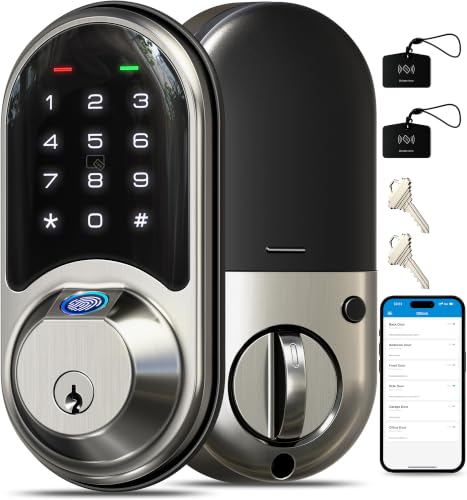
Veise 7-in-1 Fingerprint Smart Lock
Overview
This is a battery-powered, deadbolt-only smart lock for standard residential doors. It uses a touchscreen keypad, fingerprint reader, key fobs, app control, web portal access, and two mechanical backup keys. Veise specifies four replaceable AA alkaline batteries, built-in Bluetooth, and an optional G2 Wi-Fi gateway for remote control and Alexa or Google functions. The installation manual documents an inside thumb turn for manual exit, and says mechanical keys remain usable if the batteries are fully dead. It also specifies fitting doors 1-3/8 to 2 inches thick with 2-3/8 or 2-3/4 inch backsets. An FCC equipment filing independently traces this model family to Bluetooth 5.0 and 13.56 MHz NFC hardware. Veise states BHMA/ANSI Grade 3 and IP54 protection, but an exact-product public certification record or test certificate was not located.
What works
- Manual inside thumb turn allows exit without an app, account, fingerprint, or battery power.
- Mechanical key backup is documented for complete battery depletion.
- The manual provides concrete door thickness, bore, backset, strike depth, handing, and battery-installation requirements.
- Bluetooth works without the optional Wi-Fi gateway, so basic nearby app control does not depend on internet service.
- The exact model family is traceable in an FCC filing for its Bluetooth and NFC radio hardware.
What does not
- The claimed BHMA/ANSI Grade 3 and IP54 ratings could not be independently confirmed in a public exact-product certification record or certificate.
- No public independent forced-entry, drill, picking, cycle-life, or weather-resistance test report was located for this product.
- Veise's product page says fingerprint data, PINs, and access logs are local, while its broader privacy policy says biometric data may be collected. The DDLock app disclosures also differ by platform, leaving data handling unclear.
- No published vulnerability-disclosure process, firmware-security-update commitment, or end-of-support policy was found.
- It is not documented for fire-door assemblies, and the manual does not provide reinforced strike hardware guidance for higher-security installations.
Who is it for
This product suits a homeowner, renter with permission to change the deadbolt, or small property manager whose door already has a standard 1-3/8 to 2 inch bore-door preparation. It is especially practical for households that want several local entry methods, including keypad codes, fingerprints, fobs, nearby Bluetooth app access, and physical keys. The documented thumb turn and dead-battery key access are useful for users who do not want normal entry or exit to depend entirely on a phone, cloud service, or fingerprint reader.
Who is it not for
It is not suited to a fire-rated opening unless the door manufacturer, building authority, and hardware listing specifically permit this installation. It also is not the right fit for households requiring independently verified Grade 3 performance, independently tested weather protection, or published third-party cybersecurity assurance. Choose another arrangement if every household member cannot reliably operate a thumb turn, if keys cannot be securely retained for battery failure, or if a door needs reinforced strike hardware and documented resistance to forced entry.
Integrity
The product uses four replaceable AA alkaline batteries rather than a sealed rechargeable pack. That makes routine power replacement straightforward and avoids discarding the entire lock when an internal battery ages. The manual says to install alkaline cells only after installation is complete. It also says the lock is water resistant against splashes, but warns against liquid ingress and prolonged direct sunlight. No public repair-parts catalog, electronics take-back program, recycled-content claim, or end-of-life recycling instruction was found. An FCC filing independently identifies the model family as a 6 V smart lock with Bluetooth 5.0 and 13.56 MHz NFC, which confirms radio-equipment traceability rather than lock security or durability. Searches of U.S. consumer safety recall and warning resources did not identify a product-specific recall or safety action. Privacy deserves attention because the maker's local-storage statement does not fully align with its broader policy language on biometric collection.

ULTRALOQ Bolt Smart Lock
Overview
This is a zinc-alloy electronic deadbolt for a standard residential door. It provides fingerprint, keypad, phone-app, auto-unlock, physical-key, and compatible smart-home control. The current manufacturer guide specifies four AA alkaline batteries or UTEC lithium batteries, an interior thumb turn, a covered mechanical backup-key cylinder, and a reset control beneath the battery cover. The strongest safety feature is documented manual fallback. The guide says the thumb turn locks and unlocks from inside, and that the backup key provides access after battery failure or an emergency. Its Matter over Thread claim has a public Connectivity Standards Alliance record for an ULTRALOQ Bolt Fingerprint Matter lock, although the public record identifies a prior hardware and battery configuration rather than this current Bolt SE guide. Public exact-model confirmation of the advertised BHMA certification was not located.
What works
- A thumb turn provides direct indoor exit without batteries, network service, an app, or biometric recognition.
- The supplied backup keys provide a documented non-electronic entry method after battery failure or another access problem.
- The current guide gives concrete fit limits, including 1-3/8 to 1-3/4 inch door thickness, 2-1/8 or 1-1/2 inch bore options, and 2-3/8 or 2-3/4 inch backsets.
- Matter over Thread is supported by a public Alliance certification record for the ULTRALOQ Bolt Fingerprint Matter platform, not merely a brand claim.
What does not
- The advertised BHMA certification could not be independently matched to this exact current product in a public BHMA record, so its forced-entry and cycle-performance grade remains unverified.
- No public exact-model NRTL electrical-safety listing or independent forced-entry test report was located.
- The manufacturer describes the exterior as weather protected, but the current installation guide calls it waterproof without presenting an independent ingress-test certificate. The interior battery compartment is explicitly not waterproof.
- Remote control and several setup features require an account, app, or compatible Matter hub. The product documentation does not provide a dated firmware-security-update or end-of-support commitment.
- The privacy policy covers account, device, location, and biometric data broadly, but it does not clearly explain the fingerprint-template storage location, retention period, or lock-specific deletion process.
Who is it for
This product suits a household replacing a conventional deadbolt on a normally prepared, non-fire-rated residential door, especially where adults want several local entry options. It is practical for people who will keep the backup key accessible, test the thumb turn and bolt alignment with the door open, and replace four AA cells promptly after a low-battery warning. It also fits a home that already has a compatible Thread border router and wants local Matter control, while accepting that Wi-Fi and Matter are selected operating paths rather than evidence of simultaneous independent resilience.
Who is it not for
It is not well suited to a required egress door where local code, a fire-door listing, or an authority having jurisdiction demands specifically listed hardware. It also does not suit households that cannot reliably retain a mechanical backup key, or that need a publicly verified BHMA grade and named forced-entry testing for the exact lock. Privacy-sensitive users who need a clear fingerprint-template deletion procedure, or buyers who require a published long-term firmware-security-support date, should not rely on the available documentation alone. Avoid exposed interior installations where rain, snow, or condensation can reach the battery compartment.
Integrity
The current guide documents several practical safety controls. It uses user-replaceable AA cells rather than a sealed rechargeable pack, warns against rechargeable and non-alkaline batteries, and specifies exterior operation from minus 4 to 149 degrees Fahrenheit. It also requires an indoor, dry battery compartment. No relevant CPSC recall or warning for this product was located in the public U.S. recall search reviewed. The product reduces some replacement waste because batteries are accessible and the manufacturer states a lifetime mechanical warranty with an 18-month electronic warranty. That is not the same as a repair commitment. No public parts catalog, repair program, electronics take-back route, recycled-content claim, or independent environmental certification was located. Dispose of depleted AA batteries through an appropriate local battery collection program rather than household recycling.