
10 Best Scan Tool
 Daniel Kenitz
Please note that we participate in affiliate marketing programs. When you purchase through links on our site, we may earn a commission. As an Amazon Associate we earn from qualifying purchases. This comes at no additional cost to you and helps support the resources required to provide valuable content.Advertising Disclosure
Top-rated Scan Tool Comparison
1


2
3
4
5
6
7
8
9
Overview
A scan tool connects to a vehicle’s diagnostic port and translates electronic fault information into codes, live data, freeze-frame records, emissions-readiness results, and on more advanced products active tests, resets, relearns, or coding. It is a diagnostic aid, not an automatic repair tool. A code identifies a condition or system to investigate; it does not, by itself, confirm which part failed or prove that a repair is complete.
What determines whether a scan tool works is more specific than its advertised brand count or number of functions. Generic OBD-II access may cover standard emissions-related information, but enhanced access depends on the vehicle’s exact year, make, model, engine, market, module, communication protocol, and requested function. Buyers should use a manufacturer coverage checker or function matrix before purchase, especially for ABS, airbag, transmission, TPMS, hybrid, high-voltage, gateway, coding, and reset functions. “All-system,” “dealer-level,” “200-plus brands,” and “3,000-plus active tests” are not interchangeable claims: the supplied reviews repeatedly found that broad listing figures exceeded what the official model documentation established.
For emissions use, look for a documented I/M Readiness function and clear instructions explaining that erasing codes resets monitors to Not Ready or Not Complete. Readiness status can show whether the vehicle’s self-tests have run; it is not a universal inspection guarantee, a tailpipe measurement, or confirmation that the underlying fault has been repaired. State inspection rules can also differ. A product that preserves freeze-frame and diagnostic information before clearing codes provides more useful evidence for the next repair decision.
A substantiated product should also have identifiable documentation for its higher-risk functions. Manuals should state supported-vehicle limits, prerequisites, confirmation steps, warnings, and what to do if an active test, reset, calibration, or coding operation is interrupted. A manufacturer claim that a product is bidirectional is not the same as independent proof that its diagnostic performance is accurate. The strongest evidence would be a current, model-specific report from an identifiable ISO/IEC 17025 laboratory using applicable SAE J1978, ISO 15031-4, or SAE J1979 methods, with its scope, methods, and results available for checking. None of the supplied products had that level of independent diagnostic-performance evidence.
For wireless products, verify the exact model and identifier in the FCC Equipment Authorization System. An FCC authorization supports radio compliance; it does not certify diagnostic accuracy or general electrical safety. UL, ETL, or CSA marks should likewise be matched to a public listing rather than accepted from an image alone. Ownership details matter too: check update duration, renewal pricing, app dependence, account requirements, feature lockouts, warranty owner, battery replacement, repair support, and end-of-life disposal. “Lifetime updates” is incomplete unless the supplier explains what lifetime means. Headline figures can also conceal mixed listings, where wired and Bluetooth variants are presented as equivalent, or conflicting warranty and subscription terms.
Across the supplied reviews, the recurring safety caveat is that scan tools should not replace OEM service information or qualified service for brakes, airbags, steering, powertrain, emissions aftertreatment, immobilizers, high-voltage systems, or other safety-critical work. Active tests and resets can change vehicle behavior, erase evidence, alter learned settings, or affect inspection readiness. Do not clear a warning light simply to obtain an inspection result, and do not operate a tool while driving. Check recalls separately by vehicle identification number; a scan tool cannot establish that a vehicle is safe.
Integrity
A responsible scan-tool choice considers not only the functions on the screen, but also the consequences of sending commands to a vehicle, clearing emissions evidence, maintaining the hardware, and trusting wireless or software claims. The supplied scores show meaningful differences in documentation quality, while no product received independent confirmation of diagnostic accuracy against the cited scan-tool standards.
HHealth & Safety
Safe diagnostic guidance
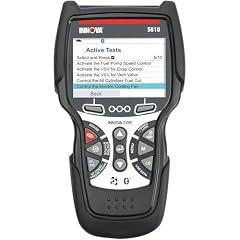
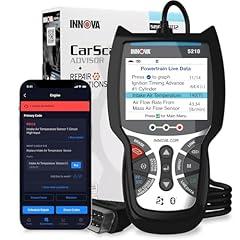
This measures whether the manual distinguishes a fault code from a confirmed repair, preserves diagnostic evidence, warns against clearing safety or emissions faults prematurely, and directs users to appropriate service. It matters because these products can expose brake, airbag, powertrain, and high-voltage information. Higher-scoring examples, such as the Innova 5210 at 86 and Innova 5610 at 82, gave clearer code-clearing and workshop guidance; lower scores reflected thinner escalation and limitation language.
Protection during active tests and resets
This measures safeguards around actuator commands, resets, relearns, calibrations, coding, and programming, including prerequisites, supported-vehicle limits, confirmation steps, and recovery instructions. These functions can change vehicle behavior or stored settings. The supplied scores ranged from 63 for the TOPDON AD800BT 2 to 84 for the FOXWELL NT604, showing that a product may advertise many service functions while still offering limited procedure-level protection.
Secure connection and respectful data practices
This measures secure pairing, update security, vulnerability reporting, data minimization, consent, and deletion or opt-out controls for tools that connect to a vehicle and often an app or cloud account. It matters because diagnostic apps may collect VINs, fault codes, location, device identifiers, or usage data. Scores ranged from 52 for the VDIAGTOOL D200 to 74 for the FOXWELL NT301; app dependence and differing privacy disclosures were recurring limitations.
EEcology
Emissions and inspection integrity
This measures whether the product reports readiness and codes honestly without implying that clearing a code repairs the fault or guarantees an inspection pass. That distinction matters because clearing memory can reset monitors. Scores ranged from 58 for the Innova SD35 to 84 for the Innova 5210, FOXWELL NT301, BLCKTEC 460T, and OTOFIX D1 Lite. Higher scores reflected clearer readiness and code-clearing explanations.
Long-lived, lower-waste hardware
This measures durable construction, update support, repairability, battery replacement or disposal information, and credible service-life planning. A longer-supported product may avoid premature electronic waste, but updates alone do not establish repairability. Scores ranged from 68 for the LAUNCH CRP919XBT and GOOLOO DS900 to 77 for the FOXWELL NT301 and Innova 5610. Most reviews still found missing recycling, parts, or battery-service information.
EEvidence
Honest capability claims
This measures whether advertised coverage, active tests, resets, subscriptions, and model-year support match the official manual and feature documentation. It matters because marketplace listings often combine variants or use broad figures. Scores ranged from 52 for several products with substantially broader listing claims than official documentation supported to 79 for the FOXWELL NT604, which presented a narrower four-system role more consistently.
Independently verified diagnostic performance
This measures whether an identifiable third party or ISO/IEC 17025 laboratory tested the exact product against applicable OBD communication or diagnostic-function requirements, with methods and results available. It is important because manufacturer claims and user reviews do not establish accuracy. Scores were mostly 68 or 70, but the supplied reviews found no model-specific independent laboratory report for any product against SAE J1978, ISO 15031-4, or SAE J1979.
Verified wireless and electrical compliance
This measures whether the exact wireless identifier has a traceable U.S. FCC authorization and whether electrical-safety claims match a public UL, ETL, or CSA listing. It matters when a scanner includes Bluetooth, Wi-Fi, or a battery. Scores ranged from 70 for several products without a fully matched record to 90 for the THINKCAR 689BT; the reviews consistently caution that radio authorization is not diagnostic or general electrical-safety certification.
Proven fit for the buyer's vehicle
This measures whether buyers can check the exact year, make, model, engine, market, module, and function before purchase. It is central to scan tools because enhanced coverage varies by vehicle even when generic OBD-II works. Scores ranged from 52 for the GOOLOO DS900, which had conflicting coverage claims and no public VIN-level checker, to 80 for the Innova 5610, which had stronger documented compatibility evidence.
Clear updates, subscriptions, and data ownership
This measures disclosure of update duration, renewal costs, app dependence, account requirements, feature lockouts, and continued basic usability. It matters because a tool can become less useful or more expensive after purchase. Scores ranged from 52 for products with conflicting or unclear update terms to 81 for the Innova 5610. “Lifetime” and included-update claims still require clarification of support duration and post-period functionality.
Traceable maker and recall response
This measures whether the manufacturer, importer, model, warranty owner, support contact, and corrective-action process can be identified and checked against recall databases. It matters when a connected device fails or a safety issue emerges. Scores ranged from 74 for BlueDriver to 82 for OTOFIX D1 Lite. Most supplied reviews found identifiable support contacts, but a lack of a product recall is not evidence that a vehicle itself is safe.
Full reviews

Bidirectional Scan Tool
Overview
This is a corded handheld vehicle scan tool that draws power from the diagnostic port. Its manufacturer documents global OBD2 code reading, I/M readiness, live data, enhanced ABS and SRS code access on supported vehicles, plus vehicle-dependent active tests, resets, relearns and calibrations. The tool can also connect by Bluetooth and Wi-Fi to the optional RepairSolutions2 phone app. The strongest documented distinction is that the manual describes bidirectional commands and service routines, not just basic code reading. It also contains meaningful operating instructions, including prerequisite checks, confirmation screens and warnings not to use the scanner while driving. The manufacturer offers a year warranty and states that scanner updates are free, although it does not publish an end date for those updates. No model-specific independent laboratory conformance report was located.
What works
- The official manual clearly explains that erasing codes also resets emissions monitors to not run, which helps prevent confusing a cleared light with a completed repair.
- Supported active tests include prerequisite instructions, confirmation steps, status screens and error advisories in the documented procedures.
- Vehicle support is explicitly limited by year, make, model and available module functions, and Innova provides a compatibility checker.
- The handheld tool can operate from the vehicle diagnostic port, without a charged internal battery, according to Innova.
- A named U.S. manufacturer, support contact and one-year repair-or-replace warranty are published.
What does not
- A fault code remains diagnostic evidence, not confirmation of the failed part or repair. The product documentation cannot replace the vehicle maker's repair procedure for brakes, airbags, powertrain or high-voltage systems.
- The tool can command actuators and run consequential functions such as ABS bleeding, injector disable, transmission-related commands and DPF routines. Documented safeguards exist, but they do not substitute for vehicle-specific service information and competent supervision.
- No publicly verifiable, model-specific ISO/IEC 17025 laboratory report demonstrating OBD diagnostic performance against SAE or ISO scan-tool methods was located.
- The official manual documents Bluetooth and Wi-Fi, but no matching public FCC equipment authorization or named electrical-safety listing was located in this review.
- Optional app use requires an account and the privacy policy allows collection of vehicle diagnostics, vehicle identification information, device data and other personal data.
Who is it for
This product suits an experienced DIY owner or entry-level technician working on several supported gasoline, diesel, hybrid or electric vehicles who wants a handheld tool for more than generic powertrain codes. It is most appropriate for users who will check Innova's year, make, model, engine and function coverage before purchase, retain codes and freeze-frame evidence before clearing anything, and consult manufacturer repair procedures before using active controls. It also fits users who value a stand-alone wired tool but may optionally use a phone for reports and vehicle information.
Who is it not for
It is not for a first-time user who expects a code definition or app suggestion to identify the failed component with certainty. It is also unsuitable for anyone planning to use active tests, brake bleeding, restraint-system resets, transmission commands, diesel regeneration functions or high-voltage vehicle work without the correct manufacturer procedure, safety equipment and training. Buyers who require independently published diagnostic conformance testing, a publicly matched FCC authorization, a named electrical-safety listing, or minimal cloud and vehicle-data collection should use a product with that evidence available before purchase.
Integrity
The documented safety strengths are practical rather than independently certified. The manual warns about carbon monoxide, hot and moving engine parts, parking-brake use, and the danger of operating the tool while driving. It explains that clearing diagnostic codes erases useful troubleshooting data and resets readiness monitors. It also presents vehicle-dependent instructions and confirmations for many active procedures. For lifecycle, Innova states that the tool runs from the vehicle port, requires no charging, and receives free regular updates. The manufacturer publishes a one-year warranty with a U.S. service address and support contact. No public model-specific independent conformance report, matched FCC authorization, or electrical-safety listing was located. The optional app has opt-out and deletion routes, but its policy allows collection of diagnostic and vehicle information, and says vehicle information may be aggregated and sold in bulk. Use the stand-alone tool when app reporting is unnecessary.

Innova 5210 OBD2 Scanner Diagnostic Tool
Overview
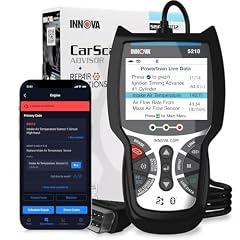
The Innova 5210 is a vehicle-powered handheld scan tool with an attached diagnostic-port cable and a small built-in screen. It is intended for owners who want to read engine and ABS fault codes, view standard live data, check emissions-monitor readiness, test battery and charging status, and attempt an oil-maintenance reset where the vehicle supports it. Its strongest documented safety feature is in the manual, which warns that clearing codes also deletes freeze-frame and manufacturer-specific diagnostic information, resets readiness monitors, and does not fix the underlying fault. The product also requires confirmation before code clearing and oil-reset actions. Innova states that its phone app is optional, updates are free, and subscriptions are not required. Vehicle coverage and available functions remain dependent on the exact year, make, model, engine, and system, so the maker's coverage checker is important before use.
What works
- The manual clearly explains that fault-code clearing does not repair the cause of a fault.
- Code erasure requires a confirmation step, and the tool prompts the user to turn the engine off before the process.
- It can report standard emissions-monitor readiness, while the manual explains that clearing codes returns monitors to a not-ready state.
- Innova provides a model-specific coverage checker and states that the phone app is optional, with free updates and no scanner subscription.
- The manufacturer, warranty owner, support contact, and one-year limited warranty are publicly identified.
What does not
- No identifiable independent laboratory report was found for this exact product's OBD communication or diagnostic accuracy against the cited SAE or ISO methods.
- No exact-model FCC authorization, UL listing, ETL listing, or other public electrical-safety certification record was located during verification. This is missing evidence, not proof of noncompliance.
- Compatibility claims are qualified by Innova itself, and functions can vary by vehicle. The current coverage materials also show limited support information for newer model years.
- The product can erase engine and ABS codes. Although its manual supplies useful warnings, a code is a diagnostic clue, not confirmation that a repair is appropriate.
- The optional app collects vehicle and personal data under Innova's privacy policy, including vehicle identification and diagnostic information. Its policy permits aggregated vehicle information to be sold in bulk.
Who is it for
This product suits a U.S. or Canadian DIY owner of a supported 1996 or newer OBD2 vehicle who wants a corded handheld tool for preliminary engine-code checks, ABS-code checks, basic live data, battery or charging checks, and readiness status. It is especially appropriate for someone willing to confirm the exact vehicle and functions in Innova's coverage checker, save the diagnostic report, and use the manual's warnings rather than treating a code clear as a repair. The optional app may help users who want repair guidance and report exports.
Who is it not for
It is not for users who need independently verified diagnostic accuracy, documented exact-model radio authorization, or independently listed electrical safety certification. It is also not suitable for programming vehicle computers, key fobs, or work that requires unrestricted secure-gateway access. Owners of newer FCA vehicles that require AutoAuth face stated function limits, including limits on code erasure and oil resets. Anyone diagnosing airbags, brakes, high-voltage hybrid or electric systems, severe drivability problems, or active safety warnings should use vehicle-specific service procedures and qualified repair support.
Integrity
The useful safety point is the documented warning around clearing codes. The manual says code erasure can remove freeze-frame and manufacturer-specific evidence, reset readiness monitors, and leave the original fault unresolved. That matters for emissions faults and for safety-related warnings, where a scan result should guide diagnosis rather than replace it. Innova also states that the 5210 cannot reprogram vehicle computers or key fobs. This is cabled, vehicle-powered hardware, so no internal rechargeable battery replacement or disposal plan is described. Innova offers a one-year limited warranty and states that scanner updates are free, which can support continued use. However, no published repairability or end-of-life recycling program was found. Innova's product page carries a California Proposition 65 warning for DINP, a chemical known to California to cause cancer. The warning identifies a possible exposure, but does not quantify exposure from normal use. No matching product-specific CPSC or NHTSA recall was located in the public sources reviewed.

Autel MaxiCOM MK900 Scanner
Overview
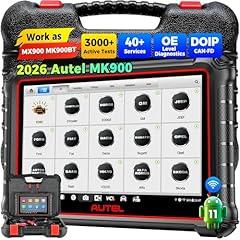
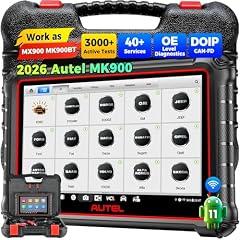
This product is an 8-inch Android 11 automotive diagnostic tablet with a 7,700 mAh lithium-polymer battery, 64 GB storage, Wi-Fi, a wired vehicle connection, and support listed for CAN FD and DoIP. It reads and clears codes, shows live data and readiness status, runs supported active tests, and performs service functions after a vehicle has been identified. The manual independently confirms that clearing emissions data resets readiness monitors to Not Ready or Not Complete, rather than repairing the fault. It also requires confirmation for code clearing and directs users to follow vehicle-maker procedures. The manufacturer states that the product provides broad coverage for 1996 and newer U.S., Asian, and European vehicles, but functions vary by vehicle. The marketplace title uses Bluetooth-version language, while the official comparison lists the base product as using a wired vehicle connection.
What works
- The manual gives substantial workshop safety guidance, including ventilation, wheel blocking, parking-brake use, and a warning not to operate the product while driving.
- Code clearing is documented as a post-repair step, and the product explicitly warns that it clears diagnostic data and resets emissions monitors.
- Active tests are vehicle-specific and use on-screen operational instructions, with confirmation messages for irreversible or data-loss actions.
- The product can create and retain pre-scan and post-scan reports, which can help document the condition before and after work.
- Autel identifies the manufacturer, provides North American support contact details, and documents a one-year limited warranty and repair process.
What does not
- No identifiable independent laboratory report was found for this exact product showing conformance testing against applicable OBD scan-tool standards.
- The official documentation does not provide a buyer-facing, model-by-model matrix that proves a specific active test, reset, or module function for a particular vehicle before purchase.
- Active tests and adaptations can change vehicle behavior, yet the manual does not provide equally detailed prerequisites and recovery steps for every vehicle-specific function.
- One year of free software updates is stated, but the renewal price and the practical capabilities retained after an update plan expires are not plainly disclosed in the reviewed materials.
- The product has a lithium-polymer battery, but the manual does not explain battery replacement or end-of-life recycling. No public UL, ETL, or CSA listing was identified in this review.
Who is it for
This product suits an experienced home mechanic, independent repair shop, or fleet technician who needs more than generic engine-code reading and can consult factory repair information. It is most appropriate for supported vehicles where the buyer has first confirmed the exact year, make, engine, market, module, and desired function through Autel coverage resources. Its larger touchscreen, all-system scans, readiness information, report generation, and guided active-test interface fit diagnosis and post-repair verification work performed in a stationary, ventilated workspace.
Who is it not for
It is not suited to a driver who wants a fault code to identify a guaranteed repair, or who intends to clear warning lights immediately before an emissions inspection. It is also unsuitable for anyone who cannot verify support for their exact vehicle and function before using resets, relearns, adaptations, or actuator commands. Avoid using it as a substitute for OEM procedures on brakes, airbags, steering, high-voltage systems, or security-related modules. Do not operate the product while driving or conduct tests in an unventilated area.
Integrity
The safety documentation is stronger than a basic code reader manual. It tells operators to use manufacturer procedures, work in a ventilated area, secure the vehicle, keep clear of moving and hot parts, and avoid using the product while driving. It also explains that codes are diagnostic information, not confirmed failed parts. Clearing codes removes emissions-related information and returns readiness monitors to an incomplete state, so it does not establish that a vehicle is repaired or inspection-ready. The product contains a 7,700 mAh lithium-polymer battery and is manufacturer-declared compliant with the European RoHS directive. The manual names an FCC identifier and states Part 15 compliance, but this review did not locate a public UL, ETL, or CSA electrical-safety listing for the exact product. Autel documents one year of warranty and updates, plus repair support, but does not provide battery replacement or disposal instructions. Its privacy policy says diagnostic records can include VIN, mileage, fault codes, freeze-frame data, device identifiers, and location-related information, while also providing deletion and consent-withdrawal routes.

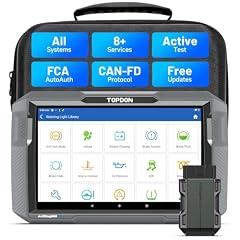
TOPDON ONE OBD2 Bidirectional Scan Tool
Overview
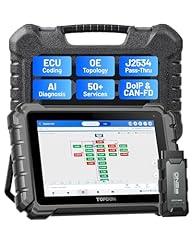
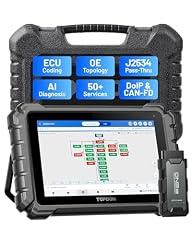
This product is a 10.1-inch Android tablet scan tool with a separate vehicle communication interface, cables, charger, and carrying case. It connects at the diagnostic port for full-system scans, live data, fault-code reading and clearing, readiness checks, active tests, service resets, coding, and pass-through work with compatible OEM software. TOPDON documents a built-in vehicle coverage lookup that lets the user select vehicle, system, function, and sub-function before attempting work. It also documents CAN-FD, DoIP, J2534 support, more than 50 maintenance functions, and coding on supported vehicles. These are manufacturer-stated capabilities, not independent performance findings. The U.S. wireless authorization for the exact TDONE model is independently verifiable. A subscription is relevant because basic diagnostic functions remain available after expiration, while current vehicle updates, topology, coding, security-gateway access, and other advanced services do not.
What works
- The exact model has a verifiable FCC equipment authorization for its 2.4 GHz wireless radios.
- The manual includes a vehicle coverage lookup by model, year, system, function, and sub-function, which can reduce compatibility guesswork before a procedure.
- TOPDON clearly states that EOBD diagnostics, code reading and clearing, live data, active tests, and maintenance functions remain available after software updates expire.
- The manufacturer documents supported-vehicle limits for J2534 use and notes that access to security-gateway-protected systems can require OEM credentials.
What does not
- No identifiable independent laboratory report was located showing this exact product tested to SAE or ISO OBD diagnostic-function requirements.
- The manual provides general safety direction and requires ignition off before connecting, but the reviewed material does not clearly explain that a code is not a confirmed repair or give detailed precautions for airbags, brakes, high-voltage systems, and emissions faults.
- Coding, programming, active tests, and resets can alter vehicle behavior. The available documentation states coverage limits, but it does not provide a public, model-specific safeguards matrix or detailed recovery steps for failed programming.
- Advanced features and current coverage depend on a paid renewal after the first year. TOPDON lists $299 for one year or $479 for two years.
- No public electrical safety listing or battery replacement and end-of-life program for this exact tablet was located.
Who is it for
This product fits an experienced independent technician or advanced fleet maintenance user who works across multiple supported vehicles and can verify coverage before beginning. It is especially suited to users who need full-system scanning, data review, active tests, and occasional supported coding or OEM pass-through workflows, and who already understand stable-power requirements and OEM procedures. The buyer should be prepared to maintain internet access, use OEM credentials where required, and budget for renewal when current vehicle coverage and advanced cloud-linked functions matter.
Who is it not for
It is not suited to a first-time vehicle owner looking for a tool that tells them exactly which part to replace. It also is not appropriate for someone planning to clear airbag, brake, powertrain, or emissions warnings without diagnosis and repair. Avoid relying on it alone for safety-critical programming, high-voltage vehicle work, or inspection decisions. Users who need guaranteed function support for one exact vehicle should confirm the vehicle, module, system, and desired function in the coverage lookup before use.
Integrity
The key safety benefit is traceability of the wireless hardware. The exact TDONE model has a U.S. FCC equipment authorization for 2.4 GHz digital transmission and spread-spectrum radio operation. TOPDON also identifies a support path, warranty process, and manufacturer contact. No product-specific U.S. recall or regulator warning was located in the reviewed NHTSA and CPSC sources. Diagnostic results need careful interpretation. The tool can display readiness and clear codes, but readiness means the vehicle has completed self-checks, not that it has passed an emissions inspection or been repaired. Its manual has basic connection and read-the-instructions warnings, yet detailed safety guidance for active control, coding, and high-risk vehicle systems was not established. The rechargeable tablet should go to a qualified electronics or battery recycler at end of life, not household trash or curbside recycling. TOPDON does not publicly explain battery replacement or a takeback route for this model.

TOPDON ArtiDiag900 Lite Automotive Diagnostic Tool
Overview
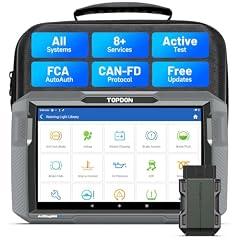
This product is an Android 11 tablet scan tool with an 8-inch, 1280 by 800 screen, a 10,000 mAh battery, and a separate vehicle interface that can connect by Bluetooth or the supplied USB cable. It reads and clears fault codes, displays live data and freeze-frame records, reports emissions readiness, and can run supported active tests and eight service functions, including ABS bleeding, DPF regeneration, electronic parking brake, battery-management, steering-angle, throttle, oil, and airbag resets. TOPDON’s manual provides useful operating precautions, including ventilation, eye protection, no use while driving, ignition off before connecting, and clearing codes only after the required repair. The manufacturer also provides a year, make, model, and function coverage lookup. Function availability remains vehicle-specific, so a retrieved code or supported test is diagnostic information, not confirmation of a repair.
What works
- The manual directs users to perform required repairs before clearing codes, preserving fault and freeze-frame evidence until diagnosis is complete.
- It can save system scans, fault-code reports, and live-data reports, which supports pre-repair and post-repair documentation.
- The manufacturer provides a coverage lookup by product, vehicle make, model, year, and requested function.
- Wireless operation is backed by a product-specific FCC authorization record for the radio-equipped hardware.
- Update terms are unusually concrete, with two years included and a published $120 price for a further year.
What does not
- TOPDON’s marketplace claim of coverage for more than 120 brands conflicts with its U.S. product page, which says more than 60 brands in one section and 65-plus in another.
- The active-test instructions state that availability varies by vehicle, but do not document detailed prerequisite checks, hazard prompts, or recovery procedures for brake, restraint, DPF, and other consequential procedures.
- No identifiable independent laboratory report was found that tests this product’s diagnostic performance against SAE or ISO OBD scan-tool requirements.
- The product-specific privacy policy referenced in the tool was not publicly available in the reviewed materials. The public store policy explicitly excludes diagnostic tools and related software.
- No verified UL or ETL listing for this exact tablet and battery system was found. A California cancer and reproductive-harm warning appears on the U.S. product page without identifying the relevant substance.
Who is it for
This product suits a hands-on owner or independent technician who needs more than generic engine-code reading, but will check compatibility before beginning work. It is particularly relevant for documenting vehicle condition before and after repair, reviewing emissions readiness, following factory service information, and running supported component tests while the vehicle is stationary. The tablet format, report saving, wired fallback connection, and stated two-year update period make it practical for periodic multi-vehicle diagnostic work rather than a single inspection-only check.
Who is it not for
It is not appropriate for someone who wants a fault code to identify a confirmed failed part or who intends to clear warning lights before diagnosing the cause. Users working on airbags, ABS, electronic parking brakes, DPF regeneration, high-voltage vehicles, or module configuration should use the vehicle maker’s procedure and obtain qualified service when the procedure requires it. It also does not suit buyers who need independently verified scan-tool conformance, a confirmed electrical-safety listing, or a public product-specific privacy and security program.
Integrity
The product’s manual contains meaningful workshop safety guidance. It calls for ventilation around running vehicles because of carbon monoxide and particulate emissions, warns against flames near fuel and battery vapors, says not to operate the tool while driving, and tells users to consult the vehicle service manual. It also says code clearing should occur after the needed repair, and provides I/M readiness and freeze-frame functions for emissions-related diagnosis. The wireless hardware has a matching FCC authorization record, which supports U.S. radio compliance. However, no exact-product UL or ETL electrical-safety listing was verified, and the manufacturer’s U.S. product page carries a California cancer and reproductive-harm warning without a substance explanation. The hardware has a one-year limited warranty and supports firmware, app, system, and vehicle-software updates. No manufacturer battery-replacement or end-of-life recycling process was identified. No product-specific U.S. recall or regulator action was found in the reviewed recall sources.

FOXWELL NT604 Elite Car Diagnostic Scanner
Overview
This handheld, vehicle-powered diagnostic product connects at the car’s diagnostic port and uses a 4.3-inch color display. Its documented purpose is to read and clear fault codes, show live data, identify the vehicle automatically when supported, and report generic OBD readiness information. Manufacturer documentation specifically assigns this version to four systems, engine, ABS, airbag, and transmission. It also lists I/M readiness, fault-code lookup, battery-voltage checking, and free updates. The manual independently available for the product family includes substantial workshop safety instructions and stresses that test results do not necessarily identify a failed component. Vehicle and function availability still varies by model year, make, and vehicle configuration.
What works
- Manufacturer documentation limits the stated enhanced coverage to engine, ABS, airbag, and transmission systems, rather than claiming all-system diagnosis.
- The manual gives concrete precautions for moving parts, hot components, flammable vapors, exhaust, cables, and unattended running vehicles.
- Generic OBD functions include I/M readiness, live data, freeze-frame data, code lookup, and vehicle information where supported.
- The manufacturer states that this version has no subscription fee and can receive updates.
What does not
- A fault code is not a confirmed repair diagnosis, and the manual does not fully explain the risks of clearing safety or emissions codes before the underlying fault is repaired.
- Documentation is inconsistent across product generations. One manufacturer page describes USB connectivity, while a newer manufacturer announcement describes Wi-Fi updating.
- No model-specific independent laboratory report was located showing conformance testing against the applicable OBD scan-tool standards.
- No public materials or battery replacement plan were located, and the one-year limited warranty is the clearest documented lifecycle commitment.
- Account registration and an email address are documented for updates, but accessible documentation did not establish a product-specific privacy, security-update, or vulnerability-reporting policy.
Who is it for
This product suits a hands-on owner or independent technician who wants a wired handheld tool for preliminary investigation of check-engine, ABS, airbag, or transmission warnings on a supported conventional vehicle. It is most appropriate when the buyer will record codes and live data, check service information, and use the results to guide a repair decision or a discussion with a qualified shop. It also fits users who value a screen-based tool rather than a phone-only adapter and who can confirm exact vehicle coverage before use.
Who is it not for
It is not for anyone who needs proof that a particular reset, calibration, coding procedure, or module test works on their exact vehicle before purchase. It is also not appropriate as a substitute for professional diagnosis of brake, airbag, drivability, emissions, or high-voltage vehicle faults. Buyers who require independently published diagnostic accuracy testing, clearly documented security practices, a public repairability plan, or unambiguous connectivity details should not rely on the available product documentation alone.
Integrity
The product’s strongest safety evidence is its manual. It directs users to follow vehicle-maker procedures and warns about fuel vapors, toxic exhaust, rotating parts, hot components, cable routing, and the need to secure the vehicle before tests with the engine running. It also cautions that a test result does not necessarily prove a component or system has failed. Those are important limits for a tool that can read and clear brake, airbag, transmission, and engine faults. The manufacturer provides a one-year limited warranty and states that updates are free. No battery is specified in the reviewed documentation because the product is powered by the vehicle diagnostic connection or USB. No model-specific independent OBD conformance report, electrical-safety listing, material disclosure, repairability plan, or end-of-life recycling program was located. Searches of major United States recall databases did not identify a product-specific recall in the reviewed results, but that is not equivalent to independent safety certification.

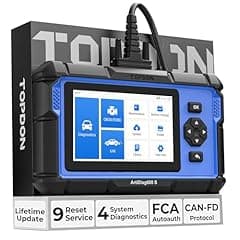
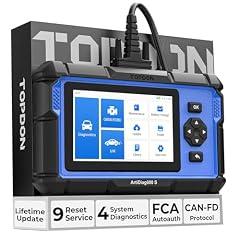
TOPDON AD600S OBD2 Scanner
Overview
This product is a handheld, wired vehicle diagnostic tablet with a 5-inch touch display. It connects to the vehicle diagnostic port with its included cable, and can also charge by USB-C. The manufacturer manual specifies Android 11, 2 GB RAM, 32 GB storage, a 3,350 mAh battery, 9 to 18 V vehicle input, and a 578 g body. Its documented core scope is diagnostics for engine, transmission, airbag, and ABS systems, plus generic emissions functions such as trouble-code reading, live data, freeze-frame data, and inspection readiness. The manual also documents nine service functions, including brake, steering-angle, battery-management, DPF, injector, and ABS-bleeding functions. These enhanced functions are vehicle-dependent, so a displayed menu item is not proof that a particular vehicle supports it. The product requires Wi-Fi and a TOPDON account during initial setup, although many basic functions may work offline afterward.
What works
- The manual tells users to complete required repairs before clearing diagnostic trouble codes.
- Inspection-readiness guidance is appropriately cautious, stating that all required tests must pass before a vehicle is considered ready for emissions inspection.
- The documented radio identifier matches a public FCC equipment-authorization record for the product, including 2.4 GHz and 5 GHz operation.
- Manufacturer documentation provides a concrete one-year limited warranty, firmware updates, diagnostic software updates, and an account-deletion setting.
- The manual includes practical workshop precautions, including ventilation, eye protection, avoiding hot or moving parts, and not watching live data while driving.
What does not
- ABS bleeding, injector coding, steering-angle reset, DPF regeneration, and brake work can affect safety or emissions systems, but the manual provides limited prerequisite, recovery, and qualified-service guidance for these tasks.
- No identifiable independent ISO/IEC 17025 diagnostic-performance report was located for this specific product against SAE or ISO OBD scan-tool performance methods.
- The broad vehicle-brand coverage claims are manufacturer-stated. Function availability varies by make, model, module, region, and vehicle configuration.
- The product needs account sign-in during setup and may require an internet connection for particular models or functions. The duration and practical meaning of lifetime updates are not fully defined.
- No public battery-replacement, repair-parts, or end-of-life recycling plan was located. The internal rechargeable battery can limit repairability.
Who is it for
This product suits a hands-on owner or independent technician who wants a self-contained tablet for reading codes, examining live data, checking emissions readiness, and documenting basic diagnostic results on a compatible conventional vehicle. It is most appropriate when the buyer can verify the exact year, make, model, engine, market, module, and desired service function through TOPDON before work begins. It also suits users comfortable following vehicle-specific OEM repair instructions after the scanner identifies a fault or indicates a reset procedure is available.
Who is it not for
It is not appropriate as a substitute for OEM procedures or trained service when airbag, ABS, electronic parking brake, steering-angle, fuel-injection, high-voltage, or emissions-control work is involved. A fault code does not confirm the failed part or the repair. Buyers who need documented model-specific coverage before purchase, independently verified scan-tool accuracy, an electrical-safety listing, offline setup without an account, or a user-replaceable battery should seek a product with those records published clearly. Do not use it while driving or use resets to bypass a warning condition.
Integrity
The safety documentation is stronger than a typical feature list. It instructs users to ventilate running-engine work areas because of carbon monoxide and particulate exposure, wear eye protection, avoid fuel and battery ignition sources, switch ignition off before connecting or disconnecting the diagnostic cable, and keep a second person available if live data must be viewed during a road test. It also states that trouble codes should be cleared only after the required repair is complete. For emissions integrity, the manual presents readiness as a check of monitor status and says a vehicle should be considered ready only when all required tests have passed. This is important because clearing codes does not repair an emissions fault or establish inspection eligibility. The US product page carries a California cancer and reproductive-harm warning, without identifying a chemical in the page material reviewed. The product contains a 3,350 mAh rechargeable battery, but no battery replacement or recycling instructions were located. No active US product recall or regulator warning specific to this product was located in the searches performed.

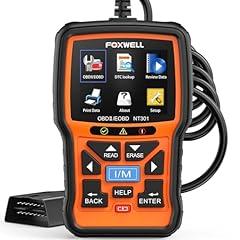
FOXWELL NT301 OBD2 Scanner Diagnostic Tool
Overview
This is a wired handheld OBD-II and EOBD code reader for the diagnostic port on compatible passenger cars, SUVs, light-duty trucks, and minivans. It runs from 8 to 18 V vehicle power, has a 2.8-inch color display, a USB port for computer connection, and no wireless radio or internal battery stated in the manufacturer manual. The manufacturer documents generic powertrain functions including stored, pending, and permanent code reading, code clearing, live-data viewing and recording, freeze-frame data, I/M readiness, oxygen-sensor and onboard-monitor results, vehicle information, and a component-test menu. It also documents that available functions vary by vehicle year, make, and model. The manual provides unusually direct guidance that a trouble code is not a diagnosis and that clearing codes does not repair the underlying fault.
What works
- The manual clearly says test results do not necessarily identify a faulty component or system.
- Its code-clear procedure warns users to complete diagnosis and repair first, and states that clearing codes does not fix the cause.
- I/M readiness, permanent-code reading, and monitor data can help a user understand whether emissions checks have completed.
- The wired connection avoids Bluetooth or Wi-Fi pairing, cloud accounts, and app permissions.
- A named manufacturer, support email, software-update utility, and one-year limited warranty are documented.
What does not
- Vehicle coverage is described broadly, but there is no buyer-facing checker for an exact year, engine, market, module, and function.
- No model-specific independent laboratory report was identified for communication accuracy or diagnostic performance.
- No public UL, ETL, or CSA listing was identified for this wired product, and the manufacturer does not claim one in the manual reviewed.
- The manual documents updates through Windows software, but does not clearly state update duration, future operating-system support, or any paid renewal terms.
- The documentation does not disclose housing materials, repair parts availability, a formal recycling program, signed-update practices, or a public vulnerability-reporting process.
Who is it for
This product suits a hands-on owner of a compatible 1996 or newer OBD-II vehicle who wants a standalone wired reader for check-engine diagnostics, live powertrain data, and readiness checks. It is particularly suited to someone willing to read the manual, retain freeze-frame and code information before clearing anything, and use OEM repair information or a qualified technician to confirm the cause. The corded format also fits buyers who prefer not to connect vehicle data through a phone app or wireless radio.
Who is it not for
It is not for someone needing confirmed coverage for a particular manufacturer-specific module, hybrid or high-voltage system, ABS, airbag, transmission function, service reset, coding, programming, or bidirectional repair workflow. The manual only documents generic OBD functions and notes that available functions vary by vehicle. It is also unsuitable for a buyer who needs independently verified diagnostic accuracy, a listed electrical-safety certification, guaranteed long-term update support, or formal cybersecurity and privacy disclosures.
Integrity
The strongest safety point is the manual. It tells users to follow vehicle-maker test procedures, keep the cable away from driving controls, manage fire, hot-surface, moving-part, exhaust, and fuel-vapor hazards, and secure the vehicle before testing with the engine running. It also warns that a code or test result alone does not establish a failed component. Those are meaningful safeguards for a tool used around an operating vehicle. For emissions integrity, the product can display readiness and permanent emissions codes, while its manual says clearing codes is not a repair. This matters because clearing faults can reset readiness monitors and does not establish that a vehicle will pass inspection. The unit is corded and manufacturer documentation describes vehicle and USB power rather than an internal battery, which avoids a battery-disposal issue. Material composition, third-party electrical certification, repairability details, recycling policy, and independent performance testing were not identified. No relevant U.S. recall or regulator action was identified in the searches performed.
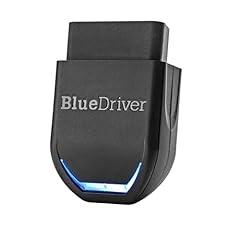
BlueDriver Pro Next Gen OBD2 Scanner
Overview
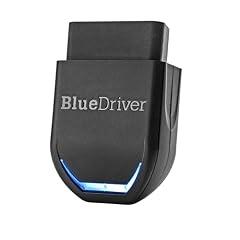
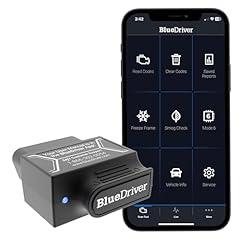
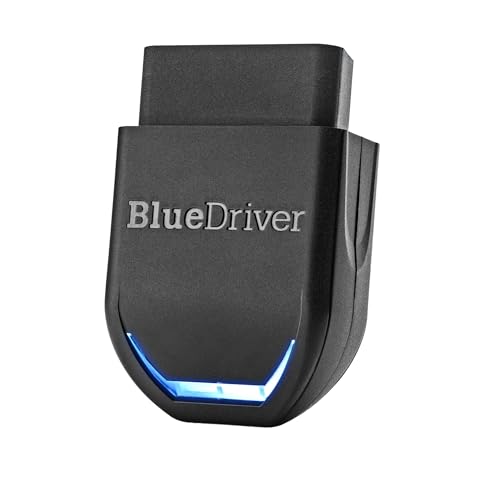
This product is a compact Bluetooth scan tool that plugs into a vehicle's diagnostic port and works through the BlueDriver app on iPhone or Android. It is powered by the vehicle rather than a separate battery. Its documented baseline use is reading and clearing engine codes, viewing live data and freeze-frame records, checking readiness monitors, and producing repair reports. The manufacturer states that it works with North American 1996 and newer cars, SUVs, and light trucks, with enhanced diagnostics varying by make, model, engine, and system. A compatibility checker provides a more specific pre-purchase check. The app's published support material makes an important limitation clear, a trouble code identifies a condition for diagnosis, not a completed repair, and clearing engine codes resets emissions readiness monitors. The tool is not documented as offering programming, coding, or broad bidirectional active tests.
What works
- Its support guidance clearly says a code will return unless the underlying fault is repaired.
- The readiness feature is candid about its limits, including that a scan cannot guarantee an emissions inspection result or assess tailpipe sampling.
- The compatibility tool asks for country of original sale, year, make, model, and engine rather than relying only on a broad vehicle-year claim.
- The mobile app has a visible recent update history, and the manufacturer states there are no subscription fees or in-app add-ons.
- A 180-day return policy and one-year limited warranty are stated by the manufacturer, with named support contact channels.
What does not
- No identifiable independent laboratory report was found for this exact product against the applicable OBD scan-tool conformance methods.
- No public exact-product FCC authorization or named UL, ETL, or CSA electrical-safety listing was located during verification.
- Enhanced diagnostics are not universal. The compatibility tool can identify a vehicle as enhanced-capable while leaving the exact supported systems unknown.
- The product can clear engine, ABS, and airbag-related codes, but its public guidance does not provide prominent, model-specific safety escalation instructions for brake, restraint, hybrid, or high-voltage faults.
- Use depends on an account-based mobile app. The published policies and store disclosures explain some collection and deletion practices, but do not document signed firmware, a vulnerability-reporting channel, or a security-update commitment.
Who is it for
This product suits a North American gasoline, diesel, or hybrid vehicle owner who wants a phone-based way to read standard engine codes, review readiness monitors, capture freeze-frame data, and check whether codes were recently cleared. It is most appropriate when the buyer first uses the compatibility checker for the exact vehicle and treats repair reports as leads for diagnosis rather than instructions to replace parts. It also fits owners who value no stated subscription fee and can use a current iPhone or Android device.
Who is it not for
It is not for anyone who needs module programming, coding, relearns, or documented bidirectional actuator control. It is also not an appropriate sole decision tool for an illuminated airbag warning, brake-system warning, powertrain fault that affects safe driving, or a high-voltage hybrid or electric-vehicle issue. Those situations need the vehicle maker's procedures and, where appropriate, qualified service. Buyers without a compatible smartphone, those unwilling to create an app account, and owners of vehicles outside the stated North American coverage should choose a tool and support arrangement that matches those conditions.
Integrity
The main safety positive is informational restraint around emissions. BlueDriver's support material says clearing a code does not fix the cause, explains that permanent codes cannot be cleared by a scan tool, and warns that clearing engine codes resets readiness monitors. It also says its readiness display cannot guarantee an inspection outcome and cannot evaluate tailpipe sampling. Those are useful guardrails against treating a cleared light as a repair. The product has no separate battery disclosed, so there is no routine user-replaceable battery waste identified. The manufacturer states a one-year limited warranty, a 180-day return policy, and ongoing support and updates, which can help extend useful life. However, no public independent conformance report for this exact product, no exact-product public wireless authorization located in the searched FCC records, and no named electrical-safety listing were found. The app store disclosures state that data are encrypted in transit and that deletion can be requested, but stronger public security documentation was not located.

BlueDriver Bluetooth Pro OBD2 Car Scanner
Overview
This product is a small Bluetooth vehicle diagnostic adapter that plugs into an OBD-II port and works through the BlueDriver app on an iOS or Android phone. It is intended to read engine fault codes, selected enhanced system codes, live data, freeze-frame information, Mode 6 results, and emissions readiness. The manufacturer states that it supports North American 1996 and newer cars, SUVs, and light trucks, with enhanced coverage varying by vehicle. Its most useful documented limits are also important. The manufacturer provides a year, make, model, engine, and original-market compatibility checker rather than treating enhanced functions as universal. It also states that permanent emissions codes cannot be erased with the product. The company’s own guidance correctly says a fault code identifies a detected symptom, not a confirmed repair, although public independent conformance testing for this exact product was not located.
What works
- The compatibility checker can identify supported systems and functions for a specific vehicle configuration before use, according to the manufacturer.
- It displays readiness-monitor status and distinguishes permanent codes that a scan tool cannot clear, according to the manufacturer.
- The manufacturer documents a one-year limited warranty, 180-day direct-sale return policy, firmware-update support, and no subscription or add-on fees.
- App-store disclosures state that Android data is encrypted in transit and that deletion can be requested.
What does not
- No public, model-specific independent laboratory report was located for diagnostic accuracy or conformance to OBD scan-tool standards.
- No matching public FCC authorization or electrical-safety listing for this exact Bluetooth product was located during verification.
- Enhanced ABS, airbag, TPMS, and other module access is vehicle-dependent, so basic OBD-II compatibility does not establish coverage for every warning light or function.
- The product relies on a phone app, and published support does not state a guaranteed update-support period or an end-of-life plan for the hardware.
Who is it for
This product suits a U.S. or Canadian owner of a 1996 or newer vehicle who wants to read powertrain faults, check emissions readiness, preserve freeze-frame context, and bring clearer information to a repair appointment. It is particularly relevant for a hands-on owner who will first use the manufacturer’s compatibility checker for the exact year, engine, original sales market, and desired system. It can also fit users who prefer an app-based Bluetooth workflow and do not want recurring feature fees.
Who is it not for
It is not for anyone who needs verified bidirectional controls, module coding, programming, relearns, or a documented recovery process after a failed active procedure. It is also not appropriate as the sole basis for deciding that an airbag, brake, transmission, hybrid, or high-voltage warning is safe to ignore. Buyers without a compatible iOS or Android device, those needing guaranteed long-term offline usability, and owners whose exact vehicle is not confirmed by the compatibility checker should use a different diagnostic route.
Integrity
The principal safety benefit is informational, not corrective. The manufacturer explains that a diagnostic trouble code is a symptom rather than a parts-replacement instruction, advises clearing codes only after addressing the cause, and notes that permanent emissions codes remain until the vehicle verifies the repair. Those are useful safeguards against masking an emissions fault before an inspection. Safety-critical warnings still require manufacturer repair procedures or qualified diagnosis. The device has no user-replaceable battery disclosed, which avoids a routine battery-disposal issue, but the company does not publish repairability, recycled-material, electronics-recycling, or formal end-of-life information. The maker, warranty owner, support contact, direct-sale return policy, and firmware-update support are identifiable. No relevant U.S. equipment recall or CPSC recall was identified in the public searches performed, but a public certification record for the exact Bluetooth hardware was not located.