
10 Best Rowing Machines of 2026
 Brianna York
Please note that we participate in affiliate marketing programs. When you purchase through links on our site, we may earn a commission. As an Amazon Associate we earn from qualifying purchases. This comes at no additional cost to you and helps support the resources required to provide valuable content.Advertising Disclosure
Top-rated Rowing Machine Comparison
1

2
4
5
6
7
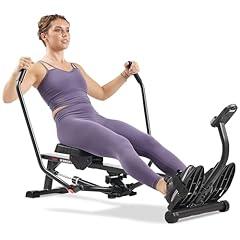
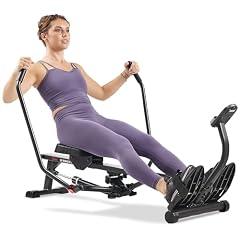
8
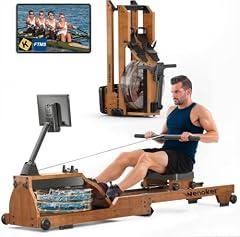
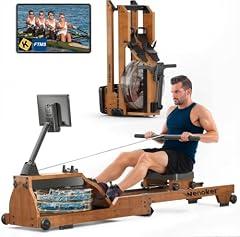
9
Overview
A rowing machine creates resistance while you repeatedly drive with the legs, hinge through the hips, and pull with the arms, then return under control. Depending on the design, resistance may come from air, water, magnets, hydraulics, or bands. The exercise can support aerobic activity and muscular endurance, but the useful health effect comes from consistent, appropriately difficult sessions not from a resistance number, calorie display, or “full-body” label by itself.
The first buying question is fit. Look for a stated user-height or inseam range, rail length, seat height, footrest adjustment, handle position, and clear technique guidance. A machine can be described as low-impact while still loading the lower back, knees, hips, shoulders, wrists, and ribs if the stroke is poorly fitted or fatigue causes the user to collapse into the catch. A stated maximum user weight is useful, but it is not proof of safe operation at that weight. Among the supplied products, capacity claims range from 265 to 500 pounds, and several are contradicted by another listing or unsupported by a public load test.
Resistance should also be described precisely. “16 levels,” “32 levels,” or a stated peak resistance does not make machines directly comparable: magnetic levels, water fill levels, air damper settings, hydraulic settings, and elastic tension produce different sensations and workloads. Confirm whether resistance is manual or automatic, whether the product is battery-powered, self-powered, corded, or entirely manual, and whether a listing combines specifications from different versions. Several supplied products have conflicting resistance descriptions or level counts.
For safety, the strongest evidence would identify the exact model in testing or certification. Relevant mechanical evidence includes ISO 20957-1 and ISO 20957-7 testing, ideally supported by a report from an ISO/IEC 17025-accredited laboratory. Check the CPSC Recalls database and SaferProducts.gov for incidents rather than treating an absent recall as certification. For powered or wireless equipment, look for an exact-product UL Product iQ or Intertek ETL listing, and an FCC Equipment Authorization record for Bluetooth or Wi-Fi hardware. A component’s certification does not automatically certify the complete rower.
A monitor can help compare your own sessions, but its numbers are not automatically physiological measurements. Check how distance, pace, power, stroke rate, heart rate, and calories are defined. Calories are especially easy to overinterpret: the supplied reviews repeatedly found no product-specific validation, and one independent study supported repeatable Concept2 power readings without establishing precise personal calorie expenditure. App access should be optional for core exercise, with clear trial, renewal, cancellation, account-deletion, data-sharing, and offline-use terms.
For ownership, look for a stated warranty, inspection intervals, replacement wear parts, schematics, repair instructions, corrosion guidance, battery details, and software support. Environmental claims should name materials, packaging quantities, recycled content, treatment chemicals, and disposal routes; a generic “eco” or wood claim is not enough. Reusable batteries still require appropriate recycling, and water rowers may require purification tablets and wastewater handling.
Across the supplied reviews, recurring cautions are significant. None of these products should be treated as medical rehabilitation equipment, and people with active or recurring back, knee, hip, shoulder, wrist, rib, balance, cardiovascular, or mobility concerns should obtain individualized clinical guidance. Technique, fatigue, and training volume can aggravate injury risk. Children and pets should be kept away from moving parts and stored equipment. Folding or upright storage often requires lifting and lacks clearly documented locks, anti-tip features, or pinch guards. Finally, do not rely on a headline weight capacity, calorie number, app claim, or “quiet” specification when the exact model’s supporting evidence is missing or contradictory.
Integrity
The reviews assess rowers as exercise equipment, household products, and connected devices. Higher scores indicate stronger, more specific evidence and clearer limits in the supplied reviews; they do not turn an unsupported manufacturer claim into independent certification.
HHealth & Safety
Realistic health benefit
This measures whether cardio, strength, low-impact, calorie, weight-loss, and rehabilitation claims match the resistance system and human exercise evidence. For rowers, a high score means the product is presented as adjustable aerobic exercise without promising treatment or precise weight loss. Supplied scores were generally strongest for realistic exercise claims, reaching 78, while lower scores reflected unsupported posture, imbalance, or targeted-muscle claims.
Back- and joint-friendly fit
This measures rail travel, seat height, handle and footrest adjustment, movement path, user range, and technique guidance. It matters because rowing repeatedly loads the back, hips, knees, shoulders, and wrists. A high score combines concrete fit limits with form instructions; a low score leaves rail length, inseam, reach, or technique unclear. Supplied scores ranged from 69 to 79, with the strongest documentation describing usable fit and stroke guidance.
Stable at its claimed user weight
This measures resistance to tipping, frame or rail failure, loose fasteners, unsafe flex, and footrest or seat failure at the advertised limit. The key distinction is exact-model safety testing, not merely a capacity printed in a listing. Supplied scores ranged from 54 to 84. The higher-scoring products had clearer limits or supporting evidence, while many lower scores reflected manufacturer-only capacity claims without public ISO or accredited-lab load testing.
Safe folding and storage
This measures pinch protection, sudden folding, unstable upright storage, wheel movement, and child access. It matters because many home rowers are lifted, separated, folded, or stood upright between sessions. A high score requires a documented lock, restraint, guard, or specific warning. Among the supplied products, scores reached 80, but many reviews still found limited evidence for anti-tip features, pinch guards, or child-safe storage.
Safe powered console and connectivity
This measures adapters, wiring, batteries, charging, screens, Bluetooth, and Wi-Fi compliance. Battery-powered consoles reduce some mains-power risks, but wireless hardware still needs traceable authorization. A high score is supported by an exact-product UL or ETL listing and, where relevant, an FCC record. Supplied scores ranged from 68 to 82; the stronger results included identifiable FCC authorization, while many products lacked complete electrical evidence.
Chemical exposure disclosure
This measures disclosure of grips, foam, plastics, coatings, lubricants, water-treatment chemicals, and product-specific warnings. It matters because rowers combine metal frames with foam, plastics, finishes, batteries, or treated tank water. A high score gives specific materials and proportionate warnings rather than a generic label. Most supplied products scored around 69–74; one lower result reflected a Proposition 65 warning that did not identify the responsible chemical or component.
EEcology
Built to be maintained, not discarded
This measures warranty length, wear resistance, replacement parts, repair instructions, inspection guidance, and software support. For a large machine, continued safe use can matter more than a broad material claim. A high score means the owner can identify and replace wear parts and maintain the rower. Supplied scores ranged from 65 to 91; the strongest product publishes manuals, schematics, repair procedures, parts support, and longer coverage.
Lower-waste materials and disposal
This measures material and packaging disclosure, recycled or renewable content, battery waste, water-treatment chemicals, and end-of-life instructions. A high score requires quantified, independently supported claims rather than simply calling a wood or metal product sustainable. Supplied scores were mostly 69–72. Reviews commonly found broad frame descriptions but no bill of materials, packaging specification, recycling plan, or product-specific battery and chemical-disposal guidance.
EEvidence
Honest specs, metrics, and app costs
This measures whether resistance, capacity, dimensions, fit, noise, metrics, compatibility, warranty, trials, renewals, and recurring costs are stated consistently. It is especially important because several listings mixed versions or contradicted manuals. Supplied scores ranged from 52 to 83. Higher scores came from clearer specifications and app terms; lower scores reflected conflicting resistance, capacity, dimensions, app support, or subscription information.
Independent proof for this exact model
This measures publicly verifiable testing or certification of the complete rower, not a seller statement or isolated component. Look for an ISO/IEC 17025 laboratory report, ISO 20957 methods, UL or ETL certification, FCC authorization where wireless hardware is included, and safety-database checks. Most supplied products scored about 68–70 because no public model-specific mechanical report was found; the highest score was 78.
Trustworthy workout data
This measures whether distance, pace, power, stroke rate, heart-rate connection, and calorie estimates are defined, repeatable, and independently compared with reference methods. A high score distinguishes training metrics from personal energy expenditure. Supplied scores ranged from 53 to 86. The strongest evidence supported repeatable Concept2 power readings; most other products displayed metrics without independent validation, especially for calories.
Respectful connected fitness data
This measures data collection, sharing, account deletion, security support, offline use, and subscription dependence. A rower should remain usable for core exercise without opaque data practices or undisclosed ongoing payment. Supplied scores ranged from 52 to 80. Higher scores reflected standalone consoles, published deletion controls, or clearer privacy information; lower scores reflected unclear apps, linked health data, sign-in problems, or sharing and renewal concerns.
Evidence across the category
The supplied products generally provide useful manuals, basic specifications, or retailer corroboration, but independent proof is uncommon. The practical dividing line is whether a claim can be checked for the exact model: a stated capacity is not a load test, a calorie display is not calorimetry, and an FCC record for a radio module is not complete mechanical certification. Buyers should prefer specific, current documentation over headline numbers.
Full reviews
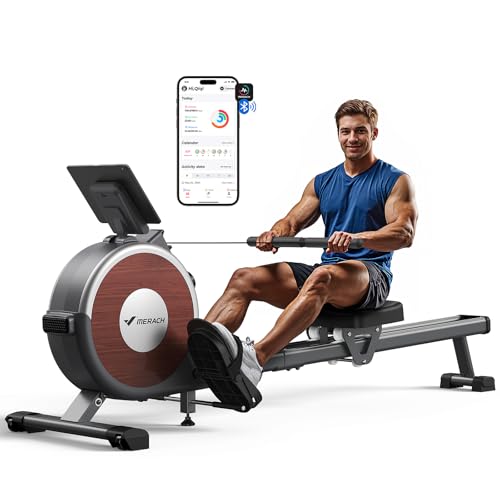
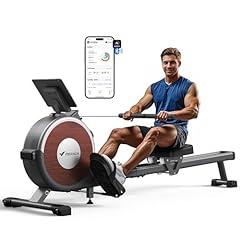
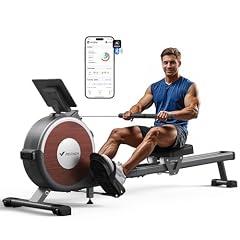
Merach Bluetooth Magnetic Rowing Machine with Dual Slide Rail
Overview
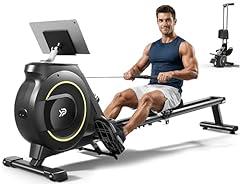
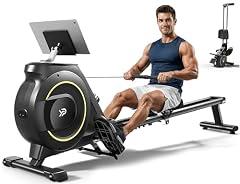
This is a compact, home-use magnetic rower with a dual rail, a basic battery-powered LCD monitor, Bluetooth app connection, and a manually adjusted 16-level resistance dial. The manufacturer manual states a 350 lb user limit, a stated user-height range of 4 ft 11 in to 6 ft 7 in, dimensions of about 65.6 by 19.6 by 25.7 inches, and a recommended session length of no more than 60 minutes. The manual includes assembly, inspection, warm-up, stroke-sequence, storage, and troubleshooting instructions. It also identifies adjustable rear foot pads to reduce rocking on an uneven floor. The product listing's description of automatic electromagnetic resistance does not match the manual and manufacturer product page, both of which describe manual resistance. The rower can be used without an app, while the companion app adds guided content and workout tracking.
What works
- The manual gives concrete fit limits, including a stated height range and 350 lb maximum user weight.
- A 16-level manual magnetic resistance dial allows a user to set workout effort without relying on app control.
- The manual provides specific stroke guidance, warm-up material, routine fastener checks, and steps for correcting machine shake.
- The LCD console runs on two AAA batteries, so normal use does not require a wall adapter or charging cable.
What does not
- The automatic resistance claim conflicts with manufacturer materials that describe manual resistance adjustment.
- No publicly verifiable report was located for independent safety, load, monitor-accuracy, UL, ETL, or ISO testing of this exact product.
- The upright storage method requires lifting the unit, and the manual does not describe a locking mechanism or child-resistant storage feature.
- The one-year limited warranty is short for a machine with moving rails, a belt, seat rollers, pedals, and Bluetooth electronics.
- The companion app has in-app purchases and collects fitness, usage, device, and diagnostic data linked to identity. Its store privacy disclosure is developer-reported, not independently verified.
Who is it for
This product suits an adult seeking a compact home rower for moderate cardio sessions who can use it on a level, grippy surface and is willing to check fasteners and foot pads routinely. It is most appropriate for people within the manufacturer-stated 4 ft 11 in to 6 ft 7 in range and below the stated 350 lb limit. It also fits users who want a simple battery-powered monitor and optional Bluetooth classes, rather than a mains-powered screen or mandatory subscription service.
Who is it not for
It is not suited to people who need independently documented load testing, certified electrical safety, validated workout power data, or commercial-duty warranty coverage. People with current low-back, rib, knee, wrist, balance, or cardiovascular concerns should obtain individualized clinical guidance before rowing, since the movement is repetitive and technique-sensitive. It is also unsuitable for homes where children can access an upright stored machine unsupervised, or for anyone who cannot safely lift it into its vertical storage position.
Integrity
Regular rowing can contribute to aerobic activity when effort and weekly volume are sufficient. Federal guidance calls for 150 to 300 minutes of moderate aerobic activity weekly, or 75 to 150 minutes of vigorous activity, plus muscle-strengthening work on two days. This product's manual appropriately advises users with relevant medical conditions to consult a clinician, to stop for concerning symptoms, and to learn the leg-first stroke sequence. That matters because rowing literature identifies the lower back and ribs among important overuse injury areas. The rower avoids an external power supply during ordinary use because its monitor uses two AAA batteries. Those batteries should be removed for long storage and recycled through an appropriate battery program. Manufacturer materials identify aluminum alloy rails and a carbon-fiber outer shell, but do not provide a bill of materials, packaging composition, recycling instructions, or product-specific chemical disclosure. No independently verifiable certification or exact-model laboratory safety report was located in the reviewed public sources.

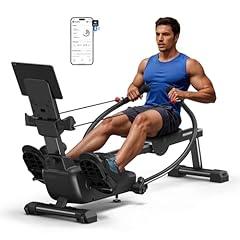
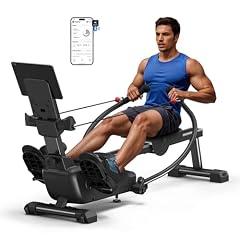
Merach Magnetic Rowing Machine with App
Overview
This is a compact, dual-scull home rower with two independently moving arms, a sliding seat, manually adjustable magnetic resistance, an LCD monitor, and Bluetooth links to the MERACH and Kinomap apps. MERACH identifies the current RS3 as the renamed MR-R26 hardware. Its own specifications state 16 resistance levels, 350 lb maximum user weight, a 4 ft 11 in to 6 ft 7 in recommended height range, and a 1,160 mm rail. The unusual feature is its broad, 120-degree outward arm path and single-arm or alternating-arm modes. Those are manufacturer claims, not independent evidence that it corrects muscle imbalance or improves posture. General aerobic benefits can come from sufficiently regular rowing exercise, but the supplied resistance and monitor have not been independently validated. The manufacturer states that the machine folds to 1540 by 750 by 315 mm and includes a basic LCD for pace, distance, strokes, watts, and calorie estimates.
What works
- Independent scull arms allow synchronized, alternating, and one-arm drills, according to the manufacturer.
- The manufacturer publishes useful fit details, including rail length, recommended height range, adjustable foot straps, and a stated 350 lb user limit.
- The product can be used with its LCD monitor without requiring an app connection for core session tracking.
- MERACH provides one year of equipment coverage, with a second year available after member registration.
What does not
- No publicly verifiable test report or certification was identified for this exact product under ISO rowing-machine safety methods, UL or ETL, or FCC equipment authorization.
- The stated 350 lb capacity and folding stability are manufacturer claims, with no independent load or upright-storage test report located.
- The wide sculling motion may increase coordination demands. Ergometer rowing is associated with low-back overuse risk, especially with prior lumbar injury, high volume, fatigue, or poor technique.
- Calories, pace, distance, and watts are displayed, but no accuracy specification or independent validation for this monitor was identified.
- The product page promises six months of premium app access, while MERACH's service terms describe auto-renewing paid subscriptions without stating the future price on the product page.
Who is it for
It suits an adult home exerciser who wants a compact, quiet-feeling magnetic rower with a nonstandard two-arm motion, has enough floor space for its 60.6 by 29.5 in deployed footprint, and is within the manufacturer's stated 4 ft 11 in to 6 ft 7 in fit range. It is most appropriate for people using perceived exertion and session consistency rather than treating the displayed calorie, watt, or pace values as laboratory-grade training data. Beginners should start at an easy resistance and learn a controlled stroke before adding volume.
Who is it not for
It is not a rehabilitation device for a person with current low-back, shoulder, knee, or wrist pain, or for anyone instructed by a clinician to avoid loaded repetitive pulling and trunk flexion. The independent arms and broad outward path add coordination demands, and no product-specific ergonomic study was found. It also does not fit buyers who need independently certified load safety, verified Bluetooth compliance, exact monitor accuracy, or a clearly priced long-term app plan. Households with unsupervised children should not leave the folded product accessible.
Integrity
Regular rowing can contribute to aerobic activity when performed at an adequate intensity and weekly volume. Federal guidance recommends 150 to 300 minutes weekly of moderate aerobic activity, plus muscle-strengthening work on two days. That supports realistic cardio use, but not the product's unverified claims to correct muscle imbalance, improve posture, or deliver individualized fat-burning results. Published rowing research also identifies the lumbar spine as a common overuse concern, particularly with prior injury and higher ergometer-training volume. MERACH describes steel, aluminum alloy, ABS plastic, rubber grips, PU foam, and a nylon pull rope, but does not publish a bill of materials, chemical disclosure, safety data sheets, packaging composition, recycling instructions, or an exact-product Proposition 65 warning. No exact-product CPSC recall was identified in the public recall search reviewed. The machine's LCD is battery powered, which avoids a mains adapter, but its Bluetooth hardware has no public exact-product FCC authorization located. MERACH offers a one-year equipment warranty, extendable to two years after registration, but a dedicated RS3 parts catalog or repair manual was not located.

YPOO Foldable Magnetic Rowing Machine
Overview
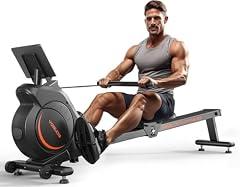
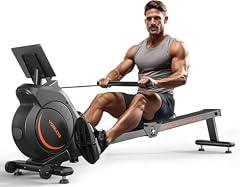
This is a compact, home-use magnetic rowing machine with a manual 16-level resistance control, a battery-powered LCD console, foot straps, a phone holder, transport wheels, and Bluetooth support for YPOOFIT and Kinomap. The manual identifies it as a non-speed, home-use product and states a 350-pound maximum user weight, 65 by 23.6 by 17.7 inches, and a 38.8-pound machine weight. The most material independently checkable fact is that its Bluetooth-equipped console has an FCC authorization record for this exact model. The manual also provides concrete assembly, maintenance, storage, and rowing-form instructions. Its claimed full-body cardio and strength use is plausible when resistance and session intensity are sufficient, but no independent testing was located for the machine's resistance output, load capacity, monitor accuracy, or mechanical safety. The listing calls it foldable, while the manual instead describes upright storage against a wall, without a folding procedure.
What works
- The manual gives specific rowing cues for straight wrists, a neutral back, knee alignment, foot restraint, and gradual progression.
- Core display functions work without mandatory app use, according to the manual, including time, strokes, strokes per minute, distance, and calorie estimates.
- The Bluetooth radio has a documented FCC authorization for the exact model.
- Maintenance instructions tell users to inspect fasteners and moving parts, stop using damaged equipment, and replace damaged parts before resuming use.
What does not
- The stated 350-pound user limit is manufacturer-stated. No public mechanical load-test report or independent certification to the rowing-machine safety standard was located.
- The listing's foldable claim is not supported by the manual. It directs upright storage against a wall rather than describing a folding mechanism or pinch protection.
- The monitor's distance and calorie figures are not accompanied by a technical method or independent accuracy validation, so they should be treated as workout estimates.
- The one-year frame warranty and 90-day warranty for other components are documented, but a public parts catalog, repair manual beyond basic troubleshooting, and parts ordering route were not located.
- No product-specific material disclosure, Proposition 65 warning information, packaging specification, or end-of-life recycling guidance was located.
Who is it for
It suits an adult home exerciser who wants a compact, cord-free magnetic rower for moderate cardio sessions and basic stroke feedback, and who is willing to assemble it, inspect bolts regularly, and follow the manual's technique cues. It is most appropriate where a stable, level floor is available and upright wall-supported storage is practical. The manufacturer-stated 350-pound limit may fit a broad range of users, but buyers near that limit should recognize that independent load-test evidence was not located. It is not a medical or rehabilitation device.
Who is it not for
It is not appropriate for children, unsupervised users with impaired ability, or households that cannot keep an upright stored machine out of children's reach. People with active low-back, rib, knee, wrist, balance, or cardiovascular concerns should seek individualized clinical guidance before beginning, because rowing technique and training volume can aggravate overuse injuries. It also does not suit users who need independently verified capacity, safety testing, precise power or calorie data, a confirmed folding lock, or readily documented replacement-parts support. Avoid relying on the connected app if you are unwilling to share fitness and account data under its stated privacy practices.
Integrity
Rowing can contribute to aerobic activity when performed at a sufficient intensity and duration. Federal guidance recommends 150 to 300 minutes weekly of moderate aerobic activity, plus muscle-strengthening work on two days. The manual's advice to progress gradually and its form cues are useful, especially because rowing injury literature identifies the lumbar region as a common concern and links poor technique and training load with risk. The product should not be presented as medical treatment or as a precise calorie-measurement device. For connectivity, the Bluetooth-equipped product has a documented FCC authorization. That verifies radio authorization, not mechanical load testing, electrical product safety listing, monitor accuracy, or overall safety certification. No product-specific UL or ETL listing, public mechanical test report, recall, exposure warning, materials disclosure, packaging data, or recycling plan was located. Its console uses two AAA batteries, which should be removed at end of life and taken to an appropriate battery-recycling program rather than discarded with the machine.
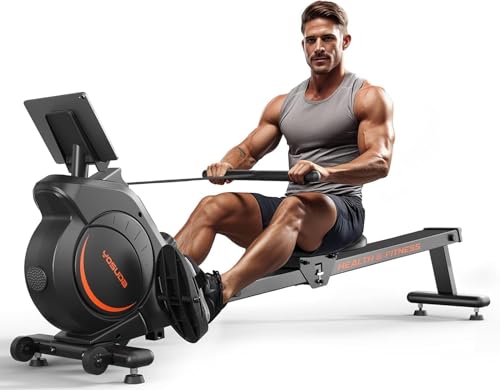
YOSUDA Magnetic Rowing Machine 350 LB Capacity
Overview
This is a compact, home-use magnetic rower with a battery-powered LCD console, manually adjustable resistance, a steel frame, foot straps, and upright storage. The available model H-181 manual identifies a 350-pound maximum user weight and dimensions of about 56.7 by 19.3 by 25.4 inches. Those are manufacturer-stated figures, not independently load-tested results. The manual confirms the basic monitor records time, distance, calories, stroke count, and total count. It also gives technique and maintenance instructions, including fastening pedal straps, pulling straight back, avoiding side pulls, and keeping clothing clear of the seat rollers. Retail listings describe Bluetooth and app support, but the available manual does not document app setup, subscription terms, or wireless specifications. No public model-specific independent mechanical, electrical, or monitor-accuracy test report was located.
What works
- The basic LCD tracks time, distance, calorie estimate, stroke count, and total count without requiring an account or app.
- The manufacturer-stated 350-pound user limit is consistently published in the available manual and retailer specifications.
- The manual includes useful basic risk controls, including foot-strap use, straight pulling, roller-clothing clearance, leveling adjustment, and upright-storage instructions.
- The manual provides an exploded parts diagram, fastener list, cleaning guidance, and a one-year manufacturer-stated warranty.
What does not
- No public ISO 20957 test report, accredited laboratory report, UL or ETL listing, or other independent safety certification was located for this exact product.
- The 350-pound capacity is a manufacturer claim, with no publicly verifiable structural load-test evidence for this exact model.
- Bluetooth and app support are advertised, but the available manual documents only the standalone LCD and does not explain pairing, app costs, data handling, deletion, or offline limitations.
- Published specifications are not fully consistent across sources, including dimensions and product weight. That makes exact space planning and claim comparison less reliable.
- The calorie display is an estimate. No model-specific validation was located for calories, distance, or any conversion to pace or power.
Who is it for
This product suits an adult who wants a compact, manually operated home rower for general cardiovascular activity and does not need connected coaching or laboratory-grade training data. It is most appropriate for someone willing to learn the stroke sequence, check fasteners periodically, and use the basic LCD for time, distance, and stroke-count tracking. The manufacturer-stated 350-pound limit may suit larger users, but people near that limit should treat it as an unverified capacity claim and inspect the frame, rail, seat, footrests, and bolts carefully before use.
Who is it not for
It is not well suited to people with active low-back, hip, knee, wrist, or shoulder symptoms who need individualized setup or clinical guidance. Indoor rowing can load the lumbar spine, particularly with fatigue or poor pelvic and trunk control, and this product has limited documented adjustment information. It is also unsuitable for households needing a verified child-safe storage lock, users who require independently validated power or calorie data, and privacy-sensitive users who expect clear documentation before connecting a fitness app.
Integrity
Rowing can provide useful whole-body aerobic exercise when resistance and session length are progressed gradually. The product's manual gives practical technique cautions, including straight, two-handed pulls and keeping clothing away from rollers. Those instructions matter because rowing research identifies lumbar mechanics, fatigue, and technique as relevant to low-back injury risk. The product should not be treated as rehabilitation equipment or as a precise calorie-burn tool. No recall or public safety warning specific to this product was located in the CPSC recall and consumer incident resources searched. No public model-specific UL, ETL, FCC, or independent ISO safety test record was located either. The unit uses two AAA batteries for its console, creating a small replaceable-battery waste stream. Materials, coatings, packaging composition, recycling instructions, replacement-part availability, and chemical exposure disclosures were not sufficiently documented to substantiate lower-impact or low-exposure claims.
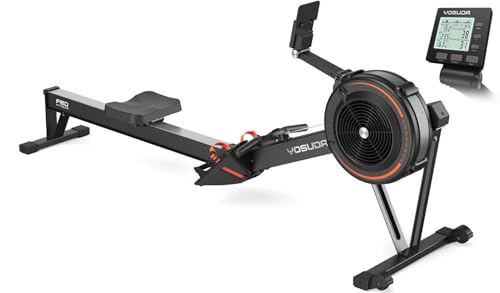
YOSUDA R2 Professional Air Resistance Rowing Machine
Overview
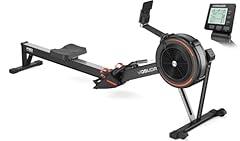
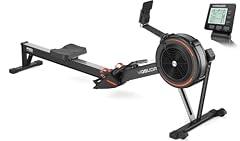
This product is a full-length, home-use air rower with a manufacturer-stated 350-pound user limit, 95 by 24 by 44 inch footprint, transport wheels, and an LCD workout display. Air resistance rises with pulling effort, so the user sets intensity mainly through stroke rate and force. That makes it suited to steady aerobic sessions as well as shorter, harder intervals, rather than a machine with a fixed programmed resistance dose. The product page states a 53.7-inch rail and a user-height range from 3 feet 11 inches to 6 feet 10 inches. It also states that the rail is aluminum alloy, the drive chain is nickel-plated steel, and the monitor is self-powered. These are manufacturer statements, not independently verified test results. No model-specific ISO test report, electrical listing, or public monitor-accuracy validation was located.
What works
- Air resistance can support progressively harder cardio work without a mains power connection, according to the manufacturer.
- The stated 350-pound capacity and broad 3 feet 11 inches to 6 feet 10 inches fit range make its intended user envelope unusually explicit.
- The manufacturer identifies wear-relevant construction details, including an aluminum alloy rail, PU rollers, and nickel-plated steel chain.
- A one-year warranty and lifetime technical support are stated by the manufacturer-distributor.
What does not
- No publicly verifiable independent mechanical safety test, electrical listing, or exact-model certification was located.
- The product claims accurate, reliable performance metrics, but no independent validation of its distance, power, heart-rate, or calorie calculations was found.
- The catalog describes a self-powered monitor while also listing two nonstandard batteries, so the console power arrangement needs clarification before purchase.
- No exact-model manual was located to verify folding or upright-storage locking, pinch protection, clearance requirements, or detailed rowing technique guidance.
- Material, packaging, chemical-warning, replacement-parts, and end-of-life recycling disclosures are not sufficiently specific.
Who is it for
It fits an adult home exerciser who wants a long-rail air rower for self-paced aerobic training or intervals, has a clear level floor, and can accommodate a 95-inch machine during use. The stated 350-pound capacity and broad height range are useful starting points for households with varied adult users. It is most appropriate for someone comfortable checking fasteners, keeping children away during use, and treating the console as a progress tracker rather than a validated training instrument.
Who is it not for
It is not a good fit for people rehabilitating a back, knee, wrist, or shoulder condition without clinician or qualified coaching input. Indoor rowing can load the lower back, especially when technique deteriorates with fatigue or training volume. It is also unsuitable for homes needing confirmed safe upright storage around children, formally verified mechanical testing, or a clearly documented battery and wireless compliance record. Data-focused athletes who need validated pace, power, calorie, or heart-rate accuracy should not rely on its stated metrics alone.
Integrity
Regular rowing can contribute to the aerobic activity recommended for adults when used at an appropriate intensity and duration. The product's air-resistance system should permit gradual progression, but its HIIT and performance language is marketing, not evidence of a specific health outcome. Research on rowing identifies the lower back as a common injury site, with prior back injury, high ergometer volume, and fatigued technique important concerns. Start conservatively and prioritize technique. No exact-product recall or CPSC safety warning was located in the searched public databases. That is not the same as independent safety clearance. No public ISO test report, UL or ETL listing, FCC equipment record, product-specific Proposition 65 disclosure, or monitor validation was found. The identified aluminum rail and metal chain may support serviceability, and one-year warranty coverage plus lifetime technical support are manufacturer-stated. Packaging composition, replacement-parts access, battery disposal guidance, and recycling instructions remain undisclosed.

MERACH Foldable Water Rowing Machine
Overview
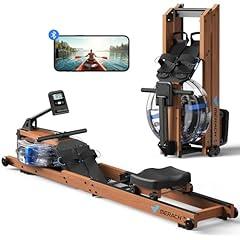
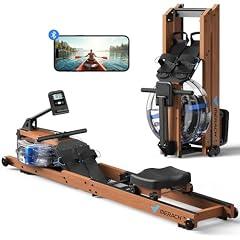
This is a manual, water-resistance home rower with a wooden frame, LCD monitor, Bluetooth connection, two AAA batteries, adjustable foot straps, and a folding rail. The supplied manual describes six water-resistance levels, a 400 pound maximum user load, and an in-use footprint of 72.6 by 17.3 by 28 inches. It is intended for one person and home use only. The manufacturer states that the frame uses FSC-certified rubberwood, the tank is leak-proof, and the unit folds 180 degrees with transport wheels. The manual provides posture, assembly, storage, inspection, and water-care instructions, including placing an upright stored product against a wall. Its Bluetooth radio module is identified by an FCC authorization, but no public, model-specific ISO mechanical safety report, monitor-accuracy validation, or third-party structural test was located.
What works
- The manual gives a concrete 400 pound maximum user load and specifies one-person home use.
- Safety instructions address clothing entanglement, children, fastener checks, upright storage, and water-tank maintenance.
- The Bluetooth module identified in the manual has an FCC equipment authorization.
- The manufacturer provides a one-year limited warranty for the frame and other components, with an extra year offered after registration.
What does not
- No public ISO 20957 test report or independent laboratory evidence was located for this product's frame, fold mechanism, load rating, or monitor accuracy.
- Published dimensions conflict. The manual lists 72.6 inches long, while the catalog listing states 60 inches, which can materially affect room planning.
- The water resistance is manual and speed-related. The product page's statement that Bluetooth pairing auto-adjusts resistance is not explained or substantiated for this water rower.
- Material disclosure is limited. There is no product-specific chemical disclosure, water-treatment ingredient sheet, packaging specification, or end-of-life guidance for the included batteries.
Who is it for
It suits an adult home exerciser who wants a manually powered rowing motion for general aerobic activity, has enough clear floor length for a rower closer to 73 inches long in use, and will follow the posture and maintenance guidance. It is also relevant for a household that needs to store the unit upright against a wall and can keep children and pets away from it. Treat the console's calories and distance as progress cues, not clinical or highly precise measurements.
Who is it not for
It is not appropriate for anyone seeking rehabilitation equipment, a medically tailored exercise plan, or verified low-back protection. Rowing can load the lumbar spine, and the available evidence does not establish a customized fit range, rail travel range, or independent ergonomic assessment for this product. It is also a poor fit for homes where upright storage cannot be secured against a wall, where unsupervised children can access the fold area, or where exact performance data, independently tested load safety, and detailed chemical disclosure are required.
Integrity
Rowing can contribute to the aerobic activity adults are encouraged to accumulate each week when the intensity and total time are appropriate. It is not a medical device, and safe progress depends on technique, training load, and an individual's health status. The manual offers basic posture and safety directions, but back pain is a recognized rowing concern, so people with current back, knee, wrist, or cardiovascular symptoms should seek individualized clinical guidance before hard sessions. The manufacturer states that the frame is FSC-certified rubberwood and supplies water-purification tablets for tank care. That is more material detail than a generic plastic-frame listing, but the certification chain, coating composition, tablet ingredients, packaging composition, replacement-parts catalog, and battery recycling instructions were not publicly documented for this product. The Bluetooth module has an FCC authorization. No product-specific UL or ETL electrical listing, recall, or public independent mechanical test report was located.
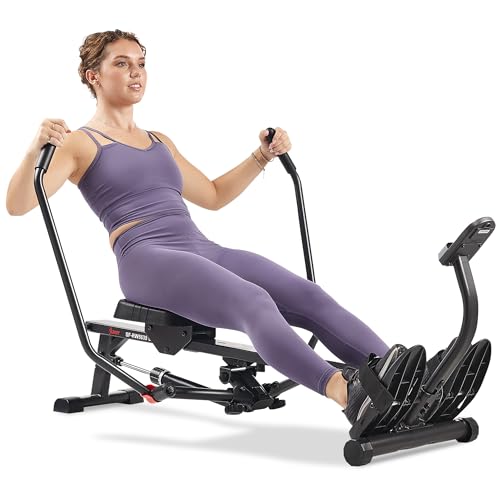
Sunny Health & Fitness Smart Full Motion Rower SF-RW5639SMART
Overview
This product is a compact, home-only hydraulic rower with a sliding seat rail, separately moving full-motion handles, adjustable foot straps, a battery-powered display, and Bluetooth connection to the SunnyFit app. The manufacturer lists 12 hydraulic resistance settings, a 42.9-inch inseam capacity, and dimensions of 55.7 by 29.1 by 22.6 inches. Its current product page says it needs no wall outlet and tracks time, distance, strokes per minute, 500-meter pace, counts, and calories. The key operating limit is manufacturer-documented: the hydraulic cylinder is intended for sessions of up to 20 minutes, followed by at least 20 minutes of cooling, because it can become hot enough to be unsafe to touch. The current product page claims a 400-pound user limit, while a publicly available version of the product manual states 350 pounds. No model-specific ISO, UL, ETL, or accredited laboratory safety report was publicly verifiable.
What works
- The manual gives practical safety directions, including a level floor, two feet of surrounding clearance, regular fastener checks, and stopping use if damaged or noisy.
- Manufacturer-stated 12-level hydraulic resistance allows the session effort to be adjusted without electricity.
- The current manufacturer specification gives a long 42.9-inch inseam capacity, padded seat, adjustable foot straps, and stabilizer bars.
- Core machine use does not require an outlet, and the SunnyFit app is currently described by its developer as free to download and use.
- The manufacturer provides a three-year structural-frame warranty and identifies replacement parts through support.
What does not
- The product documentation conflicts on maximum user weight. The current page says 400 pounds, while a public manual version says 350 pounds.
- The hydraulic cylinder has a 20-minute use limit and a required cool-down period because it can become dangerously hot.
- There is no publicly verifiable model-specific ISO safety test, accredited laboratory report, UL or ETL listing, or monitor-accuracy validation.
- The manufacturer page carries a California cancer and reproductive-harm warning without identifying the relevant chemical or component.
- Calories are displayed as calories burned, but no personal calibration method or independent accuracy evidence was found.
Who is it for
This product suits an adult home user seeking short, self-paced rowing sessions rather than uninterrupted endurance work. It is most appropriate for someone who can get on and off a seat roughly 11 to 14 inches high, has room for the stated machine footprint plus the manual's two-foot safety clearance, and is prepared to check fasteners and floor stability after assembly. The stated 42.9-inch inseam capacity may also be useful for people who need a longer seat travel range. App use is optional for core rowing and display functions.
Who is it not for
It is not appropriate for therapeutic rehabilitation, since the manual specifically says it is not for therapeutic use. People with current low-back pain, recent lumbar injury, substantial knee limitations, or poor balance should seek individualized clinical or fitness guidance before using a rower, especially one with wide-moving arms. It also does not suit users needing continuous sessions longer than 20 minutes, precise calorie or power data, or professionally verified support at the advertised 400-pound capacity. Keep it inaccessible to children and pets, as the manual limits it to adult use and warns about moving parts.
Integrity
Indoor rowing can contribute to aerobic activity when intensity and total weekly exercise are sufficient, but this product should not be treated as medical treatment or a precise calorie-burn instrument. The manual has meaningful basic safety guidance, including clearance, level-surface setup, routine inspection, adjustable balance caps, moving-part precautions, and a cylinder cool-down rule. The manufacturer also states that the product is not suitable for therapeutic use. The product uses two replaceable AAA batteries in its console, and the manual instructs owners to dispose of them under state and local rules. It provides a parts list and a three-year structural-frame warranty, although other parts have only 180 days of coverage. Material and packaging disclosures are limited. More importantly, the manufacturer displays a California cancer and reproductive-harm warning, but does not publicly identify the chemical, component, or exposure route behind that warning for this product.
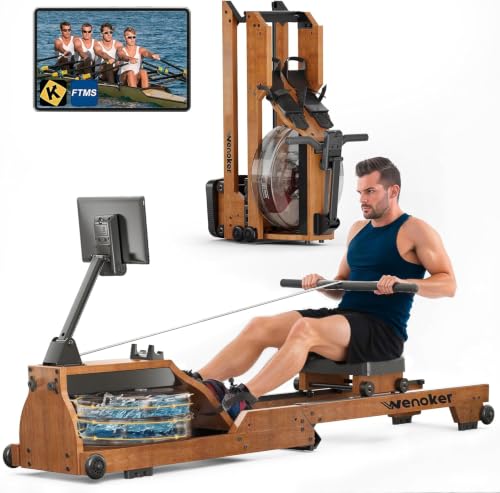
Wenoker Wooden Water Rowing Machine
Overview
This is a manual, water-resistance home rower with a folding rail, onboard battery display and Bluetooth connection to Kinomap. Wenoker describes six water-fill levels, resistance that rises with stroke speed, upright storage measuring 38.2 by 17.5 by 25.6 inches, and a 1-year warranty. Its current product page calls the frame FSC-certified solid wood with steel reinforcement, though the catalog record calls the material ash wood. The supplied manual provides assembly, water-care, folding and basic rowing-technique instructions, and identifies a monitor for time, distance, pace, stroke count, stroke rate and calories. It also creates an important specification conflict. The manual limits users to 330 pounds, while the product page and catalog claim 350 pounds. No public, model-specific ISO test report, accredited laboratory report, UL or ETL listing, or independently validated monitor-accuracy evidence was located.
What works
- Water resistance can scale with stroke speed, and six fill levels can change the starting load, according to Wenoker.
- The manual gives concrete folding, unfolding, water-care and basic stroke-sequence instructions rather than leaving setup entirely to product images.
- The battery-powered console provides basic workout feedback without requiring the connected app.
- Wenoker states that the product uses FSC-certified solid wood with steel reinforcement at structural points and includes a 1-year warranty.
What does not
- The stated maximum user weight conflicts across the available documentation, 330 pounds in the supplied manual and 350 pounds on the current product page and catalog. That is a safety-relevant inconsistency.
- No publicly verifiable, model-specific mechanical safety test, independent load test, electrical listing, Bluetooth authorization record, or monitor-accuracy validation was found.
- The calorie display is documented as a count, but no method, personal inputs, or accuracy limits are given. It should be treated as an estimate, not personal energy-expenditure measurement.
- The water-treatment tablets are included and periodic use is instructed, but the available material does not identify their ingredients or provide a safety data sheet.
- Kinomap has optional subscriptions and disclosed app tracking and identity-linked data practices. Wenoker does not clearly explain the product-specific data flow or account-deletion process.
Who is it for
It suits an adult home exerciser who wants manually paced rowing, can use a flat dedicated workout area, and values an upright storage position after use. It is most appropriate for someone comfortably below the lower documented 330-pound limit, who can use a standard fixed-seat rowing motion and is willing to inspect fasteners, water clarity and the folding mechanism routinely. It also fits users content with basic onboard time, distance and stroke feedback, with app-based training treated as optional rather than essential.
Who is it not for
It is not appropriate for anyone near or above 330 pounds, because the available documents disagree on the capacity and no independent load-test evidence was located. People with active low-back, knee, wrist, balance, cardiac or rehabilitation needs should obtain individualized clinical or qualified exercise guidance first. Repetitive ergometer rowing can aggravate lumbar problems when technique or training load is poor. Households with unsupervised children, pets, or limited clearance around stored equipment should be especially cautious with the folding rail and moving seat.
Integrity
Rowing can contribute to aerobic physical activity when intensity and weekly duration meet general activity guidance, but this product is not a rehabilitation device and its display cannot establish medical or calorie outcomes. The manual does include a basic catch, drive, finish and recovery sequence. That matters because rowing-ergometer research links fatigue, prior back injury and high training volume with lumbar pain risk. Start conservatively, maintain a neutral, controlled trunk position, and stop for concerning symptoms. Wenoker states that the frame is FSC-certified solid wood with steel reinforcement, which is a potentially useful materials claim, but no certificate number or independent chain-of-custody record was supplied for this product. The manual calls for periodic water-treatment tablets and water changes, yet does not identify tablet chemistry or provide disposal guidance beyond draining water. The console uses replaceable AAA batteries, which should go to an appropriate battery-recycling program rather than household trash.
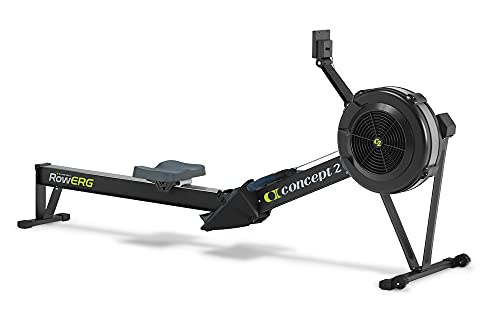
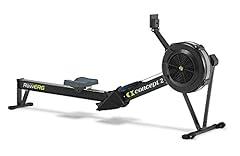
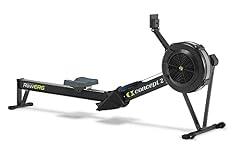
Concept2 RowErg Indoor Rowing Machine
Overview
This is a 96-inch air-resistance indoor rower with a sliding seat, nickel-plated steel chain, adjustable footrests, PM5 monitor, and two D-cell battery power. The standard-leg version has a 14-inch seat height, weighs 57 pounds, and separates into two sections for storage. Concept2 states that it needs a 9-by-4-foot use area and fits inseams up to 38 inches, with an extra-long rail available for some taller users. The manufacturer states a 500-pound user limit from its own testing, while its manual separately identifies a 300-pound limit tested to EN 20957-7. That distinction is useful, but a public third-party structural test report was not located. Independent laboratory research on a Model D, the predecessor name for this product, found PM5 power readings close to a reference system after the first five strokes, while short starts and uneven strokes were less accurate.
What works
- Independent testing supports useful PM5 power tracking once the flywheel is up to speed.
- The manual gives concrete setup, maintenance, technique, child-safety, and storage warnings.
- Public schematics and repair instructions cover the chain, seat rollers, shock cord, flywheel, monitor, and other service parts.
- The wireless PM5 is FCC-authorized, and the rower runs on low-voltage D-cell batteries rather than a supplied mains adapter.
- The manufacturer clearly distinguishes its 500-pound in-house limit from its 300-pound EN 20957-7 tested limit.
What does not
- The 500-pound capacity is manufacturer-tested, not supported by a publicly available independent load-test report.
- Rowing is not inherently back-safe. High ergometer volume, poor technique, fatigue, and prior lumbar injury are associated with low-back problems.
- The 14-inch standard seat can be difficult for people with knee, hip, balance, or sit-to-stand limitations. The taller-leg version is a separate configuration.
- The monitor's early strokes and highly uneven rowing can materially distort short-test power readings.
- Material chemistry is only partly disclosed. The PM5 documentation identifies small amounts of lead in exempt glass or ceramic components, but broader disclosure for grips, plastics, coatings, and lubricants was not located.
Who is it for
It suits adults who want a manually powered cardio machine with a long usable rail, a detailed technique guide, and data that can be used consistently for ordinary training. It is particularly practical for a home or shared gym that has roughly 9 by 4 feet of clear workout space and can store two separated sections. The standard version is best for people comfortable getting onto a 14-inch seat. Users near the stated 500-pound limit should treat that figure as manufacturer-tested rather than independently certified.
Who is it not for
It is not well suited to households with unsupervised children or pets around the machine, because the manual identifies seat-roller and connection-lock hazards. It is also a poor fit for anyone who plans to store it standing upright, which the manual warns can lead to tipping. People with active low-back pain, significant knee or hip limitations, poor balance during transfers, or a history of exercise-triggered symptoms should seek individualized clinical or coaching guidance before hard rowing sessions. It also needs more room than compact folding equipment.
Integrity
Indoor rowing can contribute to aerobic activity when used at an appropriate intensity and weekly volume. Federal guidance recommends 150 to 300 minutes of moderate aerobic activity each week, plus muscle-strengthening work on two days. This product does not need to promise medical outcomes to be useful for that purpose. Its manual appropriately warns that poor technique, extreme layback, jumping off the seat, worn parts, and overexercise can cause injury. Evidence on rowing also identifies training volume, fatigue, prior back injury, and technique as important low-back risk factors. The PM5 wireless monitor is FCC-authorized, but no UL or ETL electrical listing for the complete product was located. Concept2 provides a two-year moving-parts and monitor warranty, a five-year frame warranty, plus extensive repair documentation and replacement parts. Its sustainability page says monitors can be recycled as e-waste and foam packaging can be recycled. The company describes long-life design and repair access, but does not publish a quantified product-level material, packaging, or lifecycle assessment.

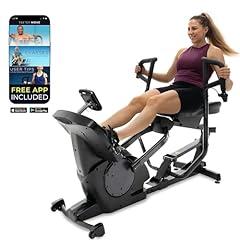
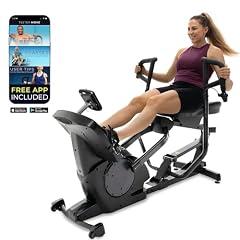
Teeter Power10 Elliptical Rower with Bluetooth
Overview
This product is a home-use elliptical rower with magnetic resistance, a push and pull motion, an LCD console, and upright storage. The manufacturer manual for the earlier Power10 configuration documents seven resistance settings, a 300 lb user limit, 12 seat positions, three handle-depth positions, and an included chest-strap heart-rate monitor. It is a large, approximately 180 lb machine, not a lightweight rail rower. The console records time, strokes, strokes per minute, distance, pulse, and calories. Its calorie counter requires a heart-rate monitor and allows an age entry, but there is no located independent validation of its energy, distance, or workload measurements. The product has clear moving-linkage pinch warnings and storage instructions, but no public model-specific ISO test report or third-party mechanical safety certification was located.
What works
- The documented 12-position seat and three-position handle adjustment give users meaningful fit options.
- The manual provides specific setup, inspection, moving-parts, foot-strap, and controlled-stop instructions.
- The included chest strap enables console pulse display, and its separate transmitter can connect by Bluetooth to compatible third-party devices.
- Teeter states that its workout app has no subscription fee or in-app purchases.
What does not
- No public independent safety, load, monitor-accuracy, UL, ETL, or ISO test report for this exact product was located.
- The console itself is not Bluetooth compatible, despite marketplace wording that can imply Bluetooth heart-rate connectivity. Bluetooth applies to the included chest strap.
- Calories are an estimate based on heart rate and entered age, not a validated personal energy-expenditure measurement.
- The product has exposed moving linkages with explicit pinch and entrapment warnings. It should be kept away from children and pets.
- No product-specific materials, chemical disclosure, packaging specification, or end-of-life recycling guidance was located.
Who is it for
This product suits an adult home exerciser who wants a resistance-based cardio machine with more fit adjustment than a fixed-position rower. It is particularly relevant for users within the stated 300 lb limit who can safely manage a roughly 180 lb machine and have enough clear floor space for its wide base. The 12 seat settings, three handle positions, adjustable resistance, and included pulse strap can help a household tailor workouts gradually. It is better treated as general fitness equipment, not rehabilitation equipment or a medical device.
Who is it not for
It is not suitable for households where children or pets can access the machine unsupervised, because the manual identifies multiple pinch points in the moving rear linkage. People with current low-back pain, a prior lumbar injury, balance limitations, or conditions that make stepping into strapped footrests difficult should seek individualized clinical or exercise-professional guidance before use. Rowing-ergometer evidence identifies prior back injury and high training volume as low-back risk factors. It is also unsuitable for buyers who need independently validated power, pace, distance, calorie, or mechanical safety results.
Integrity
The health case is credible at the general exercise level. Regular moderate or vigorous aerobic activity can support health when accumulated at an appropriate weekly dose, and the resistance range can contribute to muscular work. The manufacturer also provides detailed adjustment guidance intended to avoid locked knees and permits users to vary seat and handle positions. These are useful safeguards, although they do not eliminate the back-load and overuse risks associated with poorly progressed ergometer training. The safety manual clearly identifies moving-linkage pinch hazards, requires a level surface, directs upright storage near a wall, and sets a 300 lb limit. No active U.S. recall for this product was located. No public independent certification or laboratory test report for this exact product was found. The console uses two AA batteries, which should be removed and handled through an appropriate battery-recycling route when depleted. Teeter does offer support and a limited warranty, but material composition, packaging reduction, and recycling information remain undisclosed.