
10 Best Pull up Tower
 Brianna York
Please note that we participate in affiliate marketing programs. When you purchase through links on our site, we may earn a commission. As an Amazon Associate we earn from qualifying purchases. This comes at no additional cost to you and helps support the resources required to provide valuable content.Advertising Disclosure
Top-rated Pull up Tower Comparison
1

2
4
5
6
7
8
+
9
Pull-up towers: what matters
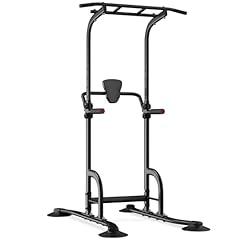
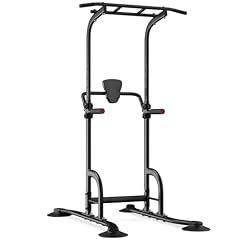
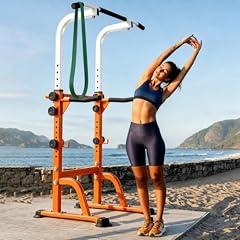
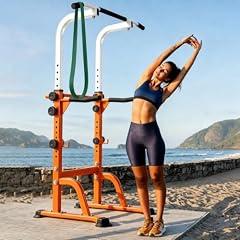
A pull-up tower is a freestanding or foldable home station for bodyweight movements such as pull-ups, chin-ups, dips, knee or leg raises, push-ups, and rows. Some models also add adjustable pull-up heights, padded supports, assistance bands, cable systems, or barbell-rack functions. The exercise options are useful only when the frame remains stable, the adjustment hardware stays locked, and the user has enough room to move without striking the ceiling, walls, furniture, or other people.
The most important distinction is between a stated capacity and demonstrated performance. A number such as 330, 400, 450, 500, 660, or 700 pounds may be only a manufacturer recommendation. It does not necessarily show that the exact tower resists tipping, joint failure, or collapse during pull-ups, dips, swinging, or other changing loads. Stronger evidence would be an exact-model test report addressing ASTM F2276-23 or ASTM F2571-15(2020), or an ISO/IEC 17025 report from an A2LA- or ANAB-accredited laboratory. A certification should also be independently checkable through directories such as UL Product iQ, Intertek ETL, TÜV Rheinland Certipedia, A2LA, or ANAB. No supplied product had that level of independently checkable safety proof.
Buyers should look for a model-specific manual that states the user-weight limit, permitted exercises, required floor conditions, surrounding clearance, anchoring or ballast requirements, adjustment-lock instructions, and inspection or retightening schedule. A broad footprint, heavy frame, triangular or H-shaped base, suction cups, anti-slip feet, locknuts, or welded steel frame may support practical stability, but these features are not substitutes for dynamic testing. A rack intended for kipping pull-ups or muscle-ups should state how it must be anchored; one supplied rack specifically requires floor bolting for those movements.
Headline specifications can also mislead through inconsistency. Supplied listings disagree about capacities, dimensions, adjustment counts, unit weights, and even whether a model is rated at 300, 330, 350, 400, 450, 500, 660, or 700 pounds. Some manuals and listings use different limits, while one manual contains a major pounds-to-kilograms conversion error. A static user-weight figure also does not establish safe added loading, ring work, weighted calisthenics, kipping, or swinging. Buyers should use the most conservative clearly documented limit until the maker resolves conflicts.
Across the supplied products, the recurring safety caveats are substantial: freestanding towers should be placed on a firm, level, non-slip surface; some suction-cup designs are unsuitable for carpet; hardware, pins, feet, grips, welds, and caps need inspection; and controlled repetitions are safer than swinging, kipping, explosive transitions, muscle-ups, or added external loading. Several products lack anchoring guidance, spare-parts information, chemical disclosures, or independent testing. Children should not climb on these stations unsupervised, and people with balance limitations, recent injuries, pain, or rehabilitation needs should use individualized professional guidance. One product also had reported concerns about loose or spinning grips and detachable feet, reinforcing the need to stop use when any component moves or becomes damaged.
Integrity
The supplied reviews show a consistent pattern: these products can provide practical resistance-training positions, but most structural, chemical, and durability claims remain manufacturer-stated. Higher scores indicate stronger documentation or more controlled design signals within this group; they do not convert into independent certification or a guarantee of safe use.
HHealth & Safety
Verified stability and load safety
This measures exact-model evidence against tipping, collapse, and joint failure under realistic user and equipment loads. It matters because pull-ups and dips create changing forces. The supplied scores range from 50 to 74: higher-scoring racks had clearer manuals, anchoring or setup controls, while lower-scoring towers relied more heavily on unverified capacity claims.
Protection against falls and tip-overs
This examines base geometry, mass, feet, floor requirements, anchoring or ballast, and limits for moving exercises. Freestanding towers can shift when users swing or pull sideways. Scores range from 63 to 77; higher results reflect clearer floor, clearance, inspection, or anchoring instructions, while lower results leave dynamic-use limits less explicit.
Frame, weld, and fastener durability
This measures whether frames, welds, pins, bolts, locking hardware, and corrosion protection are supported by construction details and maintenance guidance. Repeated bodyweight loading makes loose hardware important. Scores range from 66 to 76; higher-scoring products supplied more concrete inspection or retightening guidance, while lower scores lacked parts, endurance, or hardware documentation.
Safe grips, edges, and moving parts
This covers sharp edges, exposed tube ends, fasteners, pinch points, grips, dip handles, pads, and adjustment mechanisms. A loose, spinning, torn, or poorly protected contact point can reduce control during a loaded movement. Scores range from 54 to 74; higher-scoring products had better-described padding, capped ends, or contact controls.
Fit and safe exercise space
This measures adjustment range, grip and support geometry, user limits, footprint, ceiling height, and surrounding clearance. A tower that fits one user or room may not fit another safely. Scores range from 55 to 78; higher-scoring products offered clearer height settings or ranges and more useful space-planning information.
Realistic fitness and health claims
This asks whether the product describes resistance-training uses without promising guaranteed fat loss, medical treatment, posture correction, or rehabilitation. The exercise functions are generally credible, but outcomes depend on programming and the user. Scores range from 52 to 80; higher scores used more restrained exercise claims, while lower scores included unsupported therapeutic or outcome language.
EEvidence
Independent safety proof
This measures traceable third-party certification or accredited laboratory evidence for the exact product. It matters because seller badges and capacity claims are not independently checkable proof. Scores range from 68 to 70, but the reviews found no exact-model ASTM report, ISO/IEC 17025 report, UL, ETL, TÜV, or comparable certification for the supplied products.
Honest capacity and specification claims
This measures whether capacity, dimensions, materials, adjustments, accessories, standards claims, and warranty terms agree across the listing and documentation. Conflicting numbers make safe planning difficult. Scores range from 48 to 76; higher-scoring products had fewer or less serious discrepancies, while lower scores involved conflicting load limits, dimensions, or adjustment details.
Traceable maker and safety record
This measures whether the responsible maker, importer, model, contact information, warranty, and safety history can be identified. It matters when a tower has a defect or needs parts. Scores range from 68 to 77; higher-scoring products supplied clearer brand or contact records and no located recall, while lower scores had thin maker traceability.
Transparent coatings and contact materials
This measures disclosure of coatings, foam grips, rubber feet, plastic caps, warnings, and relevant chemical or material testing. These components are handled and may wear during use. Scores range from 68 to 70, reflecting a broad lack of declarations, safety data, Proposition 65 detail, or exact-product chemical testing across the supplied group.
EEcology
Long life and lower material waste
This measures whether a mostly metal tower can stay in service through durable construction, corrosion protection, manuals, spare parts, repair guidance, warranty support, reuse, and metal recycling. Scores range from 69 to 74. Higher-scoring products had clearer warranties, inspection guidance, or repair signals; nearly all still lacked replacement-parts catalogs and formal end-of-life programs.
Full reviews

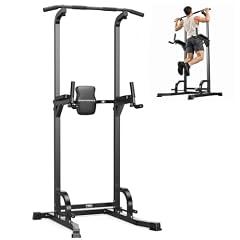
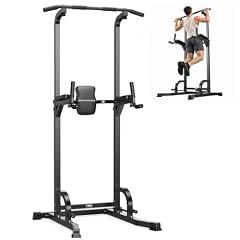
Sportsroyals Multi-Function Power Tower Dip Station
Overview
This is a freestanding indoor bodyweight station for pull-ups, dips, leg raises, inverted rows and elevated push-ups. The product is listed at 44 by 38 by 83 inches and about 47 pounds, with an alloy-steel frame, padded arm supports and backrest, lower push-up handles, and adjustable feet. It is not designed for commercial or therapeutic use. Its defining limitation is evidence quality. Retail listings and product imagery state a 360-pound maximum load, while an exact-product manual states 280 pounds, despite showing the same model, dimensions and 360-pound marketing image. The manual documents eight pull-up-bar heights from 57.09 to 83.07 inches, five backrest settings, flat-floor use, inspections and weekly bolt checks. No exact-model accredited laboratory report, third-party certification, or ASTM compliance documentation was located.
What works
- The manual gives concrete assembly, inspection and maintenance instructions, including weekly checks and retightening of bolts and nuts.
- Eight pull-up-bar heights and five backrest positions can improve fit across users, manufacturer-stated.
- The documented design includes a cross-supported base, adjustable foot covers, foam arm pads and rubber grips, manufacturer-stated.
- Its metal frame can be separated for ferrous-metal recycling at end of life, although local acceptance rules apply.
What does not
- The stated maximum load is inconsistent. The exact-product manual says 280 pounds, while retail product materials say 360 pounds.
- No accredited dynamic-load, stability, weld, fastener or endurance test report for this exact product was found.
- The freestanding base is not anchored. The manual requires a flat, stable, non-slip surface and says users must correct wobble before use.
- Marketing says the pads and armrest angle prevent posture damage, spine strain and joint wear, but no product-specific human evidence was located for those injury-prevention claims.
- No material declaration, safety data sheet, coating test report or specific disclosure for the foam, rubber or finish was located.
Who is it for
This product suits an adult home exerciser who wants a single indoor station for basic bodyweight pulling, dipping, supported leg raises, rows and push-ups, has a level floor, and can reserve roughly a 44 by 38 inch footprint plus clear exercise space. It is most appropriate for users comfortably below the more conservative 280-pound figure in the available manual, who will assemble it carefully, inspect it before use, and retighten hardware on the stated schedule. The multiple height and backrest settings may help households with differently sized adult users.
Who is it not for
It is not appropriate for anyone who needs a clearly independently verified load rating, commercial-gym durability documentation, or certified dynamic stability testing. Avoid using it near children or pets, on soft, sloped, slippery or uneven flooring, or where there is insufficient overhead and surrounding clearance for moving pull-ups and leg raises. People near or above 280 pounds should not rely on the higher 360-pound marketing figure until the maker resolves the contradiction in writing. It is also not a rehabilitation device or a substitute for clinician-guided exercise after injury.
Integrity
Regular resistance training can improve strength and physical function when performed consistently, but that evidence applies to training programs rather than proving that this station prevents injuries or corrects posture. The product materials describe foam pads, rubber grips and adjustable foot covers, but neither a coating chemistry disclosure nor independent material testing was located. People sensitive to odors, rubber additives or coating chemicals have little product-specific information to assess. The frame is described as alloy steel, which offers a practical end-of-life route through local ferrous-metal recycling programs. The available manual also supports longer service life by calling for regular bolt checks, damage inspection, dry storage and replacement of use when damaged. A search of public CPSC recall records did not identify a recall for this product or Sportsroyals. However, the responsible company information remains limited to brand support details, and no exact-product safety certificate or accredited test report was located.

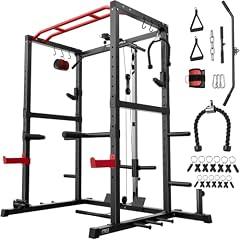
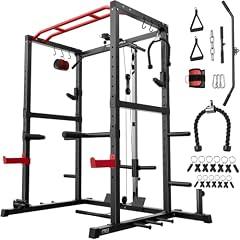
Sportsroyals Power Rack with LAT Pulldown System
Overview
This is a freestanding, red alloy-steel home power cage with upper and lower cable pulleys, a pull-up frame, dip bars, J-hooks, safety hardware, a landmine, band pegs and plate storage. Its stated footprint is 56 by 61.6 inches and its stated height is 82.6 inches. It is intended for barbell work, pull-ups, dips, lat pulldowns, seated rows and cable exercises. A seller-hosted product page identifies a 50 by 50 mm, 1.5 mm steel frame, a 150-pound product weight, two reinforcing tabs, a 1,200-pound rack claim and a 500-pound cable claim. Those are manufacturer-stated claims, not independently verified test results. No exact-product ASTM compliance record, accredited laboratory report, or third-party safety certification was located. A separately published instruction page also describes the rack as 200 pounds, creating an unresolved specification conflict.
What works
- The manufacturer-stated accessory set supports several common free-weight, body-weight and cable movements from one fixed station.
- The stated 56 by 61.6 inch footprint is concrete enough for room planning before assembly.
- Manufacturer materials identify a 50 by 50 mm steel frame with 1.5 mm wall thickness.
- A one-year manufacturer-stated warranty provides a defined minimum support period.
What does not
- No traceable exact-product ASTM test report, ISO/IEC 17025 laboratory report, UL, ETL, or TÜV certification was located.
- The 1,200-pound rating is not broken out by J-hooks, safety hardware, pull-up bar, dip bars and user load, so safe limits for each use are unclear.
- Published product information conflicts on rack weight, with 150 pounds on one product page and 200 pounds in a separately published instruction page.
- No coating chemistry, material declaration, safety data sheet, or independent testing for paint, grips, feet or plastic caps was located.
- The available instructions emphasize a level surface and tightened hardware, but do not provide clear anchoring, ballast, clearance, or stated user-weight requirements.
Who is it for
This product suits an adult home exerciser who wants a compact multipurpose station for moderate barbell practice, pull-ups, dips and plate-loaded cable work, and who has a flat indoor floor, enough ceiling clearance for an 82.6-inch frame, and room around the stated 56 by 61.6 inch footprint. It is better suited to someone willing to assemble with help, verify every fastener before use, inspect the cable path and hardware regularly, and treat the published capacity as unverified rather than as a demonstrated working limit.
Who is it not for
It is not a good fit for households with unsupervised children or pets in the training area, users needing documented accessibility accommodations, or people who need a clearly stated individual user limit. It also does not suit lifters planning maximal, dynamic, or unsupervised barbell attempts, because no exact-product independent stability or endurance report was located and component-specific limits are unclear. Avoid relying on it where a rack must be anchored, certified for institutional use, or installed on an uneven floor.
Integrity
Resistance training can improve strength, muscle size and physical function when it is programmed progressively, but the cage itself does not create those outcomes. The product marketing describes broad training uses rather than a medical treatment or guaranteed body-composition result, which is more realistic. Safe use still depends on exercise selection, load, technique, correctly positioned safeties and a level installation surface. No exact-product independent safety certification, accredited test report, recall record, or regulatory action was located in the searched U.S. sources. The product is described as alloy steel, which is a durable and commonly recyclable ferrous material. However, there is no published coating chemistry, chemical compliance documentation, replacement-parts catalog, or detailed repair program. The one-year stated warranty is useful, but it is limited evidence of long-term repairability.
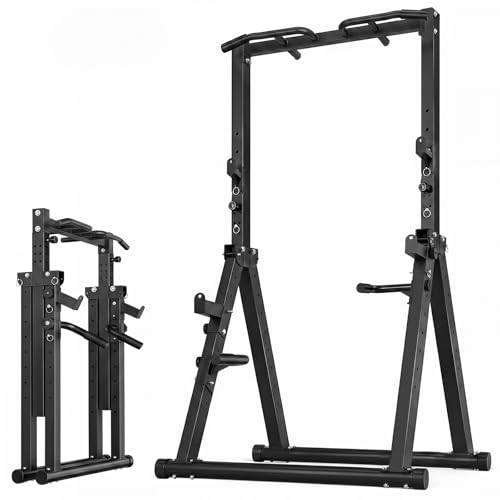
HOTCAMP Foldable Pull Up Bar Station
Overview
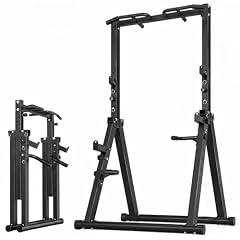
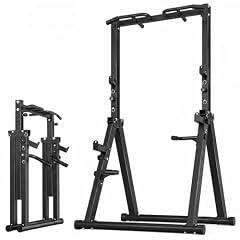
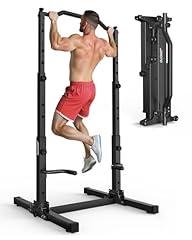
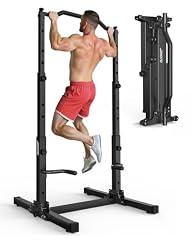
This is a freestanding, folding bodyweight tower for pull-ups, dips, and grip variations. The available retail record identifies a black product weighing 48 pounds, with adjustable height and a claimed 700-pound maximum load. The same record identifies the product as model DFG-021, while another marketplace listing identifies the related model as DFG-02 and lists China as country of origin. The 700-pound figure, folding format, height adjustment, and multi-grip setup are manufacturer-stated product claims reproduced by retailers, not independently verified performance results. Searches of major third-party certification registers did not surface an exact-product UL, ETL, TÜV, or accredited laboratory certificate. No exact-product operating manual, dimensional drawing, anchoring guidance, dynamic-load test report, or replacement-parts catalog was located. That leaves important questions about usable clearance, adjustment locks, inspection intervals, and the conditions behind the load claim unanswered.
What works
- The folding, freestanding format is practical for a home workout area with limited storage space, based on the manufacturer-stated product description.
- Height adjustment and multiple grip options can help users vary hand position and setup, although the exact adjustment range was not independently documented.
- Pull-ups, dips, and bodyweight movements are established resistance-training methods when progressed appropriately and performed consistently.
- The product has a specific model designation and UPC, which provides more traceability than an entirely unmarked tower.
What does not
- The claimed 700-pound maximum has no located accredited test report or stated dynamic-use conditions, so it should not be treated as independently verified safety capacity.
- No exact-product certification record was found in the checked UL, Intertek ETL, or TÜV directories.
- No located manual explains floor requirements, required clearance, anti-tip limits, fastener retightening, inspection schedule, or whether the unit needs ballast or anchoring.
- Materials, coating chemistry, foam-grip composition, repair parts, and corrosion-protection details are not transparently disclosed.
- No manufacturer address, importer identity, direct service documentation, or replacement-parts catalog was located in the available product records.
Who is it for
This product suits an adult home exerciser who wants a space-conscious station for basic bodyweight pulling and dipping, has a level hard floor, and can work within conservative self-imposed loading. It is most appropriate for someone comfortable checking every pin, bolt, cap, and rubber foot before use, then starting with controlled repetitions rather than swinging, kipping, or weighted movements. Its adjustable format may suit households with more than one adult user, but only after each user confirms comfortable grip height and surrounding clearance.
Who is it not for
It is not suited to users who need documented commercial-gym safety testing, verified dynamic capacity, or a tower with a clearly published inspection and maintenance program. Avoid relying on it for weighted pull-ups, explosive kipping, gymnastics-style swinging, rehabilitation directed by a clinician, or unsupervised use by children. It is also a poor fit for carpeted, uneven, slippery, cluttered, or low-ceiling spaces, and for households where the tower cannot remain clear of walls, furniture, pets, or bystanders during movement.
Integrity
Bodyweight resistance training can improve strength, muscle size, and physical function when it is practiced consistently and progressed to the individual. The exercise evidence supports the training method, not a special health effect from this particular tower. Users should begin below their perceived capacity, use controlled repetitions, and stop if the frame shifts, a lock does not fully engage, or hardware loosens. No exact-product third-party safety certificate, accredited laboratory report, material declaration, or coating test report was located. No exact-product recall was found in the checked CPSC recall results, but the available product information does not identify a clearly traceable importer or service organization. A mostly metal tower could have a long usable life and is potentially recyclable as ferrous scrap, yet no parts program, repair instructions, corrosion specification, or packaging disclosure was found.
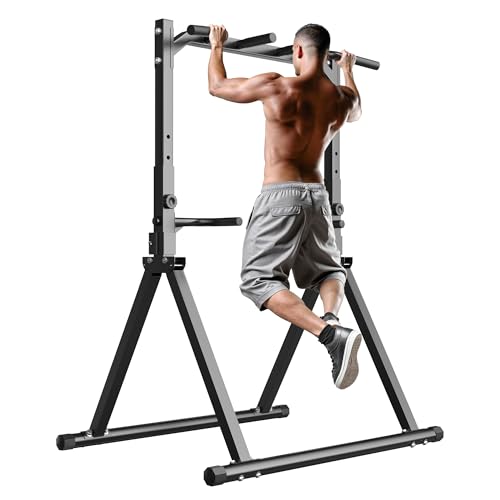
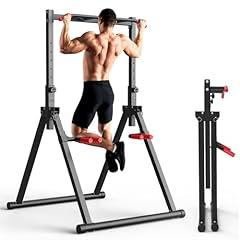
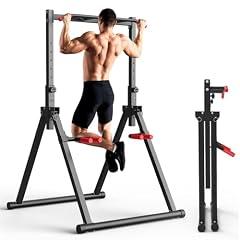
STACOO Foldable Pull Up Station
Overview
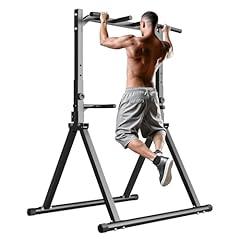
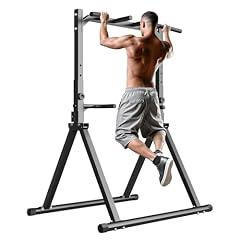
This is a freestanding, foldable alloy-steel pull-up and dip station for home bodyweight training. It is intended for pull-ups, dips and knee raises, with a triangular folding frame rather than wall mounting. Published seller descriptions state four height settings from 78.7 to 86.8 inches, a 39.4-inch exercise width, and a folded footprint of 46 by 12.5 inches. The listing presents a 300-pound capacity in its title, while product-detail fields and other seller copies state 330 pounds. That is a meaningful safety-critical inconsistency. No exact-product instruction manual, ASTM conformance record, accredited dynamic-load report, or independently checkable safety certificate was located. The triangular layout, adjustable locking points and textured contact surfaces are manufacturer-stated design features, not independent proof against tipping, fatigue, or folding-joint failure during moving exercises.
What works
- Foldable storage dimensions are clearly stated, which can help households that need to clear floor space between sessions.
- The stated four-position height range gives more fit flexibility than a fixed-height stand.
- Its intended movements are ordinary bodyweight resistance exercises, and resistance training can support strength and muscle-function goals when programmed appropriately.
- The published material and weight information identifies an alloy-steel frame at about 18.6 kg, which gives buyers a concrete starting point for handling and recycling planning.
What does not
- The product presents two different maximum capacities, 300 pounds and 330 pounds. This is a real specification inconsistency, not merely missing evidence.
- No exact-model accredited load, endurance, stability, or dynamic-use test report was located.
- No independently checkable certification from UL, ETL, TÜV Rheinland, A2LA, or ANAB-linked testing was found for this product.
- A model-specific manual with anchoring, clearance, inspection, retightening, and replacement-parts instructions was not located.
- Coating, foam-grip, rubber-foot, and plastic-cap chemistry is not disclosed with a material declaration or test report.
Who is it for
This format suits an adult home exerciser who wants a freestanding station for controlled pull-ups, dips, knee raises, and similar basic bodyweight work, but needs it to fold away after use. The stated 78.7 to 86.8 inch height range and 39.4-inch exercise width make room measurement important before setup. It is most appropriate for users willing to inspect the joints and locking hardware before training, remain within the more conservative published 300-pound limit, and avoid momentum-heavy movements until stability is personally confirmed on a level floor.
Who is it not for
It is not suited to anyone who needs independently certified load performance, especially larger users, households with several users, or settings where the station will see frequent daily use. Do not treat the higher 330-pound figure as established because the product materials also state 300 pounds. It is also a poor fit for kipping pull-ups, swinging leg raises, ring work, muscle-ups, or other high-momentum exercises, since no exact-model dynamic stability evidence or anchoring guidance was found. Households without a level floor, overhead clearance, or a dedicated exercise area should avoid relying on a freestanding folding frame.
Integrity
The exercise concept is realistic. Pull-ups, dips and knee raises are resistance exercises, and evidence-based resistance-training guidance supports strength and muscle-function benefits when training is progressive and appropriate for the individual. The product itself does not provide verified medical, rehabilitation, or guaranteed body-composition results. The frame is described as alloy steel, a material with an established recycling stream, but the product does not provide a steel grade, coating specification, recycled-content claim, packaging disclosure, or replacement-parts catalog. No exact-product recall or public incident record was located in the CPSC recall and SaferProducts databases during this review. That is not a safety certification. The maker also does not provide accessible coating or contact-material test documentation, so chemical exposure and long-term surface durability remain unverified.
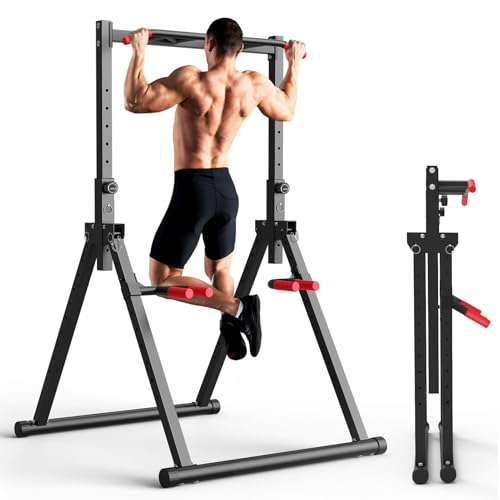
SERTT Foldable Power Tower Station
Overview
This product is a freestanding, foldable steel power tower for bodyweight pull-ups, dips, push-ups, hanging leg raises, and inverted rows. The retrieved product manual describes 10 pull-up-bar height settings, 10 dip and push-up handle positions, five pull-up grip options, and three stated handle-width options. It also lists an unfolded base of about 52.4 by 39.4 inches and a stated maximum user weight of 440 pounds. Those dimensions, the stated 2 mm steel tubing, triangular frame, fold-flat mechanism, and 440-pound capacity come from product documentation, not an accredited test report. No exact-product ASTM conformance record, third-party certification, or traceable ISO/IEC 17025 dynamic-load report was located. The manual does provide useful operating controls, including use on a flat surface, fully engaging pins, checking bolts before use, and stopping use if parts are damaged.
What works
- The manual specifies broad adjustment, with 10 pull-up heights and 10 handle positions for shared-home use.
- The fold-flat design can reduce the space occupied between workouts, according to the manufacturer documentation.
- The manual includes practical safety and maintenance instructions, including pre-use inspection, bolt retightening, pin engagement, and use on a level surface.
- Pull-ups, dips, rows, and push-ups can form part of progressive resistance training, which human evidence supports for improving strength and muscle size when training is appropriately programmed.
What does not
- The stated 440-pound capacity is not backed by a located independent dynamic-load, stability, or endurance test for this product.
- No exact-product UL, ETL, TÜV, ASTM, or accredited laboratory certification was located.
- A freestanding folding tower has multiple locks and joints. The documentation requires users to confirm that pins and bolts are secure, but does not provide independent evidence for repeated dynamic or explosive use.
- Coating, foam-grip, rubber-foot, and plastic-cap chemistry is not meaningfully disclosed. No material declaration or coating test report was located.
- The retrieved documentation does not provide a replacement-parts catalog, detailed manufacturer address, or a defined recycling plan.
Who is it for
It suits an adult home exerciser who wants a single freestanding station for controlled bodyweight movements and has enough clear, level floor space for a roughly 52.4 by 39.4 inch unfolded base. It is most appropriate for users willing to assemble the product carefully, inspect bolts and locking pins before sessions, and use the adjustable bar and handles for non-ballistic pull-ups, dips, rows, and elevated push-ups. The fold-flat format is particularly relevant where the workout area must return to normal use after training.
Who is it not for
It is not for anyone who needs independently verified loading, stability, or certification documentation before training under a high load. Avoid relying on it for kipping, swinging, explosive transitions, added-weight pull-ups, or other dynamic work until the manufacturer provides test evidence for those conditions. It also is not a good fit for uneven floors, low ceilings, cramped rooms without movement clearance, homes where children could access the folding mechanism unsupervised, or users unable to inspect and maintain locking pins and hardware.
Integrity
The health case is realistic at the exercise level, not as a promise made by the tower itself. Human evidence supports progressive resistance training for gains in strength and muscle size, but results depend on training dose, technique, recovery, and the individual. This product documentation makes no medical or guaranteed body-composition promise. Its own safety instructions appropriately call for a stable surface, secure fasteners and pins, and stopping if pain, dizziness, or damaged parts occur. The product is described as alloy steel with 2 mm tubing and a powder-coated finish, which could support a long service life if the frame and locking hardware are maintained. The manual advises cleaning, checking for rust or cracks, retightening hardware, and replacing worn or damaged parts. However, no independent coating or contact-material testing, chemical declaration, spare-parts catalog, or recycling program was located. Searches did not identify an exact-product CPSC recall, but the available manufacturer traceability remains limited.

RELIFE Power Tower Pull Up Dip Station
Overview
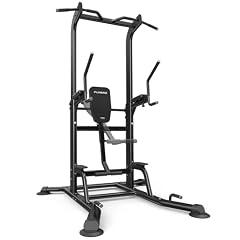
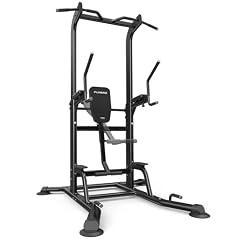
This is a freestanding, indoor home-use bodyweight station for pull-ups, chin-ups, dips, vertical knee raises and base-handle push-ups. The assembly manual documents a bolted metal frame, padded grips and arm supports, four suction-cup feet, adjustable uprights, adjustable dip handles and an adjustable backrest. It is not intended for commercial or therapeutic use. The main safety limitation is a conflicting capacity claim. The product manual sets a 150 kg, about 330 lb, maximum, while the manufacturer storefront and marketplace record state 400 lb. Neither source provides an independently checkable dynamic-load or stability test for this product. The manual does require a solid, level floor, pre-use inspection and secure fasteners, but it does not provide anchoring instructions, required exercise clearance or a specific limit on swinging movements.
What works
- The included manual gives concrete assembly steps and identifies the bolts, washers, pull-pin knobs, padded grips and four suction-cup feet.
- The manual instructs users to inspect the tower and confirm that nuts and bolts are secure before use.
- Pull-up height, dip-handle position and backrest position are adjustable, which can help fit different exercise setups.
- The manual clearly limits use to indoor home exercise and says not to modify the equipment.
What does not
- The stated load limit is inconsistent, 330 lb in the manual and 400 lb in current seller materials. This is a material safety and specification problem.
- No accredited laboratory report, certification record or independently checkable stability test was found for this product.
- The instructions call for a level floor but do not specify room clearance, anchoring, ballast, or a dynamic-use limit for swinging pull-ups and leg raises.
- Coating, foam, rubber and plastic-cap chemistry is not disclosed, and no material test report was found.
Who is it for
This product is most suited to an adult home exerciser who wants one compact, fixed-location station for controlled bodyweight movements, has a solid level indoor floor, and is willing to assemble it carefully and inspect the hardware before sessions. It can suit users who need some fit adjustment for pull-up height, dip handles and backrest position. Because its documented capacity information conflicts, users should treat 330 lb as the more conservative published limit and avoid adding external weight without written clarification from the responsible seller.
Who is it not for
It is not well suited to people who need independently verified structural testing, a clearly documented 400 lb rating, or a tower intended for commercial, therapeutic or rehabilitation settings. It is also a poor fit for households with unsupervised children or pets near workout equipment, rooms with uneven or unstable flooring, or users who perform kipping, swinging or other high-momentum pull-up variations. People who cannot safely inspect, assemble and periodically retighten bolted equipment should use a setup with professional installation or clearer support arrangements.
Integrity
Bodyweight resistance training can support strength and muscle gains when it is progressed appropriately, but this tower is only exercise equipment, not a treatment for posture problems, pain or fatigue. The manual appropriately says it is not for therapeutic use. In contrast, manufacturer advertising includes broad posture and muscle-fatigue language that is not substantiated for this specific product. Users should use controlled technique, stop for pain or dizziness, and follow the manual's inspection instructions. The product is largely metal and could have a long service life if its bolted joints, pads and grips are maintained. Its manual identifies many hardware parts, which may make replacement requests more practical, but no public replacement-parts catalog or repair program was found. No CPSC recall was identified in the searched records. Material disclosure remains limited, with no published coating, foam, rubber-foot or plastic-cap chemistry documentation, and no independent chemical test report found.

FLYBIRD PT6 Power Tower and Pull Up Bar
Overview
This is a freestanding, alloy-steel power tower for bodyweight pull-ups, dips, supported leg raises and crunches. It has padded arm and back supports, adjustable grips and foot positions, and occupies a manufacturer-stated 55.12 by 52.76 inches. The listed height range is 72.44 to 91.34 inches. The maker states an 800-pound maximum capacity, nine height levels, four grip positions and 12 foot positions. It also describes an outward-flaring steel base and non-slip feet. Those are relevant stability features, but no exact-product ASTM test record, accredited laboratory report, or independently checkable certification was located. The current manufacturer storefront also presents the same configuration under a different product name after stating that FLYBIRD became part of FED Fitness, which makes document continuity less clear.
What works
- The manufacturer publishes concrete overall dimensions, a height range, and multiple adjustment positions.
- A broad freestanding base, non-slip feet, padded supports, and ergonomic footplates are manufacturer-stated safeguards for controlled bodyweight exercises.
- The current manufacturer page lists one year of warranty coverage and lifetime technical support.
- Alloy steel is identified as the primary frame material, which is more repairable and recyclable than an all-plastic structure.
What does not
- The 800-pound capacity and claimed load-cycle performance were not supported by a traceable independent test report for this product.
- No exact-product UL, ETL, TÜV, or accredited laboratory safety certification was located.
- No exact assembly and operating manual was located to verify bolt-retightening intervals, inspection steps, clearance requirements, anchoring guidance, or dynamic-use limits.
- Coating, foam, rubber-foot, and plastic-cap chemistry is not transparently disclosed, and no material compliance report was located.
Who is it for
It suits an adult home exerciser who wants one fixed station for basic bodyweight upper-body and core work, has a dedicated indoor area large enough for its roughly 55 by 53 inch footprint, and is willing to assemble and routinely inspect a bolted steel frame. The published adjustment range and multiple grip and foot positions may be useful in a household with users of different heights. It is most appropriate for controlled repetitions rather than swinging or momentum-based movements.
Who is it not for
It is not well suited to renters or households that need a foldable, easily moved station, because the manufacturer describes a large, heavy freestanding structure. It is also a poor fit where ceiling height, side clearance, or a level floor cannot be confirmed before installation. People planning kipping pull-ups, weighted dynamic movements, rehabilitation use, or use by children should choose equipment with exact documented dynamic-load guidance and an accessible operating manual. Anyone needing verified low-chemical materials should seek fuller material disclosures.
Integrity
Resistance training can improve strength and muscle size when training is regular and appropriately progressed, but the tower itself does not guarantee fat loss, rehabilitation, or isolated lower-ab results. The manufacturer’s claims about reducing body swing and targeting the core should be read as exercise-positioning claims, not clinical outcomes. Users should work within their own capacity, use controlled reps, and seek clinical guidance when injury, pain, or medical limitations are relevant. The frame is described as alloy steel, which has a practical end-of-life recycling route. The manufacturer also lists warranty and ongoing technical support, which can help keep a repairable metal product in service. However, no replacement-parts catalog, coating safety data sheet, foam or rubber material declaration, or independent chemical testing was found. No exact-product CPSC recall was located in the checked public recall sources, but absence of a recall is not independent safety certification.

JOROTO Foldable Pull Up Dip Station
Overview
This is a freestanding, foldable alloy-steel bodyweight station for pull-ups, chin-ups, dips, push-ups, knee raises, and inverted rows. The manufacturer lists a 41.3 by 44.1 inch footprint, 82.7 inch maximum height, four pull-up-bar levels, seven dip-bar levels, and a 450-pound user capacity. It also says the folded unit is 28 inches deep. The available instruction material calls for a level surface, securely tightened connections, controlled movement without swinging, routine inspection, and adjustment of six anti-slip feet. Those are useful operating controls, but no public exact-product ASTM test report, accredited laboratory report, or third-party certification record was located. The public documents also conflict on warranty length, with the US product page stating one year and a reproduced instruction manual stating 24 months.
What works
- The manufacturer provides concrete footprint, height, adjustment, capacity, and folded-depth specifications.
- The available instructions specifically require a level surface, controlled movement, pre-use checks, and periodic fastener inspection.
- Six adjustable anti-slip feet are described for leveling on uneven floors.
- The alloy-steel construction and foldable format can support compact home storage, as manufacturer-stated.
What does not
- The 450-pound capacity is manufacturer-stated, without a public exact-product dynamic-load or stability test report.
- No public UL, ETL, TÜV, or traceable ISO/IEC 17025 certification or test record was found for this product.
- A freestanding folding station can tip or shift if used on an uneven surface or with swinging movements, so the operating restrictions matter.
- Coatings, grip materials, rubber feet, chemical testing, and material declarations are not publicly detailed.
- Warranty information is inconsistent across available product documentation, with one year on the US product page and 24 months in the reproduced manual.
Who is it for
This product suits an adult home exerciser who wants a compact, freestanding station for controlled bodyweight work and can dedicate a clear, level floor area to it. It is most appropriate for pull-ups, chin-ups, dips, rows, push-ups, and knee raises performed without kipping or fast directional changes. The buyer should be willing to check knobs, pins, bolts, feet, grips, and folding connections before use, and should treat the stated capacity as a manufacturer claim rather than independently verified performance.
Who is it not for
It is not suited to users who need documented third-party structural certification, a fixed anchored rack, or verified capacity for highly dynamic calisthenics. Avoid it for swinging pull-ups, kipping, muscle-ups, weighted bodyweight training, or other movements that can impose forces beyond a static user-weight claim. It is also a poor fit for cramped rooms without clear exercise space, uneven or slippery floors, households where children may access it unsupervised, or users who cannot safely inspect and retighten adjustable hardware.
Integrity
The station supports conventional resistance-style bodyweight exercises. Strength and fitness improvements come from consistent, progressive training rather than from the station itself, and the public product claims are generally framed as exercise functions rather than medical or guaranteed-outcome claims. The safety instructions appropriately call for controlled movement, a stable surface, secure hardware, and removal from service if damage is found. No public exact-product accredited test report or recognizable third-party safety certification was located. No recall or CPSC public incident record for this product was found in the searched databases, but that is not proof of independent safety testing. Alloy steel is a durable and widely recyclable material, and folding may help keep a usable product in service where space is limited. Public materials do not identify the coating chemistry, foam or rubber composition, replacement-part availability, or a recycling program.

BangTong&Li Power Tower Black-02
Overview
This is a freestanding home power tower for bodyweight pull-ups, chin-ups, dips, vertical knee raises and elevated push-ups. The available product documentation describes an alloy-steel frame, padded arm and back supports, a 39-pound unit weight, and five pull-up-bar height settings from 73.62 to 84.65 inches. These are manufacturer-stated specifications, not independently tested measurements. The most important limitation is evidence for dynamic safety. The instructions call for a level, non-slip floor, engaged suction cups, controlled movement and regular bolt checks, but no exact-product ASTM performance report, accredited laboratory report, or third-party certification was located. Capacity documentation also conflicts. The specification table states 330 pounds, while the safety instructions state a 300-pound maximum user weight. Treat 300 pounds as the more conservative limit until the maker supplies a clarified rating and test basis.
What works
- The available assembly guide gives useful setup controls, including a level floor, tightened hardware and anti-slip foot engagement.
- One station can support several bodyweight exercises, which can help a home routine cover upper-body and core movements.
- Five manufacturer-stated height settings offer some fit adjustment instead of a fully fixed pull-up position.
- The assembly guide identifies replaceable-looking hardware and states a one-year manufacturer warranty.
What does not
- No traceable independent certification, accredited test report, or exact-product ASTM test evidence was located for stability, load or repeated dynamic use.
- The product documentation conflicts on maximum user weight, stating both 300 pounds in safety instructions and 330 pounds in specifications.
- The available instructions do not provide bolt torque values, a quantified clearance requirement, or a published anchoring or ballasting method.
- No material declaration or test report was located for the coating, foam grips, rubber feet or plastic caps.
Who is it for
This product fits an adult home exerciser who wants a basic, freestanding station for controlled pull-ups, dips, knee raises and push-ups, and who has a level, non-slip floor with room around the frame. It is better suited to people willing to assemble carefully, use the conservative 300-pound documented limit, inspect bolts before use and avoid momentum-heavy repetitions. The height range may suit many average-height users, but should be checked against ceiling height, arm reach and the actual exercise space before setup.
Who is it not for
It is not well suited to households where children may climb on it, to users who need medically supervised exercise, or to anyone intending to use kipping, swinging, explosive pull-ups or added external weight. Those movements create greater dynamic loads than the documentation substantiates. It is also a poor fit for uneven, slick or carpeted surfaces where the suction cups cannot reliably engage, and for buyers who require independently certified load safety, detailed material disclosure, published spare-parts access or a clearly resolved capacity rating.
Integrity
Bodyweight resistance exercise can support improvements in strength, muscle size and physical function when it is performed consistently and matched to the user’s abilities. This tower can provide several such movements, but it is exercise equipment, not a treatment or a guarantee of strength, weight-loss or rehabilitation outcomes. Users should start with controlled repetitions and stop if the frame shifts, hardware loosens or a support pad becomes damaged. The frame is described as alloy steel, a durable and broadly recyclable material when the product eventually reaches end of life. The available guide also lists bolts, nuts, washers and locking hardware, which makes basic inspection practical. However, no coating chemistry, foam or rubber material declaration, independent chemical testing, recycling guidance or public replacement-parts catalog was located. No matching CPSC recall was located in the recall search reviewed, but maker and importer traceability remains limited in the available documentation.

VHUNLUN Adjustable Power Tower for Home Gym
Overview
This is a freestanding steel power tower for bodyweight pull-ups, dips, push-ups, and vertical knee raises. The product record states an 82.7-inch height and a 32.3 by 29.5-inch floor footprint. It also states 11 height settings, textured ergonomic handles, a lifetime warranty, and a 330-pound maximum weight recommendation. Assembly is described only as attaching the legs with screws and tightening them with the supplied tool. The central limitation is evidence quality. No exact-product ASTM performance report, accredited laboratory report, certification record, detailed operating manual, or anchoring guidance was located. A separately indexed listing using the same part number reports a 350-pound capacity rather than 330 pounds. That unresolved capacity conflict matters for a freestanding unit used with moving bodyweight loads.
What works
- The claimed 11 height settings may help users set the pull-up position to their available ceiling height and exercise preference, although the adjustment range is not documented.
- The stated 32.3 by 29.5-inch footprint gives a concrete starting point for planning floor space.
- The product is described as a metal frame, and steel is a material with an established recycling stream when a unit reaches end of life.
- A lifetime warranty is stated, though its coverage, claim process, and replacement-parts support were not independently documented.
What does not
- The stated user capacity is inconsistent. This product record says 330 pounds, while another listing for the same part number says 350 pounds.
- No independent stability, dynamic-load, weld, fastener, or adjustment-lock testing was found for this exact product.
- No manual was located that specifies clearance space, ceiling requirements, inspection intervals, bolt retightening, anti-tip steps, or an anchoring or ballast method.
- Coating, foam-grip, rubber-foot, and plastic-cap chemistry is not disclosed, and no material test report or safety data sheet was found.
Who is it for
This product is most suited to a healthy adult who wants one compact, freestanding station for basic bodyweight work, has a level hard floor, and can leave clearance around all sides. It fits a user who can independently assess pull-up and dip technique, assemble and periodically inspect bolted equipment, and stay well below the uncertain stated capacity. The 11 claimed height positions may be useful where several household members need different bar positions, provided the ceiling height is measured first.
Who is it not for
It is not suited to users who need independently verified load safety, such as heavier users, people adding external weight, athletes training dynamically, or households where multiple people will use it without regular hardware checks. It is also a poor fit for rehabilitation, balance-limited users, unsupervised children, or anyone with shoulder, wrist, elbow, or spinal symptoms who has not received individualized clinical or exercise guidance. Avoid cramped rooms, uneven flooring, low ceilings, and locations where a tip could strike furniture or another person.
Integrity
Bodyweight resistance exercise can contribute to strength and physical-function gains when it is progressed appropriately, but the tower itself does not guarantee those results. The available product descriptions stay mostly within ordinary exercise-equipment claims and do not establish medical, rehabilitation, or guaranteed body-composition outcomes. Users should progress conservatively and stop if a movement causes pain, dizziness, instability, or grip failure. No exact-product third-party safety certification, accredited load test, coating disclosure, safety data sheet, or material compliance report was located. No product-specific CPSC recall or safety warning was located in the searchable recall results checked on November 15, 2026, but that is not independent proof of safety. The stated steel construction can be directed to metal recycling at end of life, though no spare-parts catalog, corrosion specification, repair instructions, or packaging disclosure was found.