
10 Best Mesh System
 Daniel Kenitz
Please note that we participate in affiliate marketing programs. When you purchase through links on our site, we may earn a commission. As an Amazon Associate we earn from qualifying purchases. This comes at no additional cost to you and helps support the resources required to provide valuable content.Advertising Disclosure
Top-rated Mesh System Comparison
1

2
4
5
6
7
8
9
10
Mesh systems: what matters beyond the coverage number
A mesh system uses several coordinated Wi‑Fi units to distribute one internet connection through multiple rooms. One unit normally connects to the modem or gateway; the others extend the network, either wirelessly or through Ethernet. The goal is not simply a larger signal. A useful system must maintain acceptable speed, latency, roaming, security, and reliability as devices move between nodes and as walls, floors, interference, and backhaul conditions change.
Start with the connection you actually have. A system’s advertised link rate is usually a theoretical, combined figure across bands and streams not the speed one phone or laptop will receive. Independent testing should disclose the floor plan, client device, Wi‑Fi band, distance, interference, and whether the nodes used wireless or wired backhaul. Look for measured throughput at several distances, latency and jitter, roaming behavior, and results with simultaneous clients. A large square-footage figure is not a guarantee: supplied reviews repeatedly found that walls, node placement, building materials, and wireless backhaul can reduce usable coverage. Conflicting coverage figures are themselves a reason to be cautious.
Backhaul is especially important. Wireless mesh links share radio capacity with household traffic, so remote nodes can be slower than the main unit. Ethernet backhaul can reduce that tradeoff, but only if the product supports it and cabling is practical. Check whether satellite units have Ethernet ports, whether ports are Gigabit or 2.5 Gbps, and whether the system supports router and access-point modes. Dual-band systems may lack a separate band for backhaul; some also lack the 6 GHz band or wider Wi‑Fi 7 channels. Those limitations matter in congested homes and for buyers with newer devices.
Treat security and privacy as ongoing product features. A strong record includes WPA3, secure defaults, automatic and signed firmware updates, a vulnerability-reporting route, timely fixes, and a clearly stated support end date. Buyers should check manufacturer advisories, firmware notes, NIST vulnerability records, and CISA’s Known Exploited Vulnerabilities catalog rather than assuming that “Wi‑Fi 7” or “internet security” describes a support commitment. App-managed systems may require an account and cloud service; review what network, device, diagnostic, location, browsing, or usage data is collected, whether deletion is available, and which controls are optional.
For physical safety, look for an FCC equipment authorization and RF-exposure filing for the exact model family, plus a UL Solutions Product iQ or Intertek ETL directory record for the supplied power equipment. A manufacturer statement such as FCC or RoHS compliance is not the same as an independently located electrical-safety listing. Check the CPSC Recalls database and manufacturer corrective-action notices for unresolved problems.
Environmental claims also need specifics. Prefer measured whole-kit idle and active power, not an adapter’s maximum rating; documented support life, warranty, replaceable adapters, repair options, and take-back recycling; and quantified recycled content, packaging, carbon, or recyclability claims supported by EPEAT, TCO, an environmental declaration, or other independent evidence. Across the supplied products, recurring cautions include no published security-support end date for many models, app and account data collection, unverified UL or ETL evidence, missing full-kit power measurements, and coverage claims that exceed independent results or conflict with the manufacturer’s own figures. Older products with expired or unclear security support, products affected by firmware vulnerabilities, and systems whose satellites cannot use wired backhaul deserve particular caution. No category-wide contraindication was found, but these limitations can be safety-relevant for households that require long-term security maintenance, local-only administration, or dependable coverage in difficult buildings.
Integrity
Mesh systems are always-on networked radio and computing equipment. The most useful evidence combines regulatory records, security-maintenance documentation, privacy controls, measured household performance, and lifecycle information rather than relying on a headline speed or coverage figure.
HHealth & Safety
RF and electrical safety
This measures U.S. radio authorization, RF-exposure evidence, electrical-safety testing, and unresolved safety actions for the nodes and adapters. FCC records were available for many supplied products, while exact UL or ETL evidence was often missing. Higher-scoring products combined model-linked FCC evidence with stronger adapter documentation; lower scores reflected incomplete electrical certification records, not proof of an unsafe product.
Security and update protection
A mesh system protects every connected household device only while its firmware is maintained. This topic looks for secure defaults, signed or automatic updates, vulnerability disclosure, timely fixes, and a stated support end date. The supplied scores ranged from 52 to 84: the clearest high-score distinction was a concrete update commitment, while low scores reflected expired, unclear, or weakly documented support.
Privacy and account control
Mesh systems can expose account, device, diagnostic, network, location, usage, and sometimes browsing information through their apps and cloud services. This topic measures collection minimization, sharing, account security, access, deletion, and optional controls. Higher-scoring products offered clearer deletion or control options; lower scores reflected mandatory cloud management, broader collection, parental-control history collection, or contradictory app privacy disclosures.
Safety recall and problem response
This measures unresolved recalls, fire or shock reports, regulatory actions, and the clarity of corrective remedies. The supplied reviews found no product-specific CPSC recall or comparable unresolved action for the listed systems, but scores still differed because evidence quality and response documentation varied. A high score means a clean search plus a clear remedy path; a lower one signals less complete assurance.
EEcology
Always-on energy use
Every node and adapter draws power continuously, so the complete kit matters more than an adapter’s maximum rating. This topic rewards measured idle and active consumption and useful power management. Scores ranged from 70 to 88. The stronger examples had independent ready-state or whole-kit measurements; lower-scoring products supplied only capacity ratings or no documented wall-power result.
Useful life and e-waste prevention
Longer software support, replaceable external adapters, warranty coverage, repair options, spare parts, and take-back programs can keep a mesh kit useful and secure. Scores ranged from 58 to 86. Higher scores were associated with a stated support period, warranty, or community firmware evidence; lower scores reflected missing end dates, repair routes, or recycling commitments.
Materials and environmental claims
This topic tests whether recycled-content, packaging, carbon, recyclability, and other environmental claims are quantified and independently supportable. Most supplied products had limited evidence, with scores clustered around 68 to 72. A higher score means more specific and credible documentation; a lower score means broad RoHS or “eco” language without product-level material, packaging, or lifecycle substantiation.
EEvidence
Real-world coverage and speed
This measures independently tested throughput, range, latency, roaming, and wired or wireless backhaul under disclosed conditions. Scores ranged from 70 to 90. High-scoring products had reproducible home or laboratory results at multiple distances; lower scores reflected only theoretical rates, limited testing, reduced satellite performance, or coverage claims that were not independently reproduced.
Compatibility and reliable failover
A dependable mesh should work with ordinary Wi‑Fi devices, support suitable wired backhaul, isolate guest and IoT devices, and recover when a node or internet connection fails. Scores ranged from 72 to 85. Higher scores had certification or documented modes plus tested or credible isolation and backhaul behavior; lower scores reflected missing failover testing or satellite port limitations.
Honest, qualified claims
This measures whether speed, device-count, coverage, security, privacy, and environmental claims match their documented limits. Scores ranged from 46 to 84, making it a key separator. High-scoring products qualified headline figures and aligned them with evidence; low-scoring products had contradictory coverage numbers, theoretical rates presented too broadly, or important conditions left unstated.
Independent proof, not just promises
Important claims are stronger when regulators, accredited laboratories, certification programs, or reproducible reviewers can check them. Scores ranged from 68 to 88. Higher-scoring products combined FCC or Wi‑Fi Alliance records with disclosed performance or power testing; lower scores relied more heavily on manufacturer statements or lacked exact model-linked electrical, radio, performance, or environmental verification.
Full reviews

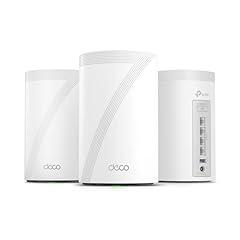
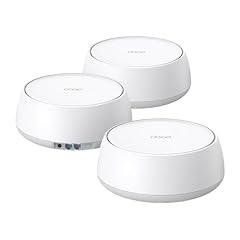
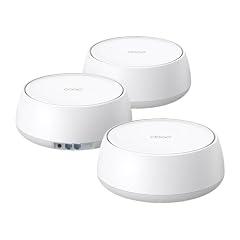
TP-Link Deco BE63 Tri-Band WiFi 7 Mesh System
Overview
This product is a three-unit, tri-band Wi-Fi 7 mesh system for distributing one home network across a larger residence. Each upright unit has four 2.5 Gbps Ethernet ports, a USB port, internal antennas, and its own 12 V power adapter. Setup and day-to-day administration use the Deco mobile app and a TP-Link account. Wi-Fi Alliance certification independently confirms Wi-Fi 7, 6 GHz, WPA3-Personal, protected management frames, and related interoperability features for this model. TP-Link states that the three-unit kit supports wired or wireless backhaul, guest and IoT networks, and four 2.5 Gbps ports on every unit. Independent testing found strong short-range and mesh-node throughput, but the advertised coverage is conditional on a favorable house layout, client hardware, interference, and placement.
What works
- Wi-Fi Alliance certification independently verifies Wi-Fi 7 and WPA3-Personal interoperability.
- Independent home testing recorded 2.069 Gbps near the main unit and 859.9 Mbps at a mesh node 40 feet away.
- Each unit has four 2.5 Gbps WAN or LAN ports, giving wired backhaul and local devices more flexibility, according to TP-Link.
- The product supports separate guest and IoT networks, local management, WPA3, and a factory-reset control, according to its datasheet and guide.
What does not
- TP-Link publishes firmware downloads and a vulnerability-reporting process, but does not state a specific security-support end date for this product.
- Initial setup requires the Deco app and a TP-Link account. Apple says the app may collect identifiers, usage data, diagnostics, support content, and some photos or videos.
- The supplied adapter specification is documented, and FCC radio authorization is traceable, but public verification of an exact UL or ETL electrical-safety listing was not found.
- Always-on electricity use is meaningful for a three-node kit. Independent testing measured 15.2 W for two units under its test conditions, suggesting roughly 46 W for three units if usage scales similarly.
Who is it for
It suits households with multi-gig internet service, Ethernet already installed between rooms, or several bandwidth-heavy activities happening at once, such as 4K streaming, gaming, large file transfers, and video calls. It is particularly relevant where Wi-Fi 7 or 6 GHz client devices are already in use and a three-node layout is genuinely needed. Buyers who can place the units openly and use 2.5 Gbps wired backhaul can make better use of the port configuration and reduce the performance penalty of wireless relaying.
Who is it not for
It is not a low-energy choice for a small apartment or a household that only needs one access point, because three units remain powered continuously. It is also a poor fit for people who require setup without a vendor account or who want minimal cloud-linked app data. Households needing a guaranteed multi-year security-support deadline, independently confirmed electrical listing for the supplied adapter, or a documented repair-parts program should seek products that publish those commitments. Thick masonry, metal, and poor node placement can also make the coverage figure unrealistic.
Integrity
The radio side has meaningful external verification. FCC filing material identifies this model within the authorized equipment family for 2.4 GHz, 5 GHz, and indoor 6 GHz operation, including RF-exposure evaluation. Wi-Fi Alliance certification independently confirms interoperability and WPA3-Personal support. No relevant active CPSC recall or product-specific U.S. safety action was found in the checked records. TP-Link lists a two-year warranty and provides an RMA process, but an exact UL or ETL listing for the supplied power adapter was not publicly verified. Its environmental case is limited. TP-Link documents RoHS compliance and specifies a 27.5 W maximum device draw per unit, excluding the adapter, but does not provide recycled-content, carbon-footprint, packaging-reduction, repairability, or product take-back evidence for this product. Independent testing measured 15.2 W for two units during testing, so leaving three nodes on all year can create a material electricity load. The external power adapters may be easier to replace than an internal supply, but no spare-parts commitment or security-support lifespan is stated.

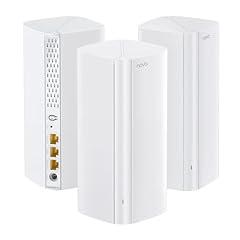
Tenda AX3000 WiFi 6 Mesh System Nova MX12
Overview
This is a three-unit, dual-band Wi-Fi 6 mesh system intended to replace a conventional router and spread one household network across a larger home. Each unit has three gigabit Ethernet ports, four internal antennas, a 1.7 GHz quad-core processor, and a supplied 12 V, 1.5 A power adapter. Tenda documents WPA3 or WPA2 security, guest networking, IPv6, app and web management, and wired Ethernet backhaul. The 2.4 GHz and 5 GHz radio rates are manufacturer-stated at 574 and 2,402 Mbps, respectively. The 7,000 square foot and 160-device figures are also manufacturer claims, not independently reproduced here. An independent home-use review of a two-node kit reported stable operation over several months and a 96 Mb/s download beside a secondary node, but it did not provide a repeatable whole-home lab test. FCC authorization is traceable to the MX12 hardware family.
What works
- The MX12 hardware family has traceable FCC equipment authorization for its Wi-Fi radios.
- Each node provides three gigabit Ethernet ports and manufacturer-documented wired backhaul, useful where Ethernet can connect the nodes.
- Tenda's current support pages show firmware releases for MX12, including a March 2026 release, and an earlier MX12 update explicitly says it fixes security vulnerabilities.
- Independent home-use reporting found good short-range secondary-node performance and stable use in one two-node installation.
What does not
- The 7,000 square foot coverage and 160-device claims are manufacturer-stated and lack disclosed independent testing for this three-unit product.
- Tenda's own materials are inconsistent on client capacity, with the one-unit MX12 page stating 40 connected devices while the three-unit page advertises over 160.
- FCC radio authorization is verifiable, but no product-specific UL or ETL electrical-safety listing was located for the supplied power equipment.
- The Android Tenda WiFi app's Google Play disclosure says collected data is not encrypted in transit, even though the developer says deletion can be requested.
- No model-specific end-of-support date, idle-power measurement, repair-part program, or quantified environmental-material claim was located.
Who is it for
This system fits a household that can place three tall mesh nodes through a medium or large home and, ideally, can run Ethernet to one or more nodes. Its documented wired backhaul, guest network, WPA3 support, and three gigabit ports per unit suit families with TVs, computers, consoles, and basic smart-home devices that need coverage beyond one router. It also suits someone comfortable checking Tenda's support page periodically and applying firmware updates manually when needed. Coverage expectations should remain flexible around walls, floors, device capability, and node placement.
Who is it not for
It is not suited to households that need independently verified whole-home throughput, low-latency roaming data, or proof that 160 simultaneous devices will perform as advertised. Security-sensitive users who require a published support end date, demonstrated signed automatic updates, and stronger app privacy assurances should use a system with those commitments. It is also a poor fit where nodes must rely only on wireless backhaul through dense masonry, several floors, or long distances, because the available independent evidence does not validate those demanding layouts. Buyers needing confirmed low electricity use or certified power-adapter safety evidence should look for documented measurements and listings.
Integrity
The radio hardware has verifiable FCC authorization tied to the MX12 product family, and Tenda documents WPA3 or WPA2 network security. Firmware remains available on the support site, including a March 2026 MX12 release. Tenda also has a vulnerability-reporting process and says it normally responds within five business days. A 2026 CERT coordination notice concerned other listed Tenda firmware versions, not MX12, so it does not establish that this product is affected. Electrical evidence is incomplete. No product-specific UL or ETL listing for the supplied adapters was located. The Tenda WiFi Android app declares collection of location, personal information, device identifiers, and diagnostics, says users can request deletion, and also declares that data is not encrypted in transit. Tenda's regulatory material includes European WEEE recycling instructions, but no United States take-back program, recycled-content figure, packaging target, or measured always-on electricity use was identified.

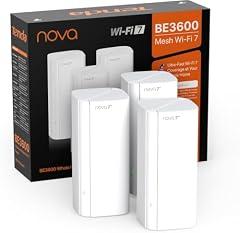
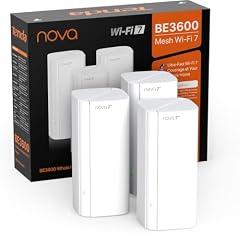
Tenda BE3600 Dual Band Mesh WiFi System
Overview
This product is a three-node, dual-band Wi-Fi 7 mesh system for distributing a home internet connection across several rooms. Each tall, internal-antenna node measures about 3.4 by 3.4 by 7.5 inches and uses a supplied 12 V, 2 A power adapter. Tenda states that each node has three Gigabit Ethernet ports, supports 2.4 GHz and 5 GHz Wi-Fi, WPA3, a guest network, app management, and online firmware upgrades. A laboratory RF report identifies the ME3 Pro as electrically identical to the tested Mesh3EP hardware and records a pass under FCC Part 15 Subpart E. Independent home testing is limited, but one published test reported near-gigabit results close to the primary node and more than 600 Mbps in an upstairs office. The product documentation does not establish a measured whole-kit power draw, a model-specific security-support end date, or a U.S. UL or ETL listing for the supplied adapters.
What works
- An RF test report for identical hardware records a pass to FCC Part 15 Subpart E requirements.
- Three Gigabit Ethernet ports per node can connect fixed devices or support wired mesh placement, according to Tenda.
- Tenda documents WPA3 support, guest networking, IPv6, firewall controls, backup and restore, and online firmware upgrades.
- A published home test reported more than 600 Mbps in a difficult upstairs location, though the test method was not laboratory-grade.
- Tenda has a public vulnerability-reporting process and says it generally acknowledges reports within five business days.
What does not
- The marketplace description's 2.5 Gigabit port claim conflicts with Tenda's U.S. product page, which lists three Gigabit ports per node. Confirm the port hardware before installation planning.
- No model-specific end date for security updates was found. Online firmware upgrades are documented, but automatic and cryptographically signed updates are not clearly documented.
- No U.S. UL or ETL listing for the bundled power adapters was located during verification.
- No documented wall-power measurements were found, so the continuous electricity use of all three nodes remains unproven.
- The companion app's disclosed privacy practices include location, device identifiers, diagnostics, and optional user content. Apple notes that those disclosures are supplied by the developer and not independently verified.
Who is it for
This product fits a household with a cable or fiber plan at or below roughly 1 Gbps, several weak-signal rooms, and practical places to set three nodes. It is especially relevant where Ethernet can be run to one or more nodes, since each node has three documented Gigabit ports. Buyers should be comfortable managing a router through a web interface or app, promptly applying available firmware, using WPA3 where client devices permit it, and reviewing app permissions before enabling cloud-linked features.
Who is it not for
It is not suited to households that need confirmed multi-gigabit wired networking, because Tenda's U.S. support page lists Gigabit ports while the marketplace description says one port is 2.5 Gigabit. It is also a poor fit where a documented security-update end date, verified automatic signed updates, or independently listed power equipment is mandatory. Buyers who need measured low-energy operation, documented repair parts, or independently certified environmental claims will find key evidence missing. Avoid placing nodes within 20 cm of routinely occupied body positions, as the installation guidance specifies that separation distance.
Integrity
The RF evidence is stronger than the electrical-safety evidence. A laboratory report for the same hardware design records FCC Part 15 Subpart E compliance testing, and the installation guide instructs indoor use with at least 20 cm separation from the body. Tenda lists FCC and RoHS among its product certifications. However, no U.S. UL or ETL listing for the included adapters was located. Searches did not identify a product-specific active U.S. recall or enforcement action. For data governance, the app's Apple disclosure lists location, identifiers, diagnostics, and optional photos or videos as data that may be collected but are not linked to identity. Tenda's policy describes account deletion and says it deletes personal information after cancellation, while also describing collection of device, network, and topology data for monitoring features. The three external power adapters are replaceable in practice, but no measured power use, take-back program, recycled-content figure, packaging analysis, or product-specific software-support end date was verified.

WAVLINK AX3000 WiFi 6 Mesh System
Overview
This is a three-unit, dual-band Wi-Fi 6 mesh system intended to replace a router or extend an existing wired network in access point mode. Each unit has one Gigabit WAN port, two Gigabit LAN ports, USB 2.0, and five external antenna elements according to WAVLINK's product specification. WAVLINK states a combined theoretical wireless link rate of 573 Mbps on 2.4 GHz plus 2402 Mbps on 5 GHz, not a guaranteed internet speed. Wired and wireless node backhaul are manufacturer-stated options, and WPA3 mixed-mode security is documented by WAVLINK. Independent OpenWrt project documentation identifies the hardware as a MediaTek MT7981B platform with 256 MB RAM and 128 MB flash, and offers a current community firmware image. No independent wall-power measurement, exact-model FCC grant, electrical listing, or controlled home-performance test was located. Coverage claims require particular caution, because WAVLINK's own product page says up to 4,800 square feet for three units while this product listing says 7,300 square feet.
What works
- Three Gigabit Ethernet ports per unit support wired devices and wired mesh backhaul, according to WAVLINK.
- WPA3 mixed mode, guest networking, access point mode, and wired backhaul are documented manufacturer capabilities.
- The exact hardware is supported by the independent OpenWrt project, creating an alternative firmware route for technically experienced owners.
- A one-year manufacturer warranty is stated in the available product documentation.
What does not
- The 7,300-square-foot listing claim conflicts with WAVLINK's own 4,800-square-foot three-pack claim, and neither figure came with disclosed test conditions.
- No exact-product FCC authorization, UL listing, ETL listing, or power-adapter safety certification was located in the searched public registers.
- No independently published throughput, roaming, latency, failover, or wall-power tests for this exact system were located.
- WAVLINK provides firmware download and update instructions, but no stated security-support end date, signed-update description, or model-specific security advisory history was located.
- The privacy picture is inconsistent. The Android app declares collection of location and personal information, while the iOS label declares no app data collection, and WAVLINK's broad policy permits collection of device, network, identifier, and location data.
Who is it for
This system suits a technically confident household that needs to place up to three Wi-Fi points, can run Ethernet between some locations, and is prepared to judge coverage after installation rather than rely on the advertised square-foot figure. It is especially relevant where Gigabit wired devices, such as a desktop, television, or switch, need local ports at each node. A technically experienced owner who understands third-party firmware installation and recovery may also value the documented OpenWrt hardware support.
Who is it not for
It is not well suited to households that need independently verified coverage, measured wireless speed, or validated seamless roaming before deployment. Buyers who require a clearly published software-support end date, a documented signed-update process, or an exact-model security advisory program should use a product with those records. It also does not fit privacy-sensitive users who do not want app permissions or broad device and network telemetry terms. Do not rely on it for wired speeds above 1 Gbps per port.
Integrity
No exact-product FCC equipment authorization or RF-exposure filing, and no UL or Intertek electrical-safety listing, was located in the public records searched. That is missing verification, not evidence of a defect. No relevant CPSC recall or public corrective-action notice for this model was located. The product documentation describes WPA3 mixed-mode Wi-Fi security, but it also permits legacy WPA and WPA2 compatibility modes, which should be configured cautiously. The three units are always-on network equipment, yet no verified idle or active whole-kit power measurements were located. WAVLINK mentions Target Wake Time, a feature that can reduce compatible client-device power use, not evidence of low router electricity use. There are no specific recycled-content, packaging, carbon, take-back, spare-parts, or repair commitments located for this system. The stated one-year warranty is limited, although independent OpenWrt support may extend useful life for owners who can safely install and maintain alternative firmware.

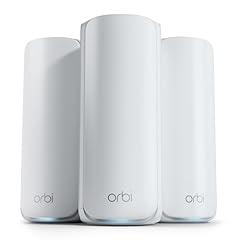
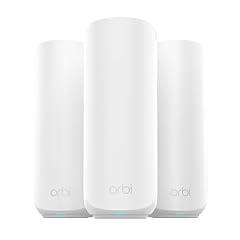
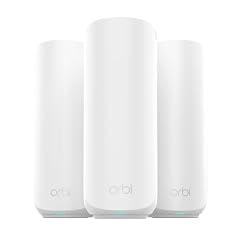
NETGEAR Orbi 770 Tri-Band WiFi 7 Mesh System
Overview
This is a three-unit WiFi 7 mesh system, with one router and two satellites. It is designed to connect to an existing modem or gateway, then distribute one household network across the home through 2.4 GHz, 5 GHz, and 6 GHz WiFi. Each unit has 2.5GbE Ethernet, and the satellites can use wired backhaul instead of relying on the wireless mesh link. The maker states up to 11Gbps aggregate wireless rates, up to 8,000 square feet of coverage, and up to 100 devices. Those are conditional maximums, not measured guarantees. Independent testing found strong close and mid-range mesh throughput, but one test installation did not fully cover a 3,500 square foot home at its outer edges. The system has FCC authorization for the router and satellite radio hardware, while an exact U.S. UL or ETL listing for the supplied power equipment was not established in the checked directories.
What works
- Independent testing found strong mesh performance, including 404.4 Mbps to a second-floor client and 457.5 Mbps to a basement client in the stated test layout.
- All three units support 2.5GbE Ethernet, and the documented setup supports 2.5GbE wired backhaul between router and satellites.
- Automatic firmware updates are enabled by default, and published 2025 and 2026 advisories show fixes for affected Orbi 770-series security vulnerabilities.
- The product supports WPA3-Personal, separate IoT network settings, guest networking, local web management, configuration backup, and physical factory reset.
- Independent testing measured 13.9 watts for the router and 9.1 watts per satellite, or 32.1 watts for the three-unit kit under the reviewer's conditions.
What does not
- The 11Gbps, 8,000 square foot, and 100-device figures are manufacturer maximum claims. They are subject to client capability, placement, building materials, traffic, and regulatory conditions.
- A guest network is disabled by default, and its documentation says guest security and encryption are also disabled by default until the owner enables and configures it.
- The current support policy describes a general end-of-service approach, but does not publish a specific end date for this product. A one-year limited warranty also limits long-term assurance.
- The Orbi app's Apple privacy disclosure lists usage tracking and collection of identifiers, location, contact information, purchases, diagnostics, and usage data linked to users. Google Play reports no third-party sharing and offers deletion requests, but these are developer disclosures rather than independent audits.
- No exact product-level UL or ETL listing for the included power adapters, no verified recycled-content claim, and no product-specific take-back or repair parts program were established in the checked records.
Who is it for
This system fits a large home that needs several wired endpoints and can place satellites thoughtfully, especially where Ethernet can be run for 2.5GbE backhaul. It is suited to households with recent WiFi 5, WiFi 6, or WiFi 7 clients, multi-gig internet up to the 2.5GbE WAN limit, and a willingness to manage router settings and firmware. It also suits owners who need separate WiFi settings for older 2.4 GHz smart-home devices while keeping newer devices on the main network.
Who is it not for
It is not suited to buyers who need independently demonstrated 8,000 square foot coverage in a difficult layout, such as dense masonry, metal framing, long narrow buildings, or detached outbuildings. It is also a poor fit for privacy-sensitive households that do not want an app ecosystem with disclosed tracking and broad data collection. Households that will enable guest access but cannot configure WPA security should avoid leaving the documented default guest settings unchanged. Buyers requiring a published long-term support end date, certified adapter listing, or repair-parts commitment need stronger documentation.
Integrity
The radio hardware is covered by an FCC authorization and associated compliance testing for the router and satellite models. The manual identifies 12V, 2.5A input and includes factory-reset procedures, which can help remove stored network settings before transfer, recycling, or disposal. No relevant product-specific CPSC recall or FCC enforcement action was identified in the checked public sources. Exact U.S. UL or ETL certification evidence for the supplied adapters was not confirmed. Always-on power is a meaningful consideration for a three-node system. Independent testing measured 32.1 watts across the router and two satellites, with an estimated annual electricity cost of about $45 at the reviewer's stated electricity rate and continuous operation. The units use external power adapters, but published evidence did not establish a dedicated spare-parts route, a product-specific recycling program, recycled material content, packaging metrics, or third-party environmental certification. The stated one-year limited warranty and unspecified product-specific security end date constrain confidence in its longest useful life.

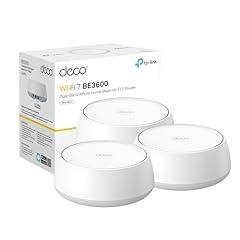
TP-Link Deco BE23 WiFi 7 Mesh System
Overview
This product is a three-unit, dual-band Wi-Fi 7 mesh system for replacing or supplementing a home router. Each compact unit has two auto-sensing 2.5 Gbps Ethernet ports, and the units can link by Ethernet or wireless mesh. TP-Link states a three-unit set can cover up to 6,500 square feet, support up to 150 devices, and deliver a combined theoretical wireless rate of 3.6 Gbps. Those figures are qualified by the manufacturer as dependent on client hardware, building materials, placement, traffic, and internet service. Independent testing of the same Deco BE23 platform found strong short and mid-range throughput, including 1.449 Gbps at 15 feet and 953.7 Mbps at 50 feet under disclosed test conditions. It is a dual-band design, so wireless mesh traffic shares the 5 GHz band with client devices. The product supports WPA3, guest networks, a separate IoT network, wired backhaul, and optional HomeShield security features.
What works
- Independent testing found 1.449 Gbps at 15 feet and 953.7 Mbps at 50 feet under disclosed conditions.
- Each unit has two 2.5 Gbps auto-sensing Ethernet ports, enabling wired backhaul without consuming the only high-speed port.
- TP-Link documents WPA3, guest networking, IoT network isolation, router and access-point modes, plus OpenVPN and IPsec-related VPN options.
- A May 2025 firmware release for this hardware version addressed stability, security, roaming, access control, and satellite connection issues.
- Measured operating draw was modest in one independent test, with 10.4 W for the host and 5.9 W for a node.
What does not
- The 6,500-square-foot coverage, 150-device, and 3.6 Gbps figures are manufacturer claims, not guarantees. TP-Link's own notes say real results depend heavily on placement, client capability, interference, and construction.
- This is dual-band mesh hardware. Without Ethernet backhaul, client traffic and mesh links share available radio capacity, which can matter in dense or high-throughput homes.
- TP-Link provides firmware downloads and has a public security-reporting channel, but it does not publish a model-specific security support end date for this product.
- Some advertised HomeShield protections are tied to a paid advanced service, and the exact included versus subscription features need checking during setup.
- No independent UL or ETL electrical-listing record for this specific product was located in the checked directories.
Who is it for
This product suits households that need three access points across a medium or large home, especially where Ethernet, MoCA, or another wired path can connect nodes. It fits users with multi-gig internet service or local wired devices who can use the two 2.5 Gbps ports on each unit. It also suits households that want app-based management, guest access, basic parental controls, WPA3, and a separate IoT network. The independent throughput results support demanding everyday use such as multiple video streams, gaming, and work calls, provided node placement is sensible.
Who is it not for
It is not well suited to households that need a dedicated third radio for wireless backhaul, especially in large homes with thick masonry, many nearby networks, or heavy simultaneous wireless traffic. It is also a poor fit for buyers who require a published, model-specific software support end date, independently documented electrical safety listing, or a local web-management-first workflow. Privacy-sensitive users who do not want a TP-Link account and app-based cloud services should examine the account, HomeShield, and app data practices before installation.
Integrity
FCC filing materials identify the Deco BE23 among the covered Wi-Fi 7 mesh models and include RF-exposure documentation for its 2.4 GHz and 5 GHz radios. No relevant CPSC recall for this exact product was located in the checked recall sources. The supplied adapter is specified at 12 V and 1.5 A, but an independent UL or ETL listing for this exact product was not found during directory checks. Always-on consumption is unusually well documented for this category. TP-Link reports an 8.65 W idle-power figure for the three-unit set in its voluntary small-network-equipment disclosure, while an independent review measured 10.4 W for a host and 5.9 W for a node. The product has a two-year limited warranty and replaceable external power adapters, but TP-Link does not state a model-specific security support end date or publish repair parts and recycling arrangements specific to this mesh system. Its documented environmental certification is RoHS, not a quantified recycled-content or carbon claim.

TP-Link Deco BE25 Dual-Band WiFi 7 Mesh System
Overview
This is a three-unit indoor mesh Wi-Fi system for homes that need one network across several rooms or floors. Each unit is a dual-band Wi-Fi 7 node using 2.4 GHz and 5 GHz, with two 2.5 Gbps Ethernet ports that can serve as either WAN or LAN. TP-Link states that the three-pack is designed for up to 6,600 square feet and supports wired or wireless mesh backhaul. The radio authorization is independently documented through an FCC equipment grant and RF-exposure filing for the Deco BE25. Independent testing also exists. RTINGS tested the exact product, while another hands-on test found good near-range Gigabit-class throughput but notably short 5 GHz range and much lower satellite performance when nodes communicate wirelessly. The system is therefore more concrete and credible as a wired-backhaul mesh than as a universal answer to a large, difficult wireless layout.
What works
- FCC authorization and RF-exposure documentation are publicly traceable for the indoor Deco BE25 hardware.
- Each node has two 2.5 Gbps auto-sensing Ethernet ports, enabling wired backhaul without sacrificing a dedicated WAN port.
- Independent testing supports strong close-range throughput, with Gigabit-class results under documented test conditions.
- TP-Link has published several firmware releases for this version, including a February 2, 2026 release described as improving security and stability.
- The stated security-support period runs to December 31, 2028 or later in TP-Link's published compliance statement.
What does not
- This is dual-band hardware with no 6 GHz band, so wireless mesh traffic shares the 5 GHz band with client devices.
- Independent testing found limited 5 GHz range and substantially reduced performance for wireless satellite nodes, making the 6,600-square-foot coverage claim highly layout-dependent.
- Three disclosed 2026 vulnerabilities affected earlier firmware, including command injection and path traversal issues. Keeping firmware current is important.
- The Deco setup and management flow requires the mobile app and a TP-Link ID, which creates an account and data-governance dependency.
- No independent wall-power measurements for the complete three-node kit were found. TP-Link publishes only a maximum unit consumption figure of 15.5 W, excluding the power adapter.
Who is it for
It suits a household with Ethernet already available between key rooms, or one willing to run it, and with internet service above 1 Gbps or several high-bandwidth local devices. The two 2.5 Gbps ports on every unit make the three nodes practical for wired mesh placement. It also fits buyers who want Wi-Fi 7 client support but do not need a 6 GHz band. The stated support period through at least December 31, 2028 is useful for households prepared to apply updates promptly.
Who is it not for
It is not well suited to a large or dense-walled home that must rely entirely on wireless backhaul, especially where satellites must be placed far from the main unit. Independent tests found limited 5 GHz reach and a clear wireless-satellite throughput penalty. It is also a poor fit for buyers who require 6 GHz Wi-Fi, a web-first management experience, or minimal account-linked data collection. Households unable to maintain firmware should avoid treating its built-in security tools as set-and-forget protection.
Integrity
The indoor product has a documented FCC authorization, including RF-exposure materials, and its label identifies the supplied electrical input as 12 V, 1.5 A. This supports lawful U.S. radio operation, but an exact UL or ETL listing for this model was not located. No relevant CPSC recall was found in the verification work. Cybersecurity deserves active attention. TP-Link provides a vulnerability-reporting channel, public advisories, and current firmware releases. Earlier firmware was affected by disclosed command injection and path traversal vulnerabilities, so updates are a practical safety measure. The app store disclosures say the Deco app encrypts data in transit and permits deletion requests, but Apple lists identifiers, usage data, diagnostics, and support content as potentially linked to users. TP-Link states a two-year warranty and security support through at least December 31, 2028. Its only clear environmental hardware claim here is RoHS compliance. No quantified recycled-content, packaging, carbon, take-back, repair-parts, or independently measured energy-use evidence was found for this product.

eero 6+ Mesh Wi-Fi Router 3-Pack
Overview
This product is a three-unit, dual-band Wi-Fi 6 mesh system. One compact unit connects to a modem, then the other two extend the same home network over wireless or Ethernet backhaul. Each unit has two auto-sensing gigabit Ethernet ports, a 2x2 Wi-Fi 6 radio design, Bluetooth Low Energy, and an 802.15.4 radio for Thread and Zigbee functions. Setup and ongoing management require the eero mobile app. The manufacturer rates the three-unit kit for up to 4,500 square feet, more than 75 connected devices, and internet plans up to 1 Gbps. Those results depend heavily on construction, node placement, client hardware, and whether satellites are wired. Independent testing by RTINGS and TechRadar confirms that this is a capable mid-range Wi-Fi 6 mesh platform, although it remains dual-band rather than using a dedicated third band for wireless mesh traffic.
What works
- The radio hardware has an FCC authorization and an RF-exposure filing for the eero 6+ model.
- A published security-update commitment runs through at least June 30, 2031.
- A U.S. small-network-equipment efficiency report lists 4.92 W ready-state power per unit and compliance with its Tier 3 level.
- The product supports a mixed wired and wireless mesh, so Ethernet-connected satellites can avoid consuming Wi-Fi airtime for backhaul.
- Independent reviewers tested coverage, throughput, and latency rather than relying only on the coverage headline.
What does not
- No matching UL or ETL listing for the supplied power equipment was located in the public certification directories reviewed. FCC authorization is not electrical-safety certification.
- The product is dual-band. Wireless satellites share available Wi-Fi spectrum with client traffic because there is no dedicated backhaul band.
- Initial setup and network management require an iOS or Android app and cloud-connected service, which is a practical dependency.
- The privacy notice covers collection of identifiers, network information, app diagnostics, and performance data. Account deletion is available, but this is not a locally managed, data-minimizing router.
- The limited warranty is one year, and public documentation offers little evidence of repair parts or a broad manufacturer take-back program.
Who is it for
This product suits households that need to spread a single Wi-Fi network across a larger home and can place three small nodes in reasonably open locations. It is most appropriate for internet service at or below 1 Gbps, ordinary Wi-Fi 6 phones and laptops, and smart-home users who value integrated Thread and Zigbee support. It also fits homes with Ethernet runs, since wiring satellite nodes can preserve wireless capacity. Buyers should be comfortable using a phone app and an online account to set up and administer the network.
Who is it not for
It is not a strong fit for people who require locally managed networking with no app or cloud-service dependency, or for privacy-sensitive households unwilling to provide account, device, and network-performance information. It is also less suitable for homes where every satellite must rely on wireless backhaul while many devices need high sustained throughput, because the dual-band design has no separate backhaul radio. Buyers seeking independently documented electrical certification, multi-gigabit wired ports, a longer hardware warranty, or established repair access should look for products with those records.
Integrity
The eero 6+ model is listed in FCC equipment documentation, including RF testing and an uncontrolled-environment RF-exposure statement. No relevant CPSC recall was located in the recall sources reviewed. That is useful safety evidence, but it does not substitute for a publicly located UL or ETL listing for the supplied power equipment. Use the included or correctly specified power supply, keep units indoors, and leave clearance around them rather than covering them. For longevity, eero states that this model receives security updates through at least June 30, 2031. The company also provides a one-year limited warranty and replacement support. The strongest environmental evidence is energy use. A U.S. industry efficiency report lists 4.92 W ready-state power per unit and Tier 3 compliance, although it is not a wall-meter test of this exact three-unit installation. No specific recycled-material, carbon, or packaging claims for this product were substantiated in the reviewed materials.

NETGEAR Orbi 370 Series WiFi 7 Mesh System
Overview
This is a three-unit, dual-band WiFi 7 mesh system, with one router and two satellites. Each unit has a 2.5 Gbps Ethernet port, while the router has separate 2.5 Gbps internet and LAN ports. It can be configured wirelessly or with Ethernet backhaul, and it supports separate main, guest, and IoT network names. NETGEAR states up to 5 Gbps combined wireless speed, up to 6,000 square feet of coverage, and up to 70 connected devices. Those are maximum figures, not measured guarantees. Independent hands-on testing found matching entry-level multi-gig capability and about 1,500 square feet per unit under its conditions, while noting that building layout and placement materially affect coverage. FCC grant records identify the included router and satellites and include RF-exposure documentation.
What works
- FCC grant documentation covers the router and satellite radio hardware, including RF-exposure material.
- A documented 2.5 Gbps Ethernet backhaul option can reduce the capacity loss of a wireless mesh link.
- Independent testing found reliable entry-level multi-gig performance under favorable test conditions.
- Automatic firmware updates are enabled by default, and current security advisories provide model-specific fixed firmware versions.
- The local browser interface can be used instead of the mobile app for setup and management.
What does not
- The 5 Gbps, 6,000 square foot, and 70-device figures are manufacturer maximums, with environmental qualifications rather than home-specific guarantees.
- It is a dual-band system with no 6 GHz band or dedicated backhaul, so wireless satellites share spectrum with client devices.
- Each satellite has only one Ethernet port. A three-unit wired layout may need an additional switch.
- A January 2026 advisory fixed a local-network authentication bypass, and a June 2026 advisory addressed information disclosure. Owners should verify current firmware.
- The guest network is unsecured by default in the manual. Encryption must be deliberately enabled before use.
Who is it for
This product suits a household that needs to distribute a wired internet connection across several rooms, especially where the router and satellites can be connected by existing Ethernet cabling. It also fits homes with a mixture of newer WiFi 7 devices and older 2.4 GHz or 5 GHz equipment, since the system retains backward compatibility. The practical user should be willing to use the local web controls, set a strong administrator password, enable guest-network encryption, and confirm that automatic firmware updates remain active.
Who is it not for
It is not suited to households that require independently guaranteed whole-home coverage, consistently multi-gig wireless transfers at every node, or a dedicated 6 GHz mesh backhaul. Large homes with dense walls, unusual layouts, or satellite locations far from the router should treat the coverage figure as an upper limit, not a plan. It is also a poor fit for users who will leave default settings unchanged, especially guest WiFi security, or who need extensive free app-based controls without account-linked services and subscription prompts.
Integrity
The radio hardware has a U.S. FCC grant covering the router and satellites, with test documentation and an RF-exposure filing. That is meaningful independent regulatory evidence for lawful radio operation. I did not find a model-specific UL or ETL listing in the searched public directories for the supplied power equipment, so electrical third-party certification should not be assumed from the product documentation alone. No relevant active CPSC recall was identified in the searched recall resources. Security maintenance is important. NETGEAR publishes model-specific firmware releases and security advisories, including fixes issued in January and June 2026. Automatic updating is enabled by default, but it can be disabled. Independent testing measured roughly 19 watts combined daily average draw for a three-unit configuration, about 170 kWh annually if sustained. NETGEAR has a general end-of-service policy and recycling guidance, but no product-specific recycled-content, carbon, packaging, repair-part, or quantified environmental claim was verified.

Amazon eero 7 Dual-Band Mesh Wi-Fi Router
Overview
This is a three-unit indoor mesh Wi-Fi system. Each compact unit is a dual-band Wi-Fi 7 router with 2.4 GHz and 5 GHz radios, two 2.5 Gigabit Ethernet ports, a 15W USB-C power adapter, and app-based setup and management. One unit connects to the modem, while the others extend the same household network wirelessly or through Ethernet backhaul. The manufacturer states that each unit covers up to 2,000 square feet, supports more than 120 devices, and reaches up to 1.8 Gbps wirelessly. Those are qualified maximums, not independently confirmed whole-home results. Independent testing does confirm strong short-range 5 GHz throughput, including a 1,097 Mbps iPerf3 result at six feet in one controlled test. The product is FCC-authorized under its specific hardware model, and eero states security updates are guaranteed through August 31, 2031.
What works
- The exact hardware model has an FCC equipment authorization and RF-exposure filing for U.S. sale.
- Independent testing found 1,097 Mbps 5 GHz throughput at six feet under disclosed iPerf3 conditions.
- Two 2.5 Gigabit Ethernet ports per unit allow a wired modem connection and optional wired mesh backhaul.
- eero states that this model receives guaranteed security updates through August 31, 2031, plus a three-year limited warranty.
- The Connectivity Standards Alliance lists a Zigbee 3.0 certification for the product.
What does not
- This is a dual-band system without a 6 GHz radio, so it lacks the extra spectrum available to tri-band Wi-Fi 7 hardware.
- The advertised 6,000 square foot total coverage is manufacturer-stated. Independent testing supports usable performance, but does not independently validate that maximum area in a typical obstructed home.
- No independently published wall-power measurements for the full three-unit kit were located. The supplied adapters are rated at up to 15W each, which is a capacity rating rather than actual always-on consumption.
- An exact-model UL or ETL electrical-safety listing could not be confirmed in the public directories reviewed. FCC authorization verifies radio compliance, not a full electrical product-safety certification.
- Setup and ongoing management require an iOS or Android app and an eero account, while the privacy notice says the service collects network performance, device, and local wireless-environment data.
Who is it for
This product suits a household that needs to spread one managed network across a larger indoor home, has internet service at or below about 2.5 Gbps, and values simple app administration over detailed local router controls. It is especially relevant where Ethernet can connect one or more units, because the two 2.5 Gigabit ports can support wired backhaul. It also fits homes using compatible Zigbee, Thread, or Matter devices, since the units can act as smart-home controllers. Buyers should place units where they still have a strong connection, not simply at the farthest edge of coverage.
Who is it not for
It is not well matched to households seeking maximum Wi-Fi 7 capacity for many high-speed clients, low-congestion wireless mesh backhaul, or 6 GHz access. Its dual-band design means mesh traffic and client traffic may share the 5 GHz band when nodes are not wired. It also is not for buyers who need a router that can be configured without a smartphone app and cloud-linked account, or those who require independently documented low idle power use. People needing a confirmed UL or ETL listing for the exact kit should obtain documentation before installation.
Integrity
The radio hardware is externally checkable. FCC records identify this exact eero 7 hardware model as an authorized wireless router and include RF-exposure documentation. A Connectivity Standards Alliance record also confirms Zigbee 3.0 certification. No relevant active CPSC recall or FCC enforcement action for this product was located in the sources reviewed. However, a public UL or Intertek directory listing for the exact router and supplied 15W adapter was not confirmed, so electrical-safety evidence is less complete than its RF evidence. eero provides a three-year limited warranty and states that security updates are guaranteed through August 31, 2031, both of which can help extend useful life. Amazon's product sustainability fact sheet for the three-unit package quantifies lifecycle emissions, with product use representing 91 percent of its modeled footprint. The company also makes specific recycled-material and recyclable-packaging claims for the eero 7 line, but no independently audited product environmental certification was located. Actual electricity use remains unverified because no independent wall-power test for this three-unit kit was found.