
4 Best 75 Inch Tv
 Daniel Kenitz
Please note that we participate in affiliate marketing programs. When you purchase through links on our site, we may earn a commission. As an Amazon Associate we earn from qualifying purchases. This comes at no additional cost to you and helps support the resources required to provide valuable content.Advertising Disclosure
Top-rated 75 Inch Tv Comparison
1

2
3
Overview
A 75-inch television is a large 4K display intended for streaming, broadcast viewing, movies, sports, console gaming, or PC use. At this size, the important question is not simply whether the screen is labeled “4K,” “QLED,” or “Mini-LED.” A useful choice depends on how the television performs in the room where it will be installed, which signals it actually accepts, how safely it can be mounted, and how much evidence supports its claims.
Start with the installation. A 75-inch screen can weigh roughly 50 to 71 pounds in the supplied products, and published VESA spacing ranged from 300 × 300 mm to 600 × 400 mm. Check the model-specific manual for the television’s weight, VESA pattern, screw size and depth, stand footprint, wall requirements, and anti-tip instructions. A mount must be rated for the set and the wall structure. Stand placement requires a level, suitably wide surface; an unsecured television is a serious tip-over hazard, especially around children or pets.
For picture quality, native refresh rate matters more than phrases such as “Motion Rate” or “Motion Xcelerator.” The supplied products range from native 60Hz panels to 120Hz, 144Hz, 165Hz, and 4K gaming claims. Confirm whether 120Hz or 144Hz works at 4K, which HDMI inputs support it, and whether VRR variable refresh rate actually operates over the stated range. A television may advertise a 120Hz mode while remaining a 60Hz panel, reduce image sharpness, drop alternate frames, or lack HDMI 2.1 bandwidth. Independent measurements of brightness, contrast, black levels, reflection handling, color, motion, VRR, and input lag are more meaningful than peak-nit claims or panel labels.
Room conditions also determine whether a television works well. Matte or anti-reflection treatment can help with direct reflections, but several reviewed products still performed poorly with lamps or windows facing the screen. Viewing angle varies substantially: some screens lose picture quality quickly off center, while others retain side-seat usability. Flicker findings also differ. Independent testing found some products flicker-free at tested brightness levels, while others used 120Hz or 480Hz pulse-width dimming. Look for disclosed laboratory conditions rather than assuming that a “flicker-free,” “glare-free,” or low-blue-light phrase is a certification.
For energy and longevity, prefer a model-specific FTC EnergyGuide label, DOE television record, or ENERGY STAR Product Finder entry. A standby figure such as 0.5W or less does not reveal normal viewing consumption or annual electricity use. For responsible ownership, look for a written warranty, repair manuals, parts and authorized-service information, a defined software-support period, and a real take-back or recycling route. Recycling programs are useful, but generic green language is weaker than model-specific lifecycle evidence, recycled-content disclosure, TCO Certified or UL SPOT records.
Across the supplied reviews, the recurring safety caveats are secure installation, glare and viewing-angle limitations, privacy risks from connected platforms and voice features, and uncertainty where exact-model measurements or certifications were missing. Some products also showed motion blur, weak HDR, or flicker that may matter to sensitive viewers. No category-wide contraindication was found beyond the need to secure a 75-inch television properly and verify the evidence behind high-refresh, brightness, energy, privacy, and support claims.
Integrity
These topics cover the practical risks and long-term consequences of owning a large connected display. The scores below are comparative signals from the supplied reviews, not certifications or guarantees; a higher score means stronger evidence or performance within this set.
HHealth & Safety
Electrical and interference safety
This measures evidence that the television and supplied power equipment have appropriate electrical, fire-safety, and radio-frequency testing, including public NRTL or FCC records and absence of unresolved safety action. Among the supplied products, scores ranged from 70 to 78. Higher-scoring models had clearer compliance evidence or documentation; lower scores commonly reflected missing model-level UL, ETL, CSA, or FCC records rather than a confirmed defect.
Safe stand and wall mounting
This measures whether the stand, VESA pattern, fasteners, weight information, and instructions support stable installation without a relevant tip-over or stand-failure recall. Scores ranged from 71 to 88. Higher-scoring products supplied concrete model-specific mounting and stability details; lower-scoring products still required careful installation but left more uncertainty about hardware, stand limits, or safe placement. A 75-inch television should never be left unsecured.
Viewing comfort and light control
This covers glare, flicker, brightness control, ambient-light adjustment, and other substantiated viewing controls without making eye-health claims. Scores ranged from 47 to 86. Higher-scoring products had independent evidence of reflection control or flicker behavior and useful picture settings. Lower-scoring products showed measured flicker, weak glare handling, or only manufacturer claims. Room lighting and seating position remain important even for a well-scored screen.
Smart-TV privacy and security
This measures opt-outs, microphone or camera controls, data transparency, updates, and security-support information. Scores ranged from 68 to 82. Higher-scoring products offered stronger controls such as hardware microphone switches, optional content recognition, or longer update policies. Lower-scoring products involved connected viewing, app, audio, advertising, or voice-data collection with less clearly defined support. Privacy settings should be reviewed during setup rather than left at default.
EEcology
Energy use
This measures normal viewing electricity, connected standby, and independently verifiable efficiency qualification. Scores ranged from 68 to 83. Higher-scoring products had clearer annual-use or standby information, while lower-scoring products lacked model-specific EnergyGuide, DOE, or ENERGY STAR evidence. A low standby figure alone is incomplete: annual consumption depends on viewing time, brightness, settings, and connected features.
Useful life and repair support
This measures warranty strength, service information, parts access, repair options, and stated software life—important because an unsupported smart TV can become premature e-waste. Scores ranged from 69 to 84. Higher-scoring products included repair guides or explicit multi-year software policies. Lower-scoring products generally had one-year warranties and no defined parts or end-of-support period. A warranty by itself does not establish long useful life.
Safer materials and responsible end of life
This measures model-specific evidence about materials, recycled content, packaging, take-back, and certified recycling. Scores ranged from 68 to 83. Higher-scoring products had stronger lifecycle or packaging disclosures alongside a disposal route. Lower-scoring products offered only general recycling information or no verified material evidence. A retailer or manufacturer recycling locator is useful, but it is not the same as TCO, UL SPOT, or an environmental declaration.
EEvidence
Honest specifications and labels
This measures whether claims about refresh rate, HDR, brightness, dimming, HDMI, audio, and gaming state conditions and match model documentation. Scores ranged from 44 to 86. Higher-scoring products qualified claims and aligned them with manuals or independent findings. Lower-scoring products used ambiguous headline figures, such as a claimed 120Hz mode on a 60Hz panel or conflicting backlight descriptions. Check the exact input, resolution, and mode.
Measured picture and gaming performance
This is weighted more heavily because repeatable tests are especially useful for a large display. It covers brightness, contrast, color, reflections, motion, input lag, VRR, and supported signals. Scores ranged from 42 to 88. Higher-scoring products had independent measurements confirming strong gaming or picture performance; lower scores reflected weak results or no exact-model laboratory data. Series-level testing is useful but is not identical to testing the 75-inch unit.
Independent proof, not self-issued badges
This measures whether safety, energy, environmental, and performance claims appear in credible public records from independent organizations. Scores ranged from 68 to 80. Higher-scoring products had more corroboration from laboratories or certification records, while lower-scoring products depended more on manufacturer statements or had missing registry entries. The absence of a located record is evidence uncertainty, not proof that a product is unsafe or noncompliant.
Full reviews

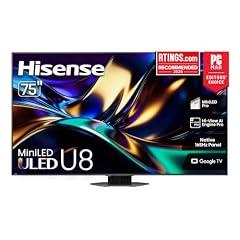
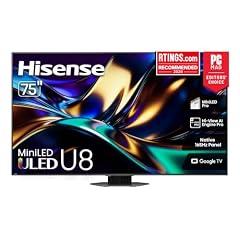
Hisense 75" U8 Series Mini-LED 4K Google TV
Overview
This is a 75-inch 4K LCD television using a Mini-LED backlight and quantum-dot color layer. It runs Google TV, connects through three HDMI 2.1 ports, Wi-Fi 6E, Ethernet, Bluetooth, USB, and USB-C display input, and is intended for streaming, broadcast TV, console play, and PC gaming. Hisense’s model-specific technical sheet states a native 165Hz panel, local dimming, HDR support including Dolby Vision and HDR10+, 4.1.2-channel built-in audio, and a 600 x 400 mm VESA mounting pattern. Independent laboratory coverage exists for the U8QG line, but the tested 65-inch version has a different panel from the 75-inch version. Its strong brightness, deep blacks, and low gaming latency therefore support the series, not a direct measurement of this 75-inch screen.
What works
- The manufacturer publishes unusually useful installation details, including 76.1 pounds without the stand, 89.3 pounds with it, stand dimensions, and the 600 x 400 mm M8 wall-mount pattern.
- Hisense states that all three HDMI ports are HDMI 2.1, with a native 165Hz panel, VRR, ALLM, and 1080p gaming up to 288Hz through HDMI.
- Independent testing of the 65-inch U8QG found exceptional HDR and SDR brightness, strong contrast, low input lag at high refresh rates, and effective handling of indirect room glare. These results are informative but not fully transferable to the 75-inch panel.
- The product has a two-year manufacturer warranty, and Hisense provides a parts and accessories channel plus a consumer electronics recycling program.
What does not
- The available independent laboratory review tested the 65-inch model, while the 75-inch version is reported to use a different ADS Pro panel. Brightness, contrast, uniformity, and viewing-angle results cannot be treated as confirmed for this size.
- The 65-inch laboratory sample over-brightened HDR relative to the intended PQ curve, had visible blur trails in fast action, and handled direct reflections only adequately. These may or may not occur to the same degree on the 75-inch version.
- A hands-free far-field microphone is listed, and the smart-TV privacy policy permits data collection and optional viewing-recognition services. The service can be disabled in settings, but there is no documented physical microphone switch in the available product material.
- No model-specific public ENERGY STAR listing, EnergyGuide label, TCO certification, UL listing, ETL listing, or public FCC declaration was located during verification. This is missing public proof, not evidence that the product is unsafe or noncompliant.
Who is it for
It suits a household that needs a genuinely large 4K screen for a bright living room, console play, or a gaming PC, and can place it mostly in front of the seating area. The published 165Hz capability, VRR support, three HDMI 2.1 inputs, and USB-C display input make its intended gaming role concrete. It also suits installers who need published dimensions, weight, stand footprint, and VESA information before selecting furniture or a wall mount. Installation should still be a two-person job because the set weighs 89.3 pounds with its stand.
Who is it not for
It is not well suited to a room where viewers sit at steep side angles, since independent testing of another U8QG size found image degradation off-axis. People highly sensitive to flicker should confirm comfort in person, because the tested 65-inch version used PWM dimming, even though it was measured at a very high frequency. It also needs careful privacy setup for homes that do not want a hands-free microphone or optional viewing-recognition service. Do not place it on narrow, unstable, or unsuitable furniture, especially where children can climb nearby.
Integrity
For mounting safety, Hisense publishes a 600 x 400 mm M8 VESA pattern, dimensions, and both bare-set and stand-installed weights for this exact 75-inch product. No recall specific to this television was located in the CPSC recall materials checked. Public third-party electrical safety listing evidence for this exact model was not located, so users should inspect the rear label, supplied cord, and installation instructions before setup. The smart platform includes a far-field microphone. Hisense says its optional Enhanced Viewing Service can be turned off through the TV settings, and users in covered states can select a Do Not Sell or Share option there. Hisense also states that certain TV models receive security updates for at least two years from launch, without clearly naming this model. The company routes consumer television recycling through MRM, but no product-specific materials declaration, recycled-content evidence, ENERGY STAR qualification, or public EnergyGuide label was found.

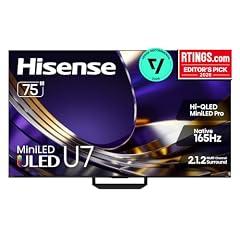
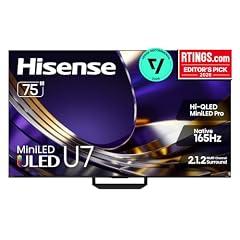
Hisense 75U7SG 75" 4K Premium Gaming TV
Overview
This is a 75-inch 4K LCD smart TV with a Mini-LED backlight, quantum-dot color layer, Google TV software, four HDMI inputs, a center stand, and a supplied voice remote. It is intended for streaming, broadcast viewing, console gaming, and PC gaming. Hisense specifies a 165Hz native panel, variable refresh rate support, a 400 x 400 mm wall-mount pattern, 61.5 pounds without the stand, and a two-year warranty. Independent testing was performed on the 65-inch version, with the reviewer stating that most results apply to the 75-inch model. It confirmed very high HDR and SDR brightness, deep blacks from local dimming, effective matte reflection control, low input lag, HDMI 2.1 bandwidth across all four inputs, and 165Hz 4K or 330Hz 1080p support. It also found slow pixel transitions, visible uniformity issues, narrow off-axis viewing, and some HDR banding.
What works
- Independent testing found high brightness and a matte finish that greatly reduce direct reflections in bright rooms.
- Independent testing confirmed low input lag, four HDMI 2.1 bandwidth inputs, VRR, and high-refresh gaming support.
- The Mini-LED local-dimming system produced deep, generally uniform blacks with little haloing in independent testing.
- The manufacturer provides concrete mounting information, including a 400 x 400 mm VESA pattern, M6 fasteners, and the screen weight without its stand.
What does not
- Independent testing found slow pixel transitions, so fast sports and games can look blurry despite the high refresh-rate capability.
- The image loses color and contrast rapidly from side seats, which is a real limitation for broad seating arrangements.
- PWM backlight dimming is present. Testing found it runs at a very high frequency and is not visibly apparent, but highly flicker-sensitive viewers should still assess it personally.
- No model-specific public EnergyGuide, ENERGY STAR qualification, third-party electrical safety listing, or defined software-security support period was located during verification.
Who is it for
This product suits a household that needs a very large screen in a sunlit living room and normally watches from seats near the center. Its independently tested brightness and matte reflection handling address window and lamp glare, while the confirmed HDMI 2.1, VRR, and low input lag support current consoles and high-refresh PCs. It also fits an installation that can safely support a 61.5-pound wall-mounted screen or has a stable, level cabinet for the supplied center stand.
Who is it not for
It is not well suited to a wide sectional, a bar-style viewing layout, or other arrangements where people often watch far off center, because independent testing found fast degradation in the viewing angle. It also deserves caution from people highly sensitive to display flicker, even though measured PWM was high frequency. Fast-action sports viewers and competitive players who prioritize motion clarity should account for the independently observed slow response time, blur, color artifacts, and dirty-screen effect.
Integrity
For viewing comfort, the strongest evidence is independent rather than promotional. The matte screen substantially reduces direct reflections, and high brightness helps preserve visibility in daytime rooms. Independent testing also found PWM dimming, but at a very high frequency that was not visibly apparent in its assessment. The product has a far-field microphone for voice control according to the manufacturer, while no physical microphone kill switch was verified. Privacy controls are meaningful but incomplete. Google TV allows users to opt out of ad personalization or reset and delete its advertising identifier, and Hisense describes an optional Enhanced Viewing Service that can use viewing data with an ACR service provider. Ads remain in the interface even after opting out of personalized ads. Hisense offers a two-year warranty, and state recycling registries list Hisense television take-back options. No public model-specific long-term software-support commitment, EnergyGuide record, ENERGY STAR qualification, or independent materials certification was located.

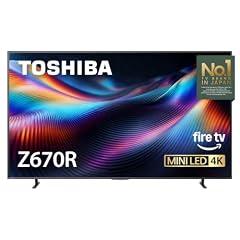
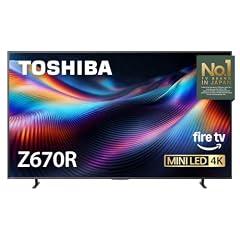
Toshiba Z670 Series 75" Mini-LED 4K Smart TV
Overview
This product is a 75-inch 4K Mini-LED LCD television with quantum-dot color and Fire TV software. It is intended for streaming, broadcast television, console play, and PC gaming. Toshiba states that the Z670R family has full-array local dimming, Dolby Vision support, native 144Hz refresh, variable refresh rate, automatic low-latency mode, and AMD FreeSync Premium. Independent evidence is more limited for this exact 75-inch screen. Consumer Reports tested the related 65-inch Z670R, reporting strong detail, color accuracy, contrast, and motion, while also noting haloing around bright objects and some HDR highlight-detail loss. Toshiba's current product page identifies the 75-inch model correctly but contains body text and images for an unrelated ArtVision television, which weakens confidence in its published documentation.
What works
- Toshiba states native 144Hz, VRR, ALLM, and FreeSync Premium support, features relevant to compatible PC gaming.
- The related 65-inch Z670R received favorable Consumer Reports laboratory findings for detail, color accuracy, contrast, and motion.
- Fire TV privacy settings provide opt-outs for device usage, app usage, interest-based advertising, and broadcast live-TV data.
- Toshiba TV USA provides a route to MRM electronics recycling locations for end-of-life disposal.
What does not
- No public independent measurement table was located for this exact 75-inch screen, so brightness, input lag, reflection handling, flicker, and VRR behavior remain unverified at this size.
- The manufacturer page has a clear documentation mismatch, with ArtVision G700S copy appearing on the 75-inch Z670R page.
- No model-specific public UL, ETL, CSA, ENERGY STAR, TCO, UL SPOT, or FCC compliance record was located during verification.
- The public support page did not provide usable model-specific manuals, installation details, repair documentation, or a defined software-support end date.
Who is it for
It suits a household that wants a very large 4K Fire TV for mixed streaming, broadcast viewing, and gaming, and that can verify settings after installation. It is especially relevant to a PC gamer who can actually output high frame rates and plans to use the manufacturer-stated 144Hz and VRR features. It also fits users comfortable managing Fire TV privacy settings, including turning off optional usage and advertising data collection where available.
Who is it not for
It is not well suited to buyers who need independently measured proof of this exact panel's brightness, glare control, input lag, HDR accuracy, or flicker before installation. Households wall-mounting a large television near children should not rely on the incomplete public support material alone. They need the supplied installation instructions, correct wall hardware, verified mount capacity, and a properly secured setup. It is also a weaker fit for people who do not want a connected, advertising-supported smart-TV platform or ongoing privacy-setting management.
Integrity
The available safety evidence does not identify a CPSC recall specific to this product. However, a public model-level UL, ETL, CSA, FCC, ENERGY STAR, or TCO listing was not located. That is missing public proof, not evidence of a defect. The large screen should be installed using its supplied instructions and securely wall-mounted or stabilized, particularly in homes with children. Fire TV offers meaningful data controls for device usage, app usage, interest-based ads, and broadcast live-TV information. Those controls reduce optional data uses but do not make a connected TV data-free. Amazon's published security-update page does not list this third-party Toshiba television by name. For end of life, Toshiba TV USA directs U.S. consumers to MRM collection locations. No model-specific environmental declaration, recycled-content disclosure, or independently verified materials certification was found.

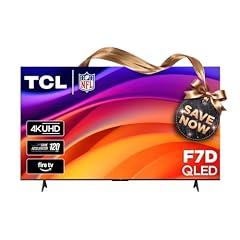
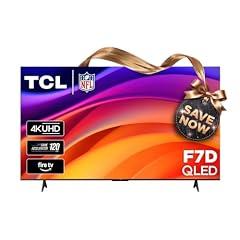
TCL 75-inch F7D QLED 4K Smart TV
Overview
This product is a 75-inch 4K QLED LCD smart television with an LED backlight, Fire TV software, Wi-Fi, a voice remote, and a supplied two-foot stand. TCL's product page confirms a 60 Hz native refresh rate, while its setup guide documents 1080p input at up to 120 Hz for the 75-inch version. That is useful for some console play, but it is not a 4K 120 Hz panel. TCL states that the product supports Dolby Vision, HDR10+, HDR10 and HLG, but its own specification table lists HDR10 only. The retailer's Game Accelerator 120 wording is also not substantiated by TCL's product page. The setup guide provides unusually concrete mounting instructions, including a 300 x 300 mm pattern, M6 x 16 mm screws, and a professional-installation warning.
What works
- The model-specific setup guide gives exact 75-inch wall-mount requirements, including 300 x 300 mm VESA spacing and M6 x 16 mm screws.
- The supplied stand instructions include stability warnings, cable-routing guidance, and advice to anchor furniture and the television where appropriate.
- Fire TV privacy settings allow opt-outs for device usage data, app usage data, interest-based ads, and over-the-air viewing data.
- TCL documents electronics collection sites and a mail-back recycling route, rather than directing owners to household trash.
- The written U.S. warranty covers parts and labor for one year for non-commercial use, with repair or replacement options for large televisions.
What does not
- TCL's own product page conflicts on HDR support, with feature copy naming four HDR formats but the specifications section listing HDR10 only.
- The 60 Hz native panel does not verify the retailer's Game Accelerator 120 wording as a 4K 120 Hz or variable-refresh-rate capability.
- No independent laboratory measurements were located for brightness, contrast, reflection handling, flicker, input lag, or color accuracy on this exact product.
- No model-specific ENERGY STAR listing, public EnergyGuide label, or independently verifiable normal-use and connected-standby power figure was located.
- The documentation carries an FCC Part 15 supplier declaration, but no public model-specific UL, ETL, or CSA safety-listing record was located.
Who is it for
This product suits a household seeking a very large 4K streaming screen with a conventional LED LCD design, Fire TV access, and occasional console play at 1080p up to 120 Hz. It is also a better fit for an installer or owner who can follow the supplied stand and wall-mount instructions closely. The documented 300 x 300 mm wall pattern, specified screws, and professional-installation warning make planning a secure fixed installation more straightforward than relying on generic mounting information.
Who is it not for
It is not suited to buyers who need independently measured picture quality before placing a 75-inch television in a bright room or a critical movie-viewing space. TCL does not publish a brightness figure, and no independent measurements were located for this exact product. It is also unsuitable for players expecting verified 4K 120 Hz or variable refresh rate. Households with climbing children should not place it on unanchored furniture, and wall installation should not be improvised because the guide calls for a suitable mount and professional installation.
Integrity
The supplied guide includes detailed stability precautions. It warns against unstable furniture, overhang, climbable objects near the screen, and unsecured cords. For wall mounting, TCL specifies a 300 x 300 mm pattern for the 75-inch product, M6 x 16 mm screws, and a mount rated for at least five times the television's net weight. No current recall for this exact product was located in the CPSC recall records searched. Its guide contains an FCC Part 15 Class B compliance statement and identifies TCL North America as the responsible supplier. A public UL, ETL, or CSA listing for this exact product was not located. TCL provides one year of U.S. parts-and-labor coverage for non-commercial use and documents electronics drop-off and mail-back recycling options. The Fire TV platform offers opt-outs for several usage and advertising data settings, but TCL does not publish a defined software-support end date for this product.