
10 Best Jump Starters of 2026
 Daniel Kenitz
Please note that we participate in affiliate marketing programs. When you purchase through links on our site, we may earn a commission. As an Amazon Associate we earn from qualifying purchases. This comes at no additional cost to you and helps support the resources required to provide valuable content.Advertising Disclosure
Top-rated Jump Starter Comparison
1


2
3
4
5

6
7
8
9

Overview
A jump starter is a portable battery pack that briefly supplies high current to a vehicle’s 12-volt starting system when the vehicle battery cannot crank the engine. Many also provide USB power, a 12-volt outlet, a flashlight, or an air compressor. The useful question is not which product prints the largest amp number, but whether the complete pack, clamps, charging arrangement, and stated vehicle limits are supported by credible evidence.
Starting performance should be described with more than peak amps. A meaningful test identifies the load, temperature, condition of the vehicle battery, voltage, current, voltage sag, number of attempts, and pass criteria. Independent testing in the supplied reviews ranges from controlled cold-weather or repeated-vehicle-start testing to less standardized field use. A manufacturer’s “2,000A,” “4,000A,” “6,000A,” or higher peak figure is not automatically a sustained cranking rating, and it may not show how long that output lasts. Engine-size claims also remain manufacturer claims unless testing supports the advertised gasoline or diesel limits.
Look for clear compatibility boundaries: 12-volt use, gasoline and diesel engine limits, battery-condition requirements, lead-acid-only restrictions where applicable, and instructions for hybrids or vehicles with unusual battery locations. A jump starter is not a replacement for a failed battery, charging system, starter, or vehicle-specific procedure. It should not be assumed to start every vehicle, and hybrid and EV owners should follow the vehicle maker’s instructions for the 12-volt auxiliary system.
Safety evidence should cover the finished product rather than just a cell or component. A public listing in UL Product iQ for UL 2743, Intertek’s ETL directory, or the CSA Group database is more useful than an unexplained “UL” or “certified” statement. Buyers should also check the supplied charger, input and output ratings, USB-C power claims, and whether the product includes a wall adapter at all. Reverse-polarity detection, spark reduction, short-circuit protection, overcurrent protection, temperature shutoffs, clear clamp indicators, and limits on repeated starts reduce common mistakes, but manufacturer instructions do not equal independent certification. Override or boost modes can bypass ordinary low-voltage or connection safeguards and require particular care.
Readiness depends on storage and maintenance. Several supplied products recommend recharging every three months; one lead-acid model calls for monthly charging. Heat, long storage, damaged cables, and repeated start attempts can reduce reliability or create hazards. A warranty, model and serial information, manufacturer contact, and production coding make a safety remedy easier to obtain if a problem is found.
Lithium products should have a stated watt-hour rating and, ideally, an exact-pack UN 38.3 transport test summary. That document is evidence about transport testing, not proof of starting performance or complete electrical safety. At end of life, lithium devices should not go in household trash or curbside recycling; use a battery, electronics, or household-hazardous-waste collection route that accepts them. Lead-acid units also require separate recycling through a battery retailer or household hazardous-waste program.
Across the supplied products, the recurring caveats are clear: no exact finished-product UL, ETL, or CSA listing was found for most models; many peak-current and engine claims lack reproducible testing; several products require separately obtained or uncertified charging equipment; boost or override modes can disable protections; and stored packs need regular charging. Do not use a product on a non-12-volt system, with damaged, frozen, leaking, swollen, or severely compromised batteries, or contrary to the vehicle manual. No single category-wide contraindication beyond those repeated limitations was found in the supplied data.
Integrity
The scores below reflect the supplied reviews and distinguish documented performance or safeguards from unsupported marketing claims. A higher score indicates stronger evidence or clearer controls for that topic; it does not mean the product is risk-free or suitable for every vehicle.
HHealth & Safety
Battery fire and electrical safety
This measures protection against overheating, electric shock, short circuits, fire, and thermal runaway across the complete jump starter and its charging system. It matters because these packs combine lithium or lead-acid batteries with high-current cables. Higher-scoring products had stronger documented controls or product-specific certification evidence; lower-scoring products relied mainly on manufacturer claims and lacked a public finished-product UL, ETL, or CSA listing.
Proven starting power
This measures whether the product can actually crank the stated 12-volt vehicle type, including voltage sag and repeat starts, rather than merely reporting peak amps. It matters when a roadside pack must work under cold or weak-battery conditions. The supplied scores were strongest where independent testing recorded repeated or cold-weather starts, while lower scores reflected only manufacturer peak-current and engine-size claims.
Safe clamps and connection protection
This measures reverse-polarity warnings, spark and short-circuit protection, clamp and cable design, and the risks of override use. These controls matter because incorrect connections are a common jump-start mistake. Higher-scoring products documented indicator lights, polarity detection, thermal or overcurrent controls, and clear procedures. Lower scores generally offered fewer documented safeguards or left more responsibility to the user, especially in boost modes.
Safe recharging and accessory power
This measures whether the input, charger, USB outputs, thermal controls, and power ratings are clearly and safely specified. It matters because some products include no wall adapter, leaving charger quality to the buyer. Higher scores came with concrete input and output ratings or a verified charging system. Lower scores reflected missing adapters, conflicting specifications, generic charging instructions, or no public certification evidence for the charging arrangement.
Clear vehicle compatibility limits
This measures whether the product states its 12-volt scope, gasoline and diesel engine limits, battery-condition requirements, and cautions for hybrids, EVs, or unusual systems. Clear limits prevent a broad peak-amp claim from being mistaken for universal compatibility. Higher-scoring products gave specific boundaries and procedures. Lower-scoring products used wider or conflicting claims, or provided little guidance for damaged batteries and nonstandard vehicles.
Ready when needed
This measures charge retention, storage guidance, repeated-use durability, temperature readiness, and the condition of the cables and enclosure. It matters because a jump starter is commonly stored for months before an emergency. Higher scores were associated with concrete recharge intervals, documented endurance, or practical storage instructions. Lower scores reflected missing long-term or temperature-aging evidence, frequent maintenance needs, or uncertainty about retained capacity.
Recall accountability and traceability
This measures whether the buyer can identify the exact model and batch, contact the maker, register a warranty, and obtain a meaningful safety remedy. It matters because battery incidents may require product-specific action. Higher-scoring products provided model or serial information, manufacturer contact, warranty or registration support, and no identified relevant recall. Lower scores reflected weaker traceability or less accessible accountability information.
EEcology
Responsible battery end of life
This measures whether the seller gives practical U.S. directions for reuse, take-back, or recycling and clearly keeps the battery out of trash and curbside bins. It matters because damaged lithium batteries can create fires during collection, while lead-acid batteries require dedicated handling. Higher scores came from explicit recycling instructions or Call2Recycle direction. Lower scores usually said only to follow local rules and named no collection route.
Lithium battery transport compliance evidence
This measures documentation for safe transport of the exact battery pack, including its watt-hour rating and UN 38.3 test summary. It matters for shipping, travel, and identifying the battery involved in a safety issue. Higher scores came from an exact-product test summary, as seen most clearly for the NOCO models. Lower scores reflected only a watt-hour claim, incomplete markings, or no public summary; this topic does not prove starting performance.
EEvidence
Honest specs and realistic claims
This measures whether peak amps, watt-hours, charge time, starts per charge, engine limits, USB power, and safety claims are defined and internally consistent. Higher-scoring products separated theoretical peak output from starting current and supplied concrete ratings. Lower-scoring products had conflicting engine or amp claims, unexplained capacity figures, or marketing language that exceeded the available testing. A large number without conditions is weak evidence.
Independently verified, not self-certified
This measures whether an identified third party publicly verifies the exact finished product or whether a reproducible independent test supports the claim. Higher scores were associated with a public product listing, exact-model transport evidence, or independent starting tests. Lower scores reflected self-certification, an unverified “UL” statement, or reviews without controlled current, voltage, temperature, and repeat-start methods. Certification scope must match the product and claim.
Full reviews

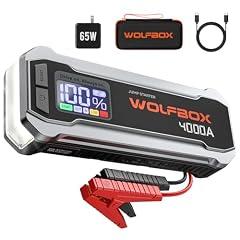
WOLFBOX 4000A 12V Car Jump Starter
Overview
This is a 12 V lithium-ion jump starter and USB power bank, measuring 9.33 by 3.86 by 1.5 inches and weighing about 2.9 pounds. The supplied package is documented to include jumper cables, a USB-C cable, a 65 W USB-C wall charger, an EVA storage case, and a manual. It is intended for starting 12 V vehicles, not for replacing a vehicle battery. WOLFBOX states 88.8 Wh, 24,000 mAh capacity, 1,000 A starting current, 4,000 A peak current, and limits of up to 10 L gasoline or diesel engines. These output and engine claims were not supported by a published independent load test found in this review. The manual does document reverse-polarity indication, overcurrent warnings, and high and low temperature output cutoffs, but public certification for the finished product and supplied charger was not identified.
What works
- The manual documents reverse-polarity indication, overcurrent detection, and a temperature cutoff at a stated 55 C core temperature.
- Includes a 65 W USB-C wall charger, USB-C cable, jumper cables, and a protective EVA storage case.
- Clearly intended for 12 V vehicle batteries, with documented limits on repeated start attempts and instructions to remove clamps after starting.
- The 88.8 Wh rating and 24,000 mAh claim are internally consistent when the capacity is expressed at nominal lithium-ion cell voltage.
What does not
- No public UL, ETL, or CSA listing for the finished product or supplied wall charger was identified in this review.
- The 4,000 A peak figure, up to 10 L engine claim, approximately 40-start claim, and storage-readiness claim lack a published independent test protocol or report.
- BOOST mode can force a start when vehicle-battery voltage is below 9 V, so it requires close adherence to the manual and should not be treated as routine use.
- Disposal guidance says to follow local regulations, but does not provide a U.S. take-back program, collection locator, or model-specific recycling route.
- No model-specific UN 38.3 lithium-battery test summary or transport documentation was publicly located.
Who is it for
This product suits a driver who wants a compact 12 V emergency starter kept in a storage case, and who is comfortable following clamp polarity, cooldown, and recharge instructions. It is most aligned with passenger vehicles, pickups, lawn equipment, and other 12 V applications within the manufacturer-stated 10 L engine limit. It also fits someone who values a USB-C power bank and emergency light in the same device, while recognizing that the stated cranking output has not been independently verified.
Who is it not for
It is not suited to anyone who needs publicly verifiable UL, ETL, or CSA certification covering the complete jump starter and its included charger. It is also a poor fit for 6 V, 24 V, or other non-12 V systems, for users who may rely on BOOST mode without understanding the risks of a severely depleted battery, or for vehicles with known battery, charging-system, cable, or starter faults. Households seeking a documented battery take-back route should seek clearer recycling support.
Integrity
The product uses a lithium-ion battery, which brings fire, burn, and leakage hazards if it is damaged, overheated, shorted, or improperly charged. Its manual gives useful controls, including reverse-polarity warning, high-temperature output cutoff, low-temperature protection, limits on repeated start attempts, and directions not to use damaged clamps or cables. Those are manufacturer instructions, not independent safety certification. The manual lists CE, FCC, and RoHS markings, but this review did not identify a public North American NRTL listing for the exact finished product or its included adapter. No WOLFBOX-specific CPSC recall or safety warning was located in the reviewed public recall sources. For end of life, the only product-specific direction is disposal under local regulations. Buyers should keep it out of trash and curbside recycling, and use a qualified lithium-battery collection option.

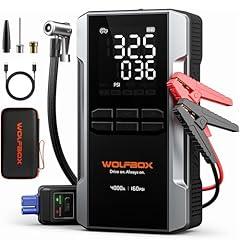
WOLFBOX 4000A Jump Starter and Air Compressor
Overview
This product is a 12 V lithium-ion roadside power pack that combines a jump starter, tire inflator, USB power bank, and LED light. The manufacturer specifies an 88.8 Wh, 24,000 mAh battery, 1,000 A starting current, 4,000 A peak current, 65 W USB-C input and output, and a built-in compressor rated to 160 PSI. It weighs about 3.4 pounds according to the manual. Its manual gives concrete operating limits, including 12 V vehicle batteries only, a battery level above 50 percent before starting, and temperature cutoffs for charging and output. Car and Driver independently tested this exact product as an inflator, reporting quick inflation, solid construction, tactile controls, and an included carrying case. That outlet did not independently verify its jump-start capability in the combo-product review.
What works
- Car and Driver independently found the tire inflator quick and described the enclosure, controls, and included carrying case favorably.
- The manual gives actual starting current as 1,000 A as well as the more promotional 4,000 A peak figure, which is more informative than a peak-only claim.
- Clamp indicators warn of reversed polarity, and the manual documents short-circuit, over-current, high-temperature, and low-temperature protections.
- The stated 88.8 Wh battery capacity and USB-C electrical profiles are specific enough to assess charging and transport needs.
What does not
- The manufacturer claims UL and FCC certification, but public UL, Intertek, and CSA registry searches did not confirm certification of this exact finished product.
- No published independent load test was found for this exact product's 1,000 A starting current, 4,000 A peak claim, or stated 10 L engine limit.
- The charging cable is included, but no AC adapter is supplied. Safe recharge therefore depends on the buyer selecting a suitable USB-C PD charger.
- No public UN 38.3 test summary or manufacturer recycling and take-back instruction was located for this exact battery pack.
Who is it for
This product suits a driver who wants a single stored emergency tool for occasional low tire pressure, a discharged 12 V starter battery, phone charging, and nighttime visibility. It is most appropriate for owners willing to follow the manual, keep the pack above the recommended charge level, recharge it every three months, and use a suitable 65 W USB-C PD wall charger that they already own. The independently tested inflation function is particularly relevant for routine tire top-offs.
Who is it not for
It is not suited to buyers who need publicly verified electrical safety certification for the exact finished product, or documented laboratory proof that it can start a particular large engine in difficult conditions. It is also unsuitable for use with non-12 V vehicle batteries, or as a substitute for diagnosing a damaged starter battery. Households unable to monitor charge level, storage temperature, cable condition, and lithium-battery disposal should avoid treating it as a maintenance-free emergency device.
Integrity
The product contains an 88.8 Wh lithium-ion battery. Its manual describes charging temperature protection below 0 C and above 55 C, plus over-current and short-circuit protection. It also uses smart clamps with a reverse-polarity warning. Those are useful manufacturer-documented controls, but no public listing was located that verifies a UL 2743 or comparable North American safety certification for this exact finished product, despite the maker's UL and FCC claim. No matching CPSC recall or safety warning was located in the CPSC recall search performed for this review. The manufacturer provides warranty registration and customer support contact details, but no public UN 38.3 test summary or product-specific recycling route was located. At end of life, EPA guidance is to keep lithium-ion devices out of trash and curbside bins, isolate terminals or bag the device where appropriate, and use a specialized recycler or household hazardous-waste collection point.
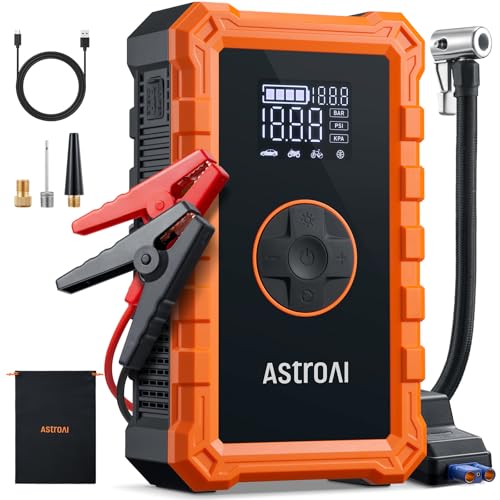
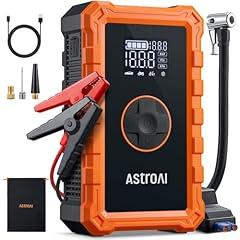
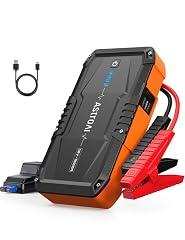
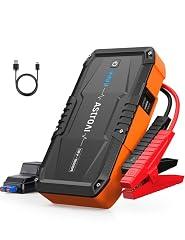
AstroAI S8 Air Jump Starter & Tire Inflator
Overview
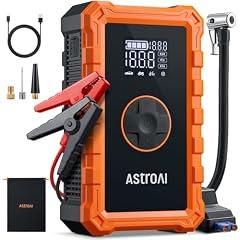
This is a 2.4-pound, 12 V roadside unit that combines a lithium jump starter, a cordless tire inflator, a USB-A power bank, and an emergency light. AstroAI’s current manual specifies a 37 Wh battery pack, 5 V 2 A USB-C charging input, 5 V 2.4 A USB-A output, and inflation from 3 to 150 PSI. It must be charged from a separate USB power source because no wall charging block is included. The manual documents reverse-polarity indication, a Boost mode for a very low vehicle battery, and automatic compressor shutoff at the selected pressure. It also states thermal shutdown behavior and recommends charging every three months. However, no public listing or accredited laboratory report was located to confirm safety certification or claimed starting output for this finished product. Published engine limits also conflict, with the manufacturer page stating up to 6.0 L gasoline and 3.0 L diesel while the marketplace record states 9.0 L and 6.5 L.
What works
- The manual clearly specifies 37 Wh capacity, USB input and output ratings, pressure range, and operating temperatures.
- Smart clamp instructions include a reverse-polarity indication and tell the user to reconnect the clamps correctly.
- The inflator is manufacturer-stated to stop automatically at the selected pressure, which can reduce overinflation risk when the target is set correctly.
- AstroAI provides a two-year limited warranty and gives three-month storage charging guidance.
What does not
- No public UL, ETL, or CSA registry listing for this exact finished product was located, despite marketplace certification claims.
- No independent laboratory report was found that tests starting current, voltage sag, repeat starts, or performance at the advertised engine limits.
- Vehicle compatibility claims are inconsistent. AstroAI’s own product page gives lower 6.0 L gasoline and 3.0 L diesel limits than the marketplace record.
- The included cable requires a separately sourced USB charging block, and no verified certification or rating for a supplied AC adapter applies because none is included.
- Recycling instructions only say to follow local guidelines. They do not provide a U.S. take-back program or a specific battery collection route.
Who is it for
This product fits a driver of a 12 V passenger vehicle, motorcycle, or light recreational vehicle who wants one compact emergency kit for modest tire top-ups and occasional battery assistance. It is most suitable for someone willing to read the manual, keep it above the stated 75 percent charge threshold, recharge it every three months, and verify the engine limit against AstroAI’s more conservative 6.0 L gasoline and 3.0 L diesel claim. It is also useful where carrying a separate inflator and phone power bank is inconvenient.
Who is it not for
It is not appropriate for drivers who need independently proven cranking performance for large gasoline or diesel engines, fleet service, severe cold, or repeated starts. Do not treat the advertised 9.0 L gasoline and 6.5 L diesel marketplace limits as settled, because they conflict with AstroAI’s own current product page. It is also unsuitable for people who cannot maintain a stored lithium pack, need a supplied and certified wall charger, or require public third-party certification of the complete jump starter before keeping it in a vehicle or home.
Integrity
The product contains a 37 Wh lithium battery pack made from four series-connected 3.7 V cells, according to the manufacturer manual. The manual warns against heat, impact, flammable surroundings, clamp-to-clamp connection, and using the product while it is charging. It also describes overheating shutdown for the jump starter and a high-temperature stop warning for the compressor. These are manufacturer-stated protections, not independently verified safety-test results. The product-specific CPSC recall search did not identify a recall for this jump starter. AstroAI has, however, recalled certain mini refrigerators for fire and burn hazards, which is separate from this product. The manual’s end-of-life instruction is generic local recycling guidance. It does not identify a U.S. battery take-back route. A public UN 38.3 transport test summary for this exact battery pack was not located, although the 37 Wh rating is disclosed.
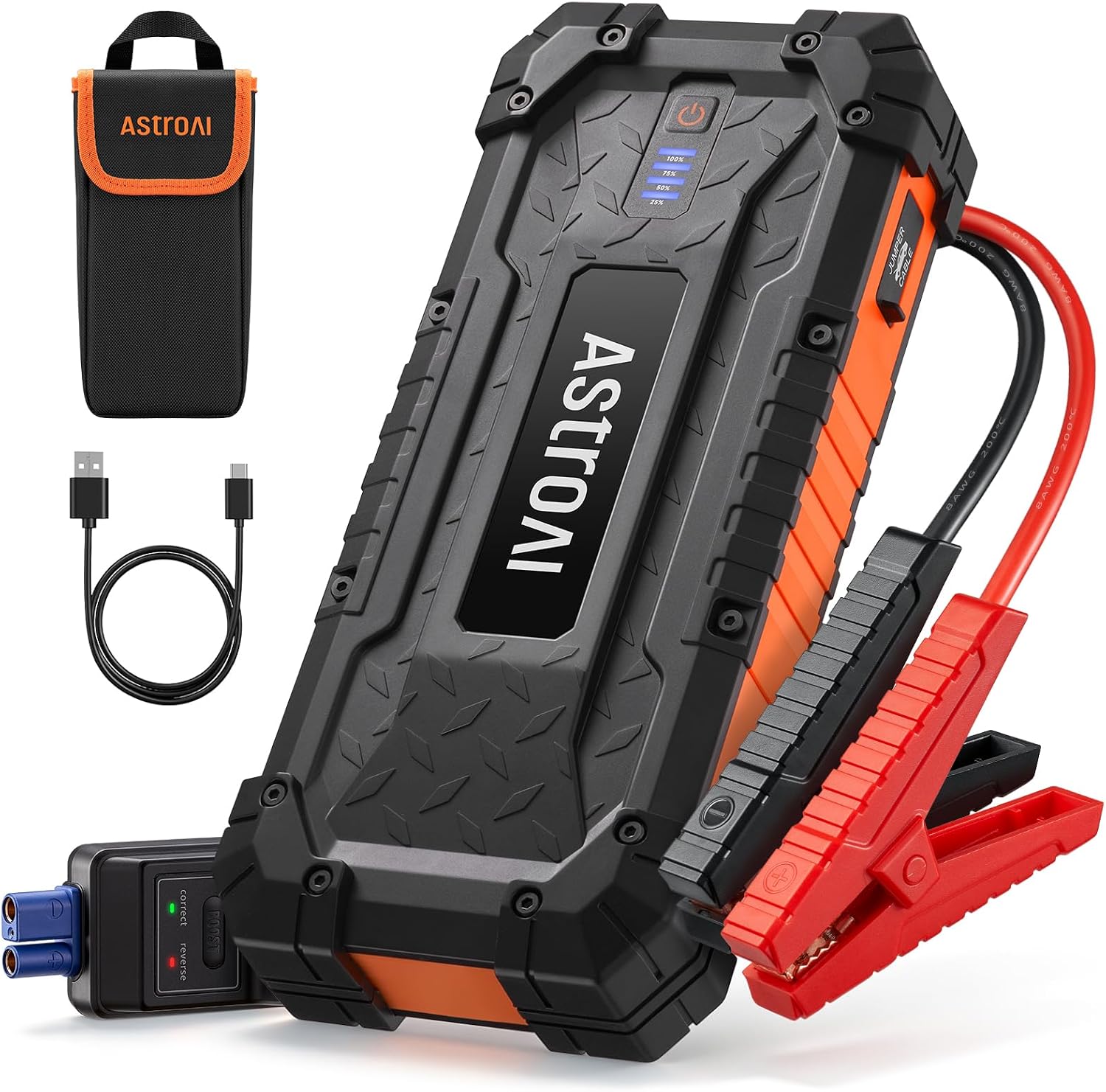
AstroAI S8 Ultra 4000A Portable Car Jump Starter
Overview
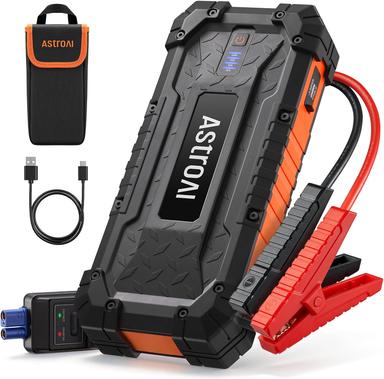
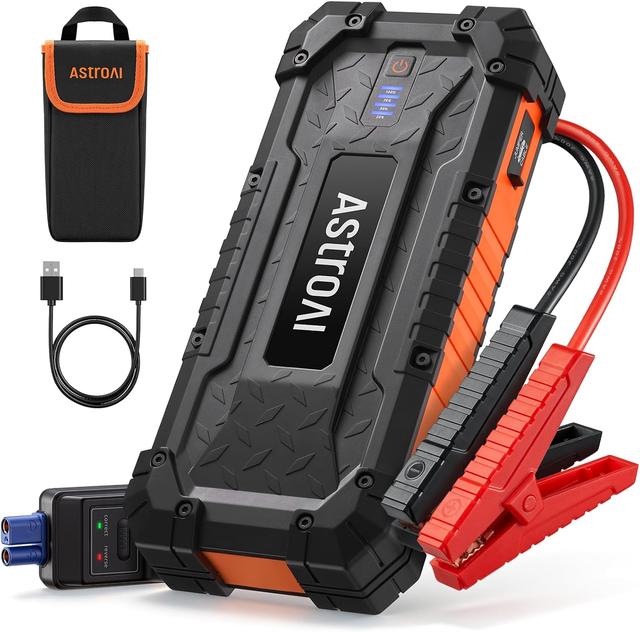
This is a compact 12 V lithium jump starter for starting a depleted vehicle battery, with detachable smart clamps, an LED flashlight, USB-C input and output, two USB-A outputs, and a storage bag. The version sold on this Amazon listing has a 4,000 A peak output. AstroAI has clarified to us that the S8U is sold in different versions for different sales channels, which can differ in configuration, appearance, pricing, and specifications. For the battery capacity and engine limits of the Amazon version, refer to this Amazon listing and the manual included in the box. AstroAI's published manual provides concrete operating limits, including 12 V vehicles only, no use while charging, a minimum 75 percent pack charge for best starting performance, and 60-second breaks between repeated starts. Its clamp instructions and indicator table address reverse polarity and low vehicle-battery voltage. On independent testing, AstroAI states that the Amazon-channel S8U has been tested by an independent laboratory in accordance with applicable NRTL standards, and it shared excerpts of those reports with us. The full reports were provided to Amazon and are confidential, so they are not publicly verifiable, and no public listing was located showing the finished product certified by UL, ETL, or CSA.
What works
- The manual included in the box gives a real energy rating rather than only a milliamp-hour figure.
- The clamp indicator instructions explicitly identify correct and reversed polarity, and direct the user how to reconnect.
- The manual states useful emergency-use controls, including a 75 percent minimum charge target and a 60-second recovery interval between repeated starts.
- A two-year limited warranty and manufacturer support contact are stated in the official manual.
- AstroAI engaged directly with this review: it provided excerpts of independent laboratory test reports.
What does not
- No public UL, ETL, or CSA certification record was located for the complete jump starter, its clamps, or a supplied AC adapter.
- AstroAI's independent test reports are confidential - it shared excerpts with us and provided the full documentation to Amazon - so a buyer cannot independently verify the cranking, voltage-sag, temperature, or repeat-start data.
- AstroAI sells different S8U versions per sales channel, and their configuration, appearance, pricing, and specifications can differ. For the specifications of the Amazon version, rely on this Amazon listing and the manual included in the box.
- The supplied cable is documented, but a wall charging block is not included.
- The manual does not identify a verified USB-C or USB power-delivery certification.
- End-of-life guidance only says to recycle according to local guidelines. It does not provide a take-back program or collection locator.
Who is it for
This fits a driver who wants a small 12 V emergency jump starter for a passenger vehicle or light-duty use, and who is willing to maintain it rather than leave it untouched in a vehicle for years. The Amazon version's compact storage-bag format, flashlight, and low-power USB outputs suit a roadside kit where compactness matters. It is better suited to a buyer who will inspect the clamps, keep the pack above the stated charge threshold, and follow the stated three-month storage charging routine.
Who is it not for
It is not suited to buyers who require publicly verifiable safety certification or published laboratory data for the finished product: the independent test reports AstroAI cites are confidential, so the buyer cannot review them. It should not be used on 24 V vehicles, aircraft, or boats, and the manual says not to start a vehicle while the pack is charging. Buyers with engines near the advertised limit should confirm the limit stated on this Amazon listing and in the manual included in the box, because S8U versions sold through other channels carry different specifications. It is also not a substitute for diagnosing a damaged battery, corroded terminals, or a vehicle fault.
Integrity
The product contains an internal lithium battery pack, so heat, impact, damaged cables, and incorrect connections matter. AstroAI's manual warns against high-temperature storage, nearby flammables, damaged clamps, operation while charging, and repeated starts without rest periods. It also describes reverse-polarity indication and an overheating shutdown feature. AstroAI states that the Amazon-channel product was tested by an independent laboratory in accordance with applicable NRTL standards and that the full reports were provided to Amazon; we reviewed excerpts of those reports. That is a stronger signal than a bare marketplace certification badge, but it is not a public third-party certification a buyer can look up, and no UL, ETL, or CSA registry listing for the finished product was located. No product-specific U.S. recall or safety warning was located for this jump starter. AstroAI did have a separate 2025 U.S. recall involving certain mini fridges after fire reports, which does not establish a defect in this product. For disposal, AstroAI gives only general local-recycling advice. EPA guidance is more specific: lithium battery devices should not enter household trash or curbside recycling, and should go to an appropriate battery collection or household hazardous-waste route. No exact-pack UN 38.3 test summary was publicly located.

WOLFBOX 3000A Jump Starter with Air Compressor
Overview
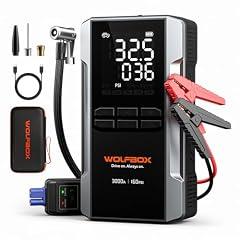
The WOLFBOX MegaVolt 16 Air is a 5.3 pound lithium-ion emergency jump starter for 12 V vehicles. It combines smart battery clamps, a built-in tire inflator, USB-C and USB-A accessory power, an LED light, and a carry case. The manual specifies 59.2 Wh, 16,000 mAh, 600 A starting current, 3,000 A peak current, and USB-C Power Delivery up to 65 W. An AC wall adapter is not included. The manufacturer states limits of 8 L gasoline and 6 L diesel engines. Independent testing documented repeated starts of a V6 SUV at 33°F, three consecutive starts of a 2010 Ford Explorer, 51.3 Wh delivered capacity, and a roughly 1.3 hour recharge. Those tests support useful real-world starting performance, but they do not independently prove the full advertised engine-size limits or peak-amp figure.
What works
- Independent testing documented repeated cold-weather starts and three consecutive starts of a dead-battery SUV.
- Independent capacity testing measured 51.3 Wh delivered, reasonably close to the 59.2 Wh manufacturer rating.
- The manual gives specific 12 V-only use limits, charge-temperature limits, and smart-clamp indicator instructions.
- The built-in compressor was independently tested adding 5 PSI to a truck tire in about three minutes, with automatic pressure shutoff.
What does not
- A model-specific UL, ETL, or CSA listing for the finished product was not supplied or located in the public certification sources checked, despite WOLFBOX collection-page safety-certification language.
- The supplied package includes a USB-C cable but not an AC adapter, so recharge safety and speed depend partly on a separately chosen charger.
- The 8 L gasoline and 6 L diesel limits, 3,000 A peak figure, and claimed 30 starts are manufacturer claims, not fully reproduced by the independent test located.
- The manual says to follow local disposal rules but gives no U.S. take-back program or collection route. A product-specific UN 38.3 transport test summary was not published or located.
Who is it for
This suits a driver of a conventional 12 V car, crossover, pickup, or diesel vehicle who wants one stored emergency tool for a low starter battery and routine tire-pressure top-ups. It is particularly relevant for drivers who can keep it charged every few months and have accessible battery terminals. The independent testing supports use on ordinary V6 SUV applications in cool weather, while the compressor and 65 W USB-C port add practical roadside utility without requiring separate tools.
Who is it not for
It is not for someone who needs a publicly documented, model-specific NRTL safety certification before keeping a lithium power pack in a vehicle or home. It is also not a substitute for a failing vehicle battery, a professional shop starter, or a dependable battery-maintenance plan. Owners of hybrids, EVs, vehicles with remote or difficult-to-access 12 V batteries, and vehicles whose manuals specify special jump procedures should follow the vehicle maker's instructions rather than assume compatibility from the product's broad 12 V claim.
Integrity
The manual contains meaningful user protections, including reverse-polarity indication, short-circuit and over-current responses, temperature-controlled charging, and warnings not to use damaged clamps, disassemble the unit, charge outside 32°F to 113°F, or use it near flammable gases. It also limits use to 12 V vehicle systems. These are manufacturer-stated safeguards, not a substitute for third-party certification of the finished product. WOLFBOX's product collection describes its jump starters as safety certified, but a public UL, ETL, or CSA record identifying this exact finished product was not available in the sources checked. No CPSC recall or safety warning specific to this product was found in the searched U.S. records as of August 16, 2026. The manual only directs users to comply with local disposal rules. Lithium-ion products should not enter household trash or curbside recycling, and should go to an appropriate battery or household hazardous-waste collection point.

GOOLOO GT6000 Car Jump Starter
Overview
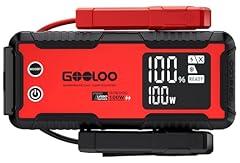
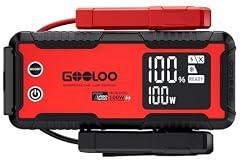
This is a 12 V lithium-polymer jump starter and portable power bank. Its manual specifies 99.9Wh capacity, 800A starting current, a 6000A peak-current claim, USB-C input and output up to 100W, two USB-A outputs, and a 15V, 10A DC output. It is supplied with smart clamps, a 100W car charger, cables, a DC adapter, and a carry bag. The manufacturer states that it can start gasoline engines and diesel engines up to 12.0L, recharge in about 1.4 hours from a compatible 100W PD charger, and retain charge for up to two years. Independent hands-on coverage from Car and Driver reports that it started a test vehicle in boost mode. That is useful real-world confirmation, but it is not a controlled laboratory report documenting cranking current, voltage sag, temperature, or repeat-start limits.
What works
- Independent hands-on testing reported a successful vehicle start using boost mode.
- The manual gives unusually concrete electrical specifications, including 99.9Wh, 800A starting current, 100W USB-C PD, and 15V, 10A DC output.
- The clamp system has a reverse-polarity alert, overcurrent protection, and a lockout after more than four starts in 10 minutes, according to the manual.
- The manual includes meaningful heat, damage, leakage, charging, and clamp-connection warnings.
- A displayed status screen can show charge level, connection state, reversed polarity, temperature status, and error conditions.
What does not
- No public UL, ETL, or CSA listing for the exact finished product was located, so its claimed electrical protections are not publicly certified for this unit.
- No independent laboratory report was located that verifies the advertised 6000A peak figure, engine-size claim, or repeat-start performance under stated load and temperature conditions.
- The compatibility guidance conflicts. The product page says it is suitable for boats, while the manual says not to use it on boats or aircraft.
- A 100W wall adapter is not included, so the stated fastest wall recharge requires a separate compatible USB-C PD charger.
- The disposal instruction only says to follow local regulations. It does not provide a U.S. take-back program or a specific battery-collection route.
Who is it for
This product fits an owner of a conventional 12 V gasoline or diesel road vehicle who wants a substantial emergency jump pack that can also power USB-C equipment, phones, or a 15V accessory. It is especially suited to people who can store it out of heat, inspect the clamps and cables before use, recharge it every three months as the manual advises, and follow vehicle-specific jump-start instructions. The independent vehicle-start result supports emergency use, but not a precise guarantee for every engine or battery condition.
Who is it not for
It is not for aircraft, non-12 V systems, damaged or leaking batteries, explosive atmospheres, or anyone likely to leave it in a vehicle exposed to prolonged heat above 140°F. Boat owners should not rely on it because the seller's product page and manual conflict on boat use. It is also not the right tool for charging or restoring a failing vehicle battery, repeated commercial starts without a documented duty-cycle test, or buyers who require a publicly listed NRTL certification for the complete finished jump starter.
Integrity
The manual gives several relevant safety limits. It says to use the product only with 12 V batteries, avoid use with damaged cables, swelling, leakage, or overheating, allow 30 minutes of cooling before recharging after a jump, and keep it away from heat, fire, water immersion, and flammable atmospheres. It also identifies a reverse-polarity alert and limits repeated starts. However, no public UL, ETL, or CSA certification record was located for this exact finished product. The 99.9Wh rating is useful transport information because it sits just below the common 100Wh threshold, but no exact-product UN 38.3 test summary was publicly located. The manual says only to dispose of the lithium battery according to local rules. In the U.S., lithium battery devices should not go in household trash or curbside recycling and should go to a dedicated battery recycler or household hazardous-waste collection point. A 2024 UK safety action involved a different GOOLOO and VTOMAN model, not this product.

GOOLOO A5 Jump Starter with Compressor
Overview
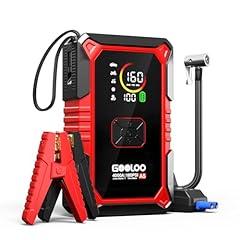
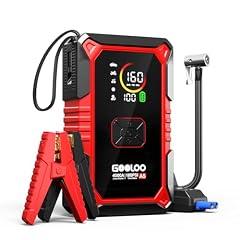
This is a 3.2-pound lithium-polymer roadside unit that combines a 12V jump starter, cordless tire inflator, USB power bank, flashlight, and SOS light. The manual identifies a 74Wh battery, 800A starting current, 4000A peak current, 45W USB-C output, and 18W USB-C input. It needs a separate compatible wall charger, which is not included. The manual documents smart-clamp indicators, reverse-polarity warning, a BOOST function, and manufacturer-stated battery-management protections including short-circuit, overcurrent, reverse-connection, overheating, and overcharge protection. A non-laboratory field review reported successful starts on a 6.7L diesel and tested reverse-polarity lockout and inflator auto-stop. Those are useful observations, but they are not accredited laboratory certification or a controlled endurance report. The product's own materials conflict on maximum engine size and inflation pressure, which limits confidence in its broadest advertised limits.
What works
- The manual gives concrete electrical specifications, including 74Wh capacity, 800A starting current, 4000A peak current, 18W input, and 45W USB-C output.
- The manual provides operating steps, reverse-polarity indication, BOOST instructions, damaged-cable warnings, and a warning that loose cable connections may melt.
- A field review reported that deliberately reversed clamps triggered an audible warning and power lockout. This is supportive, though it is not an accredited safety test.
- The inflator has selectable pressure units and automatic shutoff. A field review reported shutoff within 0.5 PSI of its selected target.
- The manual provides an 18-month limited warranty, U.S. support contact details, and a stated recommendation to recharge every three months.
What does not
- No public UL, ETL, or CSA certification listing for this exact finished product was located, and no supplied wall charger is included for separate certification review.
- No accredited independent load test was located that establishes voltage sag, repeat starts, temperature performance, or the full advertised engine range.
- The manual limits starting to 9.0L gasoline and 6.5L diesel engines, while the marketplace claim says all gasoline engines and up to 10L diesel. Treat the manual's lower limit as the more cautious guide.
- The manual is internally inconsistent about inflator pressure, listing 150 PSI in technical specifications while its operating table reaches 160 PSI.
- No manufacturer recycling or take-back route, exact-pack UN 38.3 test summary, watt-hour label photograph, or public battery transport documentation was located.
Who is it for
This product fits a driver who wants one trunk-stored emergency tool for a conventional 12V vehicle, routine tire-pressure top-offs, phone or laptop charging, and nighttime visibility. It is most appropriate for someone willing to read the manual, inspect the clamps and connector before use, keep the included cable with the product, and recharge it at least every three months. The documented 74Wh capacity and 45W USB-C output also make it more practical for occasional accessory charging than a jump pack with only low-power USB output.
Who is it not for
It is not suited to buyers who require a publicly listed UL, ETL, or CSA certification for the complete finished jump starter and its charging arrangement. It is also a poor fit for operators who need independently documented repeat-start performance in freezing conditions, commercial fleet use, aircraft, boats, non-12V systems, or confidence in the listing's all-gasoline and 10L-diesel claim. Do not use it if its enclosure swells, leaks, overheats, or if a clamp, cable, connector, or blue plug is damaged or loose.
Integrity
The manual gives meaningful handling limits for the lithium-polymer pack. It says to use the product only with 12V systems, keep it away from children, avoid fire and water, avoid damaged cables or swollen and leaking equipment, and not jump-start while charging. It also warns that storage above 140°F can damage cells, cause swelling, and create a safety hazard. This matters for products kept in hot parked vehicles. The documented protections and clamp warnings are useful, but no public finished-product listing from a U.S. Nationally Recognized Testing Laboratory was located. No matching U.S. CPSC recall or public safety report was located in the checked databases. The manufacturer also did not provide a product-specific recycling route or an exact battery-pack UN 38.3 test summary. At end of life, EPA guidance is to keep lithium battery devices out of household trash and curbside recycling, isolate terminals or connections, and use a dedicated battery recycler, electronics recycler, or household hazardous-waste collection point.

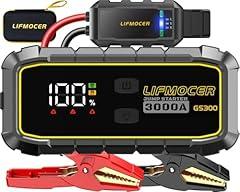
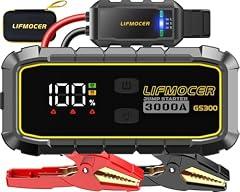
LIFMOCER GS300 Car Battery Jump Starter
Overview
This is a rechargeable lithium-polymer 12 V jump starter with smart clamp leads, a carrying case, LCD status display, USB charging functions, and an emergency LED light. It is intended to supply a brief high-current boost to a vehicle battery, not to replace or charge the vehicle battery. The manufacturer states a 59.2 Wh pack, 3,000 A peak output, and use with gasoline engines up to 10.0 L or diesel engines up to 8.0 L. Published instructions say to charge it above 50 percent before a normal start, connect red to positive and black to negative, then start within 30 seconds once the clamp indicator is green. They also describe a BOOST mode for a battery below 2 V. These are manufacturer-published operating claims, not independently verified starting tests. No public listing for an exact-product UL, ETL, or CSA certification, accredited test report, or exact-pack transport test summary was located.
What works
- Specific manufacturer-stated limits identify it as a 12 V starter for engines up to 10.0 L gasoline or 8.0 L diesel.
- Published instructions provide a normal connection sequence, clamp-status guidance, and a separate procedure for severely depleted batteries.
- The supplied instructions call for periodic charging during storage and inspection of the clamps and cables.
- The product is documented as including a case, LED light, LCD display, and USB power-bank functions.
What does not
- The 3,000 A peak claim and engine-size limits lack a public independent test showing load, voltage sag, temperature, battery condition, or repeat-start performance.
- No public UL, ETL, or CSA listing was located for this exact finished product, despite the manufacturer's reference to a certified 10-item protection system.
- The manufacturer materials conflict on important specifications. The official page says up to 50 starts and a five-year warranty, while the published instructions say 25 starts and two years of quality assurance.
- No exact-pack UN 38.3 transport test summary, battery voltage basis for the capacity claims, or manufacturer recycling and take-back route was located.
Who is it for
This product suits a driver of an ordinary 12 V gasoline or diesel vehicle who wants a compact emergency starter stored in a vehicle, understands battery-terminal polarity, and is prepared to inspect and recharge it every two to three months. It is most appropriate where the vehicle owner's manual permits external jump starting and the buyer treats the stated 10.0 L gasoline and 8.0 L diesel limits as manufacturer claims, rather than independently proven performance. The included status display, case, light, and clamp instructions can support occasional roadside use.
Who is it not for
It is not for buyers who need publicly documented safety certification, independently measured cranking performance, or validated cold-weather and repeat-start results. It is also unsuitable for anyone expecting it to revive a defective, frozen, damaged, or deeply discharged vehicle battery without risk assessment. Owners of hybrids, EVs, vehicles with hidden batteries, high-voltage systems, sensitive electronics, or manufacturer-specific jump points should follow their vehicle manual and use a product specifically approved for that vehicle. Children and untrained users should not operate the BOOST override mode.
Integrity
The product contains a rechargeable lithium battery, so damage, heat, crushed casing, wet use, altered cables, and incorrect clamp connection merit caution. The published instructions provide basic connection order, storage, cable-inspection, and recharge guidance. They also describe reverse-polarity indication and a BOOST procedure, but those protections are manufacturer-stated and were not confirmed by a public exact-model safety certification or independent misuse test. No product-specific CPSC recall or warning was located in the reviewed public searches through August 16, 2026. That is not equivalent to a certification or a safety finding. The manufacturer does not provide a public recycling route or exact battery transport test summary. At end of life, do not put this product in household trash or curbside recycling. EPA guidance directs consumers to battery collection, electronics recycling, or household hazardous-waste options, with terminals protected from contact.

AstroAI S8 Car Battery Jump Starter
Overview
This is a compact lithium jump starter for 12 V vehicle batteries, with smart clamps, a boost function for a deeply discharged battery, a flashlight, and USB power-bank output. AstroAI's current manual specifies a 37 Wh pack made from four 3.7 V cells in series, 5 V and 3 A input, 5 V and 2.4 A USB output, and a recommended recharge at least every three months during storage. The manufacturer rates it for engines up to 6.0 L gasoline or 3.0 L diesel. Independent field testing by Popular Mechanics documented successful starts over months of real use, including a Honda Element, an RV, and several guest vehicles. That is useful real-world evidence, but it is not a controlled laboratory cranking test with measured current, voltage sag, temperature, or repeat-start criteria. No public UL, ETL, or CSA certification for this exact finished product was located.
What works
- Independent field testing recorded repeated successful vehicle starts over several months.
- A year-long field account found the pack still above 50 percent charge after roughly 20 uses.
- The manual gives concrete 12 V limits, charging temperatures, storage guidance, and a 30-second rest interval between starts.
- Smart-clamp instructions identify correct connection, reverse polarity, low-voltage boost use, and damaged-battery conditions.
What does not
- No public finished-product UL, ETL, or CSA safety certification was found for this product or its charging arrangement.
- The manufacturer states protective functions, but no independent electrical misuse or thermal-runaway test report was located.
- Published capacity information conflicts. AstroAI's current manual says 37 Wh and 10,000 mAh at 3.7 V, while the catalog record and independent review describe 8,000 mAh.
- No exact-pack UN 38.3 test summary was publicly available, despite transport rules requiring supply-chain availability of such documentation.
Who is it for
This product suits a driver of a conventional 12 V passenger car, motorcycle, or small gasoline vehicle who wants a compact emergency starter stored in a bag or glove compartment. It is most appropriate for someone willing to follow the manual closely, keep the charge above 75 percent before use, recharge it every three months in storage, inspect the short clamp leads, and use the vehicle maker's own jump-start points. The independent field evidence is most relevant to occasional roadside starting, not repeated fleet-duty use.
Who is it not for
It is not suited to 24 V vehicles, aircraft, or boats, which the manual explicitly excludes. It is also a poor fit for diesel engines above 3.0 L, vehicles with inaccessible or widely spaced battery terminals, or users who need laboratory-verified cranking output in cold conditions. Households that require a publicly listed UL, ETL, or CSA finished product should choose a product with that exact certification. Do not use it if the enclosure, cable, clamps, or connector have been dropped, damaged, overheated, or exposed to water.
Integrity
The product contains a rechargeable lithium battery. AstroAI documents overheating protection, reverse-polarity indication, short-circuit-related protection claims, charging and operating temperature ranges, and instructions not to start a vehicle while the pack is charging. Those are manufacturer instructions, not public third-party certification of the finished product. A search did not locate a relevant CPSC recall for this jump starter. AstroAI did have a 2025 CPSC recall for certain minifridges, caused by an electrical-switch fire hazard, but that recall concerns a different product category and model. For disposal, AstroAI says to recycle recyclable parts according to local guidance, but it does not provide a U.S. take-back route or detailed lithium-device handling instructions. EPA advises keeping lithium-ion devices out of household trash and curbside recycling, then using a separate battery or household hazardous-waste collection route. The exact product's transport test summary was not publicly available, although its 37 Wh rating is stated in AstroAI's current manual.

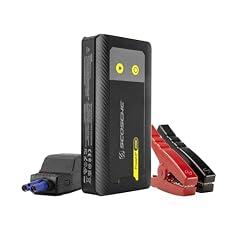
Scosche PBJ2000 Portable Car Battery Jump Starter
Overview
This is a compact 12 V lithium-ion jump starter and power bank for roadside use. It includes jumper clamps, a 12 V accessory socket adapter, USB-A to USB-C cable, carrying bag, and LED flashlight. The manufacturer specifies a 37 Wh battery, 30 W USB-C output, 12 V accessory output up to 96 W, and a 2,000 A peak claim. One important fact is independently verifiable: UL Product iQ lists this exact product as UL Certified in the Battery Charging Systems category. Its own manual provides a more useful starting specification than peak amperage alone, stating 1,000 A cranking current, with 350 A stated for five seconds. No independent published vehicle cranking test was located. The manufacturer also states limits of gasoline engines up to 8.0 L and diesel engines up to 7.0 L.
What works
- The exact product is listed as UL Certified in UL Product iQ under Battery Charging Systems.
- The manual gives a defined cranking specification, 1,000 A with 350 A stated for five seconds, rather than only a peak-current figure.
- The manufacturer provides explicit 12 V engine-size limits, battery capacity, output ratings, operating temperature range, and a one-year limited warranty.
- The manual directs users to charge the unit to at least 75 percent before attempting a jump start and to wait 10 seconds between attempts.
- Manufacturer-stated protections include reverse connection, short circuit, overcharge, overdischarge, overcurrent, and overheating safeguards.
What does not
- No independent laboratory cranking test was located that documents battery condition, temperature, voltage sag, repeat starts, and pass criteria for this product.
- The product's own documents conflict on USB-C charging input. The manual specifies 18 W maximum, while the current manufacturer product page specifies 10 W maximum.
- The Boost procedure deliberately bypasses low-voltage protection for a severely discharged vehicle battery. It requires careful polarity checks and should not be treated as a routine mode.
- No public exact-pack UN 38.3 lithium battery test summary was located, despite federal transport rules requiring it to be available on request.
- Scosche's product page carries a California cancer and reproductive harm warning, but does not identify the chemical or expected exposure route on that page.
Who is it for
This product suits a driver of a conventional 12 V gasoline or diesel vehicle whose engine falls within the manufacturer's stated 8.0 L gasoline or 7.0 L diesel limits, and who wants one compact emergency unit for a dead starter battery, phone charging, and a small 12 V accessory. It is most appropriate for someone willing to keep it charged, check its indicator before use, follow the clamp sequence in the manual, and use the stated 75 percent minimum charge before attempting a start.
Who is it not for
It is not for a buyer who needs independently documented cold-weather or repeat-start performance, fleet-duty validation, or proof that it will start a particular large diesel under severe conditions. It is also not appropriate for treating a failing vehicle battery as a permanent solution. People uncomfortable connecting battery clamps, especially when using the low-voltage Boost procedure, should seek assistance. Hybrid and EV owners should follow their vehicle maker's specific jump-start instructions instead of relying on broad universal-fit language.
Integrity
The strongest safety evidence is the public UL Product iQ listing for this exact product in the Battery Charging Systems category. That is more meaningful than an unverified safety logo or a component-only claim. The manufacturer also documents clamp order, a green ready indicator, a minimum 75 percent charge before starting, and a Boost mode for low-voltage batteries. Boost use deserves extra care because it bypasses low-voltage protection. A California cancer and reproductive harm warning appears on Scosche's product page, although the page does not explain the relevant chemical or exposure pathway. The unit contains a 37 Wh lithium-ion battery. It should never enter household trash or curbside recycling because lithium batteries can cause fires when damaged or crushed. Use a dedicated battery or electronics collection program, or local household hazardous-waste service. The watt-hour rating is publicly stated, but no exact-pack UN 38.3 transport test summary or manufacturer recycling route was located in this review.