
10 Best Security Cameras of 2026
 Daniel Kenitz
Please note that we participate in affiliate marketing programs. When you purchase through links on our site, we may earn a commission. As an Amazon Associate we earn from qualifying purchases. This comes at no additional cost to you and helps support the resources required to provide valuable content.Advertising Disclosure
Top-rated Security Camera Comparison
1

2
3
4
5
6
7
8
9
Security cameras: what matters beyond the headline numbers
A security camera turns a scene into live video, alerts, and depending on the design stored footage. The useful question is not simply whether a product says “4K,” “360°,” “AI,” or “no subscription,” but whether it captures the right area reliably, preserves usable evidence, protects people who appear in view, and remains safe and supportable over time.
Start with the installation. Wired cameras need suitable power, protected cable routes, grounding where applicable, and a secure mount. Battery and solar cameras add charging, sunlight, temperature, and battery-management limits. Outdoor claims should identify an ingress rating such as IP65, IP66, or IP67, but these numbers are often manufacturer-stated rather than supported by an accessible accredited test report. Check the installation manual, operating-temperature range, supplied power hardware, and mounting limits. A weather rating for the camera does not automatically cover its adapter, cable connection, solar panel, or battery.
Then match recording behavior to the job. Local microSD or recorder storage can continue through an internet outage, but it usually still needs power. Battery cameras commonly record motion events rather than continuously; “24/7 recording” may require a wired design, a separate recorder, added storage, or a cloud plan. Storage claims also need conditions: capacity, event volume, resolution, overwrite behavior, recording mode, and whether footage can be exported. “No subscription” may mean local event storage while advanced alerts, cloud clips, or longer retention remain paid or unavailable.
Headline imaging figures are not performance evidence by themselves. Resolution does not establish identification at a particular distance. Pan-and-tilt coverage can still miss activity while the lens is pointed elsewhere, moving, obstructed, or tracking another subject. Night-vision range, person or vehicle recognition, battery life, solar endurance, false-alert rates, and alert delay are meaningful only when tested under stated lighting, distance, weather, firmware, settings, and failure conditions. Independent testing should identify the exact model and report its method; stronger evidence includes an ISO/IEC 17025-accredited report or a reproducible protocol aligned with IEC 62676 methods.
Privacy and security deserve equal attention. Look for privacy zones, audio controls, limited retention, clear sharing permissions, least-privilege accounts, multifactor authentication, encrypted transport and storage, signed updates, a vulnerability-reporting route, and a dated minimum support period. Cloud processing may include video, audio, facial data, gait, voiceprints, location, or notification thumbnails, even when ordinary recordings are stored locally. Check the manufacturer’s privacy and retention terms rather than assuming “local” means completely offline.
For owner control, verify local viewing, export, recorder compatibility, and standards such as ONVIF for the exact model and firmware. FCC authorization confirms radio compliance, not electrical safety, image quality, privacy, or cybersecurity. Important safety claims should be traceable in FCC records, UL Product iQ, Intertek’s ETL directory, OSHA-recognized NRTL listings, or applicable test records; a badge or declaration alone is not equivalent.
Recurring caveats in the supplied reviews are substantial: no product had a located exact-model UL or ETL safety listing, and several lacked independent image, alert, weather, or battery testing. Battery and solar products do not provide dependable continuous recording in every use case, while wired products remain dependent on power. Storage, weather, Wi-Fi, and support claims were sometimes inconsistent. Cloud-connected products require careful account and privacy settings, and one platform had a documented cross-account imagery incident. Do not treat sirens, lights, AI labels, or recording capability as a guarantee of crime prevention, emergency response, or complete coverage.
Integrity
These topics assess the practical risks and evidence behind a camera system—not just its advertised features. Scores are relative to the supplied products: a higher score indicates stronger documented controls or evidence in that area, while a lower score indicates more uncertainty, missing documentation, or material limitations.
HHealth & Safety
Electrical and battery fire safety
This measures whether the camera, charger, solar equipment, and battery have credible safety certification and safe installation instructions. It matters because outdoor cameras combine electricity, weather exposure, and sometimes lithium batteries. Among the supplied products, scores ranged from 55 to 74. Higher-scoring products had clearer power specifications or safeguards; lower scores were associated with no located UL or ETL listing for the complete camera, charger, or battery system.
Privacy and bystander protection
This measures privacy zones, audio controls, sharing permissions, retention settings, and transparency about cloud processing. Cameras may capture neighbors, visitors, sidewalks, voices, or sensitive biometric information, so “local storage” alone is not enough. Scores ranged from 60 to 76. Higher-scoring products documented controls such as masking, two-factor authentication, or device-default storage; lower-scoring products had vague policies or broader cloud-processing disclosures.
Account security and software support
This measures protection from account takeover and unpatched vulnerabilities, including unique credentials, multifactor authentication, encryption, signed updates, vulnerability reporting, and a dated support period. It matters because a camera can expose live household video remotely. Scores ranged from 58 to 78. Higher-scoring products documented account protections and update practices; lower-scoring products lacked a minimum support term, public security process, or model-specific advisory history.
Weatherproof installation safety
This measures whether outdoor, wired, solar, and pan-tilt claims remain safe when installed as directed. The relevant details include an exact ingress rating, suitable power hardware, secure mounting, cable protection, and temperature limits. Scores ranged from 54 to 82. Higher-scoring products had more practical installation or operating guidance; lower-scoring products had conflicting IP claims, no accessible ingress test, or adapters that still required indoor or protected placement.
EEvidence
Verified image, night, and motion performance
This measures whether resolution, viewing angle, night vision, detection range, tracking, and false-alert claims were tested under stated real-world conditions. A specification such as “4K” does not prove identification performance. Scores ranged from 58 to 85. Higher-scoring products had independent hands-on results describing image quality, motion zones, or tracking; lower-scoring products relied mainly on marketing claims without exact-model testing.
Evidence capture during outages
This measures whether usable, time-stamped footage survives Wi-Fi, internet, power, solar, or cloud failures. Look for local recording, retention capacity, overwrite behavior, export, recovery, and continuous-versus-event limits. Scores ranged from 62 to 80. Higher-scoring products documented local recorders or cards and outage behavior; lower-scoring products depended heavily on cloud service, lacked storage, or could not record continuously on battery power.
Independently checkable compliance
This measures whether safety, radio, interoperability, and security claims can be confirmed for the exact product in authoritative records. FCC authorization is useful for radio compliance, but it is not an electrical-safety or performance certification. Scores ranged from 50 to 84. Higher-scoring products had exact FCC or other traceable records; lower-scoring products had branding or model mismatches, missing registry entries, or unsupported certification claims.
Honest security and battery claims
This measures whether claims such as “365-day battery,” “no blind spots,” “AI detection,” “24/7 recording,” and “no subscription” disclose their conditions and exclusions. It matters because sunlight, motion volume, storage settings, tracking, temperature, and paid features can change the result. Scores ranged from 50 to 77. Higher-scoring products stated meaningful limits; lower-scoring listings used absolute or inconsistent claims.
Interoperability and owner control
This measures whether owners can view, export, and retain footage without unnecessary vendor lock-in, including verified ONVIF, RTSP, local recording, and recorder compatibility. It matters when a cloud service changes or a buyer wants an independent recorder. Scores ranged from 48 to 80. Higher-scoring products documented local export or open interfaces; lower-scoring products restricted bundled cameras to proprietary recorders or lacked verified conformance.
Realistic protection claims
This measures whether sellers distinguish recording and notification from promises to prevent crime, identify every person, or guarantee safety. A siren, spotlight, or alert is not proof of deterrence or emergency response. Scores ranged from 62 to 78. Higher-scoring products used more restrained language or had fewer absolute claims; lower-scoring products promised “no blind spots” or implied protection beyond what event-based consumer recording can establish.
Durability and material life
This measures whether the product can remain useful instead of becoming e-waste through weather-rated construction, firmware support, replaceable parts, warranty coverage, and repair options. It is especially relevant for sealed outdoor cameras and nonreplaceable lights or batteries. The supplied scores ranged from 66 to 74. Higher-scoring products had documented warranties, durable housings, or continuing firmware; lower scores reflected limited service paths.
EEcology
Long useful life and repairability
This measures whether a camera can avoid premature e-waste through durable construction, replaceable batteries or wear parts where feasible, firmware support, spare parts, warranty coverage, and a repair path. It matters because outdoor exposure and sealed batteries can shorten service life. Scores ranged from 66 to 74. Higher-scoring products had longer warranties, durable housings, or ongoing firmware evidence; lower scores reflected nonreplaceable parts and no repair documentation.
Safe battery and e-waste end of life
This measures whether the seller provides accessible U.S. recycling or take-back guidance for lithium batteries, cameras, solar panels, power supplies, and recorders. It matters because batteries and electronics should not go in household trash or ordinary curbside recycling. Scores ranged from 68 to 73. Higher-scoring products had clearer recycling or trade-in information; lower-scoring products offered only general disposal language without a verified U.S. route.
Full reviews

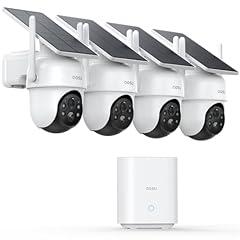
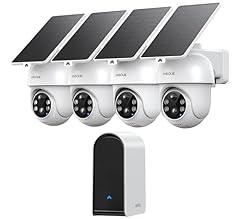
AOSU Solar-Powered Outdoor Security Cameras, 4-Cam Kit
Overview
This is a four-camera outdoor surveillance kit with solar-powered, rechargeable battery cameras and a wired HomeBase hub. Each camera has pan and tilt movement, a microphone, speaker, motion sensor, LEDs, and USB-C charging. The supplied quick-start guide directs users to mount cameras 2 to 3 meters high, test wireless signal before drilling, and keep the solar panels clear of shade. The manufacturer states that the system records to 32GB of local HomeBase storage without a required subscription, provides 3MP video at up to 15 frames per second, color night vision, and automatic motion tracking. FCC authorization documentation independently links the relevant camera family to the product's model variant and confirms radio-compliance testing. No independent, model-specific image-quality, alert-accuracy, battery-life, or outage test was located.
What works
- FCC documentation provides an independently checkable U.S. radio authorization trail for the camera family and this model variant.
- The supplied installation guide gives specific mounting height, signal-testing, drilling, anchoring, and solar-exposure instructions.
- Local HomeBase recording without a required subscription is a documented manufacturer-stated operating model.
- Aosu's current privacy notice states that ordinary video is stored on the device by default, apart from cloud-processed event-preview thumbnails.
- The manufacturer documents IP65 weather resistance, a 3.7V rechargeable lithium-ion battery, and an operating range of minus 10 C to 55 C.
What does not
- No UL, ETL, CSA, or other U.S. NRTL electrical-safety listing for the camera, battery, solar assembly, or supplied power adapter was verified.
- No independent test for this exact kit was located for image detail, color night vision, tracking accuracy, detection distance, false alerts, battery endurance, or local-storage retention.
- Aosu documents encryption in transit and at rest, but no dated minimum firmware-support period, public vulnerability-reporting process, or multi-factor authentication documentation was found.
- The 32GB capacity and loop-recording claim do not establish how much footage remains under busy scenes, weak Wi-Fi, low sunlight, or a HomeBase power failure.
- Published documentation does not verify ONVIF, RTSP, an open API, or another standards-based route for local viewing with third-party recorders.
Who is it for
This product suits a homeowner who wants to cover several exterior zones, such as a driveway, entry, side path, and backyard, with one app and a single local-storage hub. It is most appropriate where each mounting point has reliable Wi-Fi, sound exterior mounting surfaces, and regular direct sunlight. It also fits users who prefer event-based local recording rather than a required recurring cloud-storage payment, and who can accept manufacturer-stated performance claims rather than independently benchmarked detection and night-image results.
Who is it not for
It is not suited to installations that require independently verified life-safety electrical certification, professional monitoring, evidentiary-grade continuous recording, or guaranteed retention through power and network disruptions. Avoid relying on it where shaded locations, extreme temperatures outside the stated range, poor Wi-Fi, or inaccessible mounting points could compromise charging, connection, or maintenance. It is also a poor fit for buyers who need published ONVIF or RTSP compatibility, a stated long-term firmware-support commitment, or documented multi-factor account protection.
Integrity
The cameras contain rechargeable lithium-ion batteries and are designed for exterior mounting, so correct screw selection, secure anchoring, and avoiding battery damage during installation matter. The guide supplies mounting steps and asks users to test Wi-Fi and solar exposure first. The product has a documented IP65 claim and specified operating-temperature limits, but an independently searchable U.S. NRTL safety listing for its battery, solar equipment, or power adapter was not verified. Aosu's privacy notice says routine video stays on the device by default, while event-preview thumbnails use its cloud infrastructure. Optional smart functions can process video, audio, geolocation, and biometric-related data in the cloud, so users should enable only features they need. Aosu offers a 12-month warranty and mentions WEEE recycling arrangements, but it does not provide a clearly identified U.S. take-back route or product-specific lithium-battery disposal instructions.

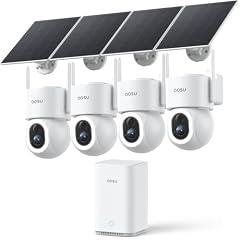
SolarCam D1 Max 4-Cam Kit
Overview
This is a four-camera, solar-powered outdoor monitoring system. Each camera is battery operated, connects wirelessly to the included aosuBase, and is intended for wall mounting around entrances, driveways, yards, or other exterior areas. The base connects by Ethernet and manages local recordings through the app. The maker states that the kit provides 4K video, motorized 360-degree viewing, activity zones, tracking, and local storage without a required subscription. Its solar-power claim has an important stated condition, it is based on 50 daily events of 20 seconds each, and charging stops below 23°F. The exact camera model also has an FCC equipment authorization trail and a published lithium-ion battery chemistry disclosure. No accredited, model-specific image, weather-ingress, or battery-safety test report was located.
What works
- Local video storage is documented by the manufacturer, reducing dependence on a paid cloud plan for ordinary recording.
- The maker documents up to three activity zones, which can help limit alerts and unnecessary recording of neighboring areas.
- A published vulnerability disclosure program promises acknowledgement within 10 business days and at least five years of free security updates from launch.
- The manufacturer discloses that this product uses a lithium-ion battery, and the product documentation gives a temperature range and outdoor mounting instructions.
What does not
- No UL, ETL, or other publicly checkable North American safety listing was located for the camera, solar panel, battery, charger, or complete kit.
- No independent, protocol-based testing was located for this exact product's image detail, night performance, motion accuracy, false alerts, or weather resistance.
- Solar charging is conditional, and the maker says it stops below 23°F. High activity, shade, and winter weather can therefore require battery management.
- No documented ONVIF, RTSP, or comparable standards-based video interface was located, so practical control remains centered on the maker's app and base.
- The battery is embedded, and no product-specific U.S. take-back or repair-parts route was located.
Who is it for
This system suits a homeowner with several outdoor approaches to cover, such as a driveway, front entry, backyard, and side gate, who can mount cameras where they receive useful sun and stable wireless coverage from the base. It fits buyers who prefer event-triggered local recording over a required cloud subscription and who accept app-based operation. It is also better suited to locations where seasonal temperatures generally remain above 23°F during the periods when solar charging is needed.
Who is it not for
It is not a strong fit for sites that require independently tested identification performance, documented continuous recording, or dependable operation through long power, internet, and winter-sun outages. Households in very cold climates should account for the stated 23°F solar-charging cutoff. It also does not suit users who require verified ONVIF or RTSP access, a formally published repair path, or independently checkable electrical safety certification for all supplied power components. Avoid pointing its microphone or camera toward neighbors' private spaces.
Integrity
The product records video and audio that can identify people, voices, movements, and surroundings. The manufacturer's current privacy notice says video data are encrypted in transit and at rest, while cloud recordings can be retained on a rolling basis for typically up to 30 days depending on the plan. Local storage and activity zones can reduce cloud dependence and unnecessary capture, but camera aim, zone settings, account sharing, and audio settings remain important household privacy controls. The manufacturer identifies the embedded battery as lithium-ion. Product documentation says electronics should not enter household waste and should go to an appropriate recycling facility. That is useful disposal guidance, but no product-specific U.S. take-back program, replaceable-battery procedure, or spare-parts pathway was located. The one-year warranty is also short relative to the maker's stated five-year security-update commitment.

ANSQUE Wireless Outdoor Security Camera Kit
Overview
This product is a four-camera outdoor surveillance kit with solar-assisted, battery-powered pan and tilt cameras, a wired-to-router HomeBase, and app control. Each camera is manufacturer-rated at 2K, or 2304 by 1296 pixels, with a 360-degree horizontal pan, 90-degree tilt, four spotlights, two-way audio, and an IP65 weather rating. The manufacturer states that the HomeBase contains fixed 32GB local storage for motion-triggered clips, with old recordings overwritten when capacity is full. It also states that the system supports up to four cameras and is not designed for 24-hour continuous recording. The app store disclosure says the app encrypts data in transit and offers deletion requests, but these are developer-provided disclosures rather than an independent security audit.
What works
- The fixed 32GB HomeBase storage can retain motion events without a mandatory cloud plan, according to the manufacturer.
- The manufacturer documents motion-triggered recording rather than implying continuous recording from a small solar and battery system.
- The official product page gives concrete operating claims, including IP65, 360-degree horizontal pan, 90-degree tilt, and a stated 33-foot night range.
- Google Play reports encrypted data in transit and an option to request data deletion, based on the developer's disclosure.
- A one-year warranty and 365-day return or exchange policy are published by the manufacturer.
What does not
- No exact-model UL, ETL, or other OSHA-recognized electrical safety listing was located in the checked certification sources.
- No exact-model independent laboratory test was located for image quality, alert accuracy, night range, battery endurance, ingress protection, or auto-tracking reliability.
- The manufacturer does not publish a dated minimum software-support period, a public vulnerability-reporting process, or documented multi-factor authentication.
- The 32GB storage is not expandable, and the stated retention depends on event frequency. The manufacturer gives examples ranging from roughly two to four months, not a guaranteed duration.
- The advertised 365-day battery language lacks prominent operating conditions. Solar exposure, motion volume, placement, and alert settings materially affect runtime.
Who is it for
This product suits a household that needs to watch up to four exterior areas, such as a driveway, front door, garden, and garage, and can place the cameras where they receive usable sunlight. It is particularly relevant for people who prefer event clips stored at home rather than paying a recurring fee. The buyer should be comfortable using a phone app, connecting the HomeBase to a router, checking solar panels for dirt or shade, and accepting motion-triggered recording instead of a continuous video record.
Who is it not for
It is not suited to homes that need evidentiary-grade continuous recording, a guaranteed retention period, or independently tested recognition and night-performance results. It is also a poor fit for deeply shaded locations, harsh climates outside the stated minus 10 to 50 degrees Celsius range, or properties requiring more than four cameras on one base. Buyers needing RTSP, ONVIF, NVR, NAS, desktop viewing, expandable storage, documented multi-factor authentication, or a public firmware-support commitment should select a system that explicitly provides those controls.
Integrity
The cameras are battery and solar powered, so installation should account for mounting security, direct sun, weather exposure, and periodic inspection of the housing and cables. The manufacturer states IP65 protection and an operating range of minus 10 to 50 degrees Celsius, but no exact-product accredited ingress test report or recognized U.S. electrical safety listing was located. No product-specific CPSC recall or FTC enforcement action was identified in the checked searches. The housing is listed as ABS and polycarbonate. Solar charging may reduce routine cable charging, but the product has a fixed internal storage system and no published battery replacement procedure, spare-parts catalog, take-back program, or U.S. recycling instructions for the cameras, lithium batteries, solar components, and power adapter. Use a dedicated battery and electronics recycling route at end of life rather than household trash.

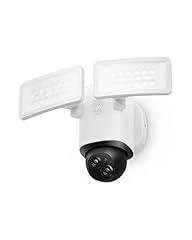
Eufy Security Floodlight Camera E340
Overview
This is a hardwired outdoor floodlight camera with two lenses, a pan and tilt camera head, two adjustable LED light panels, microphone, speaker, and a microSD card slot. It mounts to a wall, ceiling, or junction box and requires 100V to 240V AC wiring. The supplied USB cable is for indoor setup only, not normal power. The enclosure is manufacturer-stated IP65, with a stated operating range of minus 4°F to 104°F. The wide camera is manufacturer-stated 3K and the telephoto camera 2K, with 3x optical and up to 8x digital zoom. Independent hands-on testing found strong day and infrared night image quality, plus reliable person, vehicle, and animal tracking in controlled scenarios. Continuous recording is available only after adding a microSD card or compatible HomeBase storage.
What works
- Independent hands-on testing found sharp image quality, strong infrared night vision, and reliable tracking in controlled motion scenarios.
- Local recording is available without a mandatory cloud plan when a separately purchased microSD card or HomeBase is used.
- The product has documented privacy zones, device-sharing controls, encrypted storage and transport claims, and optional two-factor authentication.
- The installation documentation specifies hardwired power, grounding hardware for the US version, a UL-listed junction box, and circuit-breaker precautions.
- Its radio authorization is traceable to an FCC equipment authorization record for this exact product model.
What does not
- A memory card is not included, and the product has no internal storage. Without a card, HomeBase, or cloud storage, it can send alerts but cannot save clips.
- The manufacturer states that a 128 GB card holds up to six days at highest-resolution continuous recording, so local retention is limited unless extra HomeBase storage is added.
- No exact-product UL or ETL safety listing was located in the public NRTL directories reviewed. The manual requires installation on a UL-listed junction box, but that does not independently certify the complete camera and floodlight assembly.
- No dated minimum firmware-support period or exact-product Cyber Trust Mark record was located.
- The product is not documented as ONVIF conformant, and it lacks Apple HomeKit and Google Home camera support. Alexa and Google Assistant smart-display viewing are supported.
Who is it for
It suits a homeowner who already has a suitable outdoor junction box and wants wired lighting plus broad driveway, yard, or side-path coverage from one camera. It is especially relevant where local recording matters, because a separately purchased microSD card can enable continuous recording without requiring a cloud plan. The dual-lens design, pan and tilt movement, activity zones, and independently observed low-light performance fit larger outdoor areas where subjects may move across a wide scene.
Who is it not for
It is not suited to renters, homes without a safe existing outdoor junction box, or anyone unwilling to arrange qualified hardwired installation. It also is a poor fit for buyers who need recording immediately from the box, because no internal storage or memory card is included. Privacy-sensitive households should consider the camera's microphone, pan and tilt coverage, and cloud-connected options carefully, use privacy zones, and enable two-factor authentication. It is also unsuitable for buyers requiring HomeKit, ONVIF-confirmed integration, or a published long-term software-support commitment.
Integrity
The installation materials include grounding hardware for the US version, and the product documentation calls for hardwiring to a UL-listed junction box. The product is manufacturer-stated IP65 and rated for use from minus 4°F to 104°F. Its Wi-Fi radio authorization can be checked in FCC records for this exact product. No product-specific CPSC recall or warning was located in the reviewed US recall sources. However, a public exact-product UL or ETL listing was not located, so the safety certification status of the completed camera and floodlight assembly remains unconfirmed. The housing is manufacturer-stated polycarbonate. This is a mains-powered product rather than a battery camera, which avoids routine battery replacement. Eufy provides a 12-month camera warranty and directs US customers to electronics recycling, including the Call2Recycle locator for rechargeable-battery products. A clear product-specific repair-parts catalog and a dated software-support endpoint were not located.
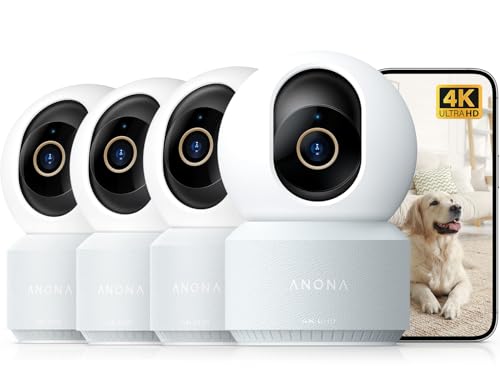
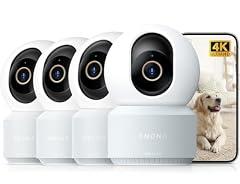
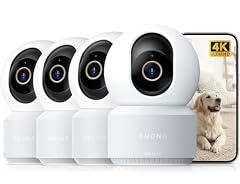
Anona Indoor Security Camera 4-Pack
Overview
This is a four-camera indoor monitoring bundle. Each corded, pan-and-tilt camera is intended for room surveillance, pet checks, and baby monitoring through the Anona Security phone app. The documented hardware specification is 3840 by 2160 video, 360-degree horizontal pan, 110-degree tilt, a 108.5-degree lens field of view, dual-band Wi-Fi, Bluetooth setup, two-way audio, and microSD support from 16 GB to 512 GB. The radio hardware is independently traceable through a U.S. FCC equipment authorization covering the matching Anona camera model and its Wi-Fi and Bluetooth radios. Local storage, auto-tracking, person, pet, and crying alerts, 4K night performance, and a privacy mode are manufacturer-stated. The support material acknowledges that cloud uploads can lose video on poor networks and recommends pairing cloud storage with an SD card.
What works
- The matching camera model has an independently traceable U.S. FCC authorization for its Wi-Fi and Bluetooth radio hardware.
- Manufacturer documentation specifies local microSD recording from 16 GB to 512 GB, which can preserve footage without relying solely on cloud playback.
- The official support material documents firmware updates through the app and camera settings.
- The product is explicitly indoor-only, and the manufacturer states it is not waterproof, which gives a clear installation limit.
- The manufacturer states that privacy mode stops both live view and recording, and describes a physical privacy cover.
What does not
- No exact-model UL or ETL electrical safety listing was located for the camera or supplied power adapter. The instructions instead require use of the supplied 5V, 2A low-voltage adapter.
- No independent, controlled test report was located for this product's 4K image quality, 30-foot night claims, alert accuracy, auto-tracking, or false-alert rate.
- The support page says the camera does not support WPA3 Wi-Fi. Public materials also do not state a minimum security-support period, MFA availability, encryption details, or a vulnerability reporting process.
- The broad claim of full-room coverage and no blind spots is not supported by an independent test, and a moving pan-and-tilt camera cannot observe every direction simultaneously.
- No manufacturer take-back program or U.S. recycling instructions for the camera, adapter, or memory card were located.
Who is it for
This product suits a household that needs several corded indoor cameras for separate rooms and is prepared to use the phone app and microSD cards for local recording. It is a practical fit for routine pet observation, checking common areas, or receiving manufacturer-stated motion, person, pet, and crying alerts. It also suits users who can place cameras away from sinks, humid rooms, splashes, and outdoor exposure, and who understand that Wi-Fi quality affects remote viewing and cloud uploads.
Who is it not for
It is not suited to outdoor, bathroom, garage, or other damp-location monitoring because the manufacturer says it is not waterproof. It is also not appropriate where independently validated night identification, alert accuracy, or uninterrupted evidentiary recording is required. Buyers with strict cybersecurity requirements should choose a product with documented MFA, encryption architecture, a published vulnerability channel, and a dated update commitment. It is not a substitute for direct adult supervision of an infant or for a professionally monitored emergency system.
Integrity
The camera uses low-voltage 5V, 2A corded power and has no internal battery identified in the documentation. Installation instructions say to use the included cable and a qualified low-voltage adapter, avoid humid conditions, avoid disassembly, and mount only on a sturdy surface. The matching wireless model has a traceable U.S. FCC authorization and RF test record. A search of the CPSC recall database found no matching Anona camera recall at the time of review. Privacy is material for an indoor microphone and camera. The manufacturer states that privacy mode stops viewing and recording, while its policy says video footage and usage data may be processed and that recordings can be deleted by the account holder. The policy does not provide a camera-specific retention schedule. The product has no stated battery disposal issue, but no dedicated manufacturer e-waste take-back or recycling route was located. Local reuse, resale, or eventual electronics recycling should account for the camera, adapter, and removable memory card.

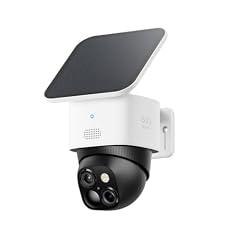
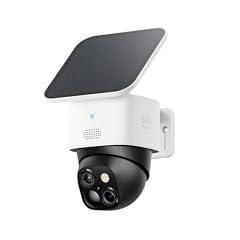
eufy Security SoloCam S340 Solar Camera
Overview
This product is a wire-free outdoor camera with a built-in rechargeable battery, removable solar panel, motorized horizontal pan, dual lenses, microphone, speaker, spotlight, and app-based live viewing. It records motion events to 8 GB of internal storage, rather than requiring a cloud plan. The manufacturer specifies a 3K wide-angle camera, 2K telephoto camera, 8x hybrid zoom, 360-degree horizontal pan, 70-degree tilt, and 2.4 GHz Wi-Fi only. An FCC equipment authorization and radio test record identify this exact camera and its Wi-Fi transmitter. The filing lists 5 V, 2 A input and an internal 3.69 V, 9,400 mAh battery. Independent home testing found sharp daytime footage, useful local storage, and solar charging that maintained a high battery level in a suitable sunny placement. That testing also found motion sensitivity could need adjustment, and tracking could jump between two subjects.
What works
- Exact-model FCC authorization and Wi-Fi compliance records are publicly traceable.
- Local 8 GB event storage works without a mandatory subscription, and recordings can be downloaded through the app.
- Independent outdoor testing found clear footage in day and night conditions, with solar charging maintaining battery level in a sunny location.
- The app provides privacy zones, text-only notifications by default, account sharing controls, login alerts, and optional two-factor authentication.
What does not
- No exact-model UL or ETL electrical-safety listing was located, so third-party certification of the battery, charging arrangement, and solar assembly remains unverified.
- The maker describes weather protection but does not publish an ingress rating. Its own pages also conflict on the upper operating limit, listing 122 F in one location and 140 F in another.
- The claim of no blind spots is too broad. The manufacturer itself advises angled placement to avoid missed detection, and vertical movement is limited to 70 degrees.
- The manufacturer documents no dated minimum software-support period, and the brand's earlier video-stream privacy failures remain relevant context despite later security changes.
- No published ONVIF or RTSP support was found for this product, leaving viewing and export primarily dependent on the eufy app and service.
Who is it for
This product suits a homeowner who needs event-based coverage of a driveway, yard, porch, or side gate where running mains power is impractical and the solar panel can receive several hours of direct sun. It is particularly practical for someone comfortable managing camera settings in a phone app, tuning motion sensitivity, and accepting 2.4 GHz Wi-Fi. The built-in storage is useful for households that want routine clips without an ongoing cloud-storage charge, while accepting that storage capacity and recording mode are limited compared with continuous local recording systems.
Who is it not for
It is not suited to locations with persistent shade, short winter sunlight, or frequent heavy activity, because solar autonomy and battery life depend on placement and motion load. It is also a poor fit for evidence-critical monitoring that requires continuous recording, a published IP rating, formal electrical-safety listing, or independently measured alert reliability. Privacy-sensitive households that need a documented minimum support term, standards-based recorder access, or confidence unaffected by the brand's past video-stream security issues should not treat app controls alone as sufficient assurance.
Integrity
The exact product has a publicly traceable FCC authorization for its 2.4 GHz Wi-Fi radio. That is useful regulatory traceability, but it is not a battery or electrical-safety certification. No exact-product UL or ETL listing was located. The manufacturer supplies outdoor mounting guidance, including a recommended height of 7 to 10 feet and a recommendation for 3 to 4 hours of direct daily sunlight. It does not publish an ingress-protection rating, and its stated maximum operating temperature is inconsistent across product pages. The rechargeable battery and integrated electronics should not enter household trash. eufy directs U.S. users with outdated rechargeable products to electronics recycling and the Call2Recycle locator. Anker also offers a U.S. recycling program for eligible old devices. No recall specific to this product was located in the checked CPSC records. The battery is not presented as a routine user-replaceable part, and no product-specific repair-parts path or minimum firmware-support period was found, which may limit its service life.

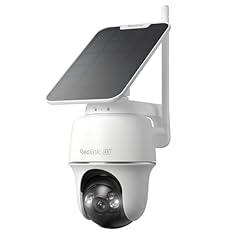
Reolink Argus PT 4K Solar Security Camera
Overview
This product is a battery-powered outdoor Wi-Fi camera with a pan and tilt head, integrated microphone and speaker, microSD slot, USB-C charging port, and a 21.6Wh rechargeable lithium-ion battery. It records motion-triggered clips at up to 3840 by 2160 pixels and 15 frames per second, according to Reolink's product support specifications. Reolink lists 355-degree pan, 140-degree tilt, person, vehicle, and pet alerts, local microSD storage up to 512GB, and optional cloud storage in selected countries. The radio label identifies this exact product as a 5V rechargeable lithium-ion Wi-Fi camera with an FCC authorization. Reolink states an IP65 weather rating and a 14 to 131 F operating range, but no exact-model UL or ETL safety listing was located. Independent hands-on coverage confirms that this battery camera lacks direct ONVIF support, a material limitation for NAS, NVR, and third-party smart-home users.
What works
- Local motion-event recording to a microSD card up to 512GB is documented by the manufacturer, reducing dependence on a cloud plan.
- Reolink documents privacy masks that black out selected areas in both live view and recordings.
- Account two-factor authentication, app lock, device-password changes, and an HTTPS web interface are documented security controls.
- The exact radio model is traceable through an FCC identifier, and the manufacturer publishes a two-year limited warranty plus post-end-of-life software support terms.
What does not
- The battery is built in and not replaceable, so battery wear can shorten the product's practical service life.
- No exact-model UL or ETL listing was located for the camera, charging equipment, or solar assembly. FCC authorization confirms radio compliance, not electrical-product safety certification.
- It records motion events rather than continuous 24-hour video. Local storage can preserve events during an internet outage, but it cannot fill gaps before a trigger or during a depleted battery.
- Independent testing confirms no direct ONVIF support, limiting use with third-party recorders, NAS systems, and local automation platforms.
Who is it for
This product suits a homeowner or renter who needs a single outdoor viewpoint where running Ethernet or mains power is impractical. It fits driveways, gates, sheds, and yards where motion-event recording is acceptable, the camera can be mounted securely within Wi-Fi range, and sunlight or periodic USB-C charging is realistic. It is also appropriate for users willing to configure privacy masks, unique device credentials, app protection, and two-factor authentication, while storing clips locally on their own microSD card.
Who is it not for
It is not suited to locations requiring evidentiary continuous coverage, such as a busy entrance, commercial perimeter, or an area where an event may occur before motion detection begins. It is also a poor fit for buyers needing direct ONVIF, NAS, NVR, or third-party video-management integration. Avoid relying on it where winter shade, extreme heat or cold outside the stated range, weak Wi-Fi, or inaccessible mounting makes solar charging, manual charging, or safe maintenance unreliable.
Integrity
The product has some meaningful safety documentation. Its label identifies a rechargeable lithium-ion battery and 5V charging input, while Reolink's battery guidance calls for dry, clean charging connections, use within stated temperature limits, and stopping use if the battery becomes hot, deformed, discolored, or otherwise abnormal. Reolink also documents an IP65 weather claim and requires the charging-port cover to be secured after charging. No relevant CPSC recall or U.S. regulator warning was located in this review. The battery is not user-replaceable, which is the main longevity and e-waste concern. Reolink provides a two-year limited warranty and says it will supply security updates for at least two years after a product reaches end of life. Its manuals direct users to follow local battery recycling rules, but a dedicated U.S. take-back route for this camera, its built-in battery, and solar equipment was not identified. Do not place lithium-ion equipment in household trash or curbside recycling.
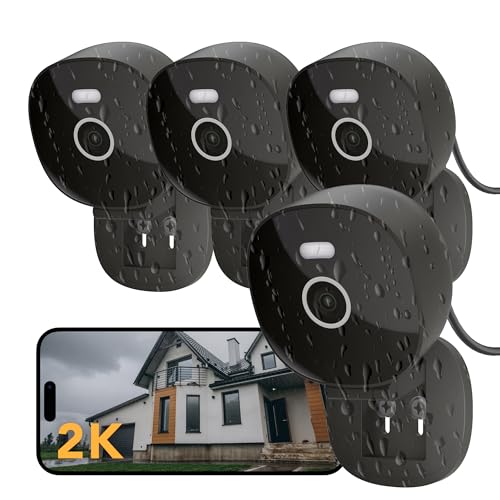
FAMVIVA 2K Security Camera, Indoor/Outdoor, Motion Detection, Alexa Compatible
Overview
This is presented as a four-camera, cord-powered 2K indoor and outdoor Wi-Fi surveillance set with color night vision, motion alerts, a spotlight and siren, and voice-assistant viewing. The product record identifies Famviva as the brand, but its stated model number and much of its specification set match TP-Link's Tapo C216, a single pan and tilt camera. That identity conflict is material because it makes the supplied accessories, manufacturer support, certifications, warranty, and app ecosystem difficult to verify for the actual marketplace unit. For the Tapo C216 model, TP-Link states 2304 by 1296 video, IP65 weather resistance, 2.4 GHz Wi-Fi, a 5 V 1 A USB-C power supply, microSD recording up to 512 GB, and RTSP and ONVIF support. These are manufacturer specifications, not independent performance-test results for this marketplace package. No accredited image-quality test for the listed product was located.
What works
- The matching Tapo C216 documentation specifies local microSD recording up to 512 GB, which can reduce reliance on cloud storage.
- The matching documentation specifies RTSP and ONVIF access, allowing compatible local NVR or NAS use when configured carefully.
- TP-Link publishes firmware for the matching model and lists a security support period through at least December 31, 2029.
- The matching Tapo documentation specifies IP65 weather resistance and a -4 to 122 F operating range.
What does not
- The marketplace identity is internally inconsistent, with a Famviva brand record paired to a model documented by TP-Link. This is a real traceability problem.
- No exact marketplace-package UL or ETL listing was located for the camera or included power supply, so electrical certification for the delivered set is unverified.
- Resolution, night performance, detection accuracy, alert delay, and false-alert rates are manufacturer claims. No independent reproducible test for this product was located.
- Cloud storage requires a subscription for the matching Tapo model, and local storage, cloud recording, and NVR use have documented configuration tradeoffs.
- No product-specific U.S. take-back, repair-parts, or recycling route was found for the listed Famviva product.
Who is it for
This product is most suitable for a buyer who can confirm before installation that the delivered cameras are genuine Tapo C216 units, including the labels, app compatibility, power adapters, and documentation. It fits a fixed-location monitoring setup where corded power is practical, Wi-Fi is stable, and the owner wants local microSD recording or a compatible local NVR or NAS rather than cloud-only footage. The buyer should be comfortable securing a Wi-Fi camera, setting privacy and activity zones, using unique account credentials, and updating firmware.
Who is it not for
It is not suitable for anyone who needs a clearly traceable manufacturer, independently verified safety certification for every included power adapter, or a verified exact-model compliance record before placing cameras around children, bedrooms, entrances, or public-facing areas. It also does not fit locations without protected power access, reliable 2.4 GHz Wi-Fi, or weather-appropriate cable routing. Buyers needing independently tested nighttime identification performance, guaranteed recording during every outage, or a documented repair and recycling program should use a product with those records clearly tied to the sold package.
Integrity
The main safety concern is traceability, not a confirmed recall or defect. The product record calls the unit Famviva, while the stated model and specifications correspond closely to TP-Link's Tapo C216 documentation. TP-Link documents TLS and AES protections, privacy zones, local storage, firmware releases, and a minimum security-support date of December 31, 2029 for that model. Those points cannot fully establish that the marketplace package uses the same hardware, app, adapter, or support commitment. The matching camera is cord-powered, not battery-powered, so it avoids an onboard lithium battery disposal issue. However, the camera, power adapter, cables, and any memory cards remain e-waste. No Famviva-specific U.S. take-back or repair-parts program was located. Keep the unit and adapter out of household trash, use an electronics recycler that accepts accessories and power supplies, and erase or physically destroy storage media before recycling.

Hiseeu Wireless Security Camera Pro
Overview
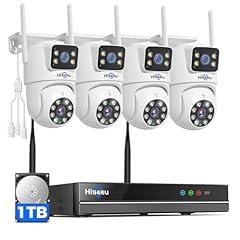
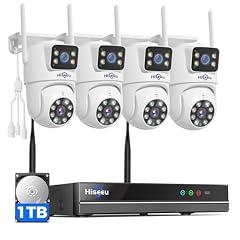
This is a four-camera outdoor surveillance kit with a network video recorder and a stated 1TB hard drive. Each plugged-in camera combines a fixed lens with a pan and tilt lens. The recorder connects to a display by HDMI or VGA, while remote access and alerts use the EseeCloud app. It is wireless for camera networking, not wire-free. Hiseeu specifies 12V 1A camera adapters and a 12V 2A recorder adapter. Hiseeu documents manual, scheduled, and motion-triggered recording, local playback, and USB video export. It also states 3MP plus 3MP camera resolution, color night vision, auto tracking, two-way audio, dual-band Wi-Fi, and no monthly fee. These are manufacturer claims, not independently reproduced performance results. Weather protection is uncertain because Hiseeu describes this same product as both IP65 and IP66 on one product page.
What works
- The recorder has local hard-drive recording, display output, playback, and documented USB footage backup.
- A fixed lens and a pan and tilt lens can maintain two simultaneous views from each camera, according to Hiseeu.
- Recording can be set to manual, scheduled, or motion-triggered modes, according to Hiseeu.
- The warranty explicitly avoids claims that the product prevents crime, injury, loss, or property damage.
What does not
- The outdoor rating is internally inconsistent. The product page calls the camera IP66 in one claim and IP65 in its specifications.
- No exact-product NRTL electrical listing, FCC authorization record, ONVIF conformance listing, or independent performance test was located during verification.
- The stated false-alarm elimination, 100-foot Wi-Fi range, auto tracking, night performance, and complete-coverage claims lack independent test conditions or failure-rate data.
- Remote viewing and app alerts require an online cloud identifier, while published policies do not provide product-specific video retention, encryption, privacy-zone, or multi-factor authentication details.
- The moving PTZ parts have only a six-month warranty, while the broader hardware warranty is one year.
Who is it for
This product suits a homeowner or small property manager who wants several powered cameras feeding a local recorder rather than relying only on a cloud plan. It is most practical where every camera position has weather-protected access to a suitable outlet, the recorder can stay indoors near a monitor or router, and the owner is willing to configure motion recording and export clips to USB. It also fits users who value a fixed overview plus a movable camera view, while treating tracking and night-vision claims as unverified.
Who is it not for
It is not suited to renters or installations that cannot safely provide permanent power at every camera location. It is also a poor fit for exposed sites where a confirmed IP rating and independently listed outdoor power equipment are required, because the published weather rating conflicts. Households needing strong privacy controls, defined footage retention, multi-factor account protection, or documented encryption should choose a product with those controls clearly published. Do not treat its alerts, tracking, or footage as a guarantee of identification, crime prevention, or emergency response.
Integrity
The cameras are corded, so this kit does not add rechargeable camera batteries or solar charging equipment to the household. Hiseeu’s documentation specifies separate low-voltage 12V adapters for the cameras and recorder, advises using the supplied power supplies, keeping recorder vents clear, and avoiding fluids near the equipment. No exact-product UL or ETL listing was located in the verification work, so outlet placement, cable protection, and weather-protected connections remain important. Local hard-drive recording can reduce dependence on a recurring cloud service and allows USB export, but it does not remove privacy risks from two-way audio, motion alerts, and remote app viewing. Hiseeu and EseeCloud publish general privacy policies, yet product-specific video retention and security details were not found. Hiseeu provides a one-year hardware warranty, with PTZ motors and bearings covered for six months. No manufacturer take-back or U.S. recycling route for the cameras, recorder, adapters, or hard drive was located.

Solar Security Cameras System C9E-2P
Overview
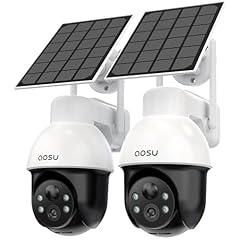
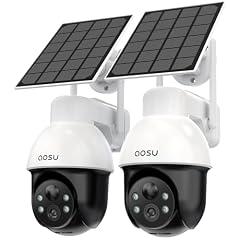
This product is a two-camera, solar-powered outdoor surveillance set with plastic pan, tilt, and digital-zoom camera bodies, separate solar panels, app control, two-way audio, spotlights, and 2.4 GHz Wi-Fi. It is intended for wall or ceiling mounting around a driveway, yard, entry, or similar exterior area. Motion events can be saved to a user-supplied microSD card of up to 128 GB, while cloud storage is also offered as a paid option. Manufacturer documentation states 3K, 5 MP video at 2880 by 1620 pixels, IP65 weather resistance, color night vision, person and vehicle classification, and motorized 360-degree horizontal movement. An FCC equipment authorization is publicly traceable for the wireless device. No independent laboratory test was found for this exact product's image detail, night performance, alert accuracy, solar runtime, or weather sealing.
What works
- Local microSD recording is documented, with motion-event downloads available through the app.
- The wireless radio has a publicly traceable FCC equipment authorization for U.S. operation.
- The privacy notice states that video data is encrypted in transit and at rest.
- Aosu publishes a vulnerability-reporting program with stated acknowledgement and assessment timeframes.
- Manufacturer documentation gives an IP65 rating and an operating range of minus 10 C to 55 C.
What does not
- No independent test was found for the exact product's night image quality, detection range, person or vehicle accuracy, false-alert rate, or solar endurance.
- The claim of no blind spots is too broad. A pan and tilt camera can move through a full horizontal circle, but it cannot observe every direction simultaneously.
- No exact-product UL or ETL electrical-safety listing was found, and the available documentation does not identify charger or battery safety certification.
- The privacy notice covers encryption and cloud retention, but the exact-product documentation does not substantiate privacy masking, granular shared-user permissions, or multi-factor authentication.
- No published RTSP, ONVIF, or other standards-based local viewing support was found. Local recording remains primarily app-managed.
Who is it for
This product suits a household that wants two wire-free exterior viewpoints for a driveway, patio, side yard, or detached structure, has dependable 2.4 GHz Wi-Fi at each mounting point, and can position the solar panels for regular direct light. It is most appropriate for event-based awareness rather than evidentiary continuous coverage. The buyer should be comfortable using a proprietary mobile app, supplying microSD cards, checking recordings after alerts, and periodically cleaning the solar panels and lenses.
Who is it not for
It is not suited to locations that need uninterrupted recording, dependable coverage during prolonged shade or severe cold, or independently tested identification-quality footage at a stated distance. It also is a poor fit for privacy-sensitive properties that require documented privacy zones, role-limited sharing, or verified multi-factor account protection. Households using 5 GHz-only Wi-Fi, buyers who need NVR integration through published ONVIF or RTSP support, and anyone unable to safely screw-mount exterior equipment should choose a different setup.
Integrity
The product uses an embedded rechargeable lithium battery. Aosu's California battery-chemistry disclosure identifies the closely related SolarCam D1 SE variant as lithium-ion, while other documentation for this product describes a rechargeable lithium-polymer battery. That naming difference makes it especially important to use the supplied charging arrangement, avoid damage or heat exposure, and confirm the label on the delivered unit before disposal. No U.S. recall or regulator warning for this product was found in the checks performed. Aosu states that video is encrypted in transit and at rest. Its privacy notice also says the service collects video and audio content, device information, Wi-Fi information, and camera location data. Cloud recordings are described as rolling overwrite storage, typically up to 30 days depending on plan. The company publishes a vulnerability-reporting channel, but no dated minimum software-support term, repair-parts program, or U.S. product take-back route for this camera was found. The embedded battery and electronics should be routed to an appropriate battery or e-waste collection program, not household trash.