
10 Best Air Tags for Android
 Daniel Kenitz
Please note that we participate in affiliate marketing programs. When you purchase through links on our site, we may earn a commission. As an Amazon Associate we earn from qualifying purchases. This comes at no additional cost to you and helps support the resources required to provide valuable content.Advertising Disclosure
Top-rated Air Tags for Android Comparison
1

2
3
4
5
6
+
7
+
8
9
10
Air tags for Android: what to look for
An Android item tracker is a small Bluetooth device that helps locate keys, bags, luggage, wallets, and similar belongings. Nearby, your phone can connect directly to the tag and make it ring. Farther away, location updates may come from a crowdsourced finding network: nearby participating phones detect the tag and relay an approximate location. This is not the same as GPS or cellular tracking. It does not guarantee a live position, and results depend on Bluetooth, internet access, location services, phone compatibility, country support, and the number of participating devices nearby.
The first question is whether the exact product is officially approved for Google Find Hub. “Works with Android” is not enough. A high-confidence product should be identifiable in Google’s official compatible-accessory information or supported by exact-model partner approval and activation evidence. Also check the phone’s Android version, whether Huawei devices are excluded, whether each tag can use only one finding network at a time, and how reset, ownership transfer, sharing, and account removal work. Several supplied products advertise Apple and Google support but are limited to one platform per tag; some are actually iOS-only or Samsung-only.
Headline range figures need careful interpretation. A claim such as 120, 200, or 400 feet describes direct Bluetooth conditions, often in open space, not guaranteed crowdsourced-network performance. A loudness claim such as 80–100 dB is not a substitute for an independent alarm test. Battery claims may be manufacturer estimates, simulated typical-use figures, or platform-specific results rather than independently measured service life. A waterproof or IP65, IP67, or IP68 label is stronger when matched to an exact-model IEC 60529 test report; a plastic enclosure or an image showing rain is not equivalent evidence.
For radio credibility, look for an exact FCC Equipment Authorization record and matching FCC ID, model, manufacturer, and manual. Bluetooth operation is more credible when the exact model appears in the Bluetooth SIG Qualified Product Database. Independent performance claims should identify the exact sample and report, preferably from an ISO/IEC 17025-accredited laboratory, with the method, date, and results disclosed. These records still do not prove every finding-network or battery-life claim.
Battery design affects both safety and waste. Replaceable coin cells can keep a working tag in service, but they create ingestion and burn hazards for children and pets. Look for documented compliance with CPSC requirements under 16 CFR Part 1263 and Reese’s Law, an ANSI/UL 4200A-2023 test report, and a General Certificate of Conformity. Rechargeable tags avoid routine disposable cells but may have sealed batteries, no replacement route, and limited cycle-life evidence. Recycling instructions matter in either case.
Across the supplied products, recurring cautions are significant: many lack exact-model Google approval, independent performance testing, or ingress reports; several contain accessible or poorly documented coin cells; and listing specifications sometimes conflict about battery type. Products described as iOS-only, Samsung-only, or one-network-at-a-time are not general Android trackers. None should be treated as a live GPS tracker, a personal-safety device, a pet or child tracker, or a guaranteed theft-recovery system. Covert tracking is not an appropriate use; buyers should rely on products with documented unknown-tracker alerts, audible finding or separation alerts, disabling instructions, and clear ownership controls.
Integrity
These products combine a radio, a battery, an attachment point, and a platform account. The strongest choices make those four parts clear, testable, and maintainable rather than relying on a broad compatibility or waterproofing claim.
HHealth & Safety
Battery safety for people and pets
This measures whether the coin-cell compartment, warnings, instructions, and rechargeable-battery protections reduce ingestion, burn, and overheating risks. It matters because many tags use accessible CR2032 cells. Higher-scoring products supplied clearer warnings or safer designs; scores ranged from 32 to 85. A high score still requires documented U.S. compliance evidence, while a low score often reflected missing certificates, conflicting battery details, or easy access.
Anti-stalking protections
This measures unknown-tracker alerts across platforms, audible finding or separation alerts, and clear owner-disabling instructions. It matters because a Bluetooth tag can be placed on someone or their belongings without consent. Among the supplied products, scores ran from 70 to 85. Higher scores were associated with documented Google or Apple alert and disable features; lower scores reflected unconfirmed network compatibility or incomplete product-specific instructions.
Location-data privacy and account security
This measures protection for location reports, ownership, sharing, reset, and account access. It matters because finding a lost item requires location data and an account relationship. Scores ranged from 52 to 88. Higher-scoring products were supported by platform privacy, removal, sharing, or encrypted-reporting documentation; lower scores reflected overstated privacy descriptions or missing policies, reset guidance, and ownership-transfer details.
EEcology
Battery waste and end-of-life impact
This measures service life, replaceable or safely rechargeable power, recycling guidance, and avoidable accessories. It matters because a depleted battery can otherwise make an entire tag electronic waste. Scores ranged from 69 to 86. Higher-scoring products generally used replaceable or rechargeable batteries; lower scores reflected sealed batteries without cycle-life or recycling information, or replaceable cells without clear disposal guidance.
Durability that prevents replacement waste
This measures whether the tag, enclosure, attachment point, and battery-service design can survive normal use and be maintained. It matters because a lost or water-damaged tag creates replacement waste even when its battery is usable. Scores ranged from 68 to 77. Higher scores reflected stated warranties, service instructions, or sturdier designs, but independent drop, retention, abrasion, and repair evidence was uncommon.
EEvidence
Official Find Hub compatibility
This measures whether the exact model is officially approved and activated for Google Find Hub, rather than merely advertised as Android-compatible. It is the category’s key dividing line. Scores ranged from 20 to 88. The higher-scoring example had Google-list evidence tied to related exact-model documentation; lower-scoring products had only marketplace or manufacturer claims, while Samsung’s tracker was not a Find Hub accessory.
Independently verified performance
This measures exact-model laboratory testing of Bluetooth operation, alarm, battery life, water resistance, and finding performance. It matters because marketing figures often describe ideal conditions. Scores ranged from 68 to 81. Higher scores reflected an independent radio or field report, while most products lacked testing for battery endurance, alarm volume, water ingress, or crowdsourced finding reliability.
Verified Bluetooth and U.S. radio compliance
This measures whether the exact wireless product matches legitimate FCC and Bluetooth records. It matters because an Android label does not establish that the radio identity is documented. Scores ranged from 69 to 93. Higher scores had matching FCC authorization or test documentation; lower scores lacked an exact FCC ID, Bluetooth SIG qualification, or a reliable match between package branding and authorized hardware.
Realistic finding performance
This measures honest, repeatable distinction between nearby Bluetooth range and network-assisted location, including ordinary environmental limitations. Scores ranged from 68 to 80. Higher scores were supported by field testing or clearer platform limitations; lower scores relied mainly on claimed range, sound level, or vague “real-time” language. No product guarantees continuous location away from Bluetooth range.
Water-resistance claim reliability
This measures whether an exact-model IP claim is supported by the correct IEC 60529 test level and consistent warranty terms. It matters because rain, splashes, and immersion can shorten service life. Scores ranged from 68 to 75. Most supplied products had manufacturer-stated IP ratings but no exact-model laboratory report; unverified labels should not be treated as permission for immersion.
Setup, platform, and ownership clarity
This measures whether the listing and manual explain supported phones, operating systems, countries, account needs, one-network limits, sharing, reset, and transfer. Scores ranged from 53 to 88. Higher-scoring products provided concrete setup and reset instructions; lower scores involved conflicting platform claims, unclear cross-network behavior, or missing transfer and disabling steps.
Honest, traceable product claims
This measures whether compatibility, range, battery, waterproofing, and certification claims are specific and traceable to the exact product. Scores ranged from 52 to 82. Higher scores had more consistent model documentation; lower scores featured unsupported “certified” language, conflicting battery information, vague platform names, or claims not matched to FCC, Bluetooth, Google, Apple, or laboratory records.
Full reviews
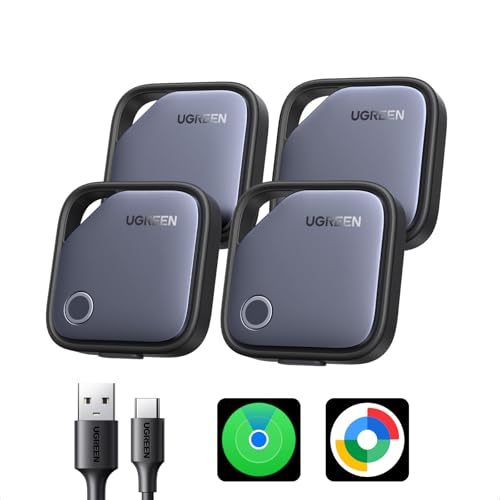
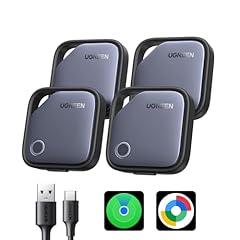
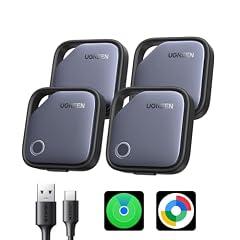
UGREEN Finder Duo Air Tracker Tags
Overview
This is a four-pack of compact plastic Bluetooth item tags for keys, bags, luggage, or similar possessions. It is designed to be paired with either Apple Find My or Google Find Hub, then located nearby by triggering its sound or remotely through participating phones in the selected crowdsourced network. UGREEN states that one tag cannot be connected to both platforms at once. The defining hardware claim is a USB-C rechargeable battery with up to 365 days per charge, according to UGREEN. Public FCC-linked documentation independently ties this product number to UGREEN's CM916 Finder Pro radio hardware and records Bluetooth Low Energy testing and RF-exposure evaluation. No public independent test was located for the claimed battery runtime, alarm loudness, attachment strength, or water resistance.
What works
- USB-C recharging can avoid routine replacement of disposable coin cells, according to UGREEN.
- The manufacturer clearly states the important one-platform-at-a-time limitation for Apple Find My and Google Find Hub use.
- A public FCC-linked report identifies the exact product family, Bluetooth Low Energy operation, and a passed RF-exposure evaluation.
- Google documents unknown-tracker alerts, sound finding, and disabling guidance for Find Hub-compatible tags on supported Android phones.
What does not
- The exact product's Apple and Google approval evidence is not publicly verifiable through an issuing-body accessory register, despite UGREEN's certification claim.
- No independent report was located for the claimed one-year battery life, audible alarm, finding range, or real-world network finding success.
- No IEC 60529 test report was located for an exact-model IP rating. A dust plug is manufacturer-stated, but it is not water-resistance evidence.
- The catalog battery description conflicts with UGREEN's own rechargeable USB-C description, which weakens claim traceability until the packaging and manual are checked.
Who is it for
This product suits a household that uses either iPhones or Android phones and wants several rechargeable tags for everyday belongings, rather than tags that require periodic coin-cell purchases. It is most appropriate for keys, bags, camera cases, and luggage where a nearby sound and a last-known or crowdsourced-network location can help with recovery. The owner should be comfortable using the Find My or Find Hub app, have the needed account and phone settings enabled, and choose one platform for each tag before setup.
Who is it not for
It is not a fit for someone who needs one tag to be visible and shareable across both iPhone and Android ecosystems at the same time. It is also unsuitable where independently proven waterproofing, impact resistance, battery-cycle life, or attachment retention is required, because public exact-product test evidence was not located. Parents and pet owners seeking documented child-resistant battery compliance should look for a product with a published UL 4200A report or comparable safety documentation. It is not a live GPS tracker and depends on nearby participating devices for remote updates.
Integrity
The main safety benefit is that UGREEN describes an internal USB-C rechargeable power system, not a user-replaceable button cell. That can reduce access to ingestion-hazard cells and cuts routine battery waste. However, no public UL 4200A report, General Certificate of Conformity, or equivalent exact-product battery-safety documentation was located. The catalog's lithium-metal battery wording also conflicts with the manufacturer's rechargeable description, so the physical product labeling should be checked before relying on either statement. For privacy and misuse prevention, the claimed networks matter more than the tag alone. Google documents encrypted Find Hub location handling and unknown-tracker alerts that can play a compatible tag's sound and guide a person through response options. UGREEN states its tag is encrypted and supports either Apple or Google, but public evidence confirming the exact model's platform approvals remains limited. No matching U.S. CPSC recall was located in the review work. Recycling instructions and a verified service-life or repair-parts program were not located.

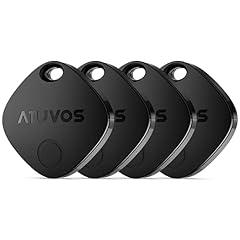
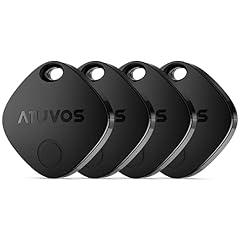
ATUVOS Air Tracker Tags 4 Pack
Overview
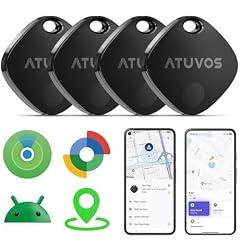
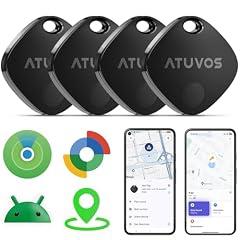
This is a four-pack of small square plastic Bluetooth tags for keys, bags and luggage. Each tag is listed at about 1.37 inches square and 0.39 inches thick. It pairs directly in Apple’s Find My app, rather than through an ATUVOS tracking app, and is expressly limited to iOS devices. It is not an Android tracker, despite the search category attached to this product. The most important confirmed point is network status, Apple lists ATUVOS Tag as a Find My compatible multipurpose tag. The product manual identifies the AT2301 design as using a replaceable CR2032 coin cell, with a stated nearby Bluetooth range of up to 200 feet and reset instructions before re-pairing. An FCC test report covers the AT2301 radio, but no independent exact-product testing was located for finding reliability, battery life, or water resistance.
What works
- Apple officially lists ATUVOS Tag as compatible with the Find My network.
- The documented reset procedure clears connection data before the tag is paired again.
- A replaceable CR2032 battery can avoid discarding a working tag when its battery is depleted, based on the product manual.
- An exact-model FCC radio test report documents a pass to the applicable Part 15 test standard.
- ATUVOS provides a 12-month limited warranty for the AT2301.
What does not
- It works with Apple devices only, so Android phones cannot set up or locate it.
- The product uses an ingestible CR2032 coin cell. The manual includes a safety warning, but public UL 4200A testing and a General Certificate of Conformity were not located.
- The stated IP67 water-resistance claim was not supported by a public IEC 60529 test report for this product.
- No independent field testing was located for the advertised range, network finding success, alarm loudness, or battery-life claim.
- The catalog specifications conflict with the product documentation by describing three C batteries, while the manual identifies one CR2032 coin cell.
Who is it for
This product suits an iPhone, iPad, Mac, or Apple Watch user who wants several compact tags for ordinary belongings such as keys, backpacks, checked bags, or suitcases. It is especially relevant when the user prefers Apple’s built-in Find My app and wants a tag with a documented reset process and a replaceable coin cell instead of a sealed battery. It also fits someone who can keep the tags away from children and pets and handle coin-cell replacement carefully.
Who is it not for
It is not suitable for Android households, because this product does not support Android setup or Google’s Find Hub network. It is also a poor fit for homes with young children or pets if the tag can be accessed unsupervised, since it contains a CR2032 coin battery that can cause severe internal injury if swallowed. Buyers needing independently demonstrated IP67 protection, documented battery-compartment testing, or tested recovery performance should note that those exact-product records were not located.
Integrity
The key health issue is the replaceable CR2032 coin cell. Coin batteries can cause serious internal chemical burns within hours if swallowed. The available product documentation includes an ingestion warning and battery-replacement directions, but no public test report or certificate was located to show that this particular battery compartment meets the current U.S. button-cell accessibility standard. Keep both new and removed batteries out of reach of children and pets, and replace a damaged tag rather than relying on a compromised enclosure. On waste, a replaceable battery is preferable to a sealed tag because a depleted cell need not end the product’s service life. The manual directs users to recycle the old battery. ATUVOS offers a 12-month warranty, but public evidence was not located for repair parts, attachment-part replacements, a take-back program, or independently verified ingress testing. No product-specific CPSC recall or safety warning was located during this review.

KPMARE Smart Tag Item Finder 2026
Overview
This is a four-piece set of small Bluetooth item finders intended for keys, bags, luggage, wallets, and similar belongings. The marketplace description presents a black-and-white set with a replaceable battery, a claimed 200-foot nearby Bluetooth range, IP68 water resistance, and compatibility with both Apple Find My and Google Find Hub. The platform claim is the defining uncertainty. Syndicated KPMARE instructions and retailer pages for a closely related four-pack instead describe Apple Find My only, iOS 14.5 or later, a CR2032 battery, a 90 dB buzzer, and no Android support. I found no exact-product record showing Google Find Hub activation, Apple program approval, Bluetooth qualification, FCC authorization, an accredited ingress report, or independent performance testing. Google requires approval, third-party certification, and activation before a tag can operate on Find Hub.
What works
- The four-tag format can cover several small everyday items without buying separate single tags.
- A replaceable CR2032 battery and claimed 12-month standby life can avoid discarding a tag when its first battery is depleted, manufacturer-stated.
- The stated 90 dB sound function can help with close-range searching, manufacturer-stated.
- A one-year manufacturer warranty is listed, although support terms and repair parts were not independently verified.
What does not
- Apple and Android network support are not clearly substantiated. Closely related KPMARE documentation says iOS only, while this product page claims both platforms.
- No exact-product evidence was located for required Find Hub certification and activation, or for Apple network program approval.
- No public exact-product FCC, Bluetooth qualification, UL 4200A battery-safety report, or battery-compartment certificate was located.
- The IP68 claim is not accompanied by an exact-product IEC 60529 laboratory report, test depth, duration, or water-damage warranty terms.
- The product information is inconsistent about battery type. The marketplace data says a C battery, while related KPMARE instructions specify a CR2032 coin cell.
Who is it for
This set suits a buyer who wants several low-cost, lightweight Bluetooth tags for ordinary belongings and is prepared to confirm compatibility during setup before assigning them to important items. It is most practical for keys, backpacks, luggage, and other possessions that benefit from a nearby audible alarm and a user-replaceable battery. The buyer should be comfortable treating the stated 200-foot range and IP68 protection as manufacturer claims, not independently verified operating limits. It also fits households able to keep spare CR2032 cells secured from children and pets.
Who is it not for
It is not suited to Android buyers who need confirmed Google Find Hub operation, cross-platform sharing, or documented transfer and reset steps. The available related KPMARE instructions say iOS only, so the Android claim requires verification before use. It is also not suited to households with young children or pets unless the actual battery compartment, warning labels, and secure closure can be inspected. Buyers needing documented FCC and Bluetooth records, independently tested water resistance, or evidence of verified long-distance finding performance should use a product with those exact-model records available.
Integrity
The main health consideration is the likely coin-cell battery. Related KPMARE instructions specify a replaceable CR2032, but I found no exact-product General Certificate of Conformity, ANSI/UL 4200A evidence, or published battery-compartment test report. U.S. rules under Reese's Law require applicable consumer products containing coin cells to meet safety, labeling, and certification requirements. Keep replacement cells inaccessible to children and pets, and inspect the closure after every battery change. Replaceable power is the clearest waste-reduction feature because it can extend service beyond the first battery. However, the claimed 12-month life is not independently tested, and no product-specific battery or electronics recycling guidance was located. IP68 and ABS enclosure claims may support longer use, but no accredited ingress report, drop test, attachment-retention test, spare-part program, or detailed repair documentation was found. No relevant U.S. recall or CPSC safety action was located in the searched sources.

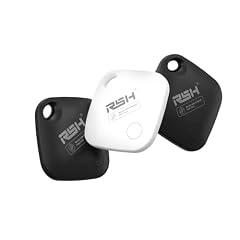
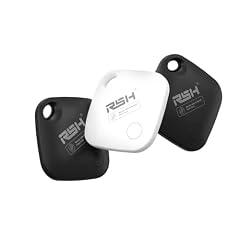
RSH Android Air Tracker Tags 4 Pack
Overview
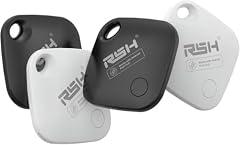
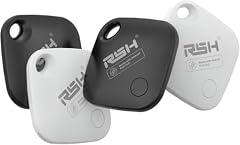
This is a four-pack of compact Bluetooth item tags intended for bags, luggage, keys, and similar belongings. The catalog listing markets them to Android users through Google Find Hub and states a replaceable battery. Independent of that listing, RSH's own product page identifies the model as an Apple Find My tag, measuring 36 by 36 by 7.8 mm, weighing 11 g, and using a replaceable CR2032 coin cell. That mismatch is the defining issue. RSH separately lists its Google Find Hub product as RSH-Gtag03, while its RSH-iTag03 documentation says it is for iOS 14.5 or later and Apple Find My. The available manual documents a tool-opened battery cover, a nearby audible finder, reset steps, and Apple-network location functions. No exact-model independent laboratory report, FCC authorization record, Bluetooth qualification record, or verified water-resistance test was located.
What works
- The documented replaceable CR2032 battery can reduce premature whole-device disposal, if the supplied product is the model described by RSH.
- The available exact-model manual says a tool is used to open the shell, and it includes a coin-cell ingestion warning.
- RSH documents a built-in nearby-finding buzzer rated at more than 75 dB at 10 cm.
- The manual provides basic reset, power-off, and battery-replacement instructions for the documented Apple-oriented model.
What does not
- The Android and Google Find Hub claim conflicts with RSH's own identification of this model as Apple Find My only. RSH labels a different model, RSH-Gtag03, as its Google Find Hub tag.
- No official exact-model Google Find Hub approval or activation evidence was located for the product named in the catalog record.
- No public exact-model FCC ID, Bluetooth SIG qualification record, accredited performance report, or independent water-ingress report was located.
- The supplied documentation gives no verified IP rating, drop test, attachment-retention test, recycling instructions, or replacement-parts program.
- The available materials make warranty coverage inconsistent, with the catalog stating one year and RSH's product page stating two years.
Who is it for
This product only suits a buyer who can inspect the delivered packaging and setup screen before relying on it, and who specifically confirms that the received tag is a Google Find Hub model rather than the Apple-oriented RSH-iTag03 documented by RSH. It may fit routine item-finding use where a replaceable CR2032 battery and a nearby audible alarm are useful. It is not appropriate to assume that the catalog title alone proves Android network activation or long-range finding capability.
Who is it not for
It is not suitable for buyers who need a clearly documented Android and Google Find Hub tracker for travel, checked luggage, or time-sensitive recovery of valuable items. The model identity and platform claims conflict. Households with young children or pets should also avoid treating the replaceable coin cell as low risk. Although the manual describes tool-assisted opening and warnings, no public compliance certificate or General Certificate of Conformity was located to verify conformance with current U.S. coin-cell compartment requirements.
Integrity
The documented model uses a replaceable CR2032 lithium coin cell rather than a sealed disposable power system. Its manual says the shell is opened with a supplied tool and warns that swallowed button batteries can cause severe injury or death. Those are useful design and warning elements, but they do not establish compliance with the U.S. requirements that apply to products using coin cells. No public ANSI/UL 4200A test report or General Certificate of Conformity was found. Replaceability can reduce electronics waste, and RSH states roughly one year of battery life in its manual. However, no product-specific battery recycling guidance, electronics end-of-life plan, IP test report, or independent durability evidence was located. No U.S. recall or CPSC warning specifically identifying this model was found in the searched sources. The central consumer-protection concern is traceability, because RSH's own materials distinguish the Apple-oriented RSH-iTag03 from its separate Google Find Hub model.

RSH Android Bluetooth Tracker Tags 4 Pack
Overview
This is a four-pack of small Bluetooth item tags for luggage, bags, and other belongings. The product documentation hosted with the marketplace identifies the Android version as RSH-GTag03, a 36 x 36 x 7.8 mm tracker with a replaceable CR2032 coin cell, BLE 5.4, and a stated direct line-of-sight range of at least 40 meters. The manual says it requires Android 9 or later, Bluetooth, location services, internet access, and a Google account. The manufacturer describes the Android model as Google Find Hub certified, and the manual documents nearby signal-strength finding, a sound function, network-assisted finding, reset, and battery replacement with a supplied tool. However, no public Google approval record, exact-model laboratory report, FCC authorization record, Bluetooth qualification record, or IP test report was located. Documentation also uses both iTag03 and GTag03 names, while the supplied Android manual identifies GTag03.
What works
- The supplied Android manual gives concrete setup requirements, reset steps, and battery-replacement instructions.
- The CR2032 cell is replaceable with a tool, which can extend the usable life of each tag.
- The manual distinguishes nearby Bluetooth finding from crowdsourced network finding, rather than presenting the stated 40 meter range as long-distance tracking.
- The manufacturer states that the tag can sound at at least 75 dB measured at 10 cm.
What does not
- The listing documentation conflicts on the product identity. The supplied Android manual identifies GTag03, while other product information calls it iTag03.
- Google Find Hub certification is manufacturer-stated. No independent public approval or activation evidence for the exact model was found.
- No independent test report was located for finding performance, buzzer output, battery life, attachment strength, water resistance, or drop resistance.
- The FCC Part 15 statement in the manual is not a substitute for a matchable public FCC authorization record or an exact Bluetooth qualification record.
- No exact-model IP rating or accredited ingress test report was found.
Who is it for
This product suits an Android 9 or later user who wants several compact tags for ordinary baggage, backpacks, or keys and is comfortable following a manual for pairing, reset, and coin-cell replacement. It is most appropriate where the stated 40 meter Bluetooth range is understood as an open-area nearby-finding figure, while remote updates depend on compatible devices participating in the Find Hub network. The replaceable battery can be useful for owners prepared to source and recycle CR2032 cells.
Who is it not for
It does not suit iPhone-only households, because the supplied manual for this Android version states Android-only operation. It is also not appropriate for families needing independently documented coin-cell compartment testing, water resistance, radio authorization, or durability testing. Keep it away from young children and pets because it contains a CR2032 coin cell. Do not use it to track people, pets, vehicles, or property without informed consent, and do not depend on it for emergency location or live GPS tracking.
Integrity
The manual identifies a replaceable CR2032 lithium coin cell and says to use a tool to open the shell. It also includes an ingestion warning and advises urgent action if a child swallows or inserts a button battery. This is relevant because U.S. button-cell rules require secure compartments, product and package warnings where applicable, and supporting certification. No General Certificate of Conformity, ANSI/UL 4200A test report, or accredited safety certificate for this exact product was located. A replaceable battery can reduce whole-device disposal, but it still creates recurring single-use coin-cell waste. No product-specific recycling guidance, service-life test, spare-parts program, IP rating, or independent durability report was found. The manual makes FCC Part 15 compliance claims, but no exact FCC identifier or public Bluetooth qualification record was matched. The manufacturer provides reset and ownership-removal steps, which are useful privacy controls, but the claimed Find Hub status remains manufacturer-stated rather than independently confirmed.

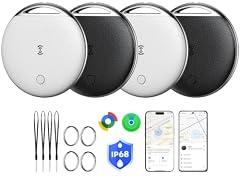
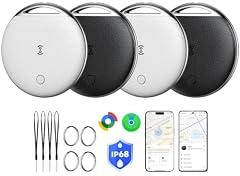
RARVSHD Air Tag for Android, 4-Pack Compatible with Apple Find My
Overview
This is a four-pack of small Bluetooth item trackers intended for keys, wallets, backpacks, and luggage. The product record describes round tags measuring about 1.3 inches across, with a replaceable CR2032 coin cell, a claimed 100 dB sounder, and an IP68 water-resistance claim. It is meant to be paired with either Apple Find My or Google Find Hub, not both at the same time. The central limitation is evidence quality. Reseller descriptions repeat the dual-platform, alarm, and crowd-network claims, but no exact-product approval was located in Google’s public compatible-device list, nor was an Apple licensed-accessory record, Bluetooth qualification, FCC authorization, laboratory report, or product manual found. Public descriptions also conflict on weight, dimensions, and warranty length.
What works
- Four tags can cover several bags, keys, or other everyday items in one set, manufacturer-stated.
- The replaceable CR2032 battery can avoid discarding a tracker solely because its battery is depleted, manufacturer-stated.
- A built-in 100 dB alarm is claimed for nearby finding, though no independent sound test was located.
- The product is described as usable with either Apple Find My or Google Find Hub, which may suit a household that changes phone platforms, but exact-product approval remains unverified.
What does not
- No exact-product Google Find Hub approval, Apple licensed-accessory record, FCC record, Bluetooth qualification, or independent laboratory report was located.
- The claimed IP68 rating, 100 dB alarm, Bluetooth range, and battery performance lack an exact-model test report.
- Public product descriptions conflict on physical measurements, weight, and warranty duration, reducing setup and claim traceability.
- No accessible manual, privacy policy, firmware-update policy, recycling guidance, or documented reset and ownership-transfer procedure was located.
Who is it for
This product fits an adult who wants several small, low-cost Bluetooth tags for ordinary belongings and is willing to verify setup immediately after delivery. It is most relevant for a mixed-phone household only if each tag successfully activates in the intended network, with one network selected at a time. The replaceable coin cell may also suit someone prepared to maintain and recycle batteries. Its stated compact shape may work with common round-tag holders, although the listed dimensions vary across public descriptions.
Who is it not for
It is not suited to households with young children or pets unless the buyer first confirms that the battery door requires a tool or two deliberate actions, and that the product and package carry required ingestion warnings. It is also a poor fit for travelers or safety-sensitive users who need documented network certification, dependable airport recovery, verified water resistance, or clear owner-transfer instructions. Do not rely on it for covert-person tracking, emergency location, or real-time GPS tracking.
Integrity
The product uses a replaceable CR2032 lithium coin cell, which can reduce whole-device waste compared with a sealed disposable tag. However, a coin cell creates a serious ingestion risk for children and pets. U.S. requirements call for a secure compartment, warnings on the product or packaging where practicable, and warning instructions. No exact-product test report, certificate, package imagery, or instructions were located to confirm those protections. The listing calls the enclosure ABS and claims IP68 resistance, but an exact-product IEC 60529 report was not located. No brand recycling instructions, electronics take-back program, spare-part support, privacy policy, or security-update policy was found. No product-specific U.S. recall or regulatory warning was located in the searches performed. Replace depleted CR2032 cells through an appropriate battery-recycling route rather than household trash.
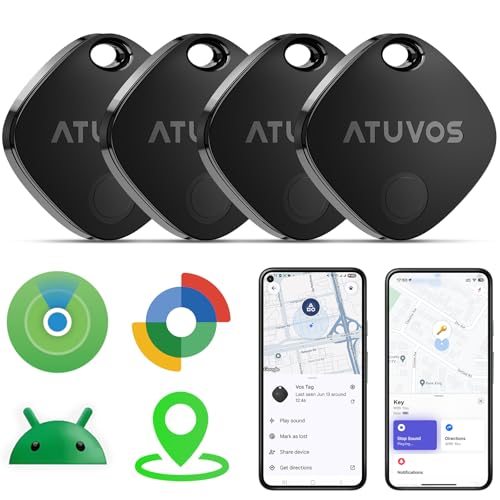
ATUVOS Air Tracker Tags 4-Pack
Overview
This is a four-pack of small plastic Bluetooth item tags for keys, bags, luggage, and similar belongings. Each tag uses a replaceable CR2032 coin cell, has a button and buzzer, and is meant to be attached to an item rather than used as a GPS tracker. Nearby finding relies on Bluetooth and a sound from the tag. Longer-distance updates depend on participating Apple or Android devices detecting it. Apple officially lists ATUVOS Tag as a Find My product, and Google officially lists Vos Tag as a compatible Find Hub accessory. The supplied manual identifies this product as a Vos Tag model AT2501. The manufacturer states a 60 m, or 200 ft, unobstructed Bluetooth range, an 80 to 100 dB sound, IP67 water resistance, and about one year per battery. No independent laboratory report was located for those performance, sound, battery-life, or ingress claims.
What works
- Apple officially lists ATUVOS Tag among products that work with the Find My network.
- Google officially lists Vos Tag as a compatible Find Hub accessory, matching the product manual's Vos Tag naming.
- The manual includes reset, battery-replacement, pairing, and coin-cell disposal instructions.
- The replaceable CR2032 design can avoid discarding the whole tag when its battery is depleted, if the tag remains functional.
What does not
- No ISO/IEC 17025 report was located for this exact product's Bluetooth range, alarm loudness, one-year battery claim, or IP67 rating.
- The battery compartment has coin-cell hazard warnings, but no public ANSI/UL 4200A certificate, General Certificate of Conformity, or test report was located.
- The catalog specifications conflict with the supplied manual by describing a C battery, while the manual specifies a CR2032 coin cell. That weakens claim traceability.
- It can be connected to only one platform at a time. Switching between Apple and Android requires removing and resetting the tag.
Who is it for
This product suits someone who already uses either Apple Find My or Google Find Hub and wants several low-complexity tags for everyday possessions such as keys, bags, or checked luggage. It is most appropriate where a replaceable coin cell is preferable to charging another device, and where the user understands that far-away finding depends on nearby participating phones rather than a built-in cellular or GPS connection. It also suits households that may later move between iPhone and Android, provided each tag is reset before changing platforms.
Who is it not for
It is not appropriate for tracking children, pets, people, or stolen property. Google specifically cautions that tracker tags should not be used for pets or stolen items, and crowdsourced location reports can be delayed or unavailable. Households with young children, people who may ingest objects, or pets that chew items should be particularly careful because each tag contains an accessible-serviceable CR2032 coin cell. It is also unsuitable for users needing independently verified waterproofing, range, alarm loudness, or battery-life results.
Integrity
The supplied manual gives meaningful coin-cell safety directions. It says to keep batteries away from children, promptly recycle or dispose of spent cells, and not put them in household trash or fire. Those warnings are useful, but they are not the same as public proof that the compartment passed ANSI/UL 4200A or the applicable U.S. button-cell safety requirements. No public certificate or exact-model safety test report was located. A replaceable CR2032 is the main environmental positive because a depleted battery does not automatically end the product's life. The manufacturer states about one year of battery life, but this was not independently verified. The enclosure is plastic and the product is still electronic waste at end of life. The available instructions address battery disposal, but did not provide a clear product take-back or electronics-recycling program. Searches did not identify a product-specific CPSC recall or safety warning.

VOCOlinc Smart Card Wallet Tracker
Overview
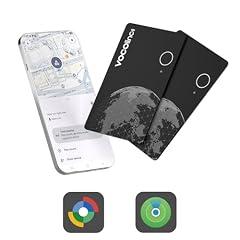
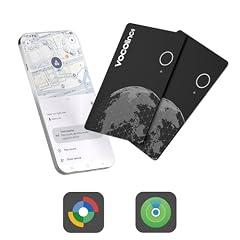
This is a two-card, rechargeable Bluetooth tracker set intended for a wallet, luggage, passport holder, or bag. Each card is marketed as 1.6 mm thick, with wireless charging and a stated runtime of up to six months per charge. Nearby finding relies on Bluetooth and its speaker. When out of direct range, the manufacturer says it can use either Apple Find My or Google Find Hub to report a detected location. The important limitation is that each card can be paired with only one platform at a time. Moving from iPhone to Android requires unpairing, resetting, and pairing again. The manufacturer also says there is no UWB precision finding, so close-range recovery relies on Bluetooth proximity and the audible ring. Public radio test documentation identifies VT2503 as part of the FCC-tested AT2503 hardware series, but no independent performance, water-ingress, battery-cycle, or product-safety report for this branded product was located.
What works
- Rechargeable power avoids routine replacement of disposable coin cells, according to the manufacturer.
- The card format and stated 1.6 mm thickness are practical for a wallet or flat document holder, according to the manufacturer.
- Public FCC-related radio documentation identifies the VT2503 model series under the same hardware family.
- Google's Find Hub system provides unknown-tracker alerts, sound-finding, and disabling guidance for compatible tags.
What does not
- Apple Find My and Google Find Hub cannot be active on the same card at the same time.
- No UWB precision finding is stated, so close-range searches depend on sound and ordinary Bluetooth proximity.
- The IP68 and six-month battery claims are manufacturer statements, not supported by a located independent ingress or battery-life test report.
- No public UL 4200A report, battery-protection report, or product-specific recycling instruction was located for this product.
Who is it for
This product suits someone who wants a thin locator for a wallet, passport holder, purse, or luggage tag slot and already uses either an iPhone or an Android phone as their primary platform. It is particularly relevant for buyers who prefer wireless recharging over periodically opening a tracker to replace a coin cell. It also fits users who understand that remote location reports depend on nearby participating devices, and who are comfortable using the native Apple or Google finding app rather than a dedicated tracker app.
Who is it not for
It is not suited to households that need one card to remain actively visible to both Apple and Android users, because the card is stated to support only one platform pairing at a time. It is also a poor fit for someone who needs arrow-style UWB precision finding, as that capability is specifically absent. Families with young children or pets should not treat the sealed rechargeable design as independently child-safe, because no product-specific battery-safety certification or protective-circuit documentation was located.
Integrity
The card uses an internal rechargeable lithium-ion battery rather than a removable coin cell. That can reduce the stream of discarded primary batteries, but it also means the card eventually becomes battery-containing electronic waste. The manufacturer provides a recharge claim, but no product-specific battery cycle-life, replacement, disassembly, or recycling instruction was located. Damaged lithium-ion products require separate handling, and should not be placed in ordinary trash or standard battery collection boxes. For misuse prevention, compatible Find Hub tags can trigger Android unknown-tracker alerts. Google says recipients can view a travel map, play a sound, identify the tracker, and follow disabling instructions. Apple also supports unwanted-tracking alerts for compatible finding accessories. The public radio paperwork matches the VT2503 hardware series to an FCC authorization family. No relevant U.S. recall or regulator warning was identified in the searches reviewed, but independent product-level safety, ingress, and durability evidence remains limited.

UGREEN FineTrack Air Tracker Tags
Overview
This is a four-pack of small Bluetooth item tags for keys, bags, luggage, and similar possessions. Each tag uses a replaceable CR2032 coin cell and is set up in Apple’s preinstalled Find My app. The product is for iPhone and iPad users, not Android users. UGREEN’s instructions list iOS and iPadOS 14.5 or later, with macOS limited to viewing location information. The important distinction is that remote updates depend on nearby devices in Apple’s Find My network, rather than on the tag having GPS or cellular service. Nearby users can make the tag sound through Find My. UGREEN states up to two years of battery life and UL 4200A compliance. An FCC-accredited laboratory’s 2024 RF exposure report identifies this product variant in the tested model family and found Bluetooth output within the applicable exposure limit. No public certificate or full independent test report was found for the claimed battery-life or finding-range performance.
What works
- Works in Apple’s Find My app without a separate UGREEN tracking app.
- The manual documents removal from the owner account and a button-based factory reset for transfer to another user.
- A replaceable CR2032 can extend service life without discarding the tag when its battery is depleted.
- Apple’s Find My accessory system provides unknown-tracker notifications, owner-account controls, and instructions for disabling a detected tag.
- An FCC-accredited laboratory report links this variant to the tested Bluetooth model family and reports compliance with the RF exposure limit.
What does not
- It does not work with Android phones or Google Find Hub, despite being placed under an Android search term.
- The UL 4200A statement is manufacturer-stated. A public General Certificate of Conformity or UL directory record for this product was not located.
- UGREEN states up to two years of battery life, but no independent battery-life test for this product was located.
- No independent field test was located for real-world network finding speed, Bluetooth range, buzzer loudness, or attachment durability.
- No IP water-resistance rating or independent ingress-test report was found for this version.
Who is it for
This product fits an iPhone or iPad household that wants several basic tags for separate keys, backpacks, checked luggage, or everyday bags. It is particularly suited to users who prefer Apple’s built-in Find My app over creating another tracker account, and who can follow the documented account-removal and reset process before lending or transferring a tag. The replaceable CR2032 design also suits buyers willing to handle battery replacement and take depleted coin cells to an appropriate battery collection point.
Who is it not for
It is not suitable for Android users, including anyone searching specifically for a Google Find Hub tracker. It is also a poor fit for households with young children or pets if the tag or a removed CR2032 could be accessible, because coin-cell ingestion can cause severe injury. Users needing documented waterproofing for swimming, heavy rain exposure, or outdoor equipment should not assume water protection here. It also does not meet buyers who require independently published range, battery-life, alarm-volume, or durability testing before use.
Integrity
The replaceable CR2032 is a meaningful waste-reduction feature because a depleted cell need not end the tag’s useful life. UGREEN states a two-year battery life, but that duration is not independently verified. Coin cells require careful handling and should be kept away from children and pets. UGREEN’s manual says the battery compartment is designed to meet UL 4200A safety requirements, while the public record reviewed did not include the product’s General Certificate of Conformity or an independently searchable UL listing. For personal safety, Find My network accessories can trigger unwanted-tracker notifications on supported Apple devices, and newer Apple software supports alerts for compatible trackers across platforms. The manual also gives account-removal and factory-reset steps, which matter before resale or transfer. The product uses Apple Find My rather than a dedicated UGREEN locator app, limiting the need to create a separate tracking-service account. UGREEN’s broad website privacy policy is not a product-specific location-data policy.

Upgrade Dual System Air Tracker 2026, Black
Overview
This is a four-pack of compact Bluetooth item tags for keys, wallets, bags, and suitcases. The product is marketed for use with either Apple Find My on iOS or Google Find Hub on Android. The available retail documentation makes an important limitation clear, each tag can pair with one platform at a time, not both simultaneously. The underlying F2TAG radio model matches a U.S. FCC equipment authorization for a 2.4 GHz anti-lost device, which confirms its radio authorization, not its finding accuracy, water resistance, or platform approval. The seller states an open-area Bluetooth range of up to 36 meters and an 80-100 dB sounder. Those are manufacturer-stated claims, with no independent field test found for this product. Battery details are materially inconsistent across available listings, which identify it as both AAA-powered and as a 230 mAh lithium-ion product.
What works
- The F2TAG model has a matching U.S. FCC authorization for 2.4 GHz digital transmission operation.
- One tag can be assigned to either Apple Find My or Google Find Hub, which can suit a mixed-phone household over time.
- The stated 80-100 dB sounder can help locate an item once it is within Bluetooth range.
- Replaceable power is claimed, which can avoid discarding a whole tag solely because its battery is depleted.
What does not
- No official Google or Apple approval record for this exact product was located, so its claimed network compatibility is not independently confirmed.
- No independent test report was found for the stated range, alarm loudness, water resistance, battery life, or network finding performance.
- Battery information conflicts between sources, including AAA and 230 mAh lithium-ion descriptions. That makes replacement, safe handling, and end-of-life planning unclear.
- No accessible battery safety certificate, General Certificate of Conformity, or documented ANSI/UL 4200A assessment was found for the product.
- No IP rating or independent ingress test was located, so it should not be treated as water resistant.
Who is it for
This product fits an adult who wants four basic Bluetooth item locators for everyday belongings, understands that each tag must be assigned to either an iPhone or an Android phone, and is comfortable checking compatibility during setup. It is most suited to keys, backpacks, wallets, and carry-on bags that stay in ordinary indoor or dry travel use. The matching FCC authorization provides useful confirmation that the radio model is authorized for U.S. operation. The stated audible alarm may also help with close-range searches at home.
Who is it not for
It is not appropriate for tracking people, children, pets, or stolen property. Google specifically says tracker tags should not be used for pets or stolen items, and its network rules prohibit tracking people without consent. Households with young children or pets should be cautious because the accessible documentation does not establish the battery compartment's compliance with U.S. button-cell safety requirements, while the actual battery type is unclear. It also does not suit wet-weather, outdoor, or water-exposed use because no verified ingress rating was located.
Integrity
The product's F2TAG radio identity can be traced to an FCC authorization held by Shenzhen Winnershine Electronics for a 2.4 GHz anti-lost device. This is a meaningful U.S. radio compliance record, but it does not verify Apple or Google network approval, durability, privacy implementation, or battery safety. Battery safety is the central unresolved issue. U.S. rules for consumer products using button or coin cells require secure compartments, warnings, and certification documentation, yet no matching safety report or certificate was located. Available seller specifications conflict on whether the tag uses AAA power or a 230 mAh lithium-ion battery. Replaceable power is preferable to sealed disposable electronics if genuine, but the uncertainty prevents reliable advice on replacement batteries and recycling. No relevant CPSC recall or safety warning was located in the checks performed.