
10 Best Expresso Maker
 Lauren Wilson
Please note that we participate in affiliate marketing programs. When you purchase through links on our site, we may earn a commission. As an Amazon Associate we earn from qualifying purchases. This comes at no additional cost to you and helps support the resources required to provide valuable content.Advertising Disclosure
Top-rated Expresso Maker Comparison
1

2
4
5
6
7
8
+
9
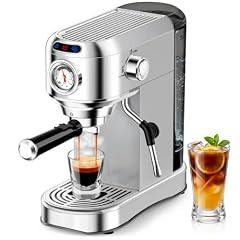
10
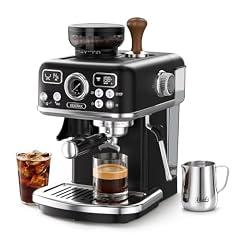
Overview
An espresso maker heats water, pushes it through finely ground coffee, and depending on the design dispenses hot water or steam for drinks such as Americanos, cappuccinos, and lattes. The main formats in this category are manual or semi-automatic machines using a portafilter, machines with an integrated grinder, and models with automatic milk systems. The right choice depends less on a pump number or a stainless-steel exterior than on how consistently the machine controls water, pressure, dose, heat, and cleaning.
For espresso quality, look for model-specific repeated measurements of brew temperature, delivered pressure, flow, and shot results. A pump rated at 15 or 20 bar describes a maximum pump capability; it does not prove that the coffee bed receives that pressure or that shots are extracted consistently. Similarly, a stated temperature or PID feature is not the same as measured temperature stability. Useful independent evidence identifies the exact model, test conditions, instruments, calibration, coffee dose, and repeated-run results. SCA test methods and espresso preparation parameters provide a more meaningful reference than a headline pressure figure.
Electrical safety deserves separate attention because these machines combine water, heating elements, pumps, and steam. A credible safety claim should identify the exact model and a current U.S. Nationally Recognized Testing Laboratory listing, such as an ETL listing from Intertek, a UL listing, or a CSA listing. Buyers can check the relevant certifier directories and the OSHA NRTL program. An unverified logo, a generic declaration, or a marketplace statement is not equivalent to a traceable listing. Safety instructions still matter: look for documented limits on steaming, overheating, pressure release, hot surfaces, and removing the portafilter.
Materials are another area where broad claims can mislead. “Stainless steel” may describe only the exterior, while the tank, tubing, seals, boiler, portafilter, and milk path may use other materials. A vague BPA-free statement does not establish that every part contacting hot water, coffee, or milk is suitable for U.S. food contact. Stronger evidence identifies the wetted materials and connects them to FDA food-contact requirements, NSF/ANSI 51, or another traceable certification.
Cleaning should be treated as part of performance, not an accessory feature. Milk wands need prompt wiping and purging, and useful designs make nozzles, trays, tanks, baskets, and other residue-prone parts removable and cleanable. Automatic cleaning claims should be supported by clear instructions describing what the cycle flushes; they do not remove the need for routine manual cleaning. For ownership and environmental impact, look for replacement parts, manuals, warranty terms, repair documentation, automatic shutoff, measured energy use, packaging information, and recycling guidance. A repairable part or documented service path can matter more than a short-lived appliance with more features.
Across the supplied reviews, recurring cautions are clear: no product should be treated as automatically safe merely because it claims 15 or 20 bar, stainless steel, PID control, or an ETL-style mark. Many lacked independently verified electrical certification, complete hot-path material disclosure, and measured extraction or energy data. Manual steam and pressurized portafilter workflows create real burn risks, especially around children or users with limited hand control; one review also reported erratic steam timing. Buyers should follow pressure-release, cooling, wand-cleaning, and hot-surface instructions and should not expect unattended operation or automatic milk preparation unless those functions are specifically documented.
Integrity
These topics assess the evidence behind safety, hygiene, durability, energy use, and environmental claims. Scores distinguish documented, model-specific support from broad manufacturer or marketplace assertions; a high score does not mean that every risk or evidence gap has been eliminated.
HHealth & Safety
Verified electrical and fire safety
This measures whether the exact machine has a current U.S. UL, ETL, CSA, or equivalent NRTL listing covering electrical, heating, and abnormal-use risks. It matters because espresso makers combine water, high heat, pumps, and steam. Among these products, the strongest score was 89 for a model with a traceable ETL report; many machines scored 68–70 because no exact current listing was located.
Pressure, steam and burn protection
This measures controls against hot-water release, steam burns, overheating, and portafilter or brew-head ejection. It matters whenever a user removes a pressurized filter or handles a live steam wand. Higher-scoring products had specific warnings, cooldown or pressure-release steps, overheating controls, and operating limits; lower scores reflected reported erratic steam, messy pressure release, or less complete documentation.
Safe materials in the hot-water path
This measures whether materials contacting hot water, coffee, or milk are identified and supported for U.S. food contact. It matters because an exterior stainless-steel claim does not identify tanks, tubing, seals, plastics, or coatings inside the fluid path. Scores ranged from 50 to 72: higher scores had more material detail, but no supplied product established complete food-contact compliance for every wetted component.
Milk-wand hygiene and cleanability
This measures whether milk and coffee residue can be promptly purged, removed, and cleaned without inaccessible traps. It matters because dried milk can obstruct a steam tip and leave residue in the wand or frother. Higher-scoring products documented removable nozzles, flushing, disassembly, or automatic milk-path cleaning; lower scores generally offered only basic wiping and purging instructions.
EEvidence
Measured espresso control and consistency
This measures independently demonstrated temperature, pressure, flow, and repeated-shot stability—not the pump’s maximum-bar label. It matters because grind, dose, heat, and delivered pressure determine the drink. The supplied scores ranged from 53 to 85. The strongest evidence included independent extraction-yield or repeatability testing; lower scores reflected only manufacturer settings or no exact-model measurements.
Honest specifications and performance claims
This measures whether capacity, voltage, wattage, pressure, temperature, grinder, cleaning, and certification claims are specific and internally consistent. It matters because several products had conflicting tank sizes, pump ratings, grinder settings, voltages, or coffee-input descriptions. Higher scores went to clearer records; lower scores reflected contradictions or claims that confused maximum pump pressure with delivered extraction performance.
Independent proof, not seller claims
This measures the quality and traceability of evidence from accredited testers, certifiers, and regulators. It matters because a self-issued badge or generic marketplace claim cannot establish the scope of a safety or sanitation test. The supplied scores ranged from 68 to 87. Higher scores had exact-model Intertek documentation or independent testing; lower scores relied mainly on manuals, listings, or unsupported claims.
EEcology
Built to last and repair
This measures warranty quality, manuals, replacement parts, and the practical chance of repairing common failures. It matters because replacing a tank, nozzle, filter, or other wear part can extend an appliance’s life. Scores ranged from 68 to 78. Higher-scoring products had documented parts diagrams, replacement tanks or nozzles, or established service support; low scores lacked parts catalogs or clear repair routes.
Energy use and idle shutoff
This measures electricity used for warming, brewing, and idle time, together with an effective automatic-off or sleep mode. It matters because heated machines can remain warm after a drink is finished. Higher scores reflected documented shutoff or sleep settings, including five-, 10-, 15-, 20-, 25-, or 30-minute intervals; no supplied product had independent energy-per-drink measurements.
Waste, packaging and end-of-life design
This measures disposable packaging, recycled content, repair or reuse potential, and instructions for responsible recycling. It matters because espresso makers are mixed-material electrical appliances that are difficult to dispose of with ordinary waste. Scores clustered between 68 and 74. Higher scores reflected limited end-of-life or repair information, but none had a fully substantiated recycled-content, packaging, or take-back program.
Full reviews

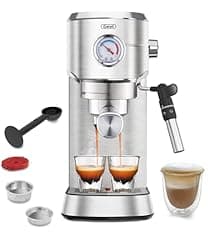
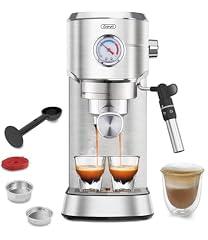
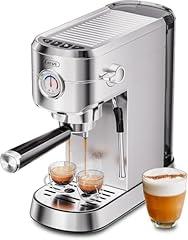
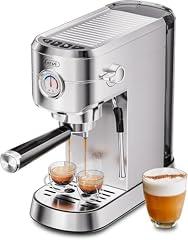
Gevi 20 Bar Espresso Machine with Automatic Milk Frother
Overview
This is a compact, semi-automatic espresso machine for ground coffee, with a 51 mm portafilter, removable water tank, removable drip tray, steam wand, and 1350 W, 120 V electrical rating. Gevi’s product page for the ECMA0 family states a 34 oz tank, 8.8 lb weight, and a narrow 5.5-inch width. It is operated by filling and tamping a basket, locking in the portafilter, brewing, then manually steaming milk or dispensing hot water. The evidence is uneven. Gevi states that the machine has a 20-bar pump and pre-infusion, but no model-specific independent test report was found for delivered brew pressure, temperature stability, flow, or repeatability. A model-specific manual gives cleaning directions and a 12-month warranty statement, but no traceable U.S. NRTL listing, food-contact material specification, or accredited product test record was found.
What works
- The manufacturer lists a very narrow 5.5-inch width, useful where counter space is limited.
- The model-specific manual calls for routine cleaning of the removable tank and drip tray, plus wiping the steam wand after each use.
- Gevi lists a replacement water tank for ECMA0, which provides at least one documented path for replacing a commonly damaged part.
- Gevi states a 12-month warranty for eligible appliances, and the model-specific manual also states lifetime technical support.
What does not
- No current model-specific UL, ETL, CSA, or equivalent U.S. NRTL listing was located in the searched certification records.
- The hot-water and milk-contact materials are not identified beyond a stainless-steel exterior or housing claim, so food-contact compliance cannot be assessed for internal plastics, seals, tubing, or coatings.
- No independent model-specific measurements were found for extraction pressure, water temperature, shot consistency, energy use, or idle power.
- The product record calls the milk system automatic, while Gevi’s ECMA0 page describes manual frothing and the manual describes operating a steam wand. Capacity also differs between the 34 oz official-page figure and the 1.2 L catalog claim.
Who is it for
This product suits a single user or small household that wants hands-on espresso drinks from pre-ground coffee, has a particularly narrow counter space, and is prepared to tamp, lock in a portafilter, and steam milk manually. Its removable tank and drip tray make basic routine cleanup practical, and the listed replacement tank plus stated one-year warranty offer limited support for ordinary ownership. It is most appropriate where convenience means a compact button-operated machine, not one-touch bean grinding or automatic milk preparation.
Who is it not for
It is not suited to households needing independently verified electrical certification, fully documented food-contact materials, or model-specific evidence of temperature and pressure control. People with reduced heat tolerance, limited hand control, or children regularly present should be cautious with the manual steam wand and hot portafilter workflow. It also does not fit buyers expecting a true automatic milk system, an integrated grinder, measured low-energy operation, or a documented repair manual and broad replacement-parts catalog.
Integrity
The available model-specific manual gives useful cleaning basics. It says to empty and rinse the removable drip tray regularly, clean the water tank periodically with mild soap and water, wipe the steam wand after every use, and use the supplied cleaning pin for blockages. Those are meaningful hygiene provisions, although the record does not document a purge procedure, full milk-system disassembly, or sanitation certification. The exterior is described as stainless steel, but the manufacturer does not identify all materials exposed to hot water, coffee, steam, or milk. No model-specific U.S. NRTL electrical listing, NSF certification, independent energy measurement, recycling instructions, recycled-content claim, recall, or regulator warning was located in the reviewed sources. Gevi does list a replacement tank and states a one-year warranty, which may avoid disposal after that particular part fails, but broader repairability and end-of-life support remain unproven.

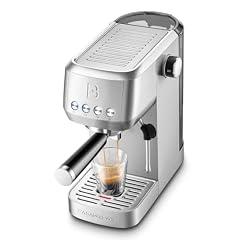
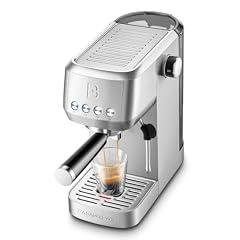
20 Bar Espresso Machine Silver
Overview
This is a compact, countertop semi-automatic espresso machine for ground coffee. It uses a 51 mm portafilter with supplied single and double dual-wall baskets, a manual steam wand, hot-water dispensing, programmable single and double volumes, and a removable 34 oz water tank. Its stated 120 V, 1,350 W format is intended for household use, rather than high-volume café service. The strongest independently traceable feature is electrical safety documentation. An Intertek construction report specifically identifies the CM5418BC-UL configuration and requires ETL Listed production to applicable U.S. and Canadian appliance standards. Independent hands-on testing also measured a 20.7% extraction yield from a 16 g dose, within a commonly used espresso extraction range. The manufacturer documents a 29-minute automatic power-down, an overheating lockout after steaming, and a removable steam tube for cleaning.
What works
- The exact CM5418BC-UL configuration is documented in an Intertek ETL listing report, and Intertek is OSHA-recognized as a U.S. NRTL.
- Independent testing measured a 20.7% extraction yield with a stated 16 g test dose, rather than relying only on the pump's 20-bar maximum claim.
- The manual provides specific burn controls, including pressure release before removing the portafilter or tank cover, hot-surface warnings, brewing limits, and an overheating lockout.
- Milk-wand care is unusually actionable for this format, with immediate purging, wiping, an unscrewable steam tube, a cleaning needle, and flushing instructions.
- The maker sells several compatible accessories, including a bottomless portafilter, tamper, cleaning brush, and puck screen, and states a one-year warranty.
What does not
- The hot-water path is not fully documented to a food-contact certification standard. The construction report identifies AS plastic, silicone, PP, stainless steel or aluminum steel components, but does not provide NSF certification or FDA compliance documentation for the complete path.
- Independent testing found low steam pressure, long milk texturing, vibration during brewing, and cooldown delays that make consecutive milk drinks less practical.
- The included portafilter is cast aluminum and the supplied tamper is plastic. Independent testing described the machine as somewhat unsteady during extraction.
- No model-specific, published laboratory data was found for brew-temperature stability, delivered puck pressure, flow consistency, energy per drink, or standby power.
- The manual says not to disassemble the brew head. That limits deep user cleaning and repair, despite the availability of some accessories.
Who is it for
This product suits one or two adult home users who want a compact machine for ground coffee, occasional espresso, Americanos, cappuccinos, or lattes. It is particularly suited to a small kitchen because the independently measured footprint is about 5.4 by 11.8 by 12 inches. It also fits a user willing to learn basic puck preparation, wipe and purge the steam wand immediately, and wait for cooling between steaming and brewing. The supplied dual-wall baskets make the setup more forgiving for pre-ground coffee.
Who is it not for
It is not suited to households that need several milk drinks in quick succession. Independent testing found low steam pressure and a cooldown delay after steaming, while the manual confirms that overheating protection can block immediate brewing until hot water is flushed through the wand. It is also unsuitable for unsupervised children or users unable to handle hot components, steam, and pressure-release steps. Buyers requiring verified food-contact certification for every wetted component, dishwasher-safe parts, deep brew-head disassembly, or published energy-use data need more documentation than this product provides.
Integrity
For electrical and burn safety, the product has stronger evidence than many marketplace appliances. An Intertek report identifies the CM5418BC-UL configuration, covers testing to UL 1082 and related Canadian standards, and requires ETL Listed production. The manual also gives meaningful use limits, including keeping the portafilter installed during steaming, releasing pressure before removal, cooling before cleaning, and avoiding contact with the hot wand and filter. The material record is incomplete from a food-contact perspective. It identifies an AS-plastic tank, silicone cold-water pipe, PP connector, and a stainless steel or aluminum steel steam tube, but it does not establish food-contact certification for the whole hot-water and coffee path. No product-specific recall or regulatory warning was found in the searched U.S. CPSC sources. The 29-minute automatic power-down reduces unnecessary heating, but no measured electricity-use results or recycled-content, packaging, or end-of-life recycling program was found. Repair support is limited to a one-year warranty and accessory availability.

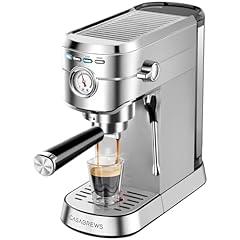
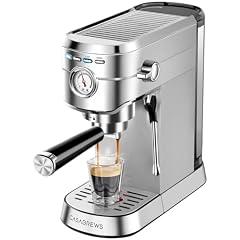
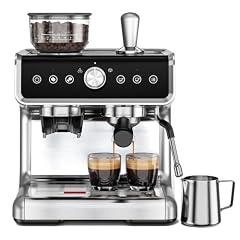
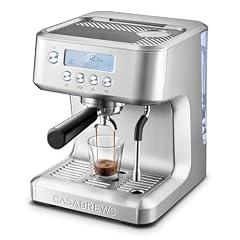
CASABREWS 20 Bar Espresso Machine with Frother
Overview
This product is a compact, ground-coffee, semi-automatic espresso machine for single or double shots, hot water, and manually steamed milk. It uses a 51 mm pressurized portafilter, buttons for single, double, and steam modes, plus a side steam control. The manufacturer manual states 120 V, 1350 W, a 43.9 oz removable tank, and 20 bar pump pressure. Independent hands-on reviewers confirmed the narrow footprint, measured at under six inches wide. The manual documents adjustable shot duration from 8 to 60 seconds, a removable steam nozzle, descaling prompts, automatic stops for prolonged steam and hot-water use, and overheating protection after steaming. Independent testing found the steam wand capable, but espresso output inconsistent, with notable post-shot dripping and one reported pressurized puck release during testing. No traceable U.S. NRTL listing, food-contact material declaration for the full hot-water path, or model-specific laboratory performance report was located.
What works
- Very narrow footprint, independently confirmed at less than six inches wide, which suits restricted counter space.
- The manufacturer provides specific milk-wand cleaning steps, including immediate purging, wiping, and removal of the nozzle for washing.
- Shot volume is user-programmable within an 8 to 60 second brew-time range, according to the manual.
- A one-year manufacturer warranty and separately sold replacement drip tray and filter set provide a limited continuing-use path.
What does not
- No current model-specific UL, ETL, CSA, NSF, or comparable U.S. certification record was located, so electrical and food-contact claims remain unverified.
- The manufacturer does not identify every hot-water-path polymer, metal, seal, or coating, or provide food-contact compliance documentation for those components.
- Independent hands-on testing found variable espresso quality, persistent post-shot dripping, and a pressurized puck release that can create a hot, messy cleanup risk if the portafilter is removed too soon.
- Manufacturer materials conflict on tank capacity and shutoff. The page variously states 43.9 oz and 49 oz, and claims automatic shutoff while the manual instructs users to unplug after each use.
Who is it for
This product suits a household user with a very narrow coffee space who wants to make basic espresso-style drinks, cappuccinos, or lattes from ground coffee. It is most appropriate for someone comfortable following hands-on routines, including warming the system, tamping, purging the milk wand immediately, waiting for the portafilter to cool, emptying the drip tray, and descaling. The pressurized baskets and programmable drink volumes make it oriented toward uncomplicated, beginner-led use rather than tightly controlled espresso experimentation.
Who is it not for
It is not well suited to users who need independently documented electrical certification, fully disclosed food-contact materials, or measured brew-temperature and pressure stability. Households with children or people likely to remove a hot portafilter immediately after brewing need to take particular care, because the manual warns that the system is pressurized and independent testing reported messy retained pressure after shots. It is also a poor fit for users who expect unattended operation, dishwasher-safe parts, easy internal brew-head disassembly, or a clearly documented repair-parts catalog.
Integrity
The manual includes meaningful operating safeguards. It warns that the portafilter, filter, steam outlet, and cup shelf can burn users, says not to remove the portafilter during brewing or steaming, and directs users to purge and wipe the milk wand immediately after use. The steam nozzle can be unscrewed and washed, which is a practical hygiene advantage. The brew head itself should not be disassembled, limiting access to an area where coffee residue can accumulate. No active product-specific recall or regulatory warning was located in the checked U.S. sources. However, no traceable NRTL electrical listing or certification of the full food-contact path was found. The manual provides a one-year warranty, descaling instructions, and general recycling guidance, while the manufacturer sells some replacement accessories. It does not provide a full repair-parts catalog, packaging-material disclosure, recycled-content evidence, or measured energy-use data. Its claimed automatic shutoff is not clearly documented in the manual.

Gevi 20 Bar Espresso Maker with Frother
Overview
This is a compact, semi-automatic espresso machine for ground coffee. Gevi states that it uses a 51 mm portafilter, a manual steam wand, a removable 34 oz water tank, and a 120 V, 1,350 W heating system. Its listed footprint is 12.3 inches deep, 5.5 inches wide, and 12 inches high, which is notably narrow for a machine with an integrated steam function. The manufacturer states that the product has pre-infusion, programmable single and double beverage volumes, a pressure gauge, and temperature control claimed to hold brewing water between 195 and 205 F. Those performance figures have not been supported by a model-specific independent laboratory test located for this assessment. Gevi does publicly offer replacement water tanks, steam nozzles, and compatible filter parts, alongside a one-year standard warranty.
What works
- Its 5.5-inch stated width can suit a constrained countertop.
- A removable tank, drip tray, portafilter, filter baskets, and removable froth nozzle support routine cleaning.
- The available instructions call for wiping and purging the steam wand immediately after milk use, which is an important hygiene practice.
- Gevi publicly sells replacement water tanks, steam nozzles, and compatible filter components for this product.
- The manufacturer provides a one-year standard warranty and lists optional extended coverage.
What does not
- A current U.S. UL, ETL, CSA, or equivalent NRTL listing for this exact product could not be verified in the certification registers searched.
- The hot-water path is not fully identified by material. Stainless steel is stated for the product overall, but the materials of the reservoir, internal tubing, seals, and steam-path components are not documented for food contact.
- No independent, model-specific testing was located for brew temperature, delivered pressure, flow, shot consistency, energy use, or long-term durability.
- The 20-bar pump statement is not a measurement of pressure at the coffee puck. Gevi separately describes 9-bar extraction on its product collection page.
- No detailed service manual, full parts diagram, recycling guidance, or packaging material disclosure was located.
Who is it for
This product suits a home user with limited counter width who wants to prepare espresso, Americanos, and occasional milk drinks from pre-ground coffee. It is most appropriate for someone comfortable learning dose, tamping, and steam-wand technique rather than expecting one-touch milk preparation. The removable tank and sold replacement nozzle make it more workable for a user willing to clean promptly after each milk drink and maintain the machine with regular descaling. It also fits buyers who value a compact format over a larger 58 mm home espresso platform.
Who is it not for
It is not a strong fit for households that require independently traceable electrical certification before bringing a heated appliance into the home, because a current exact-product NRTL listing was not verified. It is also unsuitable for users who need documented food-contact materials for every hot-water component, laboratory-verified temperature stability, or measured energy consumption. Buyers making multiple consecutive milk drinks should consider the cleaning burden of a manual wand and single-boiler workflow. It is not intended for users wanting a built-in grinder, automated milk cleaning, or clearly published repair documentation.
Integrity
The available use instructions provide meaningful burn and hygiene guidance. They call for secure portafilter installation, caution around hot surfaces and steam, immediate wiping and purging after frothing, daily drip-tray cleaning, cleaning of baskets after use, and periodic descaling. These are useful controls, but they are operating instructions rather than third-party sanitation certification. Gevi identifies the exterior product material as stainless steel and sells several replacement items, including the water tank and steam nozzle. That creates a limited repair path for common removable parts and can reduce premature disposal. However, the manufacturer does not identify all materials exposed to hot water, coffee, steam, or milk. No model-specific NSF food-equipment listing, verified U.S. NRTL electrical listing, energy test, recycling instruction, recycled-content claim, or packaging disclosure was located. No product-specific U.S. recall or regulator warning was identified in the records searched.

Euhomy Espresso Machine with Grinder
Overview
This is a countertop, semi-automatic espresso machine with an integrated burr grinder, a steam wand, hot-water dispensing, a 58 mm portafilter, and single and double filter baskets. It is intended for grinding beans, tamping a dose manually, pulling espresso, then steaming milk in the supplied metal pitcher. The product record states 120 V, 1,500 W, a 2.8 L water reservoir, and a 20-bar pump. A closely related retailer-listed version documents 30 grinder settings, PID temperature control, removable cleaning parts, an automatic pressure-release mechanism, and a one-year limited warranty. That retailer also describes ETL safety listing, but an exact current model record could not be located in Intertek's public directory. Most importantly, public product materials conflict on key specifications, including 15 versus 20 bar and different temperature-stability claims. There is no model-specific independent espresso performance test located.
What works
- The supplied documentation gives specific milk-wand hygiene steps, including wiping and purging after each use and using the included needle to clear the steam tip.
- A related retail listing documents an automatic pressure-release mechanism, which is a relevant safeguard for a pressurized brew system.
- A one-year limited warranty is documented. The warranty material also says defective products may be repaired or replaced and that replacement parts can be purchased.
- The integrated grinder's 30 settings and the PID temperature-control claim are concrete manufacturer-stated controls for hands-on espresso preparation.
What does not
- The claimed ETL safety listing could not be confirmed against a public Intertek model record for this exact product configuration.
- The hot-water path is only broadly described as plastic and stainless steel. No traceable food-contact material specification, FDA compliance declaration, or NSF materials certification was located.
- There is no model-specific independent test of brew temperature, flow, delivered pressure, shot repeatability, power use, or standby energy.
- Published product information conflicts on pump pressure, temperature-control tolerance, dimensions, weight, and reservoir details. This is a documentation problem, not proof that the appliance is unsafe.
- A related retail listing says there is no automatic shutoff. The manual describes standby after a low-water reminder, which is not the same as a verified idle power shutoff.
Who is it for
It suits a home user who wants a single countertop appliance for whole-bean espresso and milk drinks, accepts manual dosing and tamping, and will actively maintain the steam wand. The documented 30-setting grinder, 58 mm portafilter format, hot-water function, cleaning brush, and wand-cleaning needle make the format practical for someone learning to adjust grind and workflow. It also suits a buyer who can keep purchase records and use warranty support if a defect appears during the first year.
Who is it not for
It is not suited to households that need fully verified electrical certification documentation for the exact configuration, or to buyers who require traceable material declarations for every hot-water and milk-contact component. It is also a poor fit for anyone who needs independently measured espresso consistency, energy-use data, or a verified automatic idle shutoff. People unable to purge and wipe a milk wand promptly after each drink should avoid a manual steam-wand machine because milk residue can accumulate in the tip and internal steam path.
Integrity
The safety documentation is stronger on use instructions than on independent proof. A related retail listing calls the machine ETL safety listed and describes automatic pressure release. The public Intertek search did not provide an exact listing record for the product configuration reviewed, so that certification claim remains unconfirmed rather than disproved. The available instructions appropriately warn users about hot surfaces and steam, and direct them to lock the portafilter before brewing. For food contact, the supplied pitcher is described as stainless steel and the funnel as aluminum, while the broader appliance is described only as plastic and stainless steel. No complete hot-water-path material specification or third-party food-material certification was found. The manual's wipe, purge, needle-cleaning, drip-tray cleaning, grinder cleaning, and descaling directions are useful hygiene measures. Ecology evidence is limited. The one-year warranty and stated availability of replacement parts offer some repair path, but there is no verified packaging, recycled-content, recycling, or measured energy-use information.

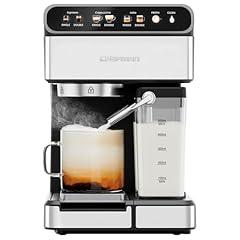
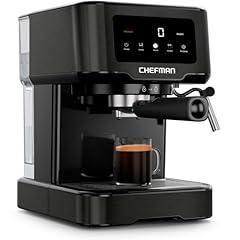
Chefman CaféMaster Pro Espresso Machine
Overview
This is a compact household espresso machine for pre-ground coffee, with a portafilter, separate single and double baskets, touch controls, and an automatic milk reservoir system. Chefman documents a 1.8-liter removable water tank, 500 mL milk reservoir, 1350 W input at 120 V, and an 11 by 8.3 by 12.6 inch footprint. Its guide specifies 8 g for a single espresso and 15 g for a double, yielding stated 1 and 2 fl oz drinks. Chefman states that this version is cETL approved, but a matching public Intertek listing record was not located during this review, so the electrical certification claim could not be independently confirmed. The manual has unusually detailed handling and cleaning directions, including a 60-second wait before loosening the pressurized portafilter and complete disassembly of the milk-frother assembly. No model-specific independent temperature, pressure, flow, or repeatability test report was located.
What works
- The official guide gives concrete doses and output volumes for its single and double espresso presets.
- The removable milk reservoir, tube flush cycle, and disassemblable frother parts provide a practical cleaning path, according to the manufacturer guide.
- The manual instructs users to wait at least 60 seconds before removing the pressurized portafilter after brewing.
- Sleep mode activates after five minutes without action, according to the manufacturer guide.
- Chefman provides a one-year limited warranty covering mechanical defects, with repair or replacement at its option.
What does not
- The product carries a California Proposition 65 cancer and reproductive-harm warning, but the manufacturer does not identify the chemical or component responsible on the product page.
- Chefman's BPA-free statement does not identify all materials in the hot-water and milk-contact path or provide food-contact compliance documentation.
- The cETL approval claim was not traceable to a matching public Intertek directory record during this review.
- No model-specific independent testing was located for brew temperature, delivered pressure, flow, energy per drink, or repeat-shot consistency.
- The milk system requires cleaning after each milk use and periodic deep disassembly with a Phillips screwdriver, which adds hygiene-critical maintenance.
Who is it for
It suits a household that wants preset espresso, cappuccino, latte, and froth functions from pre-ground coffee, and has room for an 11 by 8.3 inch countertop footprint. It is most appropriate for someone prepared to follow a hands-on routine, including locking the portafilter correctly, waiting before removing it, flushing the milk path, washing the removable milk container, and descaling when performance changes. The 1.8-liter water tank also fits several drinks between refills in ordinary home use.
Who is it not for
It is not suited to households that need independently documented electrical certification, quantified brew stability, or fully disclosed food-contact materials. California residents and anyone seeking a clear explanation of a Proposition 65 warning should note that Chefman posts the warning without naming the relevant chemical or component. It is also a poor fit for users unwilling to clean milk-contact parts promptly after each use, periodically disassemble the frother, or manage a hot, pressurized portafilter with the manual's required cooldown period.
Integrity
Chefman documents several meaningful operational safeguards. The guide tells users not to remove the portafilter or water reservoir while brewing or frothing, to wait 60 seconds after a brew before slowly releasing portafilter pressure, and to keep hands away from hot metal parts until they cool. Chefman also states that the product is cETL approved, although this review did not locate a matching public issuer-directory record for independent confirmation. Milk hygiene is a central maintenance issue. The removable reservoir, froth tube, suction straw, and frother assembly can be washed and taken apart, but the guide requires cleaning the tube after every milk drink and deep cleaning internal frother parts several times yearly or when foam declines. The machine enters sleep mode after five inactive minutes, though measured electricity use was not found. Chefman offers a one-year warranty, but no model-specific replacement-parts catalog, repair manual, recycled-content claim, packaging detail, or end-of-life recycling instructions were located. The posted Proposition 65 warning is important, because no chemical-specific explanation or complete hot-path material disclosure was found.
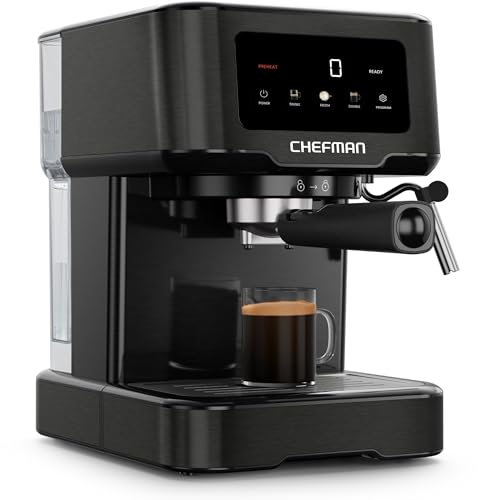
Chefman CraftBrew Digital Espresso Machine
Overview
This compact, countertop semi-automatic espresso machine uses pre-ground coffee in included single and double baskets, then produces espresso through a portafilter. A swiveling steam wand is intended for manually texturing milk. Chefman specifies a 1.5-liter removable water tank, 1350-watt, 120-volt operation, and a 10.8 by 8.9 by 11.9 inch footprint. Its most concrete documented conveniences are programmable single and double shot times, a removable drip assembly, a descale reminder after 500 uses, and a standby-to-sleep transition after 10 minutes. The manual specifies about 8 g for a single basket and 14 g for a double basket. Chefman states that the product is cETL approved, and a retailer also lists it as ETL Listed, but this assessment did not locate an exact-model listing in an issuing-body directory. No model-specific independent measurements of temperature, flow, pressure at the coffee bed, or shot repeatability were located.
What works
- The manual gives a specific after-use routine, including rinsing baskets, flushing the brew head, and wiping and purging the steam wand.
- A removable water tank and drip plate make routine rinsing more practical than fixed components.
- Single and double shot programs can be customized within a manufacturer-stated 10 to 90 second range.
- The manual documents a sleep mode after 10 minutes in standby, which can limit unattended idle operation.
- Chefman provides a model-specific user guide and a one-year limited warranty for household use.
What does not
- The cETL and ETL claims were not independently traceable to an exact-model entry in an issuing-body registry during this assessment.
- Chefman does not identify all materials and metal grades in the hot-water and milk-contact path, or provide food-contact certification for those parts.
- A California Proposition 65 cancer and reproductive-harm warning is displayed for the product, without identifying the chemical or exposure route on the product page.
- No independent exact-model testing was located for delivered brew pressure, temperature stability, flow, extraction quality, or energy consumption.
- The one-year warranty excludes normal wear and commercial use, and no replacement-parts catalog or repair manual for this product was located.
Who is it for
This product suits a household user who already buys ground espresso, wants to make one or two manually prepared shots at a time, and has limited counter space. The removable 1.5-liter tank and drip components are useful for someone willing to rinse parts after use and follow the steam-wand purge routine. It also fits users who want to adjust beverage volume by programming a shot time, while accepting that the resulting extraction has not been independently measured for consistency.
Who is it not for
It is not for a buyer who needs independently demonstrated espresso temperature, flow, pressure, or repeatability, including a user trying to closely control specialty-coffee recipes. It is also a poor fit for anyone unwilling to immediately wipe and purge a milk wand after steaming, since milk residue can remain if that routine is skipped. Households concerned about unspecified food-contact materials or the displayed Proposition 65 warning may want fuller material disclosure. Commercial users are excluded from the stated warranty.
Integrity
The product has practical hygiene instructions. The manual tells users to rinse the portafilter and baskets immediately, flush the brew head, wipe the wand after steaming, and briefly purge its interior. It also provides a descale procedure and warns that repeatedly bypassing descaling can shorten service life. Those are useful maintenance controls, though there is no sanitation certification or evidence that the steam wand can be disassembled for deep cleaning. Chefman states that the product is cETL approved, but an exact-model record was not located in an issuing-body registry during this assessment. The product page also carries a California Proposition 65 cancer and reproductive-harm warning. It does not name the relevant chemical or exposure route there. The company identifies a stainless steel finish, but does not disclose every material in the hot-water and milk-contact path. A 10-minute standby sleep mode is documented, while measured energy use, repair parts availability, recycled content, packaging details, and end-of-life recycling instructions were not found.

Espresso Machine with LCD Display
Overview
This is a 120 V, 1,350 W semi-automatic espresso machine for ground coffee. It has a 2.2 L, 73 oz removable water tank, a 58 mm portafilter, four baskets, hot-water dispensing, and a manual steam wand. Its stated footprint is 12.2 by 10.31 by 12.99 inches and its stated weight is 13.64 lb. The manual confirms these figures and identifies 13 to 15 g single and 19 to 21 g double baskets. The most concrete controls are manufacturer-documented temperature choices of 194, 197, 201, or 204 F, programmable drink volume, and a 20-minute inactive shutdown. Independent household testing found programmed timing close but not exact, with examples about 0.5 to 1 second short. No model-specific U.S. NRTL electrical listing, laboratory extraction report, or food-contact certification was located in the checked certification records.
What works
- The manual gives specific 194 to 204 F temperature settings and programmable single and double drink volumes.
- Independent testing found programmed pour timing close to the selected duration, supporting useful day-to-day dose adjustment.
- The steam nozzle can be unscrewed, soaked, and cleared with the supplied needle. The manual also directs wiping and purging after milk use.
- A manufacturer-documented automatic shutdown activates after 20 minutes without operation.
- The manufacturer documents a 12-month warranty and offers refurbished machines, rather than only new replacements.
What does not
- The manual carries a California Proposition 65 warning for styrene and bisphenol A. It does not identify the component, exposure route, or measured exposure level.
- No model-specific UL, ETL, CSA, NSF, or other independently traceable certification record was found in the checked registries.
- Hot surfaces and pressurized steam remain active hazards. The manual requires correct portafilter locking, prohibits removal during extraction, and says steam can be released during descaling.
- The manual provides cleaning steps, but does not identify every hot-water and milk-contact material or provide food-contact compliance documentation.
- Independent reviewers disagreed on steam performance, and neither review is a controlled laboratory assessment of brew pressure, temperature stability, or energy use.
Who is it for
It suits a household user who already has ground espresso or a separate grinder and wants hands-on control over dose, shot volume, and four stated temperature settings. The 73 oz tank and 58 mm portafilter support several drinks between refills, while the approximately 13 inch height is manageable under many cabinets. It also fits someone willing to flush the brew path, purge the milk wand after every use, hand-wash removable parts, and follow the descaling procedure.
Who is it not for
It is not for households needing independently verified electrical certification or fully documented food-contact materials. The Proposition 65 warning warrants extra caution for people trying to minimize possible exposure to styrene or BPA, especially where the specific source is not disclosed. It is also not for unattended commercial use, children or people unable to manage hot equipment, or anyone unwilling to lock the portafilter correctly, purge milk residue, empty the drip tray, and wait for the machine to cool before descaling.
Integrity
The manual includes practical burn and pressure precautions. It directs users not to touch hot surfaces, to lock the portafilter before extraction, never remove it during brewing, and allow at least one hour of cooling before descaling because hot steam may be released. It also documents water-shortage detection, automatic steam stopping, and a 20-minute inactive shutdown. No matching public CPSC recall was located in the checked search results. Milk hygiene depends on the user following the manual. It says to wipe the wand after frothing, purge it for a few seconds, and remove and soak the nozzle if blocked. The machine has a removable drip tray and water tank, but the maker does not provide traceable NSF food-material certification or a full material breakdown. Its manual also carries a California Proposition 65 warning for styrene and BPA. The manufacturer offers a 12-month warranty and sells refurbished machines, but provides no product-specific recycling instructions or measured energy-use data.

Aercana Espresso Machine 20 Bar
Overview
This is a compact, ground-coffee espresso machine with a manual portafilter workflow and a steam wand for cappuccinos and lattes. It is intended for countertop home or office use, with a stated 34-ounce removable water tank, hot-water function, cup warmer, drip tray, and automatic shutoff. The listed footprint is 12.2 by 5.32 by 11.5 inches, a dimension independently reproduced by a major retailer. The 1,450-watt heater, 20-bar pump, pressure gauge, stainless-steel exterior description, and rapid-heat claims are manufacturer-stated. A 20-bar pump rating is a maximum pump specification, not proof of delivered brew pressure, temperature stability, or repeatable espresso quality. Searches did not locate a model-specific manual, independent laboratory test, repair-parts catalog, or current public UL, ETL, CSA, or NSF listing for this product.
What works
- Its narrow 5.32-inch stated width can suit limited countertop space, and the dimensions are corroborated outside the catalog record.
- The removable water tank and drip tray are practical cleaning access features, although the detailed cleaning procedure was not independently verified.
- It accepts ground coffee and includes a steam-wand setup, so it can make espresso plus milk-based drinks without capsules.
- Automatic shutoff is listed, which can reduce unattended heating, though the shutdown timing and energy use were not documented.
What does not
- No current model-specific UL, ETL, CSA, or equivalent NRTL electrical-safety listing was located in the public registries checked.
- The manufacturer does not publicly identify all plastics, metals, seals, and coatings in the hot-water and milk-contact paths, or provide food-contact compliance documentation.
- No independent repeated-shot testing was found for brew temperature, pressure at the coffee puck, flow, or espresso consistency.
- No public parts catalog or clear warranty terms were found. The listing's warranty field only says "2," without a unit or coverage details.
- The 20-bar claim is not evidence of professional extraction control. No documented testing supports the stated performance language.
Who is it for
This product suits a budget-conscious home user who already buys ground coffee, wants occasional espresso, Americanos, cappuccinos, or lattes, and has a very narrow counter space. The removable tank and tray should make routine refilling and surface cleanup less awkward than with fixed-reservoir designs. It also fits a user comfortable following careful steam-wand cleaning and cooldown habits. It is more appropriate for low to moderate household use than for a setting that needs documented commercial sanitation, service support, or measured drink consistency.
Who is it not for
It is not well suited to households that require a publicly traceable U.S. electrical safety listing before using a high-wattage heating appliance. It is also a poor fit for people who need disclosed food-contact materials, a published replacement-parts path, or clear warranty coverage before purchase. Avoid relying on it for frequent shared-office service, unattended use, or repeatable specialty-coffee preparation. Anyone unable to promptly purge and wipe a steam wand after every milk drink should choose a system with easier-to-verify cleaning instructions and sanitation support.
Integrity
The main health limitation is documentation, not a confirmed defect. Public checks did not identify a matching recall or regulatory warning for this product, but they also did not find a current model-specific UL, ETL, CSA, NSF, or comparable independent certification record. CPSC recalls show that steam and hot-liquid appliances can create serious burn hazards when pressure or components fail, so the absence of a traceable listing matters for a heated, pressurized appliance. The removable tank and drip tray can support routine cleaning, but no public manual was found with a complete milk-wand sanitation schedule, disassembly instructions, or replacement diagram. The exterior is described as stainless steel, yet the manufacturer does not disclose the complete hot-water path materials or their food-contact compliance. No measured energy-use data, recycled-content claim, packaging details, parts catalog, or end-of-life recycling instructions were located. Automatic shutoff is stated, but its timing was not documented.