
10 Best Elliptical Machine for Home
 Brianna York
Please note that we participate in affiliate marketing programs. When you purchase through links on our site, we may earn a commission. As an Amazon Associate we earn from qualifying purchases. This comes at no additional cost to you and helps support the resources required to provide valuable content.Advertising Disclosure
Top-rated Elliptical Machine for Home Comparison
1

2
3
4
5
6
7
8
9
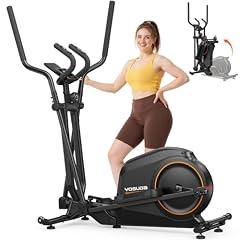
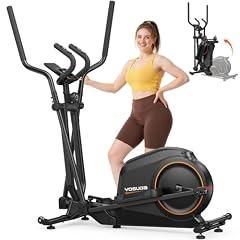
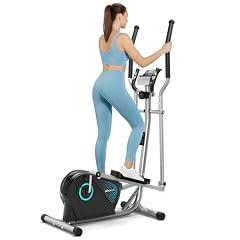
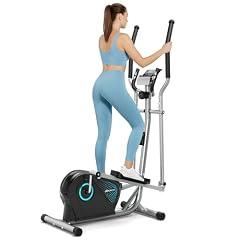
Elliptical machines for home
A home elliptical or, in some listings, a seated pedal exerciser or air-walk glider creates repeated leg movement, often with moving handles. The exercise effect comes from the motion you can perform comfortably and consistently, not from the product name alone. For a conventional standing machine, usable resistance, cadence, stride, fit, stability, and the time spent exercising determine whether it can support meaningful aerobic activity. Federal guidance for adults is 150 minutes of moderate activity weekly, 75 minutes of vigorous activity, or an equivalent combination.
Look first for a clearly stated stride length, dimensions, user-weight limit, resistance mechanism, and number of resistance settings. These figures help with comparison, but they are not proof of performance. A “16-level” dial does not show how much resistance each level produces, and none of the supplied standing machines had model-specific cadence, power, heart-rate, metabolic, or resistance-load testing showing which settings reach moderate or vigorous intensity. A long stride can improve fit for some users, but it does not establish joint comfort; a short stride can be suitable for one person and restrictive for another. User-height range, pedal spacing, handle reach, clearance, mounting height, and dismounting instructions are more useful than a generic “low impact” claim.
Capacity numbers deserve similar caution. A stated 300-, 350-, 400-, or 500-pound limit is a manufacturer recommendation unless the exact model has passed documented stability, fatigue, and overload testing. Among the supplied products, published capacity and configuration details sometimes conflict, including different stride lengths, resistance counts, dimensions, and weight limits. Buyers should verify the delivered model and use the lower published limit when records disagree rather than assuming the largest figure applies.
For safety substantiation, look for a model number, report number, date, named laboratory, scope, and certificate that can be traced through an ISO/IEC 17025 accreditation directory. Relevant test frameworks include ISO 20957-1:2024, ISO 20957-9:2016 for elliptical trainers, and ASTM F2276. A seller-issued certificate without an identifiable accredited laboratory is not equivalent to a traceable report. Also check the CPSC Recalls database and SaferProducts.gov, while remembering that finding no recall is not proof that a product was independently tested.
Console numbers are usually activity estimates, not measurements of your physiology. Calories, pulse, distance, speed, and resistance should carry stated accuracy limits and validation against appropriate reference equipment especially indirect calorimetry for energy expenditure and reference heart-rate equipment for pulse. No supplied product had located model-specific validation of these figures. Apps and programs can help structure sessions, but connectivity does not validate workload or calorie calculations.
Finally, consider the machine after purchase. A current manual, identifiable manufacturer or importer, serial labeling, warranty terms, support contact, parts catalog, exploded diagram, and replacement-parts policy provide a better service trail than “lifetime service” alone. Environmental claims should quantify recycled content, packaging, batteries, coatings, or electronics and identify independent certification where claimed. The supplied products generally lacked this information.
Safety caveats
Repeated warnings across the reviews include unverified load limits and stability, unresolved fit for taller or shorter users, moving-pedal and linkage pinch or entanglement hazards, the need for level flooring, clearance, tightened fasteners, and keeping children and pets away. People with balance limitations, a history of falls, recent surgery or injury, significant joint symptoms, cardiovascular restrictions, or rehabilitation needs should seek individualized clinical guidance. Seated machines must not be stood on. Users who need medically reliable pulse or calorie data, clinically supervised exercise, or independently documented safety should choose equipment with that evidence rather than relying on generic low-impact or quiet-operation claims.
Integrity
These topics separate a machine’s stated features from evidence about how it performs, how safely it can be used, and how long it can remain useful. Scores reflect the supplied product reviews; a higher score indicates stronger evidence or disclosure, not a guarantee of safety or clinical suitability.
HHealth & Safety
Health-supporting workout capability
This measures whether resistance, cadence, fit, and guidance can credibly support regular moderate-to-vigorous aerobic activity. For this category, adjustable resistance and a disclosed stride are useful starting points, but model-specific workload or metabolic testing is stronger evidence. Supplied scores ranged from 68 to 76: higher-scoring products had clearer resistance or exercise evidence, while lower-scoring products lacked proof of the intensity their settings deliver.
Stable under real use
This measures whether the frame, pedals, joints, handles, fasteners, and stated user limit remain secure under normal and vigorous use. It matters because a headline capacity does not prove overload or fatigue safety. Scores ranged from 53 to 72. The stronger results reflected clearer instructions or specifications, but no supplied product had a located model-specific accredited stability report, so even the higher scores are not certification.
Protection from falls and pinch points
This measures guarding, footing, tipping resistance, sharp-edge control, and instructions for mounting, dismounting, and moving parts. Ellipticals expose pedals, links, handles, and folding mechanisms to fingers, clothing, children, and pets. Scores ranged from 64 to 75. Higher-scoring products more clearly limited seated machines to seated use or provided safety instructions; low scores reflected unresolved guarding or configuration concerns.
Fit and joint-friendly motion
This measures whether stride, pedal geometry, handle reach, clearance, adjustment, and user-size limits are disclosed well enough to judge fit. It matters because “low impact” does not prove that a particular stride suits every hip, knee, gait, or body size. Scores ranged from 54 to 74. Higher scores generally had a concrete stride or footprint; lower scores had conflicting dimensions or little fit guidance.
EEvidence
Honest workout metrics
This measures whether time, distance, pulse, resistance, and especially calories are validated against suitable reference instruments and presented with appropriate limits. Elliptical calorie estimates can be materially inaccurate, so a screen should not be treated as a metabolic measurement. Scores ranged from 62 to 70. Higher scores reflected clearer monitor descriptions or manuals, but no supplied product had located model-specific calorie or pulse validation.
Evidence-based marketing
This measures whether claims about aerobic benefit, fat loss, joint comfort, rehabilitation, noise, capacity, muscle activation, and calorie burn are specific and substantiated. It matters because “quiet,” “knee-friendly,” and “full-body” are not test results. Scores ranged from 48 to 74. Higher-scoring listings made narrower claims or disclosed limitations; lower scores paired broad health or performance language with little supporting evidence.
Independent proof, not just promises
This measures whether an independent, accredited body tested the exact model and provides traceable results for safety, load, dimensions, noise, or performance. Buyers should be able to match the model, report, laboratory, date, and accreditation scope. Scores ranged from 68 to 70, but no supplied product had a located traceable report meeting that standard. Similar scores therefore indicate a shared evidence gap, not equal proof.
Traceable maker and safety support
This measures whether the responsible maker or importer, model and serial identification, current manual, warranty, parts support, and recall response are easy to verify. That matters when a machine develops a fault years later. Scores ranged from 55 to 77. Higher-scoring products had named support channels, manuals, warranty terms, or parts diagrams; lower scores involved redirected support, conflicting documents, or weak serial and parts information.
EEcology
Built to be repaired and kept
This measures whether rollers, belts, pedals, bearings, sensors, consoles, and fasteners can be identified, purchased, and replaced. Repair access can prevent an otherwise usable machine from becoming waste. Scores ranged from 68 to 78. The strongest product documentation included exploded diagrams, parts lists, maintenance steps, or a stated parts period; lower-scoring products lacked public catalogs, repair manuals, or dependable parts commitments.
Lower-impact materials and disposal
This measures quantified recycled content, coatings, packaging, batteries, electronics, and end-of-life guidance, ideally supported by independent certification. It matters because steel or alloy-steel disclosure alone says little about total environmental impact or disposal. Scores were tightly grouped at 68 to 70. The supplied products generally lacked verified recycled-content figures, packaging specifications, material inventories, or product-specific recycling plans.
Full reviews

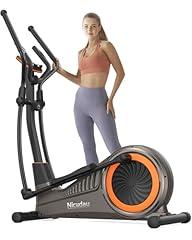
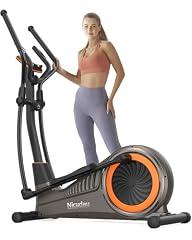
Niceday Elliptical Trainer with 18IN Stride
Overview
This is a rear-drive, magnetic-resistance home elliptical intended for standing aerobic exercise. The listed version has an 18-inch maximum stride, 16 resistance levels, a stated 400-pound user limit, and a footprint of about 39.6 by 24.4 by 61 inches. It includes a basic console for time, speed, distance, calories, odometer, and hand-contact pulse, plus app connectivity claimed by the seller. The 18-inch stride, resistance range, iron construction, and 400-pound capacity are manufacturer-stated specifications that were also reproduced by an independent retailer. A published Niceday manual for the closely related CT11 model provides assembly, inspection, floor-placement, clothing, and moving-part warnings. No model-specific accredited lab report, ISO conformity certificate, or independent validation of load capacity, stability, console data, noise, or calorie estimates was located.
What works
- The stated 18-inch stride gives buyers a concrete fit dimension rather than a generic compact-machine description.
- Sixteen manufacturer-stated magnetic resistance levels allow workload progression for regular aerobic sessions.
- Published instructions call for a solid, level floor, tightened fasteners, routine inspection, suitable clothing, and keeping fingers away from moving parts.
- The closely related published manual contains an exploded parts view and directs users to request replacement components from Niceday support.
What does not
- The 400-pound capacity and structural stability claim were not supported by a traceable model-specific fatigue, overload, or stability test from an accredited laboratory.
- No named independent certification or test report for this exact product was located, including evidence of conformance with elliptical-specific ISO safety testing.
- The console reports calories and pulse, but no validation, error range, user-input method, or calorie algorithm was disclosed. The published manual also says pulse readings are not for medical treatment.
- The seller's low-impact and knee-stress language is broader than the available product evidence. Elliptical exercise can reduce some impact measures, but joint moments and fit still matter.
- No product-level recycled-content, coating, packaging, battery-disposal, or end-of-life recycling information was located.
Who is it for
It suits an adult household buyer seeking a manually powered indoor cardio machine with a stated long 18-inch stride and adjustable magnetic resistance, provided they can leave clear space around a 61-inch-tall machine and use it on a level, solid floor. It is most appropriate for people who will judge workout effort by breathing, perceived exertion, or a separate validated heart-rate device, rather than treating the displayed calorie or hand-pulse figures as precise. Users should stay within the stated capacity and inspect fasteners regularly.
Who is it not for
It is not suited to anyone who needs independently verified load capacity, institutional fitness-equipment certification, or documented stability testing before using the machine vigorously. People with a recent injury, knee, hip, balance, cardiac, or neurologic condition should not rely on the product's low-impact marketing as individualized clearance, especially because stride fit, pedal geometry, and joint loading have not been independently documented for this version. It is also unsuitable for homes where children or pets can access the moving linkage unsupervised, or where floor clearance and stable placement cannot be maintained.
Integrity
Regular elliptical sessions can contribute to the CDC target of at least 150 minutes of moderate aerobic activity per week when the user reaches and sustains an appropriate intensity. The machine's 16 stated resistance levels make progression plausible, but there is no model-specific metabolic, cadence, resistance-output, or heart-rate testing showing what intensity each setting can deliver. Published biomechanics research also cautions that lower impact does not make every elliptical motion joint-neutral, because knee and hip demands remain relevant. Niceday states that the frame is iron or commercial steel and offers lifelong service with replacement accessories. A published manual for a closely related model includes an exploded view, maintenance prompts, and support contact details, which are useful service signals. No independently verified recycled content, environmental certification, electronics disposal plan, or parts-availability period was located. Searches of CPSC recall materials located no recall for this product as of August 16, 2026, but no independent safety certification or accredited test report was found.

Elliptical Cross Trainer, Hyper-Quiet Magnetic System
Overview
This is a compact, front-drive home elliptical with a magnetic resistance system, moving handlebars, fixed foot platforms, a basic battery-powered monitor, and contact-pulse grips. The catalog describes 16 resistance levels, a 16-inch stride, alloy-steel construction, a 400-pound user limit, and a 106-pound product weight. Those are manufacturer specifications, not independently tested figures. The available CT11 manual independently confirms the basic machine format, including a monitor that shows time, speed, distance, calories, odometer and contact pulse. It also requires users to assemble and regularly re-tighten bolts, place the machine on a solid level floor, and test it for unusual noise or rough movement. Published documentation has not established model-specific load, fatigue, stability, noise, calorie, pulse, or resistance accuracy testing by an accredited laboratory.
What works
- The manual provides concrete setup and use safeguards, including bolt checks, flat-floor placement, clothing guidance, and warnings to keep fingers away from moving parts.
- A parts list and exploded-view diagram make common components easier to identify than on a product supplied only with basic assembly pictures.
- The console offers time, speed, distance, calorie, odometer, and contact-pulse readouts for simple workout tracking.
- The manufacturer states 16 resistance levels and a 400-pound user limit, which could accommodate progressive aerobic sessions if those claims suit the user.
What does not
- No traceable, model-specific third-party certification or accredited test report was located for stability, fatigue, overload, resistance, noise, or console accuracy.
- The product information is inconsistent. The catalog describes a 16-inch stride and 42 by 21 by 61 inch dimensions, while the brand's CT11 page describes a 15.5-inch stride and different overall dimensions.
- Calories are displayed without a disclosed algorithm or validation against indirect calorimetry. Contact pulse is explicitly not for medical use.
- The manual directs users to contact the seller for replacement parts, but does not provide a parts catalog, stated long-term parts availability, serial-number traceability, or repair procedures beyond routine fastener inspection.
Who is it for
This product fits an adult seeking a manual-resistance home cardio machine with straightforward controls and enough floor space for an upright elliptical. It is most suitable for users who can safely mount and dismount a standing machine, are willing to inspect and tighten fasteners regularly, and will use perceived exertion or an external heart-rate device to pace training. The stated high user limit may be relevant to larger users, but it remains a manufacturer claim rather than independently verified load evidence.
Who is it not for
It is not well suited to buyers who need confirmed load, fatigue, or stability testing, such as households where several people will use it vigorously every day. People with balance limitations, recent falls, knee pain, joint injury, or cardiovascular conditions should not treat its low-impact or pulse features as individualized medical guidance. Taller or shorter users who need a known fit should also be cautious because the available product information conflicts on stride length and overall dimensions.
Integrity
Regular elliptical exercise can contribute to adult aerobic activity when it is performed at an appropriate intensity and accumulated consistently. Federal guidance calls for at least 150 minutes a week of moderate activity, or 75 minutes of vigorous activity, plus muscle-strengthening work on two days. This product provides adjustable resistance, but no model-specific evidence shows what cadence, resistance setting, or heart-rate response reaches those doses. The manual also warns that its contact-pulse reading is not for medical treatment. The documented material is alloy steel, and the manual provides an exploded view plus a contact route for damaged or missing parts. That creates a basic pathway for maintenance, but no independently verified recycled-content, coating, packaging, battery-disposal, or end-of-life information was located. No product-specific CPSC recall or safety warning was located in the checks performed, but buyers should retain their manual and inspect bolts and moving joints as instructed.

YOSUDA Pro Cardio Climber Elliptical Machine
Overview
This is a compact, manually driven home cardio climber that combines an elliptical-style pedal path with a steep stepping motion and moving handles. The catalog describes a 38 by 21 by 62 inch machine, 94.6 pound unit, magnetic resistance, 16 resistance levels, a 15.5 inch stride, and a 300 pound user limit. These are manufacturer-stated specifications, not independently validated performance results. An independently hosted copy of the product manual also describes an 18 pound flywheel, 16 resistance levels, textured 13.5 by 5.5 inch pedals, and routine bolt and lubrication checks. It conflicts with the catalog by listing an 18 inch maximum stride rather than 15.5 inches. No traceable third-party report was located for this product’s stability, fatigue, resistance output, noise, calorie estimates, or compliance with elliptical-trainer safety standards.
What works
- Sixteen manufacturer-stated magnetic resistance levels provide a usable way to progress effort over time.
- The stated 300 pound user limit and 94.6 pound product weight give buyers basic load and handling information, although neither was independently tested.
- The available manual gives concrete upkeep steps, including checking fasteners and lubricating moving joints.
- Textured pedal surfaces and published pedal dimensions help users assess foot support before setup.
What does not
- The published stride specification conflicts, with the catalog stating 15.5 inches and the available manual stating 18 inches.
- No named accredited laboratory, test report, or certification record was located for stability, load capacity, moving-part guarding, or fatigue resistance.
- The console shows calories, distance, speed, and pulse, but no model-specific accuracy limits or validation against reference instruments were found.
- Marketing materials include broad muscle, knee-protection, and low-noise claims without product-specific human testing or acoustic test evidence.
- Warranty and support terms are not fully consistent across available materials, so confirm coverage and replacement-part access before relying on long-term service.
Who is it for
This product suits an adult home exerciser who wants a relatively narrow, upright cardio machine and is comfortable checking fit after assembly. It is most appropriate for people who can use the handles and pedals steadily, have a level indoor floor, and plan to build aerobic sessions by adjusting resistance and pace. The stated 300 pound capacity may be relevant, but it remains a manufacturer claim rather than independently verified load evidence. Buyers should measure both floor clearance and their comfortable handle reach before choosing it.
Who is it not for
It is not well suited to people who need a documented stride length, validated calorie data, or independently certified stability for intensive training. Taller users, people with knee, hip, balance, grip, or mobility limitations, and anyone returning from injury should not assume the climbing motion is joint-friendly simply because it is marketed as low impact. It also needs adult supervision practices around children and pets because the pedal rails and moving linkages create accessible moving-part areas. Households needing assured repair parts or long-term service terms should seek clearer documentation.
Integrity
Regular aerobic activity can support health when it reaches an appropriate weekly dose. CDC guidance calls for at least 150 minutes of moderate activity, or 75 minutes of vigorous activity, each week for adults. This product has manufacturer-stated resistance adjustment, but there is no model-specific metabolic, heart-rate, cadence, or resistance-output testing to show what effort level a given setting produces. Its displayed calorie figure should therefore be treated as a rough training cue, not a precise energy measurement. No product-specific accredited safety certification, independent laboratory report, recycled-content claim, material breakdown, packaging specification, or end-of-life instruction was located. A CPSC search did not identify a published recall for this exact product, but absence of a recall is not proof of safety testing. The available manual does provide maintenance guidance, which may help service life, but it does not provide an exploded parts catalog or documented replacement-part availability.

UMAY Magnetic Elliptical Trainer
Overview
The UMAY ET70 is a battery-powered, floor-standing home elliptical with magnetic resistance, fixed and moving handlebars, pulse grips, and an LCD that the manual says displays time, speed, distance, estimated calories, and pulse. It is intended for self-paced indoor aerobic exercise, not as a medical or diagnostic device. Its most important finding is a documentation conflict. The current product record states 16 resistance levels, a 16-inch stride, and a 400-pound limit. A publicly available ET70 manual instead states 8 resistance levels, a 15.5-inch stride, and a 350-pound limit. The manual provides basic assembly, mounting, leveling, and maintenance directions, but no model-specific accredited safety, load, noise, resistance, pulse, or calorie-validation report was located.
What works
- The documented magnetic resistance and moving handles can support self-paced aerobic sessions, though workout intensity has not been independently measured for this product.
- The manual gives concrete setup and use directions, including leveling the machine, tightening fasteners, holding the handlebars while stepping on, and keeping children and pets away during operation.
- The manual identifies routine care tasks, including bolt checks, lubrication of moving parts, and inspection of pedal straps for wear.
- A named US support channel, phone number, email address, and one-year warranty are published by the brand.
What does not
- The listed 400-pound capacity and 16 resistance levels conflict with the ET70 manual's 350-pound capacity and 8 levels. The higher figures are therefore not adequately substantiated.
- No traceable independent test report or accredited certification for this specific product was located for stability, fatigue, overload, pinch-point protection, resistance output, or noise.
- The console presents calorie and pulse readings, but no product-specific accuracy limits or validation against indirect calorimetry, calibrated resistance measurement, or reference heart-rate equipment were found.
- Fit information is limited to a stated 15.5-inch or 16-inch stride. Pedal geometry, handle reach, clearance, and a user-height range are not disclosed.
Who is it for
This product may suit an adult who wants a basic, self-paced indoor cardio machine and can use it on a level floor with enough clearance for a 45-inch-deep footprint. It is more appropriate for someone willing to treat the resistance, pulse, distance, and calorie display as progress cues rather than precise measurements. Buyers should also be comfortable checking bolts, pedal straps, and moving parts routinely, and should confirm the applicable weight limit with UMAY before setup because the available product documents conflict.
Who is it not for
It is not well suited to anyone near or above 350 pounds until UMAY supplies product-specific written confirmation of the applicable capacity and safety testing. It is also a poor fit for users who need validated heart-rate, calorie, workload, or rehabilitation data, or who need a documented fit assessment for knee, hip, balance, or mobility limitations. Households with unsupervised children or pets should consider the moving pedal and handle mechanisms carefully and follow the manual's separation and mounting instructions.
Integrity
Regular elliptical exercise can contribute to aerobic activity when the individual reaches a moderate or vigorous effort and accumulates sufficient weekly time. However, this product has no located model-specific test showing its resistance range can reliably produce a particular exercise dose. Generic biomechanics evidence indicates elliptical exercise can reduce vertical loading rate relative to walking, while still increasing hip-flexor and knee-extensor demands. That matters for people with knee symptoms or reduced lower-limb strength. No recall for this product was located. A 2026 consumer incident report concerns a different UMAY treadmill model and does not establish a problem with this elliptical. The ET70 manual includes maintenance guidance, but no parts catalog, repair drawings, recycled-content figures, packaging specifications, battery-disposal guidance, or verified environmental certification was located. Alloy steel is stated, but its source and end-of-life pathway are not documented.

Merach Elliptical Exercise Machine with 8-Level Resistance
Overview
This is a rear-drive, home-use elliptical for standing cardio sessions. The product record and model-specific manual describe magnetic resistance with 16 manually selected levels, a stated 15.5-inch stride, Bluetooth app compatibility, and an 86-pound alloy-steel machine measuring 41.73 by 20.08 by 62.99 inches. Its stated maximum user weight is 350 pounds. Those capacity, stride, quiet-operation, and joint-comfort claims are manufacturer-stated, not supported by a located model-specific accredited test report. The console tracks time, count, distance, calories, and pulse, but no validation against indirect calorimetry, calibrated resistance, or reference heart-rate equipment was found. The manual provides useful assembly, leveling, inspection, and moving instructions, including adjustable rear stabilizer caps. Human research supports elliptical exercise as a plausible aerobic option when intensity is sufficient, but this product has no published cadence, heart-rate, MET, or workload testing to show what dose its resistance settings deliver.
What works
- Sixteen magnetic resistance levels offer a manufacturer-stated way to progress effort without changing equipment.
- The narrow 20.08-inch stated width can suit a dedicated small home workout area.
- The manual documents assembly, leveling, inspections, console use, battery replacement, and troubleshooting.
- MERACH publishes US contact details and a limited warranty covering exercise equipment, including frame and components, for one year, with a registration-based extension described on its support site.
What does not
- No model-specific ISO 20957, ASTM, or accredited laboratory stability, fatigue, overload, pinch-point, or performance report was located.
- The stated 350-pound limit and 15.5-inch stride are manufacturer claims, not independently confirmed. An older official E09 product page also lists a different 265-pound limit and 13-inch stride, so buyers should confirm the exact version documentation before setup.
- The console displays calories and pulse, but no accuracy limits, calorie algorithm details, or validation study for this product were found.
- The product materials are described only broadly as alloy steel. No recycled-content, coating, packaging, electronics-disposal, or end-of-life documentation was located.
- No public replacement-parts catalog, exploded repair diagram, or stated parts-availability period was located.
Who is it for
It suits an adult seeking a compact-footprint home cardio machine for regular self-paced sessions, who can use a standing elliptical safely and has room for its 62.99-inch stated height plus clearance around moving pedals and handles. It is most appropriate for someone comfortable setting effort by perceived exertion or an external heart-rate monitor, rather than relying on calorie readouts. The documented assembly and leveling instructions also make more sense for a household willing to inspect fasteners and keep the machine on a stable, level surface.
Who is it not for
It is not well suited to a buyer who needs independently verified load capacity, safety certification, or validated workout measurements for rehabilitation, clinical exercise, or intensive daily training. People near the stated 350-pound limit should not treat that figure as laboratory-confirmed, especially because E09 documentation found online is inconsistent across versions. It is also unsuitable for unsupervised children, households unable to maintain clearance from moving parts, or users with balance, dizziness, severe joint, cardiac, or medication-related concerns unless a clinician has cleared this form of exercise.
Integrity
Elliptical exercise can contribute to aerobic activity when the session is hard enough and repeated consistently. CDC guidance calls for at least 150 minutes of moderate aerobic activity weekly, or 75 minutes of vigorous activity. Research using indirect calorimetry has found elliptical exercise can produce oxygen consumption and energy expenditure comparable with treadmill work at similar perceived effort. That supports the exercise format, not the product's untested resistance scale, calorie display, quietness, or capacity claims. MERACH supplies an assembly guide, a model manual, troubleshooting resources, US contact details, and a limited warranty. A search of the CPSC recall database did not identify a recall for this product as of August 23, 2026, but absence of a located recall is not independent safety certification. No traceable ISO 20957 or ASTM test report, accredited laboratory certificate, materials disclosure, recycled-content claim, or disposal guidance for this product was located. Its electronics use replaceable AA batteries, which should be handled through local battery recycling options rather than household trash.

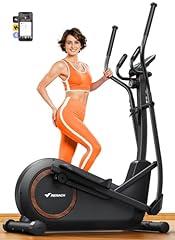
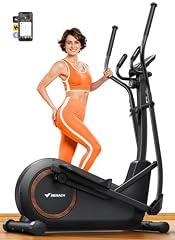
MERACH Elliptical Exercise Machine with Heart Rate Monitor
Overview
This is a full-size home elliptical with moving handlebars, pedal rails, magnetic resistance, a basic console, Bluetooth app connection, and a self-generating power system. It is intended for standing aerobic sessions, with the user controlling effort by pedaling faster and by changing resistance. CDC guidance recognizes regular moderate or vigorous aerobic activity as part of adult physical-activity targets, and research on elliptical training shows resistance and cadence can increase oxygen demand. The manufacturer manual lists 16 magnetic resistance levels, a 400-pound recommended user limit, a 130.5-pound machine weight, and dimensions of 58.6 by 22.3 by 65.1 inches. These are manufacturer-stated figures, not independently test-verified results. The supplied marketplace record conflicts on both dimensions and capacity, and its automatic-resistance wording conflicts with the manual, which says resistance is changed by turning a knob.
What works
- The manual documents 16 resistance levels, so users can progressively change effort rather than being limited to one fixed setting.
- The self-generating system is manufacturer-stated to power the console and resistance adjustment while pedaling, reducing reliance on a wall outlet during normal use.
- The manual gives specific mounting, dismounting, leveling, maintenance, and hardware-check instructions, including guidance to stop use if moving parts are damaged.
- A named manufacturer, a serial-number record field, a one-year limited warranty, and U.S. support contact details are available through the manufacturer support materials.
What does not
- No traceable model-specific report from an accredited independent laboratory was located for stability, fatigue, overload, noise, resistance output, or console accuracy.
- The capacity and size information is inconsistent across the supplied marketplace record and the manufacturer manual. The manual's 400-pound limit should not be treated as independently verified.
- The marketplace claim of automatic resistance is contradicted by the manual, which describes manual resistance changes using a knob.
- The console displays calories, distance, speed, and heart rate, but the manual provides no accuracy limits, input assumptions, or validation against indirect calorimetry or reference heart-rate equipment.
Who is it for
This product suits an adult home user who wants a standing, two-handle cardio format and is comfortable following a detailed assembly and maintenance routine. It is most appropriate for users with enough dedicated floor space for the manufacturer-stated 58.6 by 22.3 inch footprint and clearance around it. It can support regular aerobic practice when the user sets a sustainable effort and duration, rather than treating the console calorie number as a precise result. It is also practical for households that value outlet-free operation during workouts.
Who is it not for
It is not appropriate for anyone who needs independently documented load testing, safety certification, verified noise performance, or medically supervised rehabilitation specifications. People near the stated weight limit should be especially cautious because the supplied product information conflicts on capacity and no independent overload report was located. It is also a poor fit for users who need a verified stride length, pedal geometry, or height-fit range before purchase. Households with unsupervised children, loose clothing around moving equipment, unstable flooring, or limited clearance should avoid this format.
Integrity
Elliptical exercise can provide meaningful aerobic work when resistance and cadence are sufficient. Human studies show that higher resistance and stride rate raise oxygen demand, but individual responses vary. The manufacturer manual includes useful safety instructions, including level-floor placement, a 2-foot clearance area, tightening fasteners, using the lowest pedal position to mount or dismount, and stopping before stepping off. It also directs users to inspect moving parts and replace damaged parts before further use. No U.S. CPSC recall or safety action specific to this product was located in the verification work. The manual displays CE and UKCA language, but its related declaration identifies a different product, so it does not verify a certification for this product in the U.S. The product has electronics and a built-in energy-storage battery, yet no battery chemistry, recycled-content figure, packaging specification, parts-availability period, or U.S.-specific end-of-life plan was found. The manual's disposal instructions are directed to European collection systems.

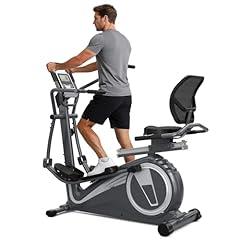
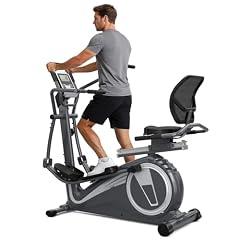
THERUN Recumbent Elliptical Exercise Machine
Overview
This is a 129-pound home cardio machine that the seller presents as both a seated recumbent bike and a standing elliptical. It uses manual magnetic resistance with eight settings, has a stated 15.8-inch stride, and fits in a stated 51.18 by 20.47 inch footprint. The console is stated to show time, speed, distance, calories, pulse, and odometer readings. The most useful product-specific information is manufacturer-stated, not independently confirmed. The listing states a sliding seat, three armrest-length settings, a padded seat with mesh backrest, a 330-pound user limit, and suitability for people 4 feet 9 inches to 6 feet 3 inches. It also claims a reinforced steel frame and a quiet flywheel system. No publicly available model-specific laboratory report was located to verify stability, noise, load capacity, or console accuracy.
What works
- The seller discloses a 15.8-inch stride, eight resistance settings, dimensions, and a 330-pound stated user limit.
- The stated sliding seat and three armrest-length settings give buyers some concrete fit adjustments.
- The product can be used seated or standing, according to the manufacturer, which may help users vary position during longer sessions.
- A two-year warranty is listed, and the brand publishes a support email and company address.
What does not
- The 330-pound limit, frame-strength claims, and claimed 20 dB operating noise lack a located model-specific independent test report.
- No public model-specific validation was located for displayed calories, distance, resistance, or handgrip pulse. Calorie readouts should be treated as estimates.
- The listing makes precise unsupported performance claims, including 25 percent more core engagement and 40 percent greater stability.
- No public parts catalog, exploded diagram, repair manual, or stated replacement-parts availability period was located for this product.
- The product page and brand materials located do not provide product-level recycled-content, coating, packaging, battery, or disposal information.
Who is it for
This product suits a home exerciser who wants a compact, manual-resistance cardio machine with a backrest and the option to alternate between seated pedaling and standing elliptical motion. The stated sliding seat, adjustable arm reach, 15.8-inch stride, and listed height range give a starting point for adults roughly 4 feet 9 inches to 6 feet 3 inches. It is most appropriate for users who can assemble, level, and inspect a 129-pound machine, and who are comfortable using perceived exertion rather than relying on calorie estimates.
Who is it not for
It is not well suited to anyone needing independently verified stability, medical rehabilitation suitability, precise heart-rate monitoring, or reliable calorie and workload data. People close to the stated 330-pound limit, those with impaired balance, or users who may have difficulty mounting, dismounting, or recovering from a loss of footing should seek professional guidance and require clearer safety documentation. It is also a poor fit for households needing assured long-term self-service repair, because no public product-specific parts catalog or repair instructions were located.
Integrity
Elliptical exercise can support aerobic activity when the user reaches an appropriate intensity and accumulates regular weekly time. Federal guidance calls for at least 150 minutes of moderate aerobic activity weekly, or 75 minutes vigorous. Research on elliptical trainers also shows that raising resistance and cadence can raise oxygen use, but individual response varies. The product's eight resistance settings make varied effort plausible, though no model-specific metabolic test establishes the intensity this unit can deliver. No THERUN-specific recall or CPSC safety warning was located in the searched United States consumer-safety databases as of September 4, 2026. The brand publishes a Hong Kong address and support email, while the product listing states a two-year warranty. No named independent certification, accredited laboratory report, public repair-parts system, recycled-content disclosure, or end-of-life guidance was located. The listed alloy-steel construction does not itself establish recycled content or lower-impact sourcing.
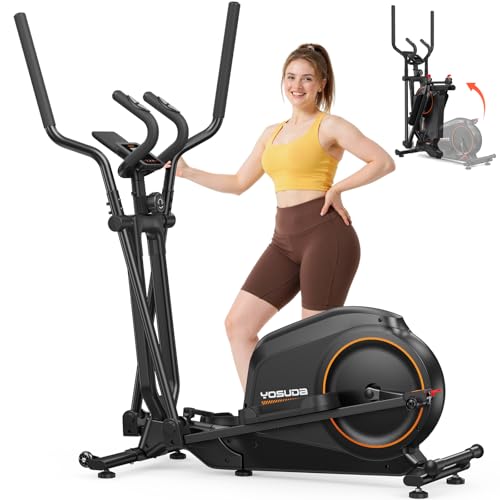
YOSUDA Foldable Elliptical Machine 15IN Stride
Overview
This is a compact, manual-use home elliptical with a magnetic resistance system, moving handles, a stated 15-inch stride, and 16 resistance levels. It is intended for standing aerobic exercise in small rooms. The catalog lists a 66-pound machine with a 36.61 by 21.65-inch floor footprint when open, plus a claimed 400-pound user limit. An independent retail listing confirms that the same E03 model is marketed as a three-step folding design with a claimed 2 square feet storage footprint and a 15-inch stride. Those are seller or manufacturer statements, not laboratory measurements. Human research supports that elliptical exercise can produce meaningful aerobic energy expenditure, but no model-specific heart-rate, workload, calorie, noise, or metabolic testing was located.
What works
- The 15-inch stride is disclosed, giving buyers a concrete starting point for judging fit.
- The same E03 model is independently listed as foldable, with a claimed 2 square feet storage footprint.
- Sixteen magnetic resistance levels are stated, providing a practical range for progressively harder home cardio sessions.
- The maker maintains a support site and provides a service email, although an E03 manual was not located there.
What does not
- No traceable third-party report was located showing that this exact product passed ISO elliptical safety, stability, fatigue, overload, or pinch-point testing.
- The stated 400-pound capacity and four-stabilizer construction are unverified performance claims, not independently confirmed load-safety results.
- No validation was located for console calories, distance, resistance level, or pulse readings. Treat any calorie total as an estimate.
- Pedal dimensions, pedal spacing, handle reach, clearance geometry, replacement-part catalog, and repair instructions were not found for this product.
- Claims that the stride reduces knee pressure, boosts heart rate, burns calories, and runs below 25 dB were not accompanied by model-specific substantiation.
Who is it for
It suits an adult who needs a compact standing cardio machine for a small apartment, bedroom, or multipurpose room and who can first confirm that a 15-inch stride feels natural. It is most appropriate for self-paced aerobic sessions where the displayed workout numbers are used only for rough trend tracking. A buyer should be comfortable following setup instructions carefully, checking fasteners periodically, and relying on the stated one-year manufacturer warranty rather than documented long-term service coverage.
Who is it not for
It is not a good fit for taller users or anyone who cannot comfortably use the stated 15-inch stride, especially because pedal spacing, handle reach, and broader fit dimensions are not published. It is also unsuitable for users who need medically supervised rehabilitation, precise calorie or heart-rate data, or independently verified load testing. Households with children should not leave it accessible during use or storage because no model-specific pinch-point or guarding test report was found. Buyers needing documented spare parts and repair procedures should choose a product with those records.
Integrity
Regular elliptical exercise can contribute to adult aerobic-activity goals when the effort and duration are sufficient. Federal guidance calls for at least 150 minutes a week of moderate aerobic activity, or 75 minutes of vigorous activity. Research using indirect calorimetry shows elliptical exercise can produce measurable aerobic energy expenditure. That supports the exercise category, not the product's unverified calorie, knee-pressure, or heart-rate claims. No model-specific independent safety certificate, accredited laboratory report, environmental certification, recycled-content disclosure, battery information, packaging specification, or disposal guidance was located. Searches of the CPSC recall and public incident-report portals did not identify an E03-specific recall or warning. The support site provides contact information, but its available manual list did not show this product and no public parts catalog or exploded repair diagram was found.

THERUN Aqua Elliptical Trainer
Overview
This is a compact, manually adjusted magnetic elliptical for indoor walking-style cardio. It has moving and fixed handlebars, foot pedals, a 3.5-inch console, pulse grips, and transport wheels. The manufacturer states a 13.2-pound flywheel, 16 resistance settings, a 14.1-inch maximum stride, and a 265-pound user limit. A retailer independently reproduces those core listed specifications, but it does not provide laboratory test data. The stated 39.4 by 20.9-inch footprint is relatively narrow, although the unit stands 63.8 inches tall. Elliptical training can contribute to aerobic activity when intensity is sufficient, but no model-specific metabolic, resistance-output, heart-rate, or calorie-validation test was located. The console displays time, speed, distance, calories, pulse, and odometer, yet published accuracy limits and the calculation method were not found.
What works
- The manufacturer-stated 16 resistance settings provide a practical way to increase effort gradually.
- The stated 39.4 by 20.9-inch base can suit a constrained home exercise area.
- A 14.1-inch stated stride and two handlebar positions give buyers more fit information than a generic low-impact claim.
- The published product information states a one-year warranty and seven years of spare-part availability in Europe.
What does not
- No public, model-specific ISO 20957, ASTM, or accredited laboratory report was located for stability, fatigue, load, pinch-point, noise, or console accuracy.
- The 265-pound capacity, reinforced-frame description, anti-slip pedal claim, and quiet-operation claim are manufacturer statements, not independently confirmed performance results.
- A 14.1-inch maximum stride and a claimed user-height range of 4 feet 6 inches to 6 feet 1 inch do not establish comfortable fit for every body size or mobility need.
- The calorie and pulse readouts are useful for trend tracking, but no validation against indirect calorimetry or a reference heart-rate instrument was found.
Who is it for
This product fits an adult who wants a compact, nonmotorized home cardio machine and can work comfortably within the stated 265-pound user limit. It is most suitable for people who prefer to set workout effort by feel, talk test, and gradual resistance changes rather than rely on precise calorie or pulse figures. The stated 14.1-inch stride may be workable for shorter to average-height users who can first confirm pedal clearance, handle reach, and mounting stability in their own space. It is also suited to users prepared to follow assembly, leveling, and routine fastener checks carefully.
Who is it not for
It is not appropriate for anyone above the stated 265-pound limit, or for a buyer who needs independently documented structural testing before using equipment for vigorous exercise. People with balance impairment, recent joint surgery, unstable cardiovascular symptoms, severe hip or knee limitations, or a high fall risk should not assume an elliptical is suitable without clinician guidance and a stable mounting plan. Taller users or people with long stride needs should be cautious because a 14.1-inch maximum stride may feel restrictive. It is also not for users who require clinically reliable heart-rate or calorie measurement.
Integrity
Regular aerobic activity can support health when it reaches an individual moderate or vigorous effort. Federal guidance calls for at least 150 minutes weekly of moderate aerobic activity, or 75 minutes of vigorous activity, plus muscle-strengthening activity on two days. This product offers manufacturer-stated resistance adjustment, but no model-specific test establishes what cadence or setting reaches those intensities. Its calorie, distance, and pulse outputs should therefore be treated as informal workout trends rather than medical or energy-balance measurements. No product-specific CPSC recall or public safety warning was located in the checked United States sources. That is not proof of safety. No accredited third-party certificate or report was found for this exact unit. The stated alloy-steel construction and seven-year European spare-parts availability are useful disclosures, but recycled content, coating chemistry, packaging composition, electronics disposal instructions, and independently verified environmental certifications were not found.