
10 Best Elliptical Machine
 Brianna York
Please note that we participate in affiliate marketing programs. When you purchase through links on our site, we may earn a commission. As an Amazon Associate we earn from qualifying purchases. This comes at no additional cost to you and helps support the resources required to provide valuable content.Advertising Disclosure
Top-rated Elliptical Machine Comparison
1

2
4
5
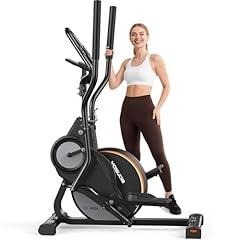
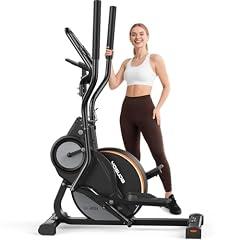
6
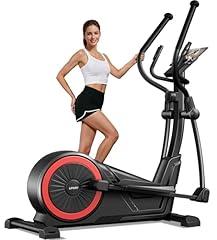
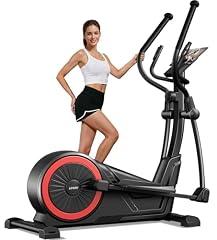
7
8
9
10
Elliptical machines: what to assess
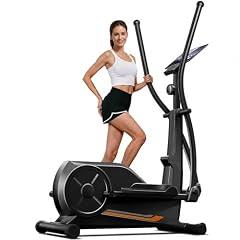
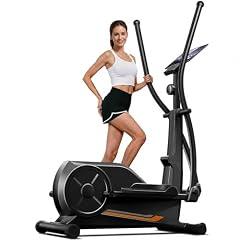
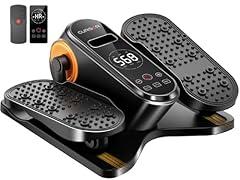
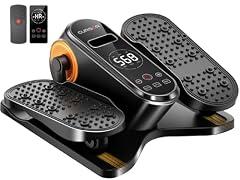
An elliptical is intended to provide repeated pedal motion for aerobic exercise, usually with adjustable resistance and, on standing models, moving handlebars. Compact under-desk products are different: they are generally motorized or manually pedaled while seated and should not be treated as standing ellipticals. Whether a product works well depends less on its headline calorie number than on whether its motion, resistance range, fit, stability, and instructions support a safe, repeatable exercise routine.
For standing machines, look for a clearly stated resistance mechanism, resistance range, stride length, user-weight limit, machine dimensions, entry and exit instructions, and required clearance. A longer or shorter stride is not automatically better; it needs to suit the user's body and movement tolerance. For seated machines, confirm that the product is explicitly designed for seated-only use, that the chair and floor can remain stable, and that the pedals, straps, cord, and moving parts can be kept away from children and pets. A stated capacity is useful only when the exact model and configuration are clear. Several supplied products had conflicting capacity, stride, dimension, or resistance figures, so the lower or more conservative documented limit is the safer reference until the maker resolves the discrepancy.
Resistance levels are not a standardized workload. “16 levels” may indicate adjustment positions, not a verified amount of resistance or a particular aerobic intensity. A display showing calories, distance, speed, pulse, or app data is also not proof of accuracy. Buyers should treat calories as estimates unless the maker provides a measurement method, calibration protocol, uncertainty information, and model-specific independent validation. Heart-rate readings should not be treated as medical data unless that use is specifically validated; several manuals expressly limit pulse readings in this way.
For safety claims, look for an exact, matchable listing in UL Product iQ, Intertek ETL, or the CSA Group database when electrical equipment is involved. For equipment performance and moving-part safety, look for a model-specific ASTM F2276 or ASTM F2571 report from an ISO/IEC 17025-accredited laboratory. A badge, a general statement that a factory follows standards, or certification for a related model is not equivalent evidence. Check the U.S. CPSC recall and SaferProducts.gov records using the model and manufacturer information, and retain the model, serial, warranty, and support details.
Noise claims need a disclosed acoustic or vibration test: a number such as 15, 20, or 30 decibels is not meaningful without the test conditions, distance, surface, and operating setting. “Low impact,” “quiet,” rehabilitation, circulation, joint-protection, weight-loss, red-light, and rapid-calorie-burn claims likewise need product-specific evidence and clearly stated conditions. Across the supplied products, no model-specific independent safety certification was located, and many displays, capacity claims, noise claims, and therapeutic or weight-loss claims remained unvalidated.
Recurring safety caveats matter. Do not stand on a seated pedal machine. Standing ellipticals are unsuitable for people who cannot safely balance, mount, or dismount moving pedals, and users with recent falls, surgery, acute injury, severe joint symptoms, dizziness, cardiovascular symptoms, or medical exercise restrictions should obtain individualized clinical guidance. Keep children and pets away from moving pedals, cords, batteries, and accessible pinch points. Inspect and tighten fasteners, pedals, straps, and moving parts as directed. No product-specific recall was identified in the supplied reviews, but that does not establish safety certification. Products with unresolved capacity or stride conflicts should not be relied on until the seller provides clarification.
Integrity
The scores below reflect the supplied reviews, with higher scores indicating stronger documented performance against the relevant topic. They are comparative signals, not proof that any product is certified or clinically validated.
HHealth & Safety
Meaningful, safe aerobic exercise potential
This measures whether the documented motion, resistance range, and user guidance can support appropriately dosed aerobic activity without promising weight loss or disease treatment. Standing ellipticals with adjustable magnetic resistance generally scored higher, reaching 78, while seated motorized products scored as low as 68. A high score means the exercise format and progression guidance are plausible; it does not establish a specific intensity for every user.
Fall, pinch, and moving-part safety
This looks at stability, pedal retention, fasteners, guarding, accessible pinch points, and warnings about mounting, dismounting, and moving parts. Scores ranged from 61 to 74. Higher-scoring products supplied clearer entry, exit, inspection, strap, level-floor, or moving-part instructions. Lower scores reflected less complete guidance or greater uncertainty around stability and accessible mechanisms; no supplied product had a model-specific independent safety test report.
Fit, load limit, and safe access
This measures whether stride or pedal geometry, stated capacity, floor clearance, handholds, and access instructions are specific and credible. Scores ranged from 50 to 75. Higher scores had more usable fit information and clearer limits, while lower scores commonly involved contradictory capacities or stride lengths. A printed number is not independently verified, so buyers should confirm the exact configuration and use the most conservative credible limit.
Electrical and powered-motion safety
This applies to corded and motorized products and considers protection from shock, overheating, unintended motion, and power-supply problems. Scores ranged from 68 to 80. Higher scores reflected features such as automatic shutoff, overheating protection, battery-powered displays, or no mains-powered drive. These features do not replace independent electrical certification; no model-specific UL, ETL, or CSA listing was located for the supplied products.
EEvidence
Independently verified safety
This measures whether the exact product or electrical system can be matched to an independent laboratory report, accredited certification, or verifiable listing. Scores ranged from 68 to 70, but the narrow range should not be mistaken for certification: no supplied product had a located model-specific UL, ETL, CSA, ASTM, or ISO/IEC 17025 laboratory record. A high comparative score mainly reflects the quality and traceability of the available documentation relative to the set.
Honest resistance and workout data
This assesses whether resistance, stride, speed, distance, pulse, calories, and app data have defined methods and validation. Scores ranged from 49 to 72. Higher-scoring products more clearly labeled calories as estimates or supplied better-defined workout functions. Lower scores commonly involved displays with no calibration method or accuracy tolerance. Across the category, calorie and pulse figures should be treated as rough guidance rather than medical or laboratory measurements.
Claims match the evidence
This measures whether health, weight-loss, calorie, quietness, capacity, low-impact, rehabilitation, circulation, or red-light claims are specific and supported for the exact product. Scores ranged from 48 to 69. Higher scores used more qualified exercise claims and better matched the available evidence. Lower scores were associated with unsupported therapeutic, disease-prevention, injury-prevention, rapid-recovery, or guaranteed-outcome language, often despite otherwise useful exercise features.
Traceability, recalls, and parts support
This considers whether the maker identifies a responsible business, model information, serial or batch route, warranty, recall contact, replacement parts, and repair support. Scores ranged from 58 to 78. Higher-scoring products provided named manufacturers, support routes, serial information, manuals, or parts contacts. Lower scores had unclear sellers, conflicting warranty terms, or no parts documentation. No product-specific recall was identified in the supplied reviews, but a clear recall search is not a safety certification.
EEcology
Low-disruption home use
This measures substantiated noise, vibration, floor-protection, and energy-use characteristics. Scores ranged from 58 to 70. Higher scores generally reflected manually driven or battery-display designs and practical home-use guidance, but even products scoring 70 lacked an accessible acoustic report for their quietness claims. A decibel figure without test distance, surface, operating condition, and method should not be treated as proof that a machine will be unobtrusive.
Built to last and repair
This measures whether wear parts, fasteners, pedals, belts, electronics, manuals, and service contacts are available so the machine can be maintained rather than discarded. Scores ranged from 62 to 75. Higher scores were associated with maintenance instructions, replacement-parts contacts, serial information, or stated service coverage. Low scores reflected missing parts catalogs, repair diagrams, or uncertain warranty terms, even where the frame was described as steel.
Materials, chemical disclosure, and end-of-life
This evaluates disclosure of plastics, coatings, electronics, batteries, and hazardous substances, along with realistic recycling or take-back options. Scores were tightly grouped from 68 to 70 because most supplied products disclosed only broad materials such as alloy steel, aluminum, ABS, rubber, or metal. A higher score indicates somewhat better documented handling or material information, not proof of safer chemistry or recyclability; model-specific declarations and take-back programs were generally absent.
Full reviews

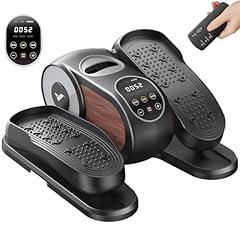
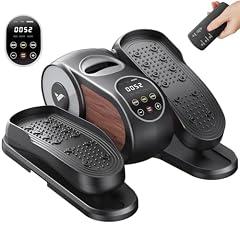
MERACH Under Desk Elliptical Exerciser
Overview
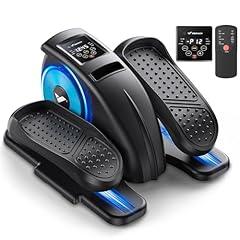
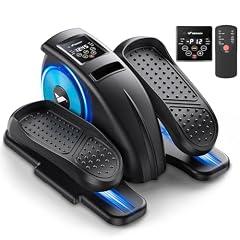
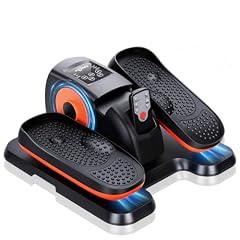
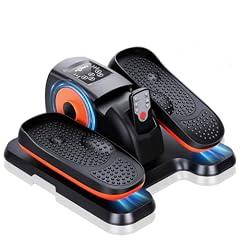
This is a compact, corded electric pedal exerciser for use while seated at a desk, sofa, or chair. It measures 17.5 by 15.4 by 9.7 inches, weighs 13.9 pounds, and uses a motor to move the pedals in forward or reverse. Manufacturer documentation specifies 12 manual speed levels, 12 automatic programs, a remote, foot straps, a 60 W power rating, and a 15-minute automatic shutoff. The manual clearly says not to stand on it, to use it only while sitting, and to place it on a level stable surface. That is important because this is not a conventional standing elliptical or a substitute for full-body aerobic training. Research on seated pedaling supports increased energy expenditure versus sitting, but the product has no model-specific exercise-intensity validation. Its stated 400-pound capacity and under-15 dB noise claim are manufacturer claims, not independently verified test results.
What works
- Ready to use without assembly, which avoids user assembly errors and supports simple seated setup.
- The manual includes meaningful powered-use precautions, including unplugging before cleaning, keeping the cord clear, avoiding liquids, and allowing the product to cool if it stops.
- Remote control and foot straps can make seated operation more manageable for users who should avoid repeated bending.
- A named manufacturer, model-specific manual, US and Canada support phone number, and one-year warranty improve traceability.
What does not
- No model-specific UL, ETL, CSA, or accredited laboratory safety listing was located for the product or its electrical system.
- The manufacturer markets rehabilitation, circulation, calorie-burning, and leg-disease-prevention benefits without product-specific human evidence. These are stronger claims than the evidence found supports.
- The display provides calories, distance, and speed, but the manual does not state an accuracy method, calibration protocol, or uncertainty. Research on elliptical and desk-pedaling displays shows that estimated energy data can be inaccurate.
- The 400-pound capacity, low-noise claim, and rubber-base stability claim lack accessible independent test reports. No parts catalog or repair manual was found.
Who is it for
It fits an adult who wants light, seated leg movement during reading, television, or desk work and has a stable chair, level floor, and adequate space under the desk. The remote can be useful for someone with limited ability to bend down, provided they can safely position both feet and follow the seated-only instruction. It is also suited to a buyer who values a compact, plug-in unit that arrives assembled. Any person beginning activity after illness, surgery, dizziness, cardiovascular symptoms, or mobility change should first ask a qualified clinician what intensity and duration are appropriate.
Who is it not for
It is not for standing exercise, high-intensity conditioning, or someone expecting a conventional elliptical workout with verified resistance and aerobic-dose data. Do not use it where children or pets can reach the moving pedals or cord, on an unstable chair or uneven floor, or near water, bedding, or blocked ventilation. It is also unsuitable as self-directed rehabilitation for a new injury, neurologic condition, circulation problem, or post-surgical recovery because the rehabilitation marketing is not matched by product-specific clinical evidence. Buyers needing verified electrical certification or repair-part availability need more documentation.
Integrity
Seated pedaling and other under-desk movement can raise energy expenditure above quiet sitting, and public-health guidance supports moving more and reducing sedentary time. This product's motorized motion may support light movement breaks, but its manual does not establish that its settings reach moderate aerobic intensity. It should not be presented as a treatment, a disease-prevention device, or a guaranteed calorie-burn tool. The manual identifies Zhejiang Yulu Electronic Technology as manufacturer, gives support contacts, and specifies a one-year warranty. It also gives cord, heat, water, supervision, and seated-only warnings. A model-specific independent US electrical safety listing, ASTM performance report, material declaration, US chemical disclosure, take-back program, and replacement-parts catalog were not located. The manual directs users to keep electronic equipment and batteries out of household waste, which is sensible, but US buyers should use local electronics and battery recycling options.

Niceday Elliptical Machine with Magnetic Resistance
Overview
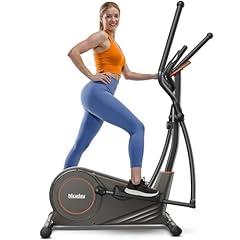
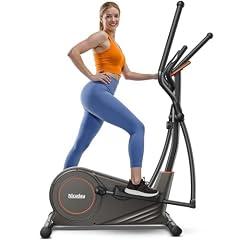
This is a compact, manually driven home elliptical with moving handlebars, a magnetic resistance system, fixed 15.5 inch stride, contact pulse grips, and a simple battery-powered monitor. The product record states 16 resistance levels, a 400 lb maximum user weight, a 100 lb machine weight, and a 39 by 21 inch floor footprint. Its manual limits use to people over 13 and to home or office settings. Elliptical exercise can provide meaningful aerobic work when effort and duration are progressed appropriately. Human studies show that resistance, stride rate, and use of the arms can raise oxygen use and perceived effort. That evidence supports the exercise format, not this product's unverified performance claims. The manufacturer supplies a basic assembly and safety manual, but no model-specific independent safety test report or third-party certification was located.
What works
- The elliptical format can support aerobic exercise when resistance, pace, and session length are adjusted to the user's capacity.
- The manual directs users to use a solid, level floor, tighten fasteners, keep children and pets away, and stop use for unusual noise or defective parts.
- The manual requires a 10 minute post-assembly check for rough movement, unusual sounds, and monitor problems.
- An exploded parts view and named support email provide a starting point for identifying assembled components and requesting service.
What does not
- No model-specific independent safety certification, accredited laboratory report, or ASTM test report was located.
- The monitor reports calories, distance, speed, and pulse, but the documentation gives no validation method. The manual also says pulse readings are not for medical treatment.
- The manufacturer states that the 15.5 inch stride minimizes knee stress and that operation is quieter than breathing, but no product-specific biomechanics or acoustic test evidence was located.
- Warranty information is inconsistent. The product record states one year, while the brand site describes lifetime service and replacement coverage without clear product-specific terms.
Who is it for
This product suits an adult home exerciser who wants a compact, self-powered elliptical for steady indoor aerobic sessions, can assemble it carefully, and has a stable level floor. It is most appropriate for someone comfortable using perceived exertion, session time, and general activity goals rather than treating the calorie or pulse display as precise. The stated 400 lb user limit and 15.5 inch stride are manufacturer claims, so users near the limit or with unusual fit needs should confirm comfort and stability before relying on those figures.
Who is it not for
It is not suited to children under 13, commercial gyms, public exercise rooms, or anyone unable to inspect and periodically tighten fasteners. People with balance limitations, recent falls, severe joint symptoms, or conditions requiring supervised exercise should seek individualized clinical or rehabilitation guidance before using a standing moving-pedal machine. It is also a poor fit for users who need medically reliable pulse data, validated calorie measurements, independently verified load testing, or documented low-noise performance for a shared living environment.
Integrity
The strongest health point is the activity format, not a special product effect. Federal physical activity guidance supports regular aerobic activity, and research on elliptical trainers shows that resistance and arm use can increase exercise demand. The manual appropriately warns against excessive exercise, asks users to consult a clinician when needed, and says that contact pulse readings are not for medical treatment. No model-specific recall was identified in the U.S. CPSC recall search, but that does not establish independent safety verification. No UL, ETL, CSA, or accredited laboratory listing was located for this product. The product is described as commercial steel, while plastics, coatings, electronics, chemical disclosures, recycled content, and take-back options were not documented. The monitor is battery powered, so its battery should be removed and handled through local battery recycling channels at end of life.

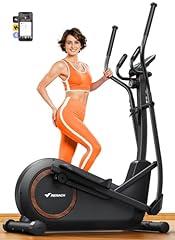
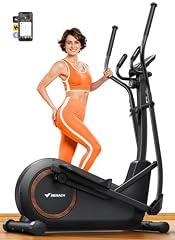
MERACH Elliptical Exercise Machine with Heart Rate Monitor
Overview
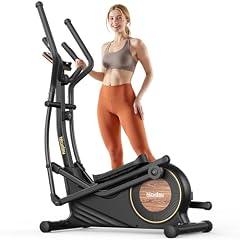
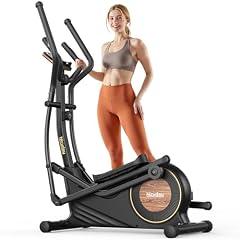
This is a full-size, home-use, standing elliptical trainer with moving pedals and handlebars, magnetic resistance, a small workout display, Bluetooth connectivity, and a stated self-generating power system. The available manufacturer page for the related E27 version describes 16 manual resistance levels, a 470 mm stride, and no need for a wall outlet. Its manual lists a 400 lb user limit and a 130.5 lb machine weight. The documentation gives practical safety directions, including level flooring, 2 feet of clearance, regular bolt checks, keeping children away, and entering or exiting only with a pedal at its lowest position after motion stops. However, the product record and available E27 documentation conflict on resistance control, resistance-level count, stride, and user limit. No model-specific independent safety or performance test report was located.
What works
- The available manual gives concrete entry, exit, clearance, clothing, maintenance, and moving-part safety instructions.
- Manufacturer documentation describes 16 manually adjustable magnetic resistance levels, which can support gradual workout-intensity changes.
- The related E27 version is manufacturer-stated to be self-powered, avoiding a wall power connection during normal use.
- A named manufacturer, U.S. contact route, serial-number field, assembly guide, and limited warranty documentation are available.
What does not
- The product record conflicts with the available E27 documentation on automatic versus manual resistance, 8 versus 16 levels, stride length, and 330 versus 400 lb capacity.
- No model-specific UL, ETL, CSA, or accredited laboratory safety and performance report was located for the U.S. product.
- The display shows speed, distance, calories, and resistance, but the manual does not disclose measurement methods or validation. Calorie values should be treated as estimates.
- The supplied manual's EU conformity declaration names a different product, which weakens confidence in its certification documentation.
- No materials declaration, U.S. chemical disclosure, parts catalog, or measured noise and vibration report was located.
Who is it for
It suits an adult home exerciser who wants a standing, self-powered elliptical format and is comfortable assembling, inspecting, and maintaining a 130 lb machine. It is most appropriate for someone with stable level floor space, at least 2 feet of surrounding clearance, and the balance needed to step on and off moving pedals. Adjustable magnetic resistance can support progression from easier to harder aerobic sessions, provided intensity is guided by exertion and health needs rather than calorie-display numbers.
Who is it not for
It is not a good fit for children, for anyone unable to safely stand, balance, or mount and dismount a moving-pedal machine, or for people who need seated exercise or clinical rehabilitation equipment. People with heart, blood-pressure, medication, mobility, or balance concerns should follow the manual's direction to consult a clinician first. It is also unsuitable where the stated capacity, stride, or resistance type must be certain before installation, because the product record and available documentation do not agree on those specifications.
Integrity
Elliptical exercise can provide meaningful aerobic work when resistance and stride rate are matched to the user. Human studies show that increasing elliptical resistance and stride rate raises oxygen consumption, perceived exertion, and heart-rate response. Public-health guidance supports accumulating regular moderate or vigorous aerobic activity, but the product itself does not establish a medical outcome or guaranteed calorie burn. The manual includes useful injury-prevention directions and identifies a 400 lb limit for the related E27 documentation, but no U.S. independent electrical or equipment-safety listing was found. Its printed CE and UKCA discussion is not U.S. certification, and the associated EU declaration names another product. The manual recommends inspecting, lubricating, and tightening moving parts, and it provides recycling guidance for packaging, electronics, and batteries. It does not provide a material or chemical declaration, a U.S. take-back program, or measured noise data. No model-specific CPSC recall was located in the searches performed.

Electric Under Desk Elliptical Machine
Overview
This is a corded, motor-driven under-desk pedal machine intended for use while seated, rather than a conventional stand-on elliptical. The manufacturer describes a 60 W unit with a 15.6 by 14.9 by 7.4 inch footprint, remote and touch controls, forward or reverse motion, and a stated 250 pound user limit. It is supplied ready to use, according to the manufacturer. A manual independently hosted online identifies 12 manual speed settings from 42 to 95 rpm and 12 automatic programs that stop after 15 minutes. It also says the motor has overheating protection and that standing or exceeding the maximum load can trigger protective operation. These are manufacturer documents, not independent performance or safety test results. The available human evidence supports aerobic effects from appropriately intense elliptical exercise generally, but it does not validate this seated, motor-assisted product's calorie, rehabilitation, or cardiovascular claims.
What works
- The manufacturer provides specific manual speeds, from 42 to 95 rpm, rather than only unnamed intensity levels.
- Automatic programs are documented to end after 15 minutes, and the manual describes motor-overheating protection.
- The manufacturer gives clear seated-only guidance and a stated 250 pound maximum user weight.
- A named U.S. business address, phone number, email contact, and warranty route are published by the manufacturer.
What does not
- No model-specific UL, ETL, CSA, accredited laboratory, or ASTM safety and performance test record was located for the product or its power system.
- The display reports calories, distance, speed, time, and count, but no validation method or accuracy data was found. Research on conventional ellipticals shows calorie estimates can overstate individual energy expenditure.
- Marketing makes rehabilitation, circulation, joint-protection, and rapid-recovery claims that are not supported by product-specific human evidence.
- Warranty messaging is inconsistent. The product page states a 12-month warranty, while the manufacturer site also displays a two-year warranty message. No model-specific spare-parts catalog or repair manual was located.
- The stated below-15 dB noise figure and eco-friendly design claim lack an acoustic test report or material disclosure.
Who is it for
It suits a seated home-office or living-room user who wants gentle, short-duration leg movement in a small footprint and can place the unit on a level floor with enough knee and desk clearance. It is also a practical format for an adult who cannot safely use a standing elliptical, provided they remain seated and stay within the stated 250 pound limit. The remote can reduce bending to reach controls. Users with a clinician-approved activity plan can use the defined speed settings to start conservatively.
Who is it not for
It is not for anyone expecting a substitute for independently verified aerobic training equipment, strength training, or a full-size elliptical workout. Do not stand on it, and keep children and pets away while its motorized pedals are moving. People with recent surgery, an acute leg injury, unstable balance, pregnancy concerns, heart disease, blood-pressure concerns, or unexplained pain should not rely on its rehabilitation marketing and should seek individualized medical guidance first. It is also unsuitable where desk height, chair position, or floor space forces cramped knee movement.
Integrity
The product has a defined seated-use format, manual speed range, 15-minute automatic shutoff, and a stated motor-overheating protection feature. Its manufacturer says it should not be stood on and advises medical consultation for users with relevant health conditions. Those limits matter because the available research concerns conventional elliptical exercise, not this exact motor-assisted seated design. There is no independent evidence that this product treats injury, improves circulation, prevents tissue problems, or produces a particular calorie burn. No U.S. recall or regulatory action specific to this product was located in the CPSC recall records searched. MERACH identifies a U.S. contact and warranty channel, but independent electrical certification and model-specific safety testing were not located. The manufacturer describes alloy steel construction and an eco-friendly design, yet provides no material declaration, chemical disclosure, take-back program, acoustic report, or product-specific repair-parts catalog. Remote-control AAA batteries and electronic components should be handled through local battery and electronics recycling programs when discarded.

YOSUDA Pro Cardio Climber Elliptical Machine
Overview
This is a manually driven, upright home cardio climber that combines a stepping and elliptical-style pedal path. It has magnetic resistance, moving and fixed handholds, a battery-powered LCD console, and a stated 300-pound user limit. The listed footprint is 38 by 21 by 62 inches, and the unit weight is about 95 pounds. The documented instructions tell users to place it on a flat, stable surface, center their feet on the pedals, inspect for loose or worn parts, and keep children and pets away while it moves. The manufacturer states 16 resistance settings and a 45-degree climbing motion. However, published product materials conflict on stride length, with current sales material stating 15.5 inches while other model documentation states 18 inches. There is no located model-specific independent safety certification, endurance report, acoustic test, or validation of the console's calorie and pulse readings.
What works
- The manual gives concrete setup and use precautions, including level-floor placement, pre-use inspection, footwear, and a 300-pound maximum user weight.
- Magnetic resistance and 16 stated settings can support gradual changes in exercise intensity, although the settings have not been independently characterized.
- The machine is manually propelled and its console uses batteries, so normal use does not require a mains cord across the workout area.
- YOSUDA publishes a support contact, a general limited-warranty policy, and a direct-purchase repair route that can supply replacement parts for eligible defects.
What does not
- Stride information is contradictory. Current sales material says 15.5 inches, while other documentation for the same model says 18 inches, making fit assessment less reliable.
- No model-specific UL, ETL, CSA, or independently accessible ASTM safety and performance test record was located.
- The display's calorie, distance, speed, and hand-pulse readings have no stated test method or independent validation. Research on elliptical consoles has found manufacturer calorie estimates can overstate expenditure.
- The advertised 26 dB noise figure and claims of millions of quiet cycles were not supported by an accessible acoustic or durability test report.
- Warranty descriptions conflict across available materials, with a one-year listing warranty, a general limited warranty with component-specific periods, and third-party hosted documentation claiming five-year service.
Who is it for
It suits an adult home user who wants a compact, manually powered standing cardio machine and can work within the stated 300-pound limit. It is most practical for someone able to step on and off a moving-pedal machine while holding the fixed handles, who has a level floor and enough clearance around a 62-inch-tall frame. The 16 manufacturer-stated resistance settings offer a simple way for a beginner or regular exerciser to progress effort gradually. Users should treat the display as a motivational timer and trend tool, not a clinical or calorie-measurement device.
Who is it not for
It is not a good fit for a buyer who needs independently certified equipment, verified console accuracy, or a documented acoustic rating for close quarters. People with balance limitations, a recent fall, severe joint symptoms, or medical restrictions should not assume a climbing pedal path is suitable without individualized clinical guidance. Taller users should be cautious because the published stride figure is inconsistent. It also does not suit households where children or pets can approach the moving pedals during use, or users above the stated 300-pound maximum.
Integrity
Elliptical and stair-climbing exercise can produce meaningful aerobic demand when intensity and duration are appropriate. Human studies show that higher elliptical resistance and stride rate increase oxygen consumption and heart-rate response. Public-health guidance supports building toward 150 minutes weekly of moderate aerobic activity for most adults, with personal adjustment for health status. This product's 16 stated resistance settings make progression plausible, but its exact workload and display accuracy have not been independently verified. No product-specific recall or U.S. exposure warning was located in the checked sources. The available manual includes basic moving-equipment precautions, but no identifiable independent safety listing or public ASTM test report was found. Materials are not meaningfully disclosed beyond broad steel and plastic descriptions in third-party sales documentation. No take-back or end-of-life recycling program for this model was located. The brand does publish general warranty and repair contacts, but available warranty descriptions are inconsistent.

UMAY Magnetic Elliptical Trainer
Overview
This is a standing, rear-drive home elliptical with moving and fixed handlebars, magnetic resistance, pedal straps, pulse grips, a battery-powered LCD monitor, and transport wheels. An independently hosted manual identifies the ET70 as an 89-pound alloy-steel machine measuring 45 by 25 by 63 inches, with a 15.5-inch maximum stride, eight resistance levels, and a 350-pound user limit. The retail product page instead states a 16-inch stride, 16 resistance levels, and a 400-pound limit. Those material conflicts were not reconciled by an official ET70 product page or model-specific test report. Elliptical exercise can support aerobic activity when intensity is progressed appropriately, but the evidence applies to the exercise format, not to this exact product. The display labels calories as an estimate, which is more appropriate than presenting a calorie figure as measured fact.
What works
- A manual gives concrete setup, entry, maintenance, and troubleshooting instructions, including checking bolts, pedal straps, and stability.
- The magnetic-resistance elliptical format can support progressively dosed aerobic exercise when the user selects an appropriate pace and resistance.
- The monitor is documented to show time, speed, distance, pulse, and estimated calories, which can help structure sessions.
- A one-year warranty is stated, and UMAY publishes a US support phone number and email address.
What does not
- The available ET70 documentation conflicts with the retail page on resistance range, stride length, and maximum user weight. The lower 350-pound limit is the prudent ceiling until the exact configuration is documented.
- No model-specific UL, ETL, CSA, ASTM, or accredited laboratory safety and performance certification was located.
- No independent validation was located for resistance levels, pulse-grip readings, distance, or calorie estimates.
- The quiet-operation claim has no published decibel or vibration test, and no official ET70 parts catalog or material declaration was located.
Who is it for
It suits an adult seeking a basic, manually adjusted home cardio machine who can use a standing elliptical safely, has a level dedicated floor area, and is comfortably within the more conservative documented 350-pound limit. It is most appropriate for self-paced sessions where time, perceived effort, and the displayed pace are used as rough guides rather than precise physiological measurements. Users should be prepared to inspect fasteners, keep pedal straps in good condition, and perform routine cleaning and lubrication checks.
Who is it not for
It is not suitable for anyone above 350 pounds, despite the higher retail-page capacity claim, until UMAY supplies model-specific documentation resolving that conflict. It is also a poor fit for people with poor balance, recent falls, severe joint instability, or symptoms that make standing exercise unsafe without clinical guidance. Taller users or people sensitive to stride geometry should not rely on the listed 16-inch stride because the available ET70 manual says 15.5 inches. Households needing independently certified equipment or low-noise proof should choose equipment with that evidence.
Integrity
Research on elliptical trainers supports their use for aerobic exercise. Studies show that increasing resistance and stride rate raises oxygen consumption and heart-rate response, while combined arm and leg use increases oxygen consumption compared with leg-only use. Federal activity guidance recommends adults accumulate 150 to 300 minutes of moderate aerobic activity weekly, with intensity adjusted to individual ability. The product documentation includes sensible safety directions, such as using a flat stable surface, tightening fasteners, holding the handlebars when stepping on, and keeping children and pets away during use. However, no model-specific independent safety listing or laboratory report was found. Alloy steel is stated for the frame, but coatings, plastics, electronics, battery chemistry, chemical disclosures, recycling instructions, and a take-back program were not documented. The published maintenance guidance may extend service life, but replacement-part availability remains unverified.

Putnen Under Desk Elliptical Machine for Home
Overview
This is a compact, plug-in seated pedal machine for use under a desk or in front of a chair. The available manual describes motor-driven forward and reverse pedal motion, 12 speed settings, three automatic programs, an LCD, and a remote. It says the product is for seated use only, should sit on a stable flat surface, and should be unplugged before cleaning. Those operating details are manufacturer-stated, not independently tested. The documentation is materially inconsistent. The catalog lists an 8.1-pound, 14.76 by 13.78 by 6.3-inch product, while an independently hosted version of the manual identifies the same part number but states 13.7 pounds and 16.3 by 12.4 by 9.6 inches. The brand website also describes a different manual, partially assembled product. These conflicts make clearance planning, portability, and stated capacity less reliable than they should be.
What works
- The manual gives practical seated-use safety directions, including stable-floor placement, keeping children and pets away, and not using a damaged cord.
- Remote controls and 12 manufacturer-stated speed levels can reduce the need to bend toward the floor during use.
- Seated pedaling has category-level human evidence for replacing some sedentary time in older adults, although that evidence was not conducted on this product.
- A two-year manufacturer warranty and basic inspection, cleaning, and troubleshooting directions are documented.
What does not
- The product’s dimensions and weight conflict across the catalog and the available manual, which complicates desk-clearance and portability planning.
- No model-specific UL, ETL, CSA, or comparable independent electrical safety listing, ASTM test report, or laboratory performance report was located.
- The stated 500-pound user recommendation is not explained for a seated device that does not support the user’s full body weight.
- The LCD provides calorie and distance figures, but no measurement method, accuracy tolerance, or independent validation is supplied.
- The brand site contains conflicting descriptions of manual operation, assembly, weight, and adjustment method, alongside unqualified health, quietness, and weight-loss testimonial claims.
Who is it for
It suits an adult who wants a small, seated movement option during reading, television, or desk time, has enough clearance beneath the desk, and can place it on a stable nonslip surface. It may be particularly practical for someone who values changing settings from a chair rather than reaching toward the floor. The intended use is gentle leg motion, not a full-body elliptical workout. Someone with a clinician-approved need to interrupt long sitting periods may find the format relevant, provided they start cautiously and follow their care advice.
Who is it not for
It is not for standing exercise, vigorous aerobic training, or anyone expecting the displayed calorie figure to be a validated energy measurement. People with unstable balance, reduced sensation, uncontrolled heart symptoms, recent surgery, painful joint movement, or a condition requiring prescribed rehabilitation should not treat the motorized motion as self-directed therapy. It also needs careful consideration in homes with children or pets because the pedals move under power. Buyers with very tight desk clearance should not rely on the conflicting published dimensions without measuring the delivered product.
Integrity
Human research on seated pedaling supports its use as a light activity that can replace some sedentary time, and a separate seated-elliptical study recorded heart-rate responses during a 30-minute session. Neither study validates this specific motorized product, its speed settings, its calorie display, or claims about circulation, rehabilitation, cognition, or weight loss. The product manual appropriately says to consult a physician before starting exercise, but the brand website goes further with broad health statements and a weight-loss testimonial without product-specific clinical evidence. No product-specific recall was located in the CPSC recall search, and the available documentation identifies a model and offers a two-year manufacturer warranty. However, no independent electrical certification or safety-performance test was located. Materials are described only as alloy steel, with no coating, plastic, electronics, hazardous-substance, or recycling disclosure. At end of life, the powered unit and remote batteries should be handled through appropriate electronics and battery recycling channels rather than ordinary recycling.

Niceday Elliptical Trainer with 18IN Stride
Overview
This is a manually driven, magnetic-resistance home elliptical with an 18-inch stated stride, 16 resistance settings, a stated 400-pound user limit, transport wheels, and a small battery-powered monitor. Independently mirrored specifications corroborate the 39.6 by 24.4 by 61-inch stated dimensions and iron construction, but they are not a laboratory verification of capacity, stride, or stability. Elliptical exercise can produce meaningful heart-rate, oxygen-consumption, and energy-expenditure responses when effort is sufficient. The product’s resistance range makes graduated aerobic sessions plausible, although no model-specific exercise testing was found. Its available manual gives useful basic precautions, including flat-floor placement, bolt checks, keeping children away, and avoiding moving parts. The manual located online is for a closely related CT11 model, not conclusively the exact 18-inch configuration.
What works
- The documented magnetic, user-driven format avoids a wall-powered drive system and its associated charger or unintended-motion hazards.
- Its stated 18-inch stride and 400-pound maximum user weight give buyers concrete fit limits to assess before setup, although neither figure was independently load-tested.
- The available manual instructs users to place it on a solid, level floor, tighten hardware before use, inspect fasteners regularly, and stop if unusual noise or defects occur.
- A parts list, assembly guidance, service email, and manufacturer-stated free replacement accessories provide a practical starting point for maintenance support.
What does not
- No model-specific UL, ETL, CSA, or equivalent independent safety listing, accredited test report, or ASTM performance report was located.
- The 400-pound capacity, 18-inch stride, 16 resistance settings, and stability claims are manufacturer-stated, not independently verified for this configuration.
- The monitor presents calories, speed, distance, and pulse, but no measurement method, accuracy tolerance, or independent validation was found. The related manual says pulse readings are not for medical treatment.
- Claims that the motion minimizes knee stress and that operation is quieter than breathing are not supported by model-specific human, acoustic, or vibration testing.
- No material declaration, coating chemistry disclosure, recycling program, or serial-number traceability information was located.
Who is it for
It suits an adult home exerciser who wants a self-powered elliptical for regular, effort-based cardio and has a clear, level location for a roughly 40 by 24-inch footprint. The stated 18-inch stride may be more comfortable than compact short-stride designs for users who want greater leg travel, provided they can test fit or confirm the return arrangement. It also fits households that prefer a basic battery display and manual resistance rather than a motorized machine or power-dependent console. Users should stay within the stated 400-pound limit and follow the setup and fastener-inspection instructions.
Who is it not for
It is not a suitable choice for anyone needing medically supervised exercise, clinically reliable pulse monitoring, or accurate calorie data. The available monitor guidance specifically says its pulse reading is not for medical treatment. It is also poorly matched to households with unsupervised children or pets around moving equipment, or to users unable to assemble, level, and periodically inspect a heavy machine. People who require independently certified load capacity, documented pinch-point guarding, verified low noise, or a robust published parts catalog should seek equipment with that evidence before relying on it.
Integrity
The health case is for aerobic activity performed at an appropriate effort, not for a product-specific weight-loss or therapeutic outcome. Human research shows elliptical exercise can create measurable heart-rate, oxygen-consumption, and energy-expenditure responses, and federal guidance supports regular aerobic activity. This product’s 16 stated resistance levels make progression plausible, but its advertised knee-comfort and quietness claims were not backed by model-specific testing. No recall for Niceday ellipticals was identified in the CPSC material searched, and the available manual provides basic moving-part, loose-clothing, level-floor, and hardware-check warnings. No independent safety certification or model-specific laboratory report was located. Iron is disclosed as the principal material, but there is no accessible disclosure for plastics, coatings, electronics, or chemical exposure, and no documented take-back or recycling program. The manufacturer states that replacement accessories are available, which could extend service life, but a public parts catalog was not found.
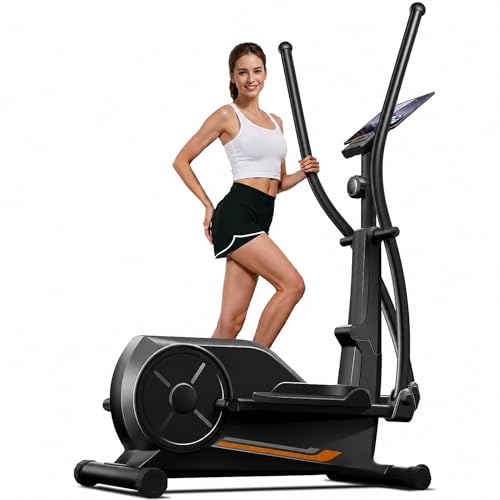
Cursor Fitness Elliptical Exercise Machine
Overview
This is a compact, manually driven home elliptical with magnetic resistance, an LCD monitor, and a listed 350-pound user limit. The product page identifies alloy steel as the material, lists eight resistance levels, and gives dimensions of 45 by 63 by 25 inches with a 72-pound product weight. These are manufacturer-stated specifications, not independently tested figures. Elliptical exercise can support aerobic activity when resistance, pace, and session duration are matched to the user. Human studies show that increasing resistance and stride rate raises oxygen consumption and perceived effort, while generic machine calorie calculations can overestimate expenditure. The product does not provide a model-specific test protocol for its resistance, display readings, noise, load rating, or safety performance. Its published stride information is also inconsistent, with product details stating 12 inches while the title presents 12 and 14 inches.
What works
- Eight manufacturer-stated magnetic resistance levels can help users pace workout intensity.
- The stated 350-pound maximum user weight is clearly presented on the product page.
- A one-year manufacturer-stated warranty provides a defined initial support period.
- The listed 72-pound weight and steel construction suggest a substantial stationary home unit, although durability testing was not provided.
What does not
- Stride length is not reliably specified. The product details say 12 inches, while the title also presents 14 inches.
- No model-specific independent safety certification, laboratory test report, or ASTM performance report was located.
- The LCD monitor has no published accuracy method, and calorie readings should be treated as estimates rather than measured energy use.
- No product manual, parts catalog, exploded diagram, or detailed repair route was located during verification.
- The hyper-quiet claim has no published sound or vibration measurement, and floor protection guidance was not found.
Who is it for
This product suits an adult seeking a basic, manually operated elliptical for self-paced indoor aerobic sessions, with enough available floor area for its stated 45 by 63 inch footprint. It is most appropriate for someone comfortable assembling and inspecting home fitness equipment, who can use eight stated resistance settings to progress gradually and who will judge exertion by breathing, effort, or an external heart-rate device rather than treating the LCD calorie figure as precise. The stated 350-pound limit should be respected.
Who is it not for
It is not well suited to users who need a confirmed stride length before purchase, including taller users or anyone managing hip, knee, or gait limitations. The published 12 and 14 inch stride claims conflict. It is also unsuitable for people needing independently certified load, stability, electrical, or display accuracy evidence, or clear replacement-parts support. People with balance limitations, recent injuries, or a condition requiring supervised exercise should favor equipment with explicit entry, exit, handhold, and clinical-use guidance.
Integrity
Elliptical training is a plausible route to moderate aerobic exercise when sessions are progressively dosed. Federal physical activity guidance recommends 150 to 300 minutes of moderate aerobic activity weekly for most adults. Research on elliptical trainers supports the basic mechanism, as greater resistance and faster stride rates increase exercise demand. That evidence supports the category, not this product's specific resistance calibration or calorie display. Verification did not locate a model-specific independent safety listing, laboratory report, manual, parts catalog, or measured noise result. The product page states alloy steel construction and a one-year warranty, but it does not provide a chemical disclosure, recycled-content documentation, take-back program, or end-of-life recycling instructions. Searches did not identify a product-specific U.S. recall or California exposure warning, but purchasers should retain product and seller records because the responsible manufacturer is identified only by the brand name on the listing.

Cursor Fitness Under Desk Elliptical Machine
Overview
This is a plug-in, seated under-desk pedal exerciser with motor-driven forward and reverse motion, a remote control, a small LCD, manual speed selection, and automatic routines. The available product manual specifies 12 speed levels, sessions adjustable from 15 to 30 minutes, and automatic programs that change speed every minute and direction every three minutes. These are manufacturer-stated operating details, not independently validated workout-intensity data. The same manual says it is for seated use only, calls for a flat stable surface, requires pedal installation with four screws, and specifies a 300-pound user recommendation. It lists a 10-inch maximum stride and dimensions of 14.33 by 13.5 by 6.14 inches. That conflicts with the catalog record's 15-inch stride claim, so fit information should be treated cautiously. The manual also displays calories, distance, speed, and time, but gives no measurement method or accuracy tolerance.
What works
- The manual gives clear seated-only, flat-surface, child-and-pet separation, and periodic screw-check instructions.
- Manufacturer-stated remote control can reduce repeated bending to reach the controls during seated use.
- Manufacturer-stated manual and automatic modes allow changes in speed and pedaling direction without standing on the product.
- A one-year manufacturer-stated warranty covers manufacturing defects.
What does not
- No model-specific UL, ETL, CSA, ASTM, or accredited laboratory safety or performance certification was identified.
- The stated 10-inch stride in the available manual conflicts with the catalog record's 15-inch stride claim.
- Calories, distance, and speed appear on the display, but no validation method, accuracy tolerance, or calorie-estimation basis was provided.
- The under-15-decibel noise claim has no disclosed acoustic test method, distance, load, or operating condition.
- No replacement-parts catalog, serial or batch traceability instructions, material declaration, or end-of-life take-back program was located.
Who is it for
This product is most suited to an adult who wants gentle seated leg movement at a desk, on a sofa, or during other stationary activities, and who has enough under-desk knee clearance for the documented 10-inch motion. It is most practical for someone able to place it on a level surface, secure the pedal screws, keep children and pets clear, and use the supplied remote. The adjustable 15 to 30 minute sessions may help an inactive adult start with short movement periods, then build activity gradually.
Who is it not for
It is not appropriate for standing exercise, users who need a body-weight-supporting elliptical, or anyone expecting verified resistance levels, heart-rate monitoring, or clinically validated calorie readings. People with a pacemaker should follow the manual's instruction not to use it unless their clinician says otherwise. Anyone recovering from surgery, with unstable balance, severe joint symptoms, impaired sensation, or a condition requiring supervised rehabilitation should seek individualized clinical advice rather than rely on the product's general circulation or rehabilitation-style marketing. Homes with unsupervised children or pets near moving pedals also need a more controlled setup.
Integrity
Seated pedaling can contribute to physical activity only when it raises effort to an appropriate individual intensity and is accumulated over time. Federal guidance supports gradually building toward 150 to 300 minutes weekly of moderate aerobic activity, plus muscle-strengthening activity on two days. Research on full-size ellipticals shows that speed and resistance can change oxygen use and heart-rate response, but that evidence does not validate this product's motor settings, calorie display, or health outcomes. The manual's pacemaker caution and advice to consult a clinician before a new exercise program are important. The product is described as aluminum, but no material declaration for coatings, plastics, electronics, remote batteries, or external power equipment was located. No independent electrical listing, chemical disclosure, recycling plan, or take-back program was found. The manual specifies a one-year warranty and basic screw inspection, but no parts catalog or service manual was identified. No product-specific U.S. recall was found in the reviewed CPSC sources, although absence of a recall is not independent safety verification.