
10 Best Dutch Ovens
 Lauren Wilson
Please note that we participate in affiliate marketing programs. When you purchase through links on our site, we may earn a commission. As an Amazon Associate we earn from qualifying purchases. This comes at no additional cost to you and helps support the resources required to provide valuable content.Advertising Disclosure
Top-rated Dutch Oven Comparison
1

2


4

5

6
7

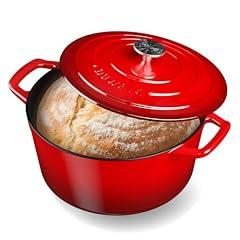
8

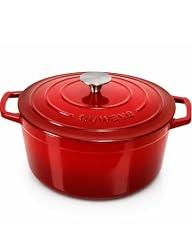
9
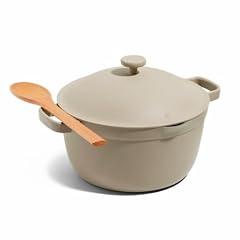
10
Dutch ovens: what to look for
A Dutch oven is a covered cooking vessel for stovetop simmering, searing, braising, roasting, soups, stews, and bread baking. Traditional versions use cast iron; enameled models add a food-contact surface over the iron, while some lighter products use aluminum, stainless steel, and ceramic nonstick materials. The right choice depends less on a headline capacity or oven number than on whether the materials, limits, care instructions, and remedy process are clearly documented for the exact product.
Start with the cooking surface. Enameled cast iron is not the same as bare or pre-seasoned iron: it does not require routine seasoning when intact, and evidence about iron transfer from bare iron should not be treated as a benefit of intact enamel. For either enamel or a coating, look for product-specific extraction results for lead, cadmium, and other relevant metals under heated, acidic-use conditions. The strongest evidence would identify the exact model and color, use an ISO/IEC 17025-accredited laboratory, describe the extraction method, and report pass/fail limits tied to applicable U.S. benchmarks. A general “non-toxic,” “chemical-free,” “lead-free,” or “food-safe” statement is not equivalent.
Check the complete hot-use specification, not just the pot’s oven rating. The lid, knob, handles, and hardware must remain secure and usable at the stated temperature and when the vessel is full. A 500°F or 900°F claim is still a manufacturer-stated limit unless supported by testing, and the highest number may not apply equally to the lid, knob, or included accessories. Cooktop compatibility, broiler use, empty preheating, sudden cooling, refrigerator-to-oven transfers, and dishwasher care can also have separate restrictions.
Capacity figures can mislead. A listed 5- or 6-quart size does not describe usable space, depth, cooking area, or how easily the vessel can be lifted when full. Weight figures can be unreliable when listings conflict, and cast iron becomes substantially harder to handle after food and a hot lid are added. Dimensions may describe the outside rather than the cooking cavity. Buyers should match the shape to the job: a shallow braiser favors browning and smaller covered meals, a deep round pot favors soups and batch cooking, and a divided or rectangular vessel may be intended mainly for smaller loaves.
For durability, look for thermal-shock and enamel-integrity evidence, clear instructions to stop using the product if food-contact enamel chips or crazes, and care guidance covering heat, cooling, utensils, cleaning, and storage. A useful warranty should identify exclusions and provide a real contact route; spare lids, knobs, or other parts can matter more than a broad lifetime claim. Independent verification is stronger when an exact product appears in an NSF listing or is supported by a traceable certificate or full report from an accredited laboratory or recognized certification body.
Across the supplied products, recurring caveats are important: no exact-product accredited migration report was located for any product; independent certification was generally absent; many products were heavy when empty; and enamel care commonly required hand washing, gradual cooling, and avoiding abrasives or metal tools. Several listings had contradictory or unreliable capacity, weight, dishwasher, material, or temperature information. Buyers should not use chipped, cracked, crazed, or badly damaged food-contact enamel, and should not assume a recall search or a return policy proves chemical safety. Products described as bare or pre-seasoned cast iron also need material-specific guidance for long acidic cooking, because acidity, moisture, and cooking time can affect iron transfer.
Integrity
The supplied reviews show a consistent pattern: operating information is often more complete than product-specific chemical and independent-testing evidence. The scores below therefore distinguish documented instructions and remedies from claims that remain unsupported.
HHealth & Safety
Food-contact chemical safety
This measures extraction evidence for lead, cadmium, and other metal migration from enamel, exposed iron, or coatings under heated, acidic conditions. It matters because a Dutch oven commonly holds moist or acidic foods for long periods. Scores ranged from 68 to 72: the higher-scoring products had clearer material descriptions or claim documentation, but none had the exact accredited migration report that would provide the strongest evidence.
Surface stays safe in use
This covers resistance to enamel cracking, crazing, chipping, corrosion, or loss of a food-contact coating, plus clear stop-use advice. Dutch ovens face thermal shock, heavy lids, abrasive cleaning, and hot-to-cold transitions. Scores ranged from 62 to 76. Higher-scoring products supplied more concrete cooling and cleaning instructions; lower-scoring products lacked thermal-shock results or clear instructions for damaged enamel.
Safe when hot and heavy
This measures whether the pot, lid, knob, and handles have credible temperature limits and secure, usable hardware for a filled vessel. Cast iron is difficult to move when hot, so lid and handle guidance matters as much as the oven number. Scores ranged from 68 to 78. Higher scores reflected specific manuals and lid-limit information; lower scores relied mainly on listing claims.
Iron-transfer and acidic-food guidance
This distinguishes bare or pre-seasoned iron from enamelled or coated cooking surfaces and checks whether acidic-food and iron-transfer guidance is accurate. Bare iron can transfer more iron with acidic, moist, long cooking, while intact enamel is not presented as a dietary iron source. Scores ranged from 52 to 80; the lowest reflected contradictory enameled and pre-seasoned descriptions, while higher scores clearly explained the material distinction.
EEvidence
Claims match the evidence
This checks whether claims such as chemical-free, non-toxic, PFAS-free, lead-free, FDA-approved, oven-safe, or dishwasher-safe are precise and supported for the exact product. Dutch-oven listings often combine broad safety language with limited testing or conflicting care data. Scores ranged from 52 to 73. Higher scores used narrower, documented claims; lower scores included broad chemical-free wording, unsupported certification language, or contradictory specifications.
Independently verified, not just claimed
This measures exact-product verification by an accredited laboratory, recognized certifier, or traceable certificate rather than seller assertion. For this category, useful evidence would include an ISO/IEC 17025 report or an applicable NSF listing matched to the model. Scores ranged from 68 to 70, but the reviews found no exact-product accredited report or recognized independent certification for the supplied products, so these scores should not be read as proof of certification.
Know what it is and who stands behind it
This measures disclosure of manufacturer or responsible U.S. business, country of origin, base metal, enamel or coating type, dimensions, capacity, and customer contact. Exact identity is needed to match a test report or obtain a remedy. Scores ranged from 68 to 83. Higher scores had model-specific manuals, support contacts, and manufacture information; lower scores lacked origin, importer, warranty, or parts details.
Reliable cooking limits
This checks whether capacity, dimensions, cooktops, oven and lid limits, broiler use, dishwasher care, and restrictions are complete and internally consistent. Dutch-oven listings frequently conflict on dishwasher safety, material, weight, or the temperature that applies to the lid. Scores ranged from 54 to 78. Higher scores came with model-specific manuals and concrete cooktop and lid guidance; lower scores depended on reseller listings or contained material and measurement contradictions.
Recall record and remedy readiness
This checks for unresolved U.S. safety actions involving the exact product, brand, importer, or materially identical item, along with a usable refund, replacement, or contact route. A clean search is not certification, but a defined remedy still matters for heavy cookware and damaged finishes. Scores ranged from 70 to 76. Higher scores generally had documented returns, warranties, or support contacts; lower scores lacked clear remedy terms.
EEcology
Built to last rather than replace
This measures construction, finish durability, warranty support, spare parts, and damage guidance that can extend safe service life. A durable cast-iron body can reduce replacement, but damaged food-contact enamel must not be kept in use simply to avoid waste. Scores ranged from 69 to 76. Higher scores included clearer manuals, storage guidance, or longer defect coverage; most products lacked spare-lid or knob programs.
Lower waste across its life
This considers packaging disclosure, reuse, realistic disposal guidance, and the end-of-life implications of heavy ferrous metal with enamel or seasoning. Cast iron may enter scrap-metal channels, but local acceptance of enameled cookware must be confirmed. Scores ranged from 68 to 72. The higher-scoring products had some packaging or material information, while most supplied no take-back, packaging, or product-specific recycling instructions.
Full reviews

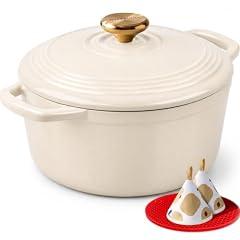
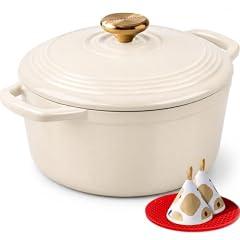
Overmont Dutch Oven 5.5QT
Overview
This is a round, 5.5-quart enameled cast-iron Dutch oven with a matching cast-iron lid, intended for braising, soups, stews, roasting and covered bread baking. The product includes cotton handle covers, a heat-resistant pad and a recipe booklet. Its listed warm-white finish is part of a larger color range sold by Overmont. Overmont states that the pot has cast iron beneath enamel, works on gas, electric, ceramic and induction cooktops, and is oven-safe to 500°F. The company also specifies hand washing and advises against abrasive tools and dishwasher use. A linked Intertek Shanghai report records non-detectable lead and cadmium in six internal-surface extracts from a cast-iron enamel pot using FDA-referenced methods. However, the one-page report does not identify this exact color or product version, report date, sampling chain, or laboratory accreditation scope.
What works
- The enamelled cooking surface removes the need to season the food-contact interior, according to the manufacturer.
- Manufacturer-stated 500°F oven limit and induction, gas, electric and ceramic compatibility support common stovetop-to-oven recipes.
- A linked Intertek report found lead and cadmium not detected in six internal enamel-surface extracts, below the FDA large-hollowware action levels stated in the report.
- The company publishes cooling, hand-washing, drying and non-abrasive-cleaning guidance, which is relevant to preserving enamel and preventing rust at exposed iron edges.
What does not
- The available migration report is not traceable to the exact warm-white product, and it lacks a visible test date, sample photographs and chain-of-custody details.
- Overmont's broad PFAS-free and toxin-free language is not matched by a public chemical test report covering PFAS or all substances implied by the word toxin.
- No public ASTM C385 or ISO 2747 enamel thermal-shock result was located for this product, so long-term chip and craze resistance remains unverified.
- The warranty is manufacturer-stated as one year, and no public spare-lid or replacement-knob catalog was located.
- The published product information does not clearly identify country of origin, enamel formulation, a responsible U.S. business address, or a direct parts pathway.
Who is it for
It suits a home cook who wants a medium family-size covered pot for soups, braises, chili, pot roasts and occasional bread baking, and who can safely handle a heavy cast-iron vessel. It is particularly relevant for cooks using induction or moving food from a compatible stovetop to an oven no hotter than 500°F, based on Overmont's stated limits. The buyer should be prepared to hand wash, let the pot cool before cleaning, use non-abrasive tools and dry it thoroughly.
Who is it not for
It is not a good fit for anyone who needs independently documented testing tied specifically to the exact color and production run, or who needs a traceable third-party certification rather than a seller-linked test report. It also does not suit people unable to manage a heavy, hot pot and lid, despite the included cotton covers. Avoid it for dishwasher-based cleanup, microwave use, abrasive scouring, or recipes requiring temperatures above the manufacturer-stated 500°F limit. Do not continue normal food use if enamel is materially chipped or damaged.
Integrity
The food-contact surface is enamel rather than bare cooking iron, so the product does not depend on seasoning for its normal interior use. A linked Intertek report using FDA-referenced extraction methods reported lead and cadmium as not detected on six enamel-pot internal-surface samples. FDA's large-hollowware action levels are 1.0 mg/L for lead and 0.25 mg/L for cadmium. The limitation is traceability, because the report does not visibly tie the sample to this precise warm-white product or show a current accreditation scope. No relevant Overmont cookware recall or FDA regulatory action was located in the checked U.S. sources. The solid ferrous-metal body has a realistic scrap-metal recovery route at end of life, but Overmont does not publish packaging composition, take-back instructions, or specific disposal guidance. EPA identifies ferrous metals as a recyclable material stream, although local recyclers set acceptance rules for enamelled cookware.

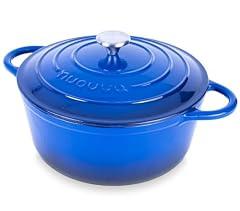
Nuovva 6.4-Quart Cast Iron Dutch Oven
Overview
The Nuovva 057 is a round, deep enameled cast-iron Dutch oven with a cast-iron lid, listed for braising, stews, roasting, and bread baking. An independent retailer record matching this product identifies the dark-blue unit as 28 cm and 6.1 liters, which corresponds closely to the listed 6.4-quart capacity. Its listed weight is about 6.46 kg, so safe two-handed handling matters when it is full. The 500 F oven rating, non-stick wording, and enamel finish are manufacturer-stated. Publicly available material reviewed for this assessment did not include an exact-product instruction manual, thermal-shock result, lead and cadmium extraction report, accredited laboratory report, or third-party food-equipment certification. The product is therefore identifiable as enameled cast iron, but its food-contact and high-temperature claims are not independently substantiated for this exact unit.
What works
- The product's 28 cm, roughly 6.1-liter format is independently corroborated by a retailer record matching model 057.
- An enamel-coated cooking surface means this is not a bare or pre-seasoned cast-iron pot, so routine seasoning is not required.
- Manufacturer guidance published for a closely related 6.4-quart Nuovva Dutch oven advises low to medium heat, gradual cooling, non-abrasive cleaning, and protected storage, all sensible practices for preserving enamel.
- No exact-product CPSC recall, FDA recall, or public safety action was identified in the searches reviewed.
What does not
- No product-specific acidic-food extraction report was found showing lead, cadmium, or other metal migration results for the exact color and cooking surface.
- No current independent certificate, accredited laboratory report, or NSF listing was found for this product.
- The stated 500 F limit is not accompanied by exact-product evidence for the lid knob, handles, or thermal-shock performance.
- Public documentation does not clearly identify country of origin, enamel composition, a responsible U.S. business address, warranty duration, or replacement parts.
- The reviewed care guidance warns against scratching and thermal shock, but it does not provide exact-product stop-use instructions for chipped or crazed food-contact enamel.
Who is it for
This product suits a home cook who wants one heavy, deep vessel for family-size soups, braises, roasts, and covered bread baking, and who can comfortably lift roughly 6.46 kg before adding food. It is most appropriate for someone prepared to use low to medium stovetop heat, oven mitts, non-metal utensils, gradual temperature changes, and handwashing to protect the enamel. The stated 500 F oven limit may suit hot baking tasks, but that limit remains manufacturer-stated rather than independently verified.
Who is it not for
It is not well suited to anyone who needs documented low lead and cadmium migration results before using enamel cookware with acidic, long-cooked foods. It also does not suit users who need a confirmed warranty, replacement lid or knob availability, country-of-origin disclosure, or independently certified food-contact compliance. People with limited grip strength, mobility limitations, or difficulty safely lifting a heavy hot pot should avoid a vessel of this weight, especially when filled. Do not continue food-contact use if the interior enamel becomes chipped, cracked, or crazed without product-specific manufacturer guidance.
Integrity
The relevant health question is the enamel, not a claimed iron-nutrition benefit. Enameled cast iron normally separates food from most of the iron body, and the available product descriptions do not make a nutrition claim. FDA guidance recognizes that acidic food can extract lead or cadmium from ceramic foodware, yet no exact-product extraction report was located for this pot. The listing's non-stick and 500 F claims should therefore be understood as manufacturer statements, not independent verification. No exact-product U.S. recall or public incident action was found in the reviewed CPSC and FDA sources. Long life depends on avoiding empty overheating, abrupt temperature changes, abrasive tools, and stacked storage that can damage enamel. The iron body has potential scrap-metal value at end of life, but Nuovva provides no reviewed packaging disclosure, take-back program, or disposal guidance. Local scrap facilities should be asked whether they accept enameled cast iron.

Overmont 5QT Enameled Cast Iron Dutch Oven
Overview
This is a 5-quart, round enameled cast-iron Dutch oven with a lid, widened side handles, a stainless-steel lid knob, handle covers, an insulating mat, and recipe material. Its format suits braising, stews, roasting, baking, and other stovetop-to-oven cooking. The manufacturer states a 10.24-inch diameter, 4.72-inch depth, 14-pound weight, induction compatibility, and an oven limit of 500°F. The corresponding manufacturer page describes three protective enamel coats, a cast-iron core, and three food-safe porcelain glazes. That is important because the marketplace description calls the product pre-seasoned, a term normally associated with bare iron rather than a fully enameled cooking surface. No current model-matched, accredited laboratory extraction report for lead and cadmium, certification listing, or enamel thermal-shock report was located in the verification work.
What works
- The manufacturer gives concrete cooking limits, including a 500°F oven limit and use on induction, gas, electric, ceramic, and halogen cooktops.
- The stated enamel-over-cast-iron construction provides a non-bare cooking surface, so routine acidic braises should not depend on an iron seasoning layer.
- Care instructions tell users to let the pot cool naturally, hand-wash with a soft sponge, avoid steel wool, and dry thoroughly.
- A published one-year limited warranty covers defects in materials and workmanship under normal use, with repair or replacement at the company's discretion.
- The manufacturer provides a customer-service email, a Hong Kong business address, and a defect return and replacement pathway.
What does not
- No product-specific, publicly available accredited extraction report was found for this 5-quart color and food-contact surface. The manufacturer's food-safe and toxic-substance claims therefore remain unverified for this unit.
- No NSF listing, traceable third-party certificate, or accredited laboratory report matching this product was found.
- The marketplace description's pre-seasoned wording conflicts with the manufacturer's description of a fully enameled, porcelain-glazed interior. This can confuse users about seasoning and acidic-food care.
- The manufacturer describes chip-resistant enamel but does not publish exact-model thermal-shock results or clear stop-use guidance for chipped food-contact enamel.
- The warranty lasts one year and offers repair or replacement, but no lid, knob, or other replacement-parts catalog was found.
Who is it for
This product suits a home cook who needs a medium 5-quart vessel for soups, beans, braises, pot roasts, bread, or batch meals, and who can safely manage a stated 14-pound empty pot. It is most appropriate for someone using gas, electric, ceramic, halogen, or induction cooking who will hand-wash it, allow it to cool naturally before cleaning, and inspect the enamel before use. The published one-year warranty and direct support route give a defined path for a confirmed manufacturing defect.
Who is it not for
It is not a good fit for anyone who requires independently published, exact-product lead and cadmium migration testing before using enameled cookware with acidic or long-cooked foods. It is also unsuitable for households unable to comfortably lift a heavy cast-iron pot when it is full, or for users who expect dishwasher use, microwave use, or readily available replacement knobs and lids. Buyers should avoid relying on the pre-seasoned wording because the manufacturer's corresponding product description identifies an enameled cooking surface instead.
Integrity
The relevant food-contact surface is manufacturer-described as porcelain glaze over cast iron, not bare seasoned iron. That distinction matters for acidic foods and for care. The manufacturer claims food-safe glazes and a chip-resistant multi-layer enamel system, but no current, exact-product accredited test report was located to independently confirm lead or cadmium migration under FDA-style extraction conditions. No NSF certification listing was found. No Overmont-specific CPSC or FDA recall, warning, or enforcement result was located in the searches performed. For longevity, the manufacturer directs users to hand-wash, avoid abrasive steel wool, cool the pot before washing, and dry it thoroughly. It offers a one-year limited defect warranty and may repair or replace a covered product. Cast iron is a ferrous metal, a material category EPA identifies as recyclable, but the company does not provide packaging-material disclosure, a take-back program, or specific end-of-life instructions for this enamel-coated cookware.

Nuovva Enamelled Cast Iron Dutch Oven, 6 Qt
Overview
This is a round, dark-blue, 6-quart enamelled cast-iron Dutch oven with a cast-iron lid. It is intended for covered bread baking, braising, roasting, stewing and moving food from a compatible cooktop into the oven. The Amazon product page identifies cast iron, an enamelled finish, a 5.72 kg listed weight and 14 by 14 by 7.8 inch dimensions. The seller states that the enamel is non-reactive and needs no seasoning. The listing also states a 500°F oven limit. Nuovva's own closely related 6L Dutch oven page states compatibility with induction, gas and electric cooking, and recommends hand washing, gradual heating and avoiding abrasives. No exact-product lead or cadmium extraction report, accredited laboratory report, or independent certification record was located in the verification search.
What works
- The enamelled food surface is manufacturer-stated to need no seasoning, which distinguishes its use from bare cast iron.
- The 6-quart covered format is sized for one-pot meals, roasts, stews and a substantial bread loaf, based on the listed capacity and intended uses.
- The listing states oven use to 500°F, and Nuovva's related 6L product documentation states induction, gas and electric compatibility.
- Nuovva's care guidance for the related 6L range gives practical enamel-protection steps, including gradual cooling, soft utensils and non-abrasive cleaning.
What does not
- No current, product-specific extraction report was found showing lead, cadmium or other metal migration results under heated acidic-use conditions.
- No traceable independent certification or exact-product accredited laboratory report was found in the certification and testing searches.
- The product page says dishwasher safe, while Nuovva's own related 6L Dutch oven guidance says hand wash only. This is a material care contradiction.
- The listing uses broad safety language including chemical-free and safe, but does not publish evidence that substantiates those claims for this product.
- The 5.72 kg listed empty weight means a filled pot and lid can be difficult to control safely for users with limited grip strength or lifting capacity.
Who is it for
This product suits a home cook who wants a heavy, covered 6-quart vessel for sourdough, braises, soups, stews and oven-finished meals. It is most suitable for someone comfortable lifting heavy cookware with two hands and willing to use mitts, gentle heat changes, soft utensils and hand washing. The enamelled surface is useful for cooks who do not want the seasoning routine associated with bare cast iron, including when preparing tomato-based or other acidic dishes. Its stated oven limit also fits high-heat bread baking, subject to following the listing's instructions.
Who is it not for
It is not well suited to buyers who require independently documented food-contact testing for lead and cadmium migration, or a third-party cookware certification matched to the exact product. It is also a poor fit for households that depend on dishwasher cleaning, because the Amazon care field conflicts with Nuovva's hand-wash guidance for related 6L Dutch ovens. People with limited hand strength, reduced balance or difficulty handling hot heavy cookware should avoid lifting it while full. It should not be used after food-contact enamel is chipped or cracked.
Integrity
The important health point is that this is stated to be enamelled cast iron, rather than bare or pre-seasoned cast iron. That means the seller presents the cooking surface as non-reactive and not requiring seasoning. However, no exact-product report was found for acidic heated extraction of lead, cadmium or other relevant metals. FDA guidance recognizes that ceramic food-contact surfaces can leach lead, so a general enamel claim cannot substitute for a matched laboratory report. Nuovva's related care guidance warns against thermal shock, metal utensils and abrasive cleaning, all relevant to preserving enamel. The listing's dishwasher-safe field conflicts with the brand's hand-wash guidance, so hand washing is the more cautious approach. No relevant U.S. recall or public safety action was located in the searches performed. Cast iron is a ferrous metal body with potential scrap value, but no product-specific packaging disclosure, take-back program or end-of-life instructions were located.

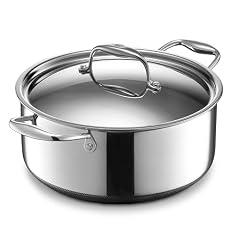
HexClad 5-Quart Hybrid Nonstick Dutch Oven
Overview
This is a 5-quart hybrid nonstick Dutch oven for soups, braises, sauces, casseroles, and roasts. The catalog describes aluminum, stainless steel, ceramic coating, and a tempered-glass lid. HexClad’s current official page for its 5-quart Dutch oven instead describes stainless-steel hexagonal ridges over TerraBond ceramic nonstick, an aluminum core, and a stainless-steel lid. That discrepancy means the lid and coating details of the specific Amazon unit cannot be fully confirmed from current manufacturer information. HexClad states that the current version is induction-compatible, dishwasher-safe, metal-utensil-safe, and oven-safe to 900°F. The company also reports third-party non-detect results for selected PFAS compounds, but it does not publish a full product-specific laboratory report showing lead, cadmium, or other metal migration under acidic heated-use conditions.
What works
- The 5-quart format is practical for medium batches of soup, braises, sauces, and one-pot meals.
- HexClad states that the hybrid cooking surface combines stainless-steel ridges, ceramic nonstick valleys, and an aluminum heating core.
- The current manufacturer page states compatibility with induction and other major cooktop types.
- HexClad offers a lifetime warranty for manufacturer defects, subject to use and care exclusions.
What does not
- The Amazon record and current manufacturer page conflict on the lid material, tempered glass versus stainless steel, so the exact offered configuration is unclear.
- No public, exact-product ISO/IEC 17025 laboratory report was found for lead, cadmium, or metal migration during acidic heated cooking.
- The company’s cited third-party PFAS results are summarized on its product page, but the full report, sample identity, method, detection limits, and laboratory accreditation scope are not publicly provided.
- A 2025 class-action settlement addressed earlier HexClad marketing of certain PTFE-containing products as PFAS-free, PFOA-free, or non-toxic. HexClad denied wrongdoing, but agreed to stop those claims for products containing PTFE or other PFAS.
Who is it for
This product suits a household that wants a relatively light 5-quart pot for frequent stovetop-to-oven cooking, especially soups, sauces, grains, braises, and smaller roasts. It is most appropriate where induction compatibility, a nonstick-assisted surface, and a defect warranty matter more than having fully disclosed food-contact testing. Buyers should confirm the delivered lid material and the care leaflet before relying on the stated 900°F oven limit, because the available specifications are inconsistent.
Who is it not for
It is not well suited to buyers who require a fully documented food-contact safety file, including exact-model lead and cadmium extraction results from an accredited laboratory. It also does not fit households that want an uncoated cooking surface, or people who need certainty that the listing’s tempered-glass lid can be used at the same oven temperature as the pot. Anyone considering high-heat oven use should verify the limit for the pot, lid, handle, and knob separately before cooking.
Integrity
The current official product page identifies a stainless-steel and aluminum hybrid construction with TerraBond ceramic nonstick. HexClad says this coating is PTFE-free and PFAS-free, and presents third-party PFAS non-detect summaries. Those summaries are useful signals, but they are not a substitute for a public exact-product report covering acidic, heated extraction of lead, cadmium, and other relevant metals. The product is not bare cast iron, so iron-transfer guidance for long acidic cooking is not central here. HexClad provides a lifetime manufacturer-defect warranty, which can support longer use, although normal wear and damage from excessive heat, misuse, or improper cleaning are excluded. No relevant CPSC recall was found in the reviewed recall sources. Packaging composition, take-back options, spare-lid availability, and end-of-life recycling instructions were not publicly disclosed.

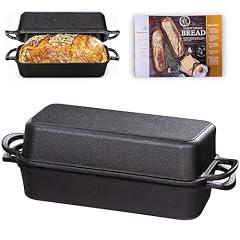
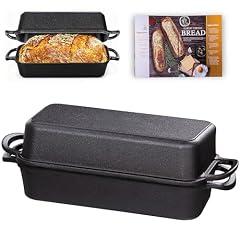
Vanderlume Cast Iron Loaf Pan with Lid
Overview
This is a large, covered cast-iron loaf pan intended for sourdough and other homemade breads. The product listing identifies an 11 by 5 inch baking area, 5.8-quart capacity, lid, 13.3-pound weight, gas-stovetop compatibility, and a 500 F upper temperature rating. Those are manufacturer-stated marketplace specifications, not independently tested measurements. The material is declared as cast iron, but the listing does not clearly identify whether the black food-contact surface is bare, pre-seasoned, enamelled, or another finish. No product-specific lead, cadmium, or broader metal-migration report, accredited laboratory report, certification, instruction manual, warranty, or replacement-parts policy was located. The published care information is also inconsistent. The marketplace page says dishwasher safe, while a matching reseller record says it is not dishwasher safe.
What works
- Large 5.8-quart, covered format is suited to substantial sandwich loaves and sourdough, manufacturer-stated.
- The listing specifies cast iron and a 500 F upper temperature rating, manufacturer-stated.
- A 13.3-pound cast-iron body is a substantial, potentially long-lived form factor if its surface is maintained intact.
- Iron and steel are commonly handled through metal-recycling pathways, although local acceptance rules apply.
What does not
- No exact-product food-contact extraction report was located for lead, cadmium, or other relevant metals under heated acidic use.
- The food-contact finish is not clearly declared, so buyers cannot tell from the listing whether acidic-food and cleaning guidance should follow bare iron, seasoning, or enamel care.
- Dishwasher guidance conflicts across matching marketplace records, which makes the care claim unreliable until clarified in writing.
- No independent certification, accredited test report, manual, warranty terms, country of origin, or spare-lid and spare-knob policy was located.
- The product is heavy when empty, and the listing provides no verified filled-weight, handle, or lid-security evidence.
Who is it for
This product suits a home baker who specifically wants a large rectangular covered vessel for baking sourdough or sandwich-style loaves, has room to lift and store a 13.3-pound pan, and is willing to use conservative cast-iron care. It is most appropriate for someone who can seek written clarification from the seller before using a dishwasher, cooking acidic foods for long periods, or relying on the stated 500 F limit. The listed capacity may be useful for family-size baking rather than small single-loaf recipes.
Who is it not for
It is not well suited to buyers who need documented food-contact testing, a clearly identified enamel or seasoning system, or a traceable third-party safety certification. Avoid relying on it for dishwasher cleaning until the conflicting care statements are resolved. It is also a poor fit for people with limited grip strength, mobility limitations, crowded ovens, or a need for clearly documented lid and handle limits. Buyers who frequently simmer acidic foods should choose cookware with explicit surface and acidic-food guidance.
Integrity
The main health uncertainty is not a confirmed hazard, it is missing product-specific evidence. The product is declared cast iron, but the seller does not clearly identify the actual food-contact finish or publish an accredited migration report for lead, cadmium, or other metals. That matters because acidic foods, moisture, and cooking time can increase iron transfer from iron cookware. Existing research supports that transfer in general, but it does not establish this product's dose or make it a nutrition intervention. No product-specific U.S. recall or regulatory warning was located in the public sources checked. The care discrepancy is more concrete, with one marketplace record stating dishwasher safe and another saying no. From a waste perspective, the cast-iron body is ferrous metal and may be accepted by local metal-recycling programs. The seller provides no packaging disclosure, take-back program, warranty, repair pathway, or end-of-life instructions.

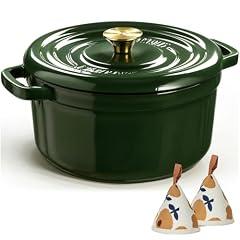
Nuwave 6 Qt Cast Iron Dutch Oven
Overview
This is a round 6-quart enameled cast-iron Dutch oven with lid, intended for braising, stews, roasting, and bread baking. Nuwave’s official product page identifies a cast-iron body with a seven-layer enamel finish, hand-wash care, and a 500°F oven limit. Its manual also lists induction, ceramic, gas, electric, halogen, hotplate, and oven use. The manufacturer supplies unusually concrete care instructions for an enameled pot. It says not to heat it empty, avoid abrupt cooling, use nonabrasive tools, check the lid handle before use, and permanently stop using the product if interior enamel chips. Nuwave also states that the finish is free of PFAS, PTFE, and PFOA, but no product-specific accredited migration report for lead, cadmium, or other metals was published in the materials reviewed. The catalog’s Crimson model designation does not align cleanly with the manufacturer manual’s Crimson model entry, so confirm the color and model on delivery.
What works
- The manufacturer identifies an enameled cast-iron food-contact surface, rather than a bare pre-seasoned iron cooking surface.
- Detailed instructions address thermal shock, empty heating, abrasive cleaning, utensil damage, steam burns, and chipped interior enamel.
- The manual specifies a 500°F oven limit and compatibility with induction plus common stovetop types.
- Nuwave identifies itself as the responsible U.S. business, provides telephone and email support, and states that the product is made in China.
- A storage protector is included and the manual identifies separate pot and lid part numbers for the product line.
What does not
- No publicly available, product-specific accredited report was found for heated acidic-food extraction of lead, cadmium, or other relevant metals.
- No traceable third-party certification or independent test report was published for this exact product.
- The manufacturer uses the phrase "chemical-free cooking," which is not a precise or supportable description of an enameled cast-iron product, even though it separately states PFAS, PTFE, and PFOA exclusions.
- The one-year warranty excludes the enamel finish, the component most central to long-term food-contact performance.
- The supplied catalog identifies Crimson differently from the manufacturer manual, which lists Crimson under a different model designation.
Who is it for
This product fits a household cook who wants a 6-quart covered pot for batch soups, braises, no-knead bread, and roasts, and who can safely handle a heavy cast-iron vessel. It is particularly suited to people using induction or rotating among gas, electric, ceramic, and oven cooking, because those uses are stated in the manual. It also suits a careful hand-washer willing to use low to medium heat for most cooking, avoid thermal shock, and inspect the interior enamel and lid handle before use.
Who is it not for
It is not suited to anyone who needs independently documented lead and cadmium migration results for the exact food-contact enamel, such as buyers making a precautionary purchase for frequent acidic cooking. It is also a poor fit for users unable to lift or control a heavy hot pot, households likely to use dishwashers, metal utensils, outdoor flames, or rapid temperature changes, and buyers expecting enamel chips to be covered by a long warranty. Do not use it if the interior enamel is chipped.
Integrity
The cooking surface is manufacturer-described as enamel over cast iron, so food is not intended to contact bare iron. That distinction matters for acidic, long-cooked dishes because the product is not presented as a bare or pre-seasoned iron vessel. Nuwave states that its enamel system is free of PFAS, PTFE, and PFOA. However, its broader "chemical-free" wording is imprecise, and the reviewed official materials do not publish an accredited, product-specific migration report for lead or cadmium under heated acidic-use conditions. The manual gives meaningful damage-prevention guidance and says to discontinue use immediately if interior enamel chips. Nuwave identifies a U.S. contact route, a one-year limited warranty, and repair or replacement for covered defects, though enamel finish damage is excluded. No relevant CPSC recall or FDA cookware warning naming this product was found in the reviewed sources. Nuwave describes recycled material content, but does not disclose packaging materials or provide end-of-life instructions. The cast-iron body may be accepted as ferrous scrap locally, while enamel finish acceptance depends on the recycler.

Nuwave 6QT Enameled Cast Iron Dutch Oven
Overview
This is a 6-quart, enameled cast-iron Dutch oven for braising, stewing, roasting, and bread baking. The manufacturer lists a 500°F oven limit, hand-wash-only care, a 12.1-pound listed weight, and compatibility with induction, ceramic, gas, halogen, electric, and hotplate cooking. Its exact-model manual also identifies the Crimson version and says it is made in China. The food-contact surface is described by the manufacturer as seven-layer enamel over cast iron, with no seasoning required. The manual gives unusually direct safety instructions to stop using the product if interior enamel chips, avoid thermal shock and dry heating, and check that the lid handle is tight before use. No product-specific accredited laboratory report for lead or cadmium migration, enamel thermal-shock testing, or independent certification was located in this review.
What works
- The exact-model manual provides a specific 500°F oven limit and names compatible stovetop types, including induction.
- It includes explicit stop-use guidance for chipped interior enamel, plus instructions intended to reduce thermal-shock and scratch damage.
- The manual identifies Nuwave LLC, a U.S. address, telephone support, email contacts, color-specific models, and China as the country of manufacture.
- A storage protector is included and the manual gives storage instructions intended to reduce contact damage between the lid and pot.
What does not
- No public, product-specific accredited test report was located for lead and cadmium migration from the food-contact enamel under heated acidic-use conditions.
- No traceable independent certification or recognized third-party verification was located for this exact Dutch oven.
- The manufacturer uses broad phrases such as chemical-free cooking and PFAS-free, but publishes no product-specific composition analysis or test report supporting those safety claims.
- The one-year warranty excludes the enamel finish, which is the food-contact surface most important to long-term use.
- The product page gives two different weights, 12.1 and 13 pounds, so the listed specification is not fully internally consistent.
Who is it for
This product suits a household cook who wants a medium 6-quart enameled cast-iron vessel for soups, braises, roasts, no-knead bread, and other oven-to-stovetop cooking. It is most appropriate for someone able to handle a heavy pot, follow low-to-medium heat and hand-washing guidance, and inspect the interior enamel before use. It also suits cooks using induction or conventional electric, gas, ceramic, halogen, or hotplate cooking surfaces, based on the manufacturer’s exact-model instructions.
Who is it not for
It is not suited to buyers who need independently documented food-contact migration testing for lead and cadmium, or a third-party certification for the exact product. It is also a poor fit for people who need dishwasher-safe cookware, have difficulty lifting heavy cast iron, or expect enamel damage to be covered by warranty. Do not continue using it if the interior enamel chips. Avoid this format if your routine includes frequent empty preheating, rapid cooling, abrasive cleaning, metal utensils, outdoor grills, campfires, or microwave use.
Integrity
The health-positive point is not an external certification, it is the exact-model manual’s practical damage guidance. It says not to use the product when interior enamel is chipped, warns against thermal shock and dry heating, calls for non-abrasive hand washing, and instructs users to verify that the lid handle is secure. These steps matter because an intact enamel surface is central to the product’s intended food-contact use. Nuwave states that the pot is recycled-material cast iron with seven-layer enamel and is free of PFAS, PTFE, and PFOA. Those are manufacturer statements, not independently verified findings in the materials reviewed. No public product-specific migration report, third-party certificate, packaging disclosure, or end-of-life guidance was located. Cast iron is a ferrous-metal body with scrap value, but local recyclers determine whether they accept enameled cookware. The product includes a one-year limited warranty, while explicitly excluding enamel finish damage.

Our Place Perfect Pot
Overview
This is a 5.5-quart aluminum, ceramic-nonstick cooking pot with a lid, integrated straining function, and included beechwood spoon. It is intended to cover wet cooking, braising, roasting, boiling, baking, serving, and food storage in one relatively light vessel. The manufacturer’s current documentation for the same Perfect Pot format identifies an aluminum body, induction compatibility, hand-wash-only care, and a 450°F oven limit. Our Place states that the food-contact ceramic coating is made without PFAS, including PTFE and PFOA, lead, and cadmium, and says its cookware receives third-party lab testing to FDA and LFGB food-contact standards. Those are manufacturer statements. No product-specific, publicly traceable accredited-laboratory extraction report for this exact 5.5-quart color and version was located. The product is coated aluminum, not bare or enameled cast iron, so iron-transfer guidance for acidic foods is not a material concern here.
What works
- The manufacturer gives clear low-to-medium heat, no-empty-heating, no-metal-utensil, hand-washing, and no-broiler instructions for protecting the ceramic nonstick surface.
- The stated 450°F oven limit applies with the lid, and the manufacturer specifically warns that the pot body, handles, and lid parts can become hot.
- The stated aluminum construction and induction compatibility support use across common home cooktops.
- Our Place has a documented warranty-claim process that can provide repair, replacement, or refund if a claim is approved.
What does not
- Food-contact claims are not matched by a public, exact-product laboratory report showing lead, cadmium, or other migration results under heated acidic-use conditions.
- The broad phrase "toxin-free" is less precise than the company’s specific PFAS, PTFE, PFOA, lead, and cadmium statements.
- The nonstick surface needs protective handling. The manufacturer excludes normal wear, many scratches, abrasive cleaning damage, and high-heat damage from warranty coverage.
- The manufacturer identifies manufacturing across several countries, but a country of origin and responsible factory were not publicly confirmed for this exact product.
Who is it for
This product fits a home cook who wants one medium-large, lighter-weight pot for soups, pasta, braises, grains, oven-finished dishes, and serving, while using induction or another standard cooktop. It is most suitable for someone willing to use low-to-medium heat, oil when appropriate, soft utensils, oven mitts, and hand washing. Its straining lid is useful for households that regularly cook pasta or vegetables and prefer not to use a separate colander. The buyer should accept that the coating-safety evidence available publicly is manufacturer-stated rather than fully published product-specific test data.
Who is it not for
It is not suited to cooks who routinely use metal tools, dishwasher cleaning, abrasive scrubbers, broilers, empty preheating, or high-heat searing. Those practices conflict with the manufacturer’s care instructions and can shorten nonstick-coating life. It also does not suit buyers seeking an uncoated cooking surface, a bare-iron pot for iron-transfer cooking, or a publicly available accredited laboratory report for the exact product before using it with acidic, long-cooked foods. Households needing a fully documented country of origin for this unit should seek clearer product-level traceability.
Integrity
The food-contact surface is ceramic nonstick over aluminum, rather than bare iron or enamel. Our Place states that the surface is made without PFAS, PTFE, PFOA, lead, and cadmium, and says all cookware receives independent laboratory testing to FDA and LFGB food-contact standards. Its California cookware disclosure names aluminum, iron, chromium, nickel, and manganese as intentionally added candidate-list chemicals for the aluminum cookware category. It does not provide a public migration report for this exact product, so those safety claims cannot be independently audited at the product level. For longevity, the company directs users to avoid high heat, thermal shock, metal utensils, dishwashers, and abrasive cleaners. A limited warranty offers a claim route, though wear and certain scratches are excluded. Our Place says its current Perfect Pot body and lid use certified post-consumer recycled aluminum and that packaging uses biodegradable materials, but these environmental statements were not supported by product-specific third-party lifecycle or packaging documentation. No relevant CPSC recall was located in the review search.
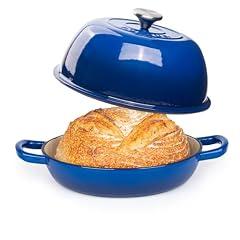
AHJ 6QT Enameled Cast Iron Dutch Oven
Overview
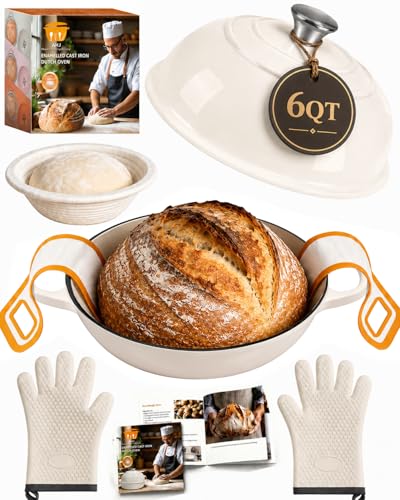
This is a round, ivory-white enameled cast-iron Dutch oven marketed primarily for sourdough and other covered bread baking. The product is described as a 6 quart, or 5.7 liter, vessel measuring about 10.5 inches wide by 6 inches high and weighing about 13 pounds. It is also intended for braising, roasting, and other oven cooking. Independent retail records corroborate the basic cast-iron, enamel, capacity, weight, hand-wash, and 500 F specifications, and identify China as the country of origin. The seller states that the set includes a lid, proofing basket, silicone sling, mitts, and instructions. No product-specific accredited laboratory report for lead, cadmium, or other metal migration was located. No current third-party certification, warranty terms, replacement-parts program, or published thermal-shock test evidence was located either.
What works
- Independent retail records consistently identify an enameled cast-iron body, roughly 6 quart capacity, 13 pound weight, and hand-wash care.
- The stated 500 F oven limit and gas, electric, and induction compatibility give clear intended-use boundaries, although they remain seller claims rather than test-backed limits.
- The enamelled interior means ordinary cooking does not rely on a bare-iron seasoning layer.
- Care guidance found in retail records advises avoiding metal utensils, avoiding microwave use, and drying thoroughly, which is relevant to protecting enamel and exposed edges.
What does not
- No exact-product extraction report was found showing lead, cadmium, or other metal migration under acidic heated-use conditions.
- No traceable independent certification or accredited laboratory report was located for this specific product and color.
- The listing's triple-layer enamel, non-stick, even-heating, and steam-retention statements were not accompanied by supporting test data.
- No public warranty, spare-lid or knob availability, repair pathway, or product-specific damaged-enamel stop-use instructions were located.
- The pot is heavy when empty, and the available records do not provide detailed evidence for handle, lid, or accessory performance at a filled cooking weight.
Who is it for
This product suits a home baker who wants a compact, heavy, covered cast-iron vessel for one medium sourdough boule, plus occasional braises or roasts. It fits a user comfortable with hand washing, careful lifting, and avoiding metal utensils. The stated 500 F limit can suit conventional bread-baking temperatures, provided the buyer treats it as a manufacturer-stated limit and inspects the enamel, lid, and handles before use. It is most appropriate where the included bread accessories are useful, rather than essential safety equipment.
Who is it not for
It is not well suited to buyers who need documented lead and cadmium extraction results, an independently verified food-contact certification, or a clearly identified U.S. manufacturer or importer contact. People with limited hand strength, wrist pain, or difficulty managing hot heavy cookware should consider the approximately 13 pound empty weight and the added load of food. It also does not suit households seeking dishwasher-safe cookware, a published long-term warranty, readily available replacement parts, or detailed instructions for what to do if enamel chips or crazes.
Integrity
The food-contact surface is described as enamel over cast iron, not bare pre-seasoned iron. That distinction matters because research showing iron transfer from cookware applies primarily where food contacts exposed iron, especially with acidic foods and longer cooking times. This product makes no verified nutritional iron benefit claim. No product-specific evidence was found that its enamel meets FDA extraction benchmarks for lead or cadmium, so food-contact safety remains unverified rather than demonstrated unsafe. No relevant current CPSC or FDA recall or warning was located for this exact product or AHJ cookware in the searched public records. The available retail record identifies China as origin, but no manufacturer website, U.S. responsible-business details, warranty, packaging disclosure, take-back plan, or replacement-parts catalog was found. Cast iron can have a long service life if its enamel remains intact and is cared for, while the heavy metal body may be accepted by scrap-metal recyclers at end of life. Local acceptance policies should be checked because enamel can affect processing.