
10 Best Crossbows
 Brianna York
Please note that we participate in affiliate marketing programs. When you purchase through links on our site, we may earn a commission. As an Amazon Associate we earn from qualifying purchases. This comes at no additional cost to you and helps support the resources required to provide valuable content.Advertising Disclosure
Top-rated Crossbows Comparison
1

2
4
5
6
7
8
9
Crossbows: what to look for
A crossbow stores substantial mechanical energy and releases it through a trigger to propel a compatible bolt. Whether it works well and whether it can be handled responsibly depends on more than the advertised feet-per-second figure. The important questions are whether the trigger and manual safety resist an unintended discharge, whether the bolt is correctly retained, whether the cocking system keeps stored energy under control, and whether the limbs, string, cables, rail, stock, and fasteners remain reliable through normal use.
Start with the exact model’s manual. It should specify compatible bolt length, nock type, and minimum finished-bolt weight. The supplied products commonly require details such as 20- or 22-inch bolts, particular clip-on, half-moon, or Alpha-Nock formats, and minimum finished weights from 370 to 410 grains. A bolt retainer, nock sensor, or dry-fire inhibitor can reduce risk, but none removes the need to seat the bolt fully against the string and inspect it for cracks, damaged nocks, loose fletching, or other defects. A product’s instructions should also cover eye protection, hand placement, loading, unloading, storage, transport, inspection intervals, lubrication, and what to do after a dry fire.
Cocking and unloading deserve separate attention. Rope cockers, sleds, and cranks can reduce the effort needed to draw a 175- to 210-pound system, but they still require correct hook placement, controlled handle movement, and inspection of cords and straps. Many supplied products cannot be safely de-cocked with their cocking aid; the instructions instead require firing a practice bolt into a suitable target or safe ground where lawful. A true de-cocking system should provide an illustrated, model-specific procedure and controlled backwinding rather than relying on hand control of the string.
Treat speed, kinetic-energy, trigger-pull, range, and accuracy figures as conditional measurements. A headline such as 390, 400, 405, 410, or 420 fps may depend on a lighter bolt than the one included. A substantiated claim identifies bolt mass, configuration, distance, chronograph or accuracy method, and results. Independent field measurements can support a claim, but they are not the same as a model-specific laboratory report covering trigger, drop, abuse, anti-dry-fire, fatigue, cocking-cycle, or component-containment testing.
For certification and accountability, do not rely on an uncheckable tested badge. The supplied reviews found that ANSI/NACF 001-2018 was withdrawn in February 2021, so it is not a current recognized certification route. Stronger evidence would identify the exact model and sample, test method, pass criteria, laboratory, and production or serial traceability. Buyers should be able to check the manufacturer’s registration and warranty system, recall notices in the CPSC Recalls database and SaferProducts.gov, and the laboratory’s accreditation through A2LA or ANAB with an applicable ISO/IEC 17025 scope.
Across the supplied products, recurring warnings are significant: these crossbows are not for children, unsupervised beginners, casual backyard use, or homes without secure restricted storage and a controlled firing lane. Users need a safe backstop, eye protection, clear hand and finger placement, compatible bolts, pre-use inspections, and a lawful, suitable way to unload. No supplied product had model-specific independent laboratory safety evidence for every major mechanism, and no supplied product offered a fully documented environmental end-of-life program. One product also carried a Proposition 65 lead warning, although the available information did not identify the component or exposure route.
Integrity
Crossbow safety is shaped by stored energy, projectile control, maintenance, and the quality of the evidence behind protective claims. The scores below compare the supplied products on those specific questions; they do not replace the exact-model manual, recall check, or safe handling training.
HHealth & Safety
User and bystander injury protection
This measures protection against projectile, eye, hand, laceration, and impact injuries. For crossbows, meaningful controls include finger guards, pass-through foregrips, enclosed trigger areas, clear firing-path warnings, and instructions keeping bystanders behind the shooter. The supplied products scored 72–79: higher-scoring designs combined documented hand-placement guidance and protective hardware, while lower scores reflected less complete evidence or greater dependence on user technique.
Trigger and safety reliability
This measures whether the trigger, manual safety, and sear resist firing without a deliberate pull. That matters because a loaded crossbow can release enough energy to cause severe injury even during handling, transport, or loading. Supplied scores ranged from 69 to 75. The higher scores had documented safety engagement and trigger-related instructions, but no product had a model-specific independent report covering trigger, drop, and abuse testing.
Dry-fire and bolt compatibility protection
This measures whether the product prevents firing without a correctly seated, compatible bolt and clearly states length, nock type, and minimum finished weight. Wrong or underweight bolts can damage strings, limbs, and cables and may send fragments toward the user. Scores ranged from 73 to 80. Higher-scoring products supplied concrete bolt and nock limits plus retention or inhibitor features; lower scores relied more heavily on correct loading by the user.
Cocking and de-cocking safety
This measures control of rope cockers, sleds, cranks, hooks, handles, and stored energy during loading and unloading. It is especially important because many products use 175- to 210-pound draw systems and several supplied models cannot be safely uncocked with their ordinary crank or rope device. Scores ranged from 62 to 78. The strongest result belonged to a product with a documented controlled de-cocking procedure; ordinary effort reduction alone was not enough.
Limb, string, and structural reliability
This measures whether limbs, cams, cables, strings, rails, stocks, and fasteners withstand use without fracture, derailment, or flying fragments, and whether inspection and replacement support are available. Supplied scores ranged from 70 to 76. Higher scores reflected clearer maintenance intervals, replaceable wear parts, and service support. No supplied product had a model-specific independent fatigue, proof-load, dry-fire-containment, or component-failure report.
Clear safe-use instructions
This measures whether instructions clearly address assembly, inspection, compatible bolts, loading, unloading, dry-fire response, eye protection, storage, transport, and keeping people out of the firing path. Scores ranged from 70 to 87. The higher-scoring manuals gave concrete bolt limits, hand-placement rules, inspection steps, and unloading procedures. Lower scores were associated with incomplete model-specific documentation or greater ambiguity about package contents and safe unloading.
EEvidence
Verified safety-mechanism testing
This measures whether trigger, safety, anti-dry-fire, bolt-retention, finger-protection, and cocking claims are supported by reproducible model-specific testing that identifies the sample, method, pass criteria, results, and laboratory. Scores were 68–72, a narrow range because no supplied product had the requested accredited laboratory report. Manufacturer manuals and field reviews provided useful evidence, but they did not establish full trigger, drop, abuse, fatigue, or containment performance.
Independent verification and product traceability
This measures whether the exact product and production batch can be connected to independent evidence, manufacturer support, and a usable serial-number system. Scores ranged from 70 to 77. Higher-scoring products had serial registration, warranty or repair pathways, and some independent performance evidence. A strong traceability system still does not prove that a safety mechanism passed independent testing, and buyers should verify the seller, exact listing, serial records, and any recall status.
Honest speed, range, and accuracy claims
This measures whether advertised performance states bolt mass, configuration, distance, and test method and matches reproducible results. Scores ranged from 54 to 82. The strongest claims identified the test-bolt condition and had independent chronograph or accuracy support. Lower scores involved conflicting speed figures, missing bolt mass or test setup, or no independent result. A lighter test bolt can make a headline speed look better than the supplied configuration.
Recall and corrective-action accountability
This measures whether affected units are identified precisely, hazards are communicated, remedies are effective, and safety notices remain accessible. Scores ranged from 71 to 76. Higher-scoring products had serial-number registration and service or warranty pathways, while lower scores provided less complete accountability evidence. Older recalls involving other models are not evidence that the reviewed product is recalled, but they show why registration and checking CPSC records matter.
EEcology
Materials and field-impact responsibility
This measures durability, repairability, replaceable wear parts, material disclosure, and steps to reduce lost bolts and discarded composite, plastic, battery, or lead-containing components. Scores ranged from 53 to 73. Higher-scoring products offered replacement strings, cables, bolts, nocks, or service parts, helping extend product life. Across the set, material disclosure, lost-bolt recovery, recycling, and end-of-life guidance remained limited; one product also carried an unspecified Proposition 65 lead warning.
Full reviews

Wicked Ridge Fury 410 De-Cock Crossbow
Overview
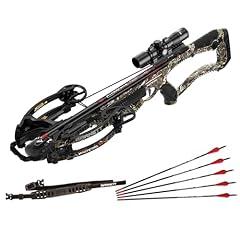
This is a reverse-draw hunting crossbow package with a crank-operated ACUdraw De-Cock system, a variable-speed RangeMaster Pro scope, three Match 400 carbon arrows, and a three-arrow quiver. It is intended to cock, load, aim, fire, and then unload without firing a bolt. The manufacturer lists a 200-pound draw weight, 29-inch length without the stirrup, and 15-inch uncocked or 9-inch cocked width. The advertised 410 fps is qualified in the manufacturer catalog as using a 370-grain Pro Lite arrow. With the included 410-grain Match 400 arrow, the same catalog lists 400 fps and 146 foot-pounds of kinetic energy. The current catalog lists 8.25 pounds with the ACUdraw De-Cock fitted, while an earlier specification lists 7.5 pounds without accessories. Manufacturer documentation gives detailed cocking, de-cocking, inspection, and arrow-handling instructions, but no model-specific independent safety-laboratory report was located.
What works
- The supplied-arrow speed claim is qualified, 400 fps with the 410-grain Match 400 arrow.
- The crank manual gives a defined, arrow-free de-cocking sequence and tells the user to secure the claw on both sides of the string.
- The manufacturer identifies a Dry-Fire-Prohibitor in the two-stage D1 trigger and includes Match 400 arrows intended for this platform.
- A serial-number warranty-registration process and manufacturer support resources provide meaningful ownership traceability.
- Published maintenance instructions call for string, cable, serving, rail, nock, and shaft inspection, rather than treating wear parts as maintenance-free.
What does not
- No model-specific, independent trigger, anti-dry-fire, crank load-cycle, drop, abuse, or structural test report was located.
- The safety and dry-fire claims are principally manufacturer statements, not independently reproduced results.
- The 2026 catalog weight with the crank installed differs from the lighter bare-crossbow figure often presented in listings, so buyers should confirm the field-ready weight.
- This is a high-energy projectile device. Safety wings, arrow retention, and a dry-fire inhibitor reduce some foreseeable hazards but do not protect people in the firing path.
- Material composition, end-of-life guidance for composite bolts and polymer parts, and a formal consumables recycling program are not clearly disclosed.
Who is it for
This product suits an experienced adult hunter who needs a compact crossbow for blinds, stands, or dense cover and specifically wants to return the string to rest without taking a discharge shot. It is most appropriate for someone able to follow a multistep crank procedure, inspect strings, cables, nocks, and bolts before use, and keep a controlled firing area. The included 400-grain arrows and scope make it a more complete starting package, but correct arrow and nock compatibility still needs to be maintained after replacements.
Who is it not for
It is not appropriate for unsupervised minors, casual target users without formal crossbow instruction, or households that cannot control access, transport, and a safe firing direction. It is also a poor fit for anyone who expects independently certified trigger, anti-dry-fire, structural, or crank-failure testing, because no model-specific report was located. Users with limited hand control, difficulty following the crank sequence, or reluctance to perform regular string and cable inspections should use equipment only after qualified fitting, instruction, and supervision.
Integrity
The main health consideration is stored energy. The manufacturer documents a D1 trigger with a dry-fire inhibitor, a nylon arrow-retention brush, fore-grip safety wings, and an ACUdraw De-Cock procedure that begins by removing the arrow and requires the crank claw to engage both sides of the string. Those are useful design controls, but they are manufacturer-documented features rather than independently validated safety-test results. The manufacturer provides maintenance guidance for lubrication, string and cable wear, nock alignment, and inspection after a dry-fire inhibitor event. Its registration system records a serial number and requires the owner to attest to reading safety instructions. A 2015 CPSC recall involved older TenPoint and Wicked Ridge models made from 2011 through 2014, not this product, and identified affected units by model and serial range. Material disclosure and disposal guidance for carbon bolts, synthetic parts, and worn strings remain limited, so damaged bolts should be removed from field use and disposed of according to local waste rules.

Wicked Ridge RDX 410 Peak XT Crossbow
Overview
The Wicked Ridge RDX 410 is a reverse-draw hunting crossbow package with an integrated ACUdraw Silent crank, illuminated Pro-View 400 scope, quiver, and three Match 400 carbon arrows. Manufacturer specifications list a 29-inch length without the stirrup, 15-inch uncocked and 9-inch cocked width, 200-pound draw weight, and 7.5-pound bare weight. The maker states that the crank reduces operating effort to 5 pounds and that the package reaches 410 fps with a 370-grain arrow. Its supplied 410-grain arrows are listed at 400 fps and 146 foot-pounds. An independent magazine test averaged 402 fps over three bolts, which is close to the stated headline speed but is not a laboratory safety test. The product documentation identifies a dry-fire inhibitor, manual safety, finger-protection wings, and specified Alpha-Nock arrow compatibility.
What works
- Independent field chronograph testing averaged 402 fps, close to the maker's 410 fps headline claim.
- The supplied Match 400 arrows have disclosed 20-inch, 410-grain, and Alpha-Nock specifications.
- The documented dry-fire inhibitor prevents trigger firing when it captures the string instead of the string latch.
- The detailed manufacturer instructions require eye protection and cover loading, cocking, arrow use, inspection, and storage precautions.
- A serial-number registration process, repair authorization system, service centers, and limited lifetime operational warranty provide practical support traceability.
What does not
- No model-specific independent laboratory report was found for trigger, safety, anti-dry-fire, crank endurance, drop, or abuse testing.
- The ACUdraw Silent manual explicitly says there is no anti-over-cranking slip clutch. Over-cranking can damage draw cords and send the claw flying.
- The crank must not be used to decock this product, which leaves a cocked bow to be discharged only through the maker's prescribed unloading procedure.
- The structural support is limited by normal wear exclusions. Strings and cables are excluded from the warranty, while limbs, scope, and cocking devices have five-year coverage.
- Material disclosure is partial, and no product-specific recycling or end-of-life guidance for carbon arrows, composites, scope electronics, or worn strings was located.
Who is it for
This product suits an experienced adult hunter or range user who wants a compact reverse-draw crossbow and is willing to follow a detailed loading and maintenance routine. It is especially relevant for users who benefit from the maker-stated 5-pound crank effort instead of hand cocking a 200-pound draw-weight bow. The buyer should have a controlled target setup, use the specified Alpha-Nock arrows, wear eye protection, inspect strings and crank components, and have a plan to safely discharge a loaded bow.
Who is it not for
It is not suited to unsupervised beginners, children, casual households, or anyone without a secure backstop and a disciplined loading routine. The product stores substantial energy and the instructions warn that frayed crank straps, over-cranking, an improperly stored claw, and incorrect cocking steps can cause serious injury. It is also a poor fit for users who need a crank-operated decocking method, since the included ACUdraw Silent must not be used to decock the bow. Do not use unapproved arrows or substitute nock styles.
Integrity
The main health issue is mechanical injury, not chemical exposure. The maker's instructions require safety glasses and identify hazards from limbs, cables, strings, crank cords, flying parts, dry-fire events, and fingers entering the flight deck. The product has a documented dry-fire inhibitor, manual safety engagement during cocking, specified Alpha-Nock arrow compatibility, and prominent cocking instructions. However, no independent accredited laboratory report was located that validates these mechanisms under trigger, drop, endurance, or misuse testing. Materials are only partly disclosed. Trade reporting identifies a cast aluminum riser and glass-filled polypropylene stock, while the package includes carbon arrows with aluminum inserts and replaceable nocks. The maker publishes lubrication and inspection guidance, provides replacement support, and offers a limited lifetime operational warranty, though strings and cables are excluded. No product-specific end-of-life or recycling instructions were found for worn composite arrows, strings, electronics, or plastic components. A 2015 CPSC recall involved older Wicked Ridge models manufactured from 2011 through 2014, not this RDX 410 model.

Barnett Hyper Whitetail 410 Crossbow Bundle
Overview
This is a compound hunting crossbow package built around a 190-pound draw-weight platform. Barnett lists the core Whitetail 410 at 7.6 pounds, 35.25 inches long, 9.19 inches axle to axle when cocked, with a 15.5-inch power stroke. The manufacturer states that it ships with an illuminated 4x32 scope, two 22-inch Hyperflite bolts, a side-mount quiver, rope cocking sled, and lubrication wax. Barnett states a 410 FPS maximum using a 380-grain bolt, plus a three-pound TriggerTech release, anti-dry-fire system, nock sensor, pass-through foregrip, finger reminders, and bristle bolt retainer. Those are manufacturer claims, not independently reproduced safety or performance results. Barnett publishes a broad owner manual and safety guidance, but an exact-model manual and independent trigger, drop, fatigue, or cocking-device test report were not located.
What works
- The manufacturer states the 410 FPS figure was measured with a 380-grain bolt, which gives needed context for the headline speed claim.
- Barnett specifies a 190-pound draw weight, 15.5-inch power stroke, 7.6-pound product weight, and compact cocked width for the core model.
- The stated safety package includes anti-dry-fire protection, a nock sensor, a Soft-Lok bolt retainer, finger reminders, and a pass-through foregrip.
- Barnett provides registration support and a broad manual with inspection, storage, loading, eye-protection, and bystander-safety instructions.
What does not
- No model-specific independent report was found for trigger reliability, unexpected discharge resistance, anti-dry-fire function, bolt retention, limb fatigue, or rope-cocking durability.
- The core unit requires dedicated 22-inch Hyperflite bolts with capture nocks. This limits replacement-bolt choice and makes bolt inspection and compatibility especially important.
- Barnett's current broad manual warns against hand or rope decocking and directs users to discharge into a safe target. This can be inconvenient where a suitable backstop is unavailable.
- Barnett had a 2016 CPSC recall for six different older crossbow models after nock-sensor malfunctions caused unexpected firing. This product is not named in that recall, but the history makes pre-use function checks important.
Who is it for
This product suits an adult hunter or target shooter who has completed hands-on crossbow instruction, has a safe range or approved backstop, and is prepared to inspect bolts, nocks, string, cables, fasteners, and the cocking rope before use. It is most appropriate for someone specifically comfortable maintaining a high-energy, 190-pound-draw crossbow and sourcing the required 22-inch Hyperflite replacement bolts. The supplied scope, quiver, cocking sled, and basic bolts support initial setup, but do not replace supervised safety training.
Who is it not for
It is not appropriate for children, untrained users, or households where safe storage and a controlled shooting area cannot be maintained. It is also a poor fit for anyone unable to use a rope cocking device with stable footing, close-toed footwear, and controlled hand placement, including people whose hand, back, heart, or balance limitations could interfere with safe operation. Users who need a product that can be manually decocked should look elsewhere, because Barnett instructs users to unload by shooting into a safe target, not by hand or rope decocking.
Integrity
The main health issue is stored energy. Barnett's instructions warn that fingers or thumbs near the flight track, string, or cables can be seriously injured or amputated. The manufacturer directs users to wear safety glasses, keep bystanders well behind the shooter, inspect strings, cables, limbs, nocks, bolts, and the cocking rope before every use, and stop using worn or damaged parts. The stated anti-dry-fire and nock-sensor features are useful design claims, but independent model-specific testing was not located. The product uses an aluminum flight track, while the bolt system relies on specialized small-diameter carbon bolts and replaceable nocks, vanes, points, strings, cables, and bristle retainers. Barnett sells replacement bolts and identifies inspection and replacement needs, which supports maintenance rather than disposal of the whole product. No meaningful product-specific recycled-content, end-of-life, or lost-bolt recovery program was found. A CPSC recall for older Barnett models involved a nock-sensor malfunction, not this product.

TenPoint Titan 400 Compact Crossbow with Pro-View Scope
Overview
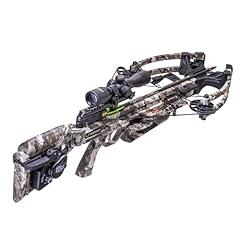
The Titan 400 is a forward-draw hunting crossbow package. It includes a Pro-View 400 scope, a quiver, three Pro Elite 400 carbon arrows, and an integrated ACUdraw Silent crank-cocking device. TenPoint lists the product at 33 inches long, 6 pounds, 215-pound draw weight, and 13 inches wide uncocked, narrowing to 9.75 inches when cocked. Its advertised 400 fps figure is qualified by a 410-grain Pro Elite 400 arrow, with stated kinetic energy of 146 foot-pounds. The maker specifies that supplied arrows are 20 inches, 410 grains plus or minus 5 grains, and use Alpha-Nock HP nocks. The owner documentation provides unusually detailed handling, trigger, hand-placement, loading, maintenance, and storage warnings, but no model-specific independent safety or durability test report was located.
What works
- The speed claim identifies its 410-grain test arrow and stated 146 foot-pound energy figure, rather than presenting an unqualified headline number.
- The supplied arrow system has concrete compatibility information, including 20-inch length, 410-grain weight, and the required Alpha-Nock HP format.
- The manufacturer provides detailed safety instructions, including eye protection, finger clearance, trigger-safety checks, compatible-arrow requirements, and dry-fire warnings.
- The integrated ACUdraw Silent device is manufacturer-stated to reduce operating force to 5 pounds, which can reduce the physical effort of cocking.
- Replacement strings, cables, cocking-device parts, and factory service pathways are published by the manufacturer.
What does not
- No independent, model-specific laboratory report was located for trigger function, anti-dry-fire function, drop resistance, cocking-device failure, limb fatigue, or containment testing.
- This product does not have a safe de-cocking system. The manual instructs users to discharge a practice or discharge arrow to uncock it.
- The ACUdraw Silent has no anti-over-cranking slip clutch. The manual warns that over-cranking can misalign the trigger box or break the draw strap, with a risk of flying parts.
- The current product is not named in the TenPoint crossbow recall located, but TenPoint recalled older models in 2015 for a safety-related firing hazard after safety re-engagement.
- Carbon-arrow and composite-component disposal, recovery, and end-of-life guidance are limited. Lost or damaged arrows should not be left in the field.
Who is it for
This product suits an experienced adult hunter or supervised adult-range user who wants a compact, forward-draw crossbow package and can follow a detailed operating routine. It is particularly relevant where lower crank effort is useful, because TenPoint states that the integrated cocking device reduces operating force to 5 pounds. The user should have a safe range or lawful hunting area, suitable arrow-discharge space for uncocking, eye protection, and willingness to inspect strings, cables, nocks, and the cocking strap before use.
Who is it not for
It is not suited to unsupervised minors, casual users unwilling to study the manual, or households where a cocked projectile launcher cannot be securely controlled and stored. It also does not fit users who need to de-cock mechanically after a hunt, because this model must be discharged with a suitable arrow rather than safely de-cocked with its crank. Anyone unable to maintain strict finger clearance, manage a high-energy 215-pound draw system, inspect wear parts, or provide a clear downrange area should choose a different use arrangement.
Integrity
The main health issue is stored-energy and projectile risk, not chemical exposure. The documentation specifically calls for safety glasses during assembly, cocking, loading, servicing, and shooting because strings, limbs, cables, and cocking components can fail. It also gives specific trigger-safety and hand-position rules, requires compatible Alpha-Nock-family arrows, and warns against dry-firing. The crank device lowers cocking effort according to the manufacturer, but it is not a de-cocking system and has no anti-over-cranking slip clutch. The package uses carbon arrows with aluminum inserts and polymer nock components. These are durable field consumables, but damaged carbon arrows can splinter and should be removed from use. The manual recommends recovering the discharge or practice arrow when uncocking, which also helps limit field loss. TenPoint publishes replacement string and cable options and offers factory warranty service after product registration. No current recall naming this product was located, although an older TenPoint recall involved different models and a safety-related firing hazard.

Wicked Ridge Rampage XS Crossbow - 390 FPS
Overview
This is a forward-draw hunting crossbow package with an integrated ACUdraw crank, a lighted 3X scope, quiver, and bolts. Wicked Ridge states that the 5.8-pound crossbow shoots up to 390 feet per second. That headline is qualified by a 370-grain bolt specification, which is important because bolt mass materially affects speed and stored-energy loading. Its documented safety design includes an automatically engaging trigger safety, a Dry-Fire-Inhibitor, bolt retention, a pass-through foregrip, and safety wings intended to keep hands below the flight deck. The manufacturer also specifies compatible nock systems and a 370-grain minimum finished arrow weight. An independent magazine test of the related Tactical Stock Rampage XS measured 345.7 feet per second with a 401.2-grain manufacturer bolt, plus a 4.12-pound average trigger pull. That test was not of this ACUdraw package and was not a formal safety certification test.
What works
- The manufacturer provides concrete bolt-safety rules, including approved nock types and a 370-grain minimum arrow weight.
- The safety design combines a Dry-Fire-Inhibitor, automatic trigger safety, bolt retention, a pass-through foregrip, and safety wings.
- The owner materials give detailed pre-use inspection, loading, transport, unloading, and safe uncocking instructions.
- A factory registration path, instruction library, authorized service network, and limited lifetime operational warranty support traceability and repair access.
- Independent range testing of the related Tactical Stock version documented speed, trigger pull, shot noise, and 35-yard grouping.
What does not
- No model-specific third-party laboratory report was found for trigger abuse, drop, anti-dry-fire, finger-protection, crank-load, or structural fatigue testing.
- The ACUdraw instructions identify real stored-energy hazards, including loss of crank control, cord damage, and no anti-over-cranking slip clutch with the original crank handle.
- The only manufacturer-approved way to uncock is firing a practice or discharge arrow into a suitable safe backstop, not reversing the crank.
- The 390 feet-per-second claim is manufacturer-stated. Independent measurements located were for a related Rampage XS configuration with a heavier bolt, not this packaged product.
- Material disclosure is limited. Available information identifies carbon bolts, glass-filled polymer components, aluminum parts, and composite limbs, but does not provide end-of-life or recycling instructions.
Who is it for
This product suits an adult hunter who can establish a controlled target area and follow a detailed crossbow routine before every use. It is especially relevant for someone who wants a crank-assisted cocking method instead of drawing a 175-pound bowstring by hand, while accepting that safe uncocking still requires a deliberate shot into an appropriate target or backstop. It also fits users willing to use the specified 20-inch compatible bolts, inspect strings, cables, nocks, and crank components, and register the product for factory support.
Who is it not for
It is not appropriate for unsupervised minors, households where children or uninformed visitors may access it, or anyone without a secure place to shoot and recover bolts. It is also a poor fit for a user who needs a hand-operated crank to safely decock after a hunt, since the manual specifically says not to uncock with the ACUdraw. Avoid it if you plan to use unverified bolts, flat or moon nocks, underweight arrows, damaged carbon shafts, or modified safety parts.
Integrity
The main health issue is stored energy. The manual requires a safe firing direction, target awareness, eye protection, inspections before each session, and removal from service when strings, cables, limbs, bolts, or hardware appear damaged. It warns that damaged carbon bolts can shatter, that underweight arrows can create a dry-fire effect and limb failure, and that the crank magnet can interfere with pacemakers or other electronic implants. A CPSC recall announced on May 18, 2015 covered older named TenPoint and Wicked Ridge models made from 2011 through 2014, not the Rampage XS. The recall used model and serial-number ranges and offered repair for an unexpected-firing hazard, showing an established corrective-action process. For field impact, the product uses replaceable bolts and serviceable strings, cables, and cocking components, but no product-specific recycling or disposal program was found for carbon shafts, composite limbs, polymer parts, or lighted nock batteries.
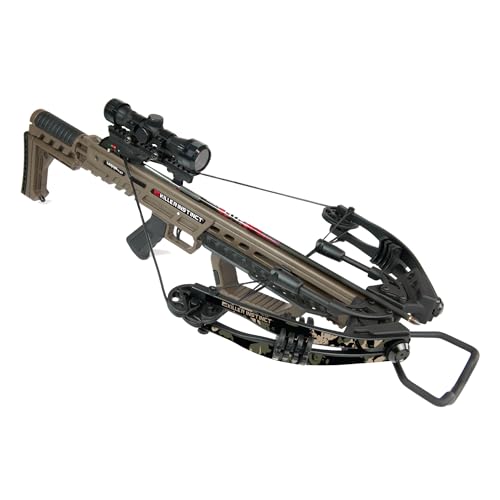
Killer Instinct Lethal 405HD Crossbow Kit
Overview
This is a compound hunting and target crossbow package built around a 210-pound draw weight. It includes a 4x32 scope, rope cocker, quiver, rail lubricant, and two 20-inch, 390-grain bolts. The maker rates it at up to 405 feet per second, but does not publish the bolt weight, setup, distance, or test method behind that headline speed claim. Its exact-model manual documents an auto-engaging manual safety, an anti-dry-fire release arrangement, an arrow retainer, and finger and thumb protection zones. It also specifies finished bolts of at least 20 inches and 370 grains, using half-moon or KI V-nocks. These are meaningful operating controls, but no model-specific independent trigger, drop, abuse, chronograph, accuracy, or fatigue test report was located.
What works
- The manual gives unusually concrete bolt compatibility limits, including minimum finished weight, length, and accepted nock styles.
- The documented anti-dry-fire system is designed to prevent moving the safety to FIRE until a properly loaded bolt is present.
- Safety instructions cover eye protection, hand placement, backstops, inspection, storage, transport, and bystander clearance.
- The maintenance schedule calls for pre-shot inspection, regular lubrication, replacement of worn strings or cables, and periodic dealer inspection.
- Serial-number registration and an authorized service path support warranty and service traceability.
What does not
- The 405 feet per second claim is manufacturer-stated and lacks published test conditions or a model-specific independent chronograph report.
- No independent, reproducible testing was located for the trigger, safety, anti-dry-fire system, cocking aid, structural durability, or bolt retention.
- Decocking requires firing a bolt or an appropriate discharge bolt into a suitable target or rock-free ground. It does not provide a built-in let-down system.
- The 210-pound draw weight still involves substantial stored energy. The rope cocker reduces manual loading demands but does not eliminate hook, pinch, back, or loss-of-control risks.
- The manufacturer posts a California lead exposure warning for products sold through its site, without identifying the component or exposure route for this specific package.
Who is it for
This product suits an experienced adult hunter or target shooter who has completed hunter education or can receive qualified in-person instruction. The user should be comfortable following detailed loading, bolt inspection, rope-cocking, and maintenance steps, and should have access to a safe crossbow target or approved discharge area. It is also better suited to someone willing to register the product, retain proof of purchase, record the serial number, and arrange periodic authorized service rather than attempting string, cable, limb, or trigger work at home.
Who is it not for
It is not suitable for children using it without direct adult supervision, inexperienced users without formal instruction, or households unable to secure it uncocked and inaccessible. People with back, shoulder, hand, balance, dizziness, or other conditions that could interfere with controlled cocking should not treat the rope cocker as a substitute for medical judgment. It is also a poor fit where there is no safe target and backstop for unloading, because decocking is done by shooting a bolt rather than by a built-in controlled let-down mechanism.
Integrity
The principal health issue is stored energy and a fast projectile. The manual explicitly warns of severe hand injury, including possible finger or thumb amputation, if hands enter the string and cable path. It directs users to wear eye protection while cocking, loading, and shooting, inspect both bolts and bow before use, keep the safety engaged until firing, and keep people clear of the firing path. These instructions are specific and usable, though the product lacks publicly located independent safety-mechanism testing. The package uses carbon bolts and replaceable strings, cables, cable slide, and other wear parts. The manual instructs users to discard damaged bolts and replace worn string or cables, which can reduce breakage hazards and field debris when followed. The manufacturer also posts a California warning that products sold through its site can expose users to lead, but it does not identify the relevant component or exposure pathway for this package. No product-specific recycling or end-of-life materials plan was located.

Wicked Ridge Commander 400 Crossbow Package
Overview
The Wicked Ridge Commander 400 is a forward-draw hunting crossbow package with a 190-pound draw weight, 12.5-inch power stroke, 7.3-pound listed weight, built-in ACUdraw crank, illuminated Pro-View 400 scope, quiver, and three Match 400 carbon arrows. It is cocked with the integrated crank, loaded with a compatible arrow, and fired at a target or during lawful hunting. The maker specifies 400 fps and 146 foot-pounds of kinetic energy with a 410-grain Match 400 arrow, which is a useful test condition rather than an unqualified speed number. The maker also states that the ACUdraw reduces cocking effort to 5 pounds. Model-specific owner resources include a current general safety manual, maintenance guidance, scope instructions, assembly video, and a serial-number registration process. No model-specific independent trigger, anti-dry-fire, crank load-cycle, or structural test report was located.
What works
- The listed 400 fps figure is qualified by a 410-grain arrow and a stated 146 foot-pounds of kinetic energy.
- The built-in ACUdraw is manufacturer-stated to reduce cocking effort to 5 pounds, which can make loading more manageable than direct manual cocking.
- The package includes an illuminated scope, quiver, and three compatible carbon arrows, reducing setup work before initial sighting.
- The manufacturer provides model-specific assembly, cocking, maintenance, and scope resources, plus serial-number registration and warranty support.
- Maintenance guidance calls for regular string, cable, rail, nock, and arrow inspection, with replacement parts and service channels available.
What does not
- No independent, model-specific laboratory report was found for trigger safety, anti-dry-fire function, arrow retention, crank durability, dry-fire resistance, or limb fatigue.
- The integrated crank still has stored-energy hazards. The manufacturer warns not to use it for uncocking, not to crank without its safety pawl, and to replace a frayed cord before use.
- This is a 190-pound draw-weight crossbow that launches an arrow at a manufacturer-stated 400 fps, so it demands controlled targets, eye protection, a clear firing path, and disciplined handling.
- The 400 fps speed, 5-pound cocking effort, limb-quality, and accuracy claims are manufacturer statements. The cited accuracy comparison does not provide a publicly accessible full test method or raw results.
- The included lighted scope and carbon-arrow consumables add battery and field-loss considerations that require user-managed disposal and recovery.
Who is it for
This product fits an adult, trained crossbow user who wants a complete forward-draw hunting setup and can follow a detailed loading, inspection, and target-safety routine. It is especially relevant for someone who benefits from reduced cranking effort but is still able to operate, inspect, and secure a crank system correctly. The stated 400 fps configuration is best suited to users with an established safe shooting location, a suitable backstop, compatible 410-grain arrows, and access to an authorized service center if strings, cables, limbs, or the cocking device need attention.
Who is it not for
It is not appropriate for children, unsupervised users, or households where safe locked storage and a controlled shooting area are unavailable. It also does not suit anyone seeking a crossbow that can be safely uncocked with its crank, because the ACUdraw instructions specifically direct users not to uncock that way. Buyers who need independently published trigger, anti-dry-fire, crank endurance, or limb-fatigue testing should look for a product supported by those reports. Do not use damaged arrows, worn strings or cords, incorrect nocks, or underweight arrows.
Integrity
This is a high-energy projectile device, not a casual recreational item. The available manufacturer materials identify a dry-fire inhibitor, a trigger safety system, finger-protection features, compatible-arrow guidance, and repeated instructions to keep hands and fingers below the flight deck. The same materials warn that a worn ACUdraw cord can release the claw with force, that the crank safety pawl must be engaged, and that the crank is not for uncocking. No current recall specific to this Commander 400 model was located. TenPoint and Wicked Ridge did conduct a serial-number-based repair recall for certain older models in 2015 after reports of firing under particular safety-reset conditions. The product uses carbon arrows, strings, cables, composite limbs, metal components, and a lighted scope. The manufacturer supports inspection, maintenance, replacement strings and cables, nocks, and authorized service, which can extend service life. Users should recover arrows rather than leave carbon, plastic, metal, or broadhead debris in the field, retire cracked shafts and damaged nocks, and dispose of scope batteries through an appropriate local battery collection program.

RAVIN Crossbow Package - R8, R10, R10X, XK7 Models
Overview
The Ravin R8 is a compact compound crossbow package for hunting and target shooting. Ravin lists a 32.5-inch length, 7.55-pound product weight, aluminum CNC riser, composite quad limbs, nylon-fiber stock, 3x32 illuminated scope, three 400-grain arrows, quiver, and removable draw handle. It is supplied fully assembled and pre-tuned, according to the manufacturer. The defining operating feature is the built-in Versa-Draw system, which Ravin says cocks and uncocks the bow with 12 pounds of draw force. Ravin also states that the R8 has a Trac-Trigger mechanism, anti-dry-fire protection, and an automatic safety. The stated 420 fps speed is qualified by a 400-grain arrow, which is useful context. No public, model-specific independent safety, drop, trigger, durability, or chronograph report was located during verification.
What works
- Ravin specifies the test-arrow mass for its 420 fps claim, 400 grains, rather than presenting speed without a configuration.
- The manufacturer states that the integrated cocking system can both cock and uncock the crossbow with 12 pounds of draw force.
- The supplied package is manufacturer-stated to be fully assembled and pre-tuned, with a scope, three arrows, quiver, and draw handle.
- A serial-number registration system and five-year limited warranty provide a traceable route for safety updates and service.
- Ravin sells replacement strings and cables for this model family, supporting maintenance of key wear components.
What does not
- No publicly available independent test report was found for this exact product covering trigger pull, safety engagement, anti-dry-fire operation, drop resistance, cocking-system failure modes, or structural fatigue.
- The accessible manufacturer safety library did not provide a clearly identifiable instruction manual for this exact model during verification, limiting confirmation of model-specific bolt, nock, inspection, storage, and dry-fire procedures.
- Ravin previously recalled white clip-on arrow nocks after reports of finger injuries. The recall was for older white nocks and does not identify this product, but it makes exact arrow and nock verification important.
- A 2024 recall involved a different Ravin R500-series design that could discharge when nearly, but not fully, cocked. It does not establish a defect in the R8, but it is relevant background when judging unverified cocking safety claims.
- The five-year warranty excludes strings, cables, scopes, arrows, and several other wear or accessory components, and requires registration within 30 days for coverage.
Who is it for
This product suits an experienced adult hunter or target shooter who wants a compact, pre-tuned crossbow package and is prepared to follow a model-specific manual before use. The stated 12-pound integrated cocking and uncocking force may be useful for someone who finds high-force rope cockers difficult. It also suits a buyer who will register the product promptly, maintain strings and cables through qualified service, inspect every arrow and nock, and use only the specified compatible ammunition.
Who is it not for
It is not suited to unsupervised minors, households where people may enter the firing or cocking area, or anyone unwilling to learn and follow crossbow handling procedures. It is also a poor fit for users who expect independently published trigger, drop, fatigue, or mechanism testing for the exact model. Avoid improvised bolts, nocks, broadheads, repairs, or modifications. Buyers needing a transferable warranty, broad coverage for strings and accessories, or a product intended for casual recreational handling should seek a different arrangement.
Integrity
This is a high-energy projectile product, so the most important health issue is controlling the firing path and the stored energy during cocking, loading, uncocking, and maintenance. Ravin states that this model includes automatic safety and anti-dry-fire features, but those claims were not supported by a public independent test report for the exact product. The company’s safety materials emphasize reading the manual, keeping hands out of the string path, and using compatible Ravin arrows and clip-on nocks. Ravin has a serial-number registration system and previously issued remedies for recalled white arrow nocks and for affected R500-series crossbows. Neither recall identifies this product, but both support checking current safety notices and confirming nock compatibility. The R8 uses an aluminum riser, composite limbs, nylon-fiber stock, and carbon arrows. Replacement strings and cables are sold, which can extend service life. No product-specific material-recycling, arrow-recovery, battery-disposal, or end-of-life disposal program was identified.

Barnett Whitetail Hunter II Crossbow Black
Overview
This is a compound hunting crossbow with a composite flight track, a supplied rope cocking device, a 4x32 multi-reticle scope, side-mount quiver, lubrication wax, and two 20-inch Headhunter arrows. It is intended for target practice and hunting with crossbow-specific arrows, not for casual handling or unsupervised storage while cocked. Barnett currently specifies a 6.4-pound weight, 150-pound draw weight, 12.5-inch power stroke, and 350 fps using a 380-grain arrow. That draw-weight figure conflicts with the 165-pound value in the catalog record. The manufacturer also states that this product has a TriggerTech trigger, automatic anti-dry-fire system, and Soft-Lok bristle arrow retainer. Its manual provides unusually concrete operating limits, including moon or half-moon nocks, at least 400-grain finished arrows, eye protection, pre-use inspections, and a prohibition on hand or rope-assisted de-cocking.
What works
- The manual gives specific compatibility rules, including moon or half-moon nocks and a minimum finished arrow weight of 400 grains.
- The manufacturer-stated anti-dry-fire mechanism, nock sensing, and bristle retainer address a major foreseeable loading hazard.
- The supplied rope cocker is the prescribed loading method, with instructions to inspect its cord for fraying or binding before each use.
- The manual requires inspection of limbs, cams, cables, fasteners, rail, and arrows before use, with frequent lubrication guidance.
- Barnett provides a five-year limited warranty for the stock, trigger mechanism, and limbs for the original registered owner.
What does not
- No model-specific independent report was located that documents trigger, drop, anti-dry-fire, bolt-retention, fatigue, or abuse-test methods and results.
- The product cannot be safely de-cocked with the rope cocker or by hand. The manual directs the user to discharge it into an approved crossbow target.
- The manual warns that a dry fire can cause catastrophic damage. Correct bolt seating, nock type, arrow condition, and minimum finished weight remain user-critical.
- The five-year warranty excludes strings, cables, arrows, accessories, wear, and shipping. Registration is required within 10 days, and improper arrows or a dry fire can void coverage.
- The manufacturer's current specification lists 150-pound draw weight, which conflicts with the catalog record's 165-pound figure.
Who is it for
This product suits an adult hunter or target shooter who will read and follow a detailed manual, can use a rope cocking device with controlled footing and hand placement, and has access to an appropriate crossbow target or safe range. It is particularly relevant for someone who values explicit bolt compatibility rules and a relatively light stated product weight. The user should be prepared to inspect strings, cables, limbs, fasteners, and bolts before every session, wax the string and flight track frequently, and maintain replacement wear parts.
Who is it not for
It is not suited to households where children under 16 could access it without direct, competent adult supervision, or where safe locked storage and a controlled shooting direction are unavailable. It also does not suit anyone who needs to quietly and mechanically de-cock a loaded crossbow, since the manual forbids using the rope cocker or hands for that task and directs discharge into an approved target. Buyers unwilling or unable to verify bolt weight, nock style, condition, and full seating should choose a different activity or obtain qualified in-person instruction first.
Integrity
The central health issue is stored energy. Barnett's manual warns that fingers near the string, cables, or flight track can be seriously injured, and requires safety glasses during assembly, cocking, loading, cleaning, and shooting. It also sets practical controls for dry-fire risk, including compatible nocks, at least 400-grain finished arrows, proper bolt seating, and pre-shot inspection. These instructions are detailed, but the safety mechanisms themselves were not supported by a public model-specific independent test report located in this review. A 2016 CPSC recall involved six other Barnett crossbow models with malfunctioning arrow sensors, not this product. A 2017 CPSC recall of TriggerTech carbide-roller triggers named other crossbow brands, not Barnett. Barnett identifies a composite flight track, while its manual supports repair-oriented maintenance through inspection and replacement of damaged strings, cables, arrows, and retainers. It does not provide meaningful material-disclosure, recycling, or lost-bolt recovery guidance. Damaged carbon arrows and composite parts should not be reused in the field.
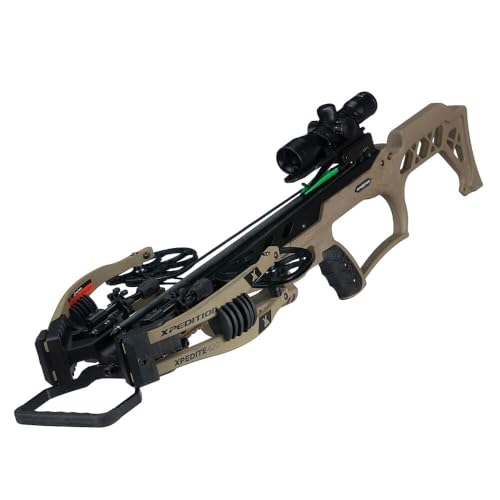
Xpedition Archery Xpedite 420 Crossbow Package
Overview
This is a compound hunting crossbow with a 36-inch stated overall length, 190-pound stated pull weight, 8-inch stated cocked width, illuminated 4x32 scope, quiver, three Xit-20 bolts, and a rope cocking sled. The manufacturer states a mass weight of 7.7 pounds, a 3-pound trigger, anti-dry-fire technology, and speeds up to 420 fps. Those are manufacturer specifications, not independently reproduced test results. The manufacturer’s model-specific manual provides useful operational detail. It requires at least 380-grain total bolt weight, specifies 20- or 22-inch bolts with clip-on or half-moon nocks, directs loading under a retention spring, and says cocking automatically moves the safety to safe when the string locks. No model-specific independent trigger, drop, fatigue, chronograph, or accuracy report was located.
What works
- The manual gives a specific compatible-bolt envelope, including minimum 380-grain finished weight, length, and nock types.
- Loading instructions require the bolt to pass under a retention spring and fully seat with a clip-on nock click.
- The manual documents automatic movement of the safety to safe when the string locks during cocking.
- A serial-number registration process and one-year defect warranty are documented by the manufacturer.
What does not
- No publicly located independent laboratory report verifies the trigger, safety, anti-dry-fire mechanism, crank, limbs, or 420 fps claim for this model.
- The 420 fps headline is qualified only as “up to,” without published bolt mass, chronograph method, or accuracy distance.
- The product record describes both a rope cocker and crank, while the manufacturer’s current base-package description lists a rope cocker and does not list a crank. Buyers should confirm included equipment before setup.
- The manual prohibits decocking with either rope or mechanical cocking device. A cocked product must be discharged with a recommended bolt, which requires a suitable safe backstop and controlled range conditions.
Who is it for
This product suits an experienced adult crossbow user who can follow a detailed setup, lubrication, inspection, and loading routine, and who has a safe location for every discharge. It is particularly relevant to a user seeking a compact stated 8-inch cocked width for hunting access or confined blind use. The user should be prepared to use only the specified bolt configuration, inspect strings, cables, fasteners, and wear parts before use, and confirm whether the purchased package actually includes the mechanical crank.
Who is it not for
It is not suited to children, casual first-time users without direct instruction, or households lacking secure storage and a safe backstop. It is also unsuitable for anyone who expects to uncock it with the rope or crank after deciding not to shoot, because the manual expressly prohibits that procedure. Users who need independently published trigger, drop, abuse, fatigue, or chronograph testing should choose a product with those reports. It also does not suit users who cannot reliably source specified 20- or 22-inch, 380-grain minimum bolts and compatible nocks.
Integrity
The important health information is unusually concrete in the manufacturer manual. It warns against dry firing, hand or thumb placement above the finger guards, damaged strings or cables, cocked transport, and improper bolt mass. It specifies a 380-grain minimum bolt weight and says that a dry fire can damage limbs, string, and cables. The instructions also direct users to inspect for loose, worn, missing, frayed, or damaged parts and to lubricate the rail and strings every 5 to 10 shots. No product-specific CPSC recall was located in the search performed, and the manual provides a serial-number registration field plus a one-year warranty for defects in materials and workmanship. However, no independent safety-test report or current recognized crossbow product standard certification was found. Material composition is not meaningfully disclosed beyond component descriptions, and the manual has no bolt-recovery, composite disposal, or battery-disposal guidance for the illuminated scope.