
10 Best Chargepoint Level 2 Chargers of 2026
 Daniel Kenitz
Please note that we participate in affiliate marketing programs. When you purchase through links on our site, we may earn a commission. As an Amazon Associate we earn from qualifying purchases. This comes at no additional cost to you and helps support the resources required to provide valuable content.Advertising Disclosure
Top-rated Chargepoint Level 2 Charger Comparison
1

2
4
5
6
7
8
9
10
Overview
A Level 2 charger supplies alternating-current power to an electric vehicle or plug-in hybrid faster than a standard household outlet. The charger is an electric-vehicle supply device: it controls the connection, communicates with the vehicle, and provides protection while the vehicle’s onboard charger converts AC power for the battery. The product may be hardwired or plugged into a NEMA 14-50 receptacle, and may use a J1772 or NACS/J3400 vehicle connector.
Whether a charger works safely and usefully depends on more than its headline amp rating. First confirm the vehicle connector and the vehicle’s maximum AC charging rate. A J1772 charger directly fits vehicles with J1772 inlets; a vehicle with a native NACS inlet needs a suitable, vehicle-approved adapter. A NACS charger is not a direct fit for a J1772 vehicle without the appropriate adapter. The charger’s maximum output also does not guarantee that the vehicle will accept that amount.
Electrical installation is the next constraint. EV charging is a continuous load, so the selected current must match the dedicated circuit, breaker, conductors, grounding, receptacle, and local code. A 48A or 50A setting commonly requires a substantially larger circuit than the number in the product title suggests. Supplied reviews include products whose manuals limit a NEMA 14-50 plug-in setup to 32A, 40A, or another lower setting while reserving the advertised maximum for hardwiring. A 50A charger is therefore not automatically suitable for a 50A breaker, and a plug-in charger should not be treated as a hardwired one.
For safety evidence, look for the exact model and configuration in an independent registry. Relevant records include UL Product iQ for UL 2594 and applicable UL 2231 personnel-protection standards, Intertek’s ETL Listed Directory, or CSA Group listings for CSA C22.2 No. 280. The certifier should be an OSHA-recognized Nationally Recognized Testing Laboratory. A marketplace badge, a family-level certificate, or a brand-level claim is weaker than a searchable record covering the product actually being purchased.
Outdoor claims also need precise support. IP codes should be tied to the IEC 60529 test method, and NEMA claims should identify the applicable enclosure standard. Check the exact operating-temperature, ingress, impact, cable, connector, and strain-relief information. “Weatherproof” does not by itself establish resistance to every combination of rain, dust, freezing temperatures, vehicle impact, cable wear, or exposed receptacle conditions.
Energy and connected features deserve separate checks. ENERGY STAR’s exact-product record can provide independently measured no-vehicle and idle power, as well as output and cable details. Do not assume all Level 2 chargers waste the same amount of electricity while waiting. For Wi-Fi, Bluetooth, or app-connected products, check the privacy policy, access controls, firmware-update and support period, disclosed vulnerabilities, and whether basic charging works locally if the cloud service or home network fails. Finally, a meaningful warranty, replacement cable or parts availability, repair route, and support policy affect whether a minor failure leads to premature electronic waste.
Across the supplied reviews, the recurring safety caveats are clear: professional installation and correct continuous-load sizing are essential; plug-in and hardwired ratings must not be conflated; J1772 and NACS compatibility must be checked; and exact-model certification should not be inferred from a marketing badge. Several products also lacked a public exact-model safety listing, clear weather-test evidence, replacement parts, or a defined firmware-support period. Connected products raise additional privacy and security questions, including broad charging and network-data collection and, for some brands, disclosed vulnerabilities without a model-specific remedy. One product showed a documented cold-weather cable-handling limitation. No category-wide contraindication beyond these installation, configuration, weather, and support checks was identified in the supplied data.
Integrity
These topics reflect the supplied reviews’ evidence about people, property, electricity use, product longevity, and claim reliability. Higher scores indicate stronger model-specific evidence within this set; they do not replace electrical code, the vehicle manual, or professional installation.
HHealth & Safety
Electrical shock and fire safety
This measures independently evaluated protection against ground faults, overheating, abnormal current, shock, and energized connectors. It matters because a Level 2 charger remains connected to household mains for long periods. Among the supplied products, higher scores generally correspond to exact or family certification evidence such as UL or ETL records and documented fault protection; lower scores often lacked a traceable safety listing for the exact configuration.
Safe fit for the electrical circuit
This measures whether amperage, breaker guidance, wiring, plug or hardwire method, and adjustable settings make a code-compliant installation understandable. It matters because EV charging is a continuous load. Higher-scoring products clearly separated plug-in and hardwired limits and mapped current to circuit requirements; lower-scoring products had conflicting headline ratings, incomplete manuals, or unclear requirements for the advertised maximum.
Weather, cable, and connector durability
This measures evidence for resistance to water, dust, temperature, impact, cable damage, strain, and connector wear. It matters when a charger is mounted outdoors or its cable crosses a parking route. Higher scores reflected clearer enclosure and cable information or supporting evidence; lower scores reflected manufacturer-only IP or NEMA claims, missing test reports, or a documented cold-weather handling limitation.
Vehicle and connector compatibility
This measures whether connector type, pilot signaling, current limits, adapters, and vehicle compatibility are accurately described. It matters because a J1772 and a NACS/J3400 charger are not interchangeable without an appropriate adapter. Higher scores came with consistent connector and vehicle limits; lower scores reflected contradictory specifications or broad compatibility language that required adapter or vehicle-specific qualification.
Recall and safety incident accountability
This measures unresolved recalls, regulatory warnings, serious incident patterns, and the quality of corrective action for the brand and exact product. It matters because a charger is a high-power household appliance. Scores were fairly clustered, but stronger results reflected searches without an identified product-specific action and clearer accountability; lower results reflected less complete evidence or relevant brand and vulnerability history.
App security and charging-data privacy
This measures access controls, firmware support, privacy clarity, local operation, and disclosed security issues for connected chargers. It matters because the charger may expose household network, location, account, and charging data. Higher scores generally belonged to products with offline operation or clearer support information; lower scores reflected broad data collection, unclear security lifetimes, mainland-China storage, or unresolved vulnerability questions.
EEcology
Energy waste while charging and idle
This measures independently tested electricity use while idle, powered without a vehicle, or charging. It matters because a home charger can remain energized every day. Higher-scoring products had exact ENERGY STAR records with measured no-vehicle or idle power, including very low readings around 0.8W to 3.7W in the supplied set; lower scores lacked exact-model measurements or certification.
Long service life and less e-waste
This measures warranty, durability, repairability, replacement parts, service, firmware support, and take-back information. It matters because replacing a cable or unsupported smart unit creates avoidable waste. Higher scores combined meaningful warranties with documented replacement or repair pathways; lower scores commonly had no parts catalog, no repair pricing, no support end date, or only a general warranty statement.
EEvidence
Honest power, speed, and feature claims
This measures whether amp, kilowatt, speed, weather, smart, compatibility, and certification claims match the exact product and state their limits. It matters because titles often present maximum output without the required circuit or hardwire condition. Higher scores reflected consistent manuals, records, and configuration details; lower scores reflected plug-in versus hardwire conflicts, incorrect connector fields, or contradictory power ratings.
Independently verified exact model
This measures whether the exact product and configuration appear in a qualified third-party registry rather than merely carrying a brand badge. It matters because a family certificate may not cover every retail variant. Higher scores came from exact UL, ETL, CSA, or ENERGY STAR records; lower scores reflected untraceable claims, family-only evidence, or an independent record that did not match the marketed configuration.
Reliable operation and lasting support
This measures warranty coverage, fault guidance, firmware maintenance, support responsiveness, and evidence that the charger will continue delivering its rated function. It matters because a failed or unsupported smart charger can strand a vehicle. Higher scores reflected published manuals, warranty, support, and repair-or-replace terms; lower scores reflected unclear patch lifetimes, limited service information, or missing replacement parts.
Full reviews

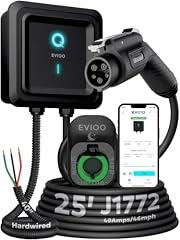
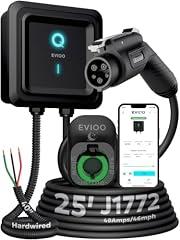
EVIQO Level 2 EV Charger 48 Amp
Overview
This is a wall-mounted Level 2 AC charging product for J1772-equipped electric vehicles. In its hardwired configuration, it is specified for 240 V, up to 48 A, or about 11.5 kW, and has a 25-foot charging cable. The manufacturer instructs installers to use a dedicated 60 A circuit for 48 A charging, with 6 AWG copper conductors for the two hot wires and a 10 AWG equipment ground. The safety claim has meaningful independent support. An Intertek certificate covers EVIQO EVIPOWER 48 A hardwired variants to UL 2594 and CSA C22.2 No. 280. EPA ENERGY STAR also independently lists the matching 48 A J1772 configuration at 11.52 kW and reports measured idle and no-vehicle energy use. The stated IP66 and NEMA 4 outdoor ratings were not independently verified in the records reviewed.
What works
- Intertek certification covers 48 A hardwired EVIPOWER variants to UL 2594 and CSA C22.2 No. 280.
- The installation guidance clearly ties 48 A output to a dedicated 60 A circuit and gives conductor, ground, torque, and current-setting instructions.
- EPA ENERGY STAR independently lists a matching 48 A J1772 configuration at 11.52 kW with a 25-foot cord.
- ENERGY STAR testing reports 2.43 W no-vehicle input power and 4.99 W idle input power for the matching 48 A J1772 configuration.
- A three-year limited parts-exchange warranty is documented by the manufacturer.
What does not
- The catalog's EVIPOWER-2 designation does not exactly match the public ENERGY STAR product name, so the efficiency record is strong configuration-level evidence rather than a direct identifier match.
- IP66 and NEMA 4 outdoor claims are manufacturer-stated. The reviewed Intertek certificate confirms EVSE safety standards, but does not state the ingress-rating test scope.
- The app collects charging and account-related data under a published privacy policy, but no product-specific security-update commitment, support end date, or public vulnerability disclosure process was found.
- Independent hands-on testing found the app less suitable for detailed time-of-use scheduling and session accounting, including schedules that cross midnight.
- No replacement-parts catalog or formal repair pathway was found. The warranty is replacement-oriented, which can limit repairability after coverage ends.
Who is it for
This product fits an owner of a J1772 vehicle or plug-in hybrid who has, or will obtain, a professionally installed dedicated 60 A, 240 V circuit and wants up to 48 A home charging. It is particularly relevant where the parking position needs a long cable, since the independently listed matching configuration has a 25-foot cord. It also suits drivers who value automatic plug-in charging and basic app scheduling, but do not need exceptionally detailed charging-session accounting or complicated overnight time-of-use schedules.
Who is it not for
It is not for renters or households without authority and budget for a permanent electrical installation. A 48 A continuous load needs a correctly sized dedicated circuit, suitable conductors, and local code approval, so it is not appropriate to connect to an existing 50 A outlet or undersized wiring. It is also a poor fit for NACS-only vehicles unless the vehicle maker permits the specific adapter arrangement. Households requiring documented long-term cybersecurity support, repair parts, or sophisticated utility-rate automation should note that those support details were not verified.
Integrity
Electrical safety evidence is stronger than the marketing badge alone suggests. Intertek's certificate covers EVIPOWER 48 A hardwired variants to UL 2594 and CSA C22.2 No. 280. The manufacturer also specifies built-in ground-fault protection and requires a dedicated 60 A circuit for 48 A output. Correct professional installation remains essential because this is a high, continuous electrical load. Energy performance has independent evidence for the matching 48 A J1772 configuration. EPA ENERGY STAR lists 11.52 kW maximum output, 2.43 W no-vehicle input power, and 4.99 W idle input power. That reduces avoidable electricity use while parked, although charging losses still rise with load. The manufacturer offers a three-year warranty, but no public replacement-parts catalog, take-back program, or product-specific security support lifetime was found. No U.S. CPSC or NHTSA recall or safety action was located in the searches performed.

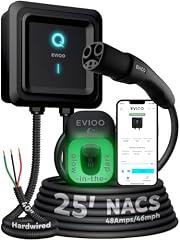
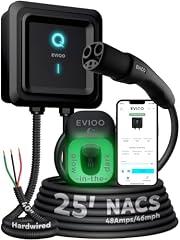
EVIQO Level 2 48 Amp EV Charger for Tesla
Overview
This is a wall-mounted, hardwired 240 V Level 2 home charger with a native NACS connector, intended primarily for Tesla vehicles and other vehicles using that inlet. It has a 25-foot vehicle cable and is designed for professional connection to a dedicated 60 A circuit when set for its 48 A maximum output. The manufacturer says the app can schedule charging, track energy use, and remotely set charging current from 6 A to 48 A. The EPA ENERGY STAR record independently identifies this exact configuration as a 48 A, 11.52 kW, 240 V charger with a 25-foot cord. An Intertek certificate covers EVIQO EVIPOWER 48 A variants to UL 2594 and CSA C22.2 No. 280. The enclosure's IP66 and NEMA 4 ratings, built-in fault protections, operating-temperature range, and automatic firmware updates are manufacturer-stated rather than supported here by a public model-specific test report.
What works
- The exact configuration is listed by EPA ENERGY STAR at 48 A, 11.52 kW, and 240 V.
- EPA ENERGY STAR testing reports 2.43 W in no-vehicle mode, which limits idle electricity use.
- An Intertek certificate covers EVIQO EVIPOWER 48 A variants to UL 2594 and CSA C22.2 No. 280.
- The 25-foot charging cable is independently documented in the ENERGY STAR record.
- The manufacturer gives clear 60 A dedicated-circuit and licensed-electrician guidance for 48 A operation.
What does not
- The manufacturer describes the unit as both 48 A output and 50 A maximum, while the exact ENERGY STAR record lists a 48 A maximum nameplate output.
- IP66 and NEMA 4 outdoor claims are manufacturer-stated, with no public model-specific ingress test report located.
- The app privacy policy permits collection of contact, device, location, charging, and usage data, including data collection when the app is closed, for service and advertising-related purposes.
- No public replacement-parts catalog, repair program, or defined software support lifetime was located.
- Smart functions require a 2.4 GHz internet connection according to the manufacturer.
Who is it for
This product suits an owner of a Tesla or another vehicle with a NACS inlet who has a licensed electrician available to install a dedicated 60 A, 240 V circuit. It is also suited to households where a fixed 25-foot cable helps reach an EV parked in different positions. The independently listed 48 A output can be useful for vehicles that accept that Level 2 current, while the manufacturer-stated adjustable current setting may help an installer match charging to available circuit capacity.
Who is it not for
It is not suited to renters, frequent movers, or anyone seeking a simple plug-in installation, because this version is intended to be permanently hardwired. It is also not appropriate for homes without panel capacity for a dedicated 60 A circuit or without access to a licensed electrician and locally required permits. Buyers who want a publicly documented ingress test report, repair parts, long-term firmware commitment, or data-minimizing connected features should look for those records before relying on this product outdoors or on a household network.
Integrity
For electrical safety, the strongest external evidence is an Intertek certificate covering EVIQO EVIPOWER 48 A variants to UL 2594 and CSA C22.2 No. 280. The product's installation guidance also calls for a licensed electrician and a dedicated 60 A circuit for 48 A charging. These are important safeguards because EV charging is a continuous high-current load. Searches of U.S. CPSC and NHTSA recall resources did not identify a product-specific recall or safety warning as of August 16, 2026. For energy use, EPA ENERGY STAR lists this exact configuration with 2.43 W no-vehicle power and 4.99 W idle power. That is independently reported efficiency information, not a general assumption about Level 2 chargers. The manufacturer offers a three-year warranty and states that over-the-air updates are provided. However, it does not publish a replacement-parts catalog, repair pathway, or defined software-support end date. Its privacy policy also allows broad app and charging-data collection, including for advertising-related purposes.

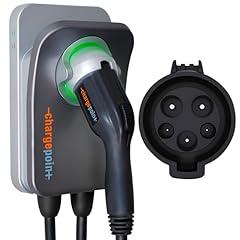
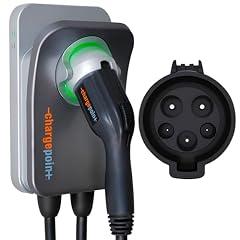
ChargePoint Home Flex Level 2 EV Charger
Overview
ChargePoint Home Flex is a wall-mounted Level 2 AC charging station for vehicles with a J1772 inlet. This version has a NEMA 14-50 plug, a 23-foot attached charging cable, Wi-Fi and Bluetooth connectivity, and a 240 V input. It supplies up to 40A when used as the supplied plug-in product on a correctly sized 50A circuit. Higher settings require a properly hardwired installation. The CPH50 model family is listed by UL Solutions, and the manufacturer documents ground-fault, ground-monitoring, relay, over-current, pilot-signal, and self-test fault responses. EPA Energy Star certification independently covers this exact plug-in configuration and reports 0.8W in no-vehicle mode. ChargePoint states the enclosure is NEMA 3R rated for outdoor use and provides a three-year parts warranty.
What works
- UL Solutions lists the CPH50 charger family, and the manufacturer documents multiple electrical fault responses including ground-fault and over-current conditions.
- The installation guide gives unusually concrete continuous-load guidance. It requires a dedicated 240V circuit rated at 125 percent of the selected charging load and maps each setting to circuit size.
- EPA Energy Star independently lists the exact NEMA 14-50 configuration and measures 0.8W no-vehicle power, 1.36W partial-on power, and 3.53W idle power.
- The charging cable is replaceable through ChargePoint, which can avoid replacing the whole station after cable damage.
- Charging remains possible without Wi-Fi after a licensed electrician sets the current through Bluetooth.
What does not
- The supplied NEMA 14-50 plug-in configuration is limited to 32A on a 40A circuit or 40A on a 50A circuit. The advertised 50A maximum requires hardwiring and suitable electrical infrastructure.
- NEMA 3R outdoor suitability is manufacturer-stated. The publicly available evidence reviewed did not provide an independent ingress-test report for this exact plug-in configuration.
- The privacy policy says home-station use can involve collection of contact information, address, charging and scheduling data, and the connected Wi-Fi network name.
- ChargePoint provides fault guidance and support, but no clear public firmware support lifetime or model-specific security-update commitment was found.
- No CPSC or NHTSA recall was located in this review, but online owner reports describe isolated loud failures and damaged units. Those reports do not establish cause or frequency.
Who is it for
This product suits a homeowner with a J1772-equipped EV, a dedicated 240V circuit, and a licensed electrician who can match the selected current to the breaker, wiring, receptacle, and panel capacity. It is particularly appropriate where a 40A or 50A NEMA 14-50 circuit already exists and 32A or 40A charging is sufficient. It also fits buyers who value measured low no-vehicle energy use, scheduling and charging records, a long reach cable, and the option to replace a worn cable rather than discard the complete unit.
Who is it not for
It is not suited to a household expecting 50A charging simply by plugging into an existing NEMA 14-50 outlet. The supplied plug-in setup is limited to 40A charging on a 50A circuit, while 48A and 50A settings require hardwiring and a larger properly designed circuit. It is also a poor fit for anyone unable to use a licensed electrician, anyone with a marginal or shared circuit, or privacy-sensitive users who do not want a connected charger collecting home charging, scheduling, location, and Wi-Fi network information.
Integrity
The strongest safety evidence is the UL Solutions listing for the CPH50 model family, supported by a detailed manufacturer fault-code guide covering ground faults, ground-monitoring faults, relay conditions, over-current, pilot errors, and self-test failures. The installation guide also treats EV charging as a continuous load, requires a dedicated circuit, and specifies a 125 percent circuit-sizing rule. Outdoor use requires hardwiring or a weather-resistant receptacle, and ChargePoint states the enclosure is NEMA 3R rated. Energy Star independently certifies the exact NEMA 14-50 configuration. Its record reports 0.8W with no vehicle connected, which limits idle electricity use, although charging losses still rise with output current. A replaceable charging cable and three-year parts warranty can reduce unnecessary whole-unit disposal. No CPSC or NHTSA recall was located for this product during this review. Connected use carries a data tradeoff because ChargePoint's policy covers home charging, scheduling, address, and Wi-Fi network information.

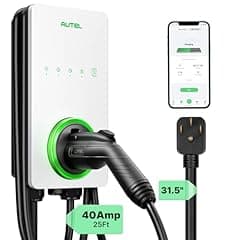
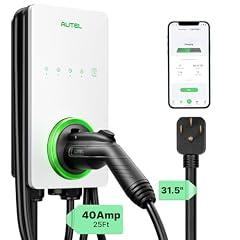
Level 2 EV Charger 40Amp 240V
Overview
This is a plug-in Level 2 home charging station for a properly grounded 240V NEMA 14-50 receptacle. It is sold as a 40A unit, equivalent to up to 9.6 kW at 240V, with a 25-foot J1772 vehicle cable. The J1772 connector suits most non-Tesla North American EVs and plug-in hybrids. Tesla vehicles need a compatible adapter supplied or approved by the vehicle maker. Manufacturer and reseller materials describe adjustable 16A, 24A, 32A, and 40A charging, Wi-Fi and Bluetooth app functions, and a NEMA 4X outdoor enclosure claim. A 40A continuous charging load needs a correctly installed dedicated 50A circuit under standard continuous-load sizing practice. Independent product records create an identity problem, because the white version is described under a different model designation than the one in the marketplace record. That reduces confidence that every stated specification and certification has been matched to this exact product.
What works
- The 25-foot cable can make a fixed driveway or garage layout easier to reach, according to manufacturer and reseller specifications.
- Adjustable 16A through 40A charging gives an electrician and owner a way to match charging current to the installed circuit.
- The J1772 connector is the established North American AC connector for many EVs and plug-in hybrids.
- Autel states a three-year warranty, lifetime customer support, and app-based firmware updating support.
What does not
- The claimed CSA compliance could not be confirmed for this exact white product in a public CSA, UL, or Intertek certification record.
- The marketplace record conflicts with independent product records on the model designation, which weakens traceability for safety, enclosure, and certification claims.
- No exact-product ENERGY STAR record or measured idle-power test report was located, so standby energy use is unverified.
- NEMA 4X weather resistance is manufacturer-stated, not independently confirmed here for this exact white configuration.
- The 40A plug-in format requires a properly installed dedicated 50A circuit and suitable receptacle. It should not be connected to an unknown, worn, shared, or undersized outlet.
Who is it for
This product fits an owner of a J1772-equipped EV or plug-in hybrid who already has a professionally installed, dedicated 240V NEMA 14-50 circuit sized for continuous 40A charging. It is particularly practical where a 25-foot cable is needed to reach a vehicle parked in a garage or driveway. It also suits users who want app scheduling or current adjustment, provided they are comfortable with a connected product and use a strong account password and current app software.
Who is it not for
It is not suited to homes without a verified dedicated 50A charging circuit, a sound industrial-grade receptacle, and a qualified electrical installation. It is also a poor fit for drivers whose vehicle uses NACS unless they have a vehicle-maker-approved J1772 adapter and understand the vehicle's AC charging limit. Buyers needing independently traceable exact-product certification, measured standby consumption, or documented replacement-part availability should seek fuller documentation, because those points were not publicly verified for this white configuration.
Integrity
The core health issue is electrical installation. A 40A EV charging session is a continuous high-current load, so the receptacle, conductors, breaker, grounding, and current setting must be matched by a qualified electrician. Manufacturer materials for the related 40A product family describe ground-fault detection, overcurrent and voltage protections, a NEMA 4 or NEMA 4X enclosure claim, and a J1772 cable. These are relevant safeguards, but this review did not confirm an issuing-body listing for this exact white product. Searches of the CPSC recall resources and SaferProducts public database did not identify a recall or safety warning for this product. That is not proof of incident-free operation. The product has a manufacturer-stated three-year warranty and firmware-update capability, which can extend useful service life. However, no exact-model ENERGY STAR listing, measured idle-power result, repair manual, or replacement-parts catalog was located, leaving energy waste and repairability insufficiently documented.
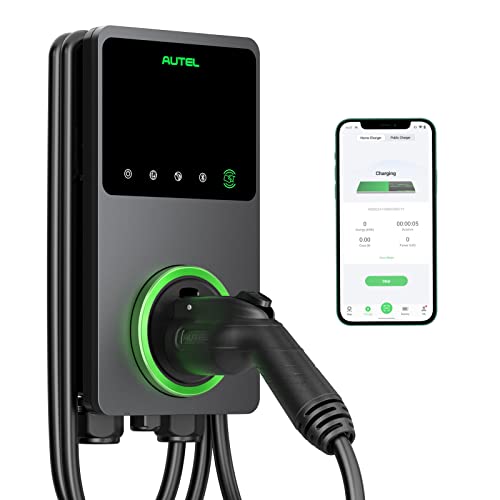
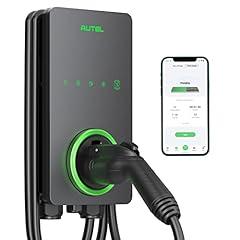
Autel MaxiCharger Home Smart EV Charger 50 Amp
Overview
This product is a hardwired, single-port Level 2 home EV charging station for a 208 or 240 V dedicated circuit. It uses the standard SAE J1772 vehicle connector, has a 25-foot cable, Wi-Fi, Bluetooth, Ethernet, RFID capability, and an in-body connector holster. Autel states a maximum 12 kW output at 240 V and 50 A, with selectable circuit settings and a three-year warranty. EPA ENERGY STAR independently lists this exact product for the United States and Canada as a 240 V, 50 A, 12 kW charger with a 25-foot, 8 AWG output cable. That listing also reports measured no-vehicle power of 3.45 W and idle input power of 5.83 W. The installation manual states NEMA 4 outdoor suitability and protection features including 20 mA ground-fault detection, overcurrent, voltage, and surge protection, but the reviewed public evidence did not provide an exact-model UL, ETL, or CSA directory record for those safety claims.
What works
- Exact product is independently ENERGY STAR certified for the United States and Canada, with measured charging and standby performance.
- EPA lists a 12 kW, 50 A output rating and 25-foot, 8 AWG charging cable for this exact product.
- The manufacturer manual gives concrete continuous-load installation guidance, including breaker options and a 125 percent sizing example.
- The J1772 connector is clearly specified, which supports use with North American J1772-equipped EVs and plug-in hybrids.
- Autel states NEMA 4 indoor or outdoor use, a -40 to 131 F operating range, and integrated ground-fault and surge protections.
What does not
- The manufacturer cites UL and CSA safety standards, but an exact-model listing could not be confirmed in a public UL, ETL, or CSA product directory during this review.
- A 50 A output is a continuous load and requires a properly sized dedicated circuit, correct conductors, and professional installation. It is not a safe fit for every existing garage circuit.
- The public materials reviewed do not provide a clear product-specific security-update commitment, support lifetime, or detailed connected-device security documentation.
- The enclosure and cable durability claims rest primarily on manufacturer documentation, rather than a publicly accessible certification report for this exact configuration.
- The manual says there are no user-serviceable internal parts, and the reviewed materials did not establish a replacement-cable, spare-parts, or repair program.
Who is it for
This product fits an owner of a J1772-equipped EV or plug-in hybrid who has, or will install, a professionally designed 208 or 240 V dedicated circuit that can support the selected charging current. It is particularly suited to a fixed home parking space where the 25-foot cable helps reach a vehicle inlet without an extension cable. It also suits a household that wants scheduled or monitored charging through a local app connection, while retaining RFID and vehicle-connected charging options described by the manufacturer.
Who is it not for
It is not suitable for a household planning to connect a 50 A charger to an existing outlet or circuit without confirming breaker, conductor, panel capacity, permits, and local code requirements. It is also not the direct connector choice for a vehicle that only accepts NACS unless the vehicle maker permits and supplies an appropriate J1772 adapter. Buyers who require publicly verifiable NRTL listing records, detailed cybersecurity support commitments, user-replaceable cables, or documented repair parts should seek those records before installation.
Integrity
The most concrete ecology result is independent ENERGY STAR certification for this exact product. EPA reports 3.45 W with no vehicle connected, 5.83 W in idle mode, and measured losses at several charging currents. Those figures are more useful than assuming all Level 2 chargers have comparable standby use. The exact product is listed for the United States and Canada. For electrical safety, Autel's manual specifies 20 mA ground-fault detection with auto retry, protection against overcurrent, abnormal voltage, and surges, plus NEMA 4 indoor or outdoor installation. It also names UL 2594, UL 2231-1, UL 2231-2, UL 1998, and CSA requirements. Those are relevant standards, but the review could not independently locate an exact-model public safety-listing record in the major NRTL directories. No product-specific CPSC or NHTSA recall was located in the reviewed searches. The three-year warranty helps service life, although public evidence of repair parts and long-term firmware support was limited.
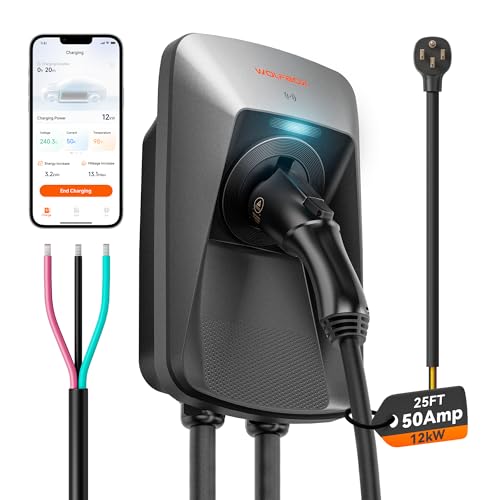
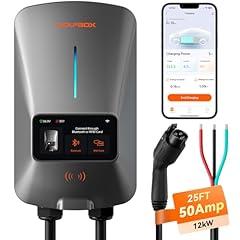
WOLFBOX Level 2 EV Charger 50 Amp WE50
Overview
This product is a wall-mounted 240 V Level 2 home charger for vehicles using the J1772 inlet. WOLFBOX documents a maximum 50 A output, with a hardware switch that can limit output to 48 A or 40 A. The same manual covers both hardwired and NEMA 14-50 plug-in configurations, although the product record describes this version as hardwired. Its main practical features are app scheduling, Wi-Fi and Bluetooth setup, RFID-card activation, and a 25-foot charging cable stated by WOLFBOX. The manufacturer manual documents ground-fault, leakage-current, overcurrent, overtemperature, control-pilot, voltage, and relay fault indications. However, the claimed CSA certification and UL 2594 compliance could not be traced to an exact WE50 listing in the searched third-party certification registers. Official WOLFBOX pages also contain conflicting breaker guidance for this 50 A model.
What works
- The official manual gives specific 40 A, 48 A, and 50 A current-limit settings and associated circuit guidance.
- RFID cards allow charging when the app cannot connect, so ordinary charging is not fully dependent on cloud access.
- The manufacturer documents fault indications for ground faults, leakage current, overcurrent, overtemperature, abnormal voltage, control-pilot faults, and relay faults.
- A three-year manufacturer warranty provides repair or replacement for defects in materials or workmanship under normal operating conditions.
What does not
- The stated CSA certification and UL 2594 compliance were not independently traceable to this exact product configuration in the certification registries searched.
- Official WOLFBOX material conflicts on electrical installation. The model manual calls for a 70 A or greater circuit at 50 A output, while a product page incorrectly gives 40 A installation guidance.
- The IP66 and NEMA weather-resistance claims are manufacturer-stated, with no exact-model third-party test record located.
- There is no published exact-model standby-power result. An ENERGY STAR record exists for an E50, not this WE50, so its measured energy data cannot be applied here.
- The app has a privacy policy and local RFID fallback, but no clear EV-charger security-update lifetime or public firmware-release policy was located.
Who is it for
This product suits an owner of a J1772-equipped EV or plug-in hybrid who has a licensed electrician available to install a dedicated 240 V circuit and set the internal output limit to match it. It is especially relevant where the vehicle parking position needs a long cable, or where several household members benefit from RFID access and scheduled charging. The buyer should be prepared to use the manual's 70 A circuit guidance for full 50 A operation, rather than relying on inconsistent storefront copy.
Who is it not for
It is not suited to households that need an independently traceable exact-model NRTL safety listing before a high-current charger is installed. It is also unsuitable for anyone planning to place it on an existing 50 A circuit while expecting 50 A output, because the manufacturer manual specifies reduced output for that circuit. Tesla owners need a compatible adapter. Buyers who require audited idle-energy data, documented replacement parts, or a stated security-support period should also look for products with those records published.
Integrity
Electrical installation is the central health issue. WOLFBOX instructs use by a licensed electrician, permanent grounding, 90-degree copper conductors, a dedicated 240 V circuit, and immediate disconnection for specified ground, leakage-current, overcurrent, and relay faults. Those instructions and fault guides are useful, but they are manufacturer documentation rather than an exact-product certification record. The claimed CSA and UL 2594 status could not be independently confirmed for this product. The product has a three-year manufacturer warranty, which may reduce premature replacement. Its manual also allows RFID charging with no network, which can preserve basic operation if Wi-Fi or app service fails. WOLFBOX publishes a privacy policy and provides deletion rights, while also collecting app device information, IP address, and account data. Measured ENERGY STAR efficiency data found for WOLFBOX's E50 cannot responsibly be assigned to this differently named WE50 product.

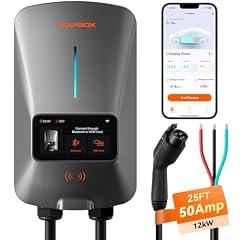
WOLFBOX 50 Amp Level 2 EV Charger
Overview
This is a wall-mounted, hardwired Level 2 home charging product with a J1772 vehicle connector, a 25 foot cable, and a stated maximum output of 50 amps at 240 volts. It is intended for a qualified electrician to connect to a dedicated residential circuit, then for the driver to plug into a compatible electric vehicle or plug-in hybrid. Tesla vehicles require a suitable J1772-to-NACS adapter. An EPA ENERGY STAR record independently identifies the exact E50 model as a 50 amp, 12 kW, single-output charger with a 25 foot cord. That same record reports measured no-vehicle power of 3.7 watts and idle-mode input power of 8.52 watts. The manufacturer documentation states that maximum 50 amp operation needs hardwiring on a 70 amp or larger circuit, and offers Wi-Fi app functions, RFID cards, scheduled charging, and selectable current settings.
What works
- The exact E50 model is independently listed by EPA ENERGY STAR at 240 volts, 50 amps, and 12 kW.
- The 25 foot J1772 cable length is independently documented, which can simplify reaching a vehicle in a garage or driveway.
- EPA ENERGY STAR testing reports 3.7 watts in no-vehicle mode, providing measured idle-energy evidence rather than an unsupported efficiency claim.
- Manufacturer instructions give a specific 70 amp or larger circuit requirement for full 50 amp hardwired operation.
- RFID cards provide a local charging-control method if app connectivity is unavailable, according to the manufacturer manual.
What does not
- The claimed CSA certification and UL 2594 compliance could not be traced to a public CSA, UL, or Intertek listing for this exact configuration during verification.
- NEMA 4 and IP66 outdoor-protection claims are manufacturer-stated. No exact-model independent enclosure test record was located.
- The app collects or may collect location, contact, identifier, usage, and diagnostic data according to its store privacy disclosures. A model-specific security-update commitment was not found.
- The manufacturer describes three years of trouble-free performance, but published replacement-parts availability, repair procedures, and long-term firmware support are limited.
- The 50 amp setting is not a simple replacement for an existing 50 amp circuit. It requires a properly sized dedicated hardwired circuit and professional installation.
Who is it for
This product suits an owner of a J1772-equipped EV or plug-in hybrid who has a qualified electrician available and electrical capacity for a dedicated hardwired circuit sized for 50 amp continuous charging. It is especially practical where the vehicle does not park in exactly the same position every day, since the independently listed 25 foot cable gives useful reach. It also fits drivers who want a physical RFID option alongside basic plug-and-charge use, rather than depending entirely on an app.
Who is it not for
It is not suited to a household hoping to use full output from an existing 50 amp receptacle or a lightly documented circuit. The manufacturer calls for a 70 amp or larger circuit for its 50 amp hardwired setting, so circuit capacity, conductor sizing, permit requirements, and local code must be checked by an electrician. It is also a less suitable choice for buyers who require publicly traceable third-party confirmation of every safety and weatherproofing claim, or a published long-term software-support policy.
Integrity
The strongest independently confirmed point is the exact model's EPA ENERGY STAR certification. EPA lists it as a 240 volt, 50 amp, 12 kW Level 2 charger and publishes measured operating losses and idle consumption. No CPSC or NHTSA recall or safety action specifically identifying this product was located in the reviewed U.S. recall sources through September 20, 2026. The manufacturer states that the enclosure meets NEMA 4 and IP66 claims, and that the product is CSA certified and meets UL 2594 requirements. Those claims were not independently traceable in the public issuing-body directories reviewed, so they should not be treated as equivalent to a verified listing. The app's store disclosures also indicate collection of charging-related and account data categories, although encryption in transit and user data-deletion requests are declared.

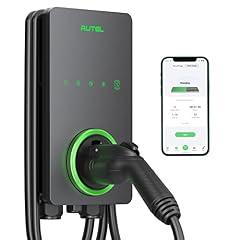
Autel Home Level 2 EV Charger
Overview
This product is a hardwired 240 V Level 2 EV charging station with a J1772 vehicle connector and a 25-foot cable. It is intended for fixed indoor or outdoor installation and supplies AC power to compatible battery-electric and plug-in hybrid vehicles. The vehicle, not the station, ultimately determines the charging rate it accepts. The exact model is independently listed by EPA ENERGY STAR at 50 A, 12 kW, with one output and a 25-foot cable. EPA also reports measured no-vehicle power of 3.5 W and idle input power of 5.77 W. Autel's installation documentation states selectable current settings, circuit-breaker options from 20 A through 70 A, a 20 mA charge-circuit interrupt device with auto retry, and NEMA 4X outdoor enclosure protection. Those protection and enclosure details are manufacturer-stated, not confirmed here through a public exact-model UL, ETL, or CSA safety-listing record.
What works
- The exact 50 A, 12 kW configuration, 25-foot cable, and ENERGY STAR certification are independently listed by EPA.
- Measured no-vehicle power is 3.5 W, with EPA-published charging-loss and idle-power test results.
- The J1772 connector and 240 V Level 2 format are clearly specified for North American AC charging.
- Autel states that the hardwired installation supports multiple current settings and breaker options, which can help an electrician match it to a dedicated circuit.
- Autel states a three-year warranty for this product.
What does not
- A public exact-model UL, ETL, or CSA directory record confirming the claimed personnel-protection standards was not located during verification.
- The 50 A output is a continuous electrical load. It requires a correctly sized dedicated circuit and professional installation, not simply any available 240 V circuit.
- The connected product family has a 2026 disclosed remote-code-execution vulnerability affecting certain MaxiCharger Single firmware versions. Exact applicability and a remediation status for this unit were not established.
- Autel's app privacy disclosures permit collection of identifiers, contact information, location, and product-use data for app functions and marketing.
- No public replacement-parts catalog or repair pathway for the cable, connector, or internal electronics was located.
Who is it for
This product fits a homeowner or small-site operator with a compatible J1772 vehicle, a permanently available parking position, and a properly designed 240 V dedicated circuit. It is particularly relevant where a longer 25-foot cable reduces the need to park precisely next to the wall unit. It also suits users who value measured low standby consumption and want optional app-based scheduling or monitoring, while retaining a conventional physical J1772 charging connection. Installation should be planned with a qualified electrician who can set the output current to the circuit capacity.
Who is it not for
It is not suited to renters or drivers who need a portable plug-in charger, because this version is hardwired. It is also not appropriate for a household without electrical-panel capacity for a dedicated continuous load, or for anyone intending to install it without permits and qualified electrical work. Tesla and other NACS-equipped vehicles need a vehicle-approved adapter, unless their vehicle has a J1772 inlet. Privacy-sensitive households and network-security-conscious users should also account for the app data practices and ensure firmware status is checked before connecting it to home Wi-Fi.
Integrity
The strongest independently confirmed environmental point is the exact model's EPA ENERGY STAR certification. EPA lists 3.5 W in no-vehicle mode, 3.56 W in partial-on mode, and 5.77 W in idle mode, rather than relying on a general claim that all Level 2 charging stations are similarly efficient. EPA also independently confirms the 50 A, 12 kW rating and 25-foot cable. Autel's documentation states NEMA 4X outdoor protection, 20 mA ground-fault detection with automatic retry, and protections for overcurrent, voltage faults, and surges. However, an exact-model public UL, ETL, or CSA safety-listing record was not found. No matching CPSC or NHTSA recall was located in the searches performed. Connected use deserves caution because a 2026 disclosure affects certain MaxiCharger Single firmware versions, while exact applicability and a fix for this product were not established. A three-year manufacturer warranty is documented, but public repair-parts support was not found.

Lectron J1772 Level 2 EV Charger
Overview
This is a wall-mounted Level 2 home charging station for electric vehicles with a J1772 inlet. It plugs into a 240V NEMA 14-50 receptacle and is specified for a fixed 40A maximum output, or 9.6 kW at 240V. The manufacturer manual specifies a 23-foot cable, high-strength polycarbonate housing, a connector holster, and plug-and-charge operation without an app or Wi-Fi. The exact product appears in an independent ENERGY STAR certification record, supporting its idle and charging-efficiency qualification. Lectron states that it is ETL listed to UL 2594, UL 2231, UL 2251, and UL 817 requirements, but an exact matching public Intertek listing could not be directly retrieved in this review. Its manual gives unusually concrete circuit, grounding, fault-code, thermal-derating, and cable-storage instructions.
What works
- The exact product is independently recorded as ENERGY STAR certified for AC charging equipment.
- The manual clearly calls for a dedicated 50A, 240V circuit for the fixed 40A plug-in version, with 125 percent continuous-load sizing guidance.
- A built-in charging-circuit interrupting device, ground-fault fault code, over-temperature protection, and thermal derating are documented in the manufacturer manual.
- It has no Wi-Fi, Bluetooth, app account, or cloud dependency, which avoids connected-device data collection and keeps basic charging local.
- Lectron provides a three-year limited warranty for the Nexus line, covering defects in materials and assembly.
What does not
- The ETL and UL-standard claims are manufacturer-stated here because a matching exact-product Intertek directory result could not be directly retrieved.
- The product is new, with an ENERGY STAR certification date of April 23, 2026, so long-term reliability evidence is limited.
- The 40A output is not adjustable at the charger. Buyers need a properly installed dedicated 50A circuit, even if their vehicle can accept less current.
- Cable length is described as 23 feet in Lectron material, while the ENERGY STAR record reports 22 feet. Plan conservatively if reach is tight.
- No replacement-parts catalog, repair procedure, or published firmware and end-of-support policy was found. The manual directs users not to repair a damaged cable themselves.
Who is it for
This fits a household with a J1772 vehicle, a parking position within roughly 22 feet of the charge port, and a correctly installed dedicated 240V NEMA 14-50 receptacle on a 50A circuit. It is particularly relevant for someone who wants fixed 40A home charging without accounts, Wi-Fi setup, app permissions, cloud scheduling, or software maintenance. The included wall mount and connector holster also suit a garage or exterior wall where keeping the cable off the ground is practical.
Who is it not for
It is not suited to homes with an undersized circuit, shared 240V circuit, worn receptacle, unknown grounding, or no safe location for the cable. A licensed electrician should assess those conditions before installation. It also does not suit buyers who need charger-side current adjustment, remote scheduling, energy monitoring, access control, or app notifications. NACS-equipped vehicles need a separately appropriate adapter, and any adapter use should follow both the vehicle maker's and adapter maker's instructions.
Integrity
The main safety-positive evidence is the detailed installation manual. It specifies grounding, a dedicated circuit, 125 percent continuous-load sizing, inspection before use, cable storage, fault responses, and automatic thermal derating. Lectron also states that the product is ETL listed to several applicable UL standards and includes a charging-circuit interrupting device, although the exact public NRTL listing was not directly retrievable in this review. The exact product is independently listed as ENERGY STAR certified, which is meaningful evidence for low no-vehicle energy use and charging efficiency. The unit has no network connection or app, reducing household data and network exposure. Its polycarbonate enclosure, outdoor IP66 and NEMA 4 claims, and three-year limited warranty are manufacturer-stated. No recall for this exact charging station was located. A separate 2024 recall involved a different Lectron fast-charging adapter, not this product.

Grasside Level 2 EV Charger 48 Amp
Overview
This is a wall-mounted, hardwired Level 2 home charger for 240 V service, with a J1772 vehicle connector and a stated maximum output of 48 A, or about 11.5 kW. It is intended for fixed residential charging, rather than portable use. Matching product documentation includes RFID cards and app materials. An independent FCC test filing covers this exact electrical configuration at 48 A and 11.5 kW. A utility qualified-products list based on ENERGY STAR data also identifies the matching model pattern as a 48 A, 240 V Level 2 charger. Those records support the basic power specification and efficiency certification. However, a current exact-product safety listing could not be located in the UL, Intertek, or CSA public directories reviewed, despite seller claims referencing UL 2594 and CSA C22.2 No. 280.
What works
- The 48 A, 11.5 kW configuration is documented in an independent FCC test filing for the matching product model.
- The exact model pattern appears on an ENERGY STAR based qualified-products list at 48 A and 240 V.
- Hardwired 48 A operation has clear matching-platform guidance for a dedicated 60 A circuit, consistent with continuous-load sizing.
- The stated J1772 connector is appropriate for North American non-Tesla EVs and plug-in hybrids with that inlet.
What does not
- A current exact-product UL, ETL, or CSA safety-directory record was not located, so the seller's electrical-safety certification claims remain unconfirmed.
- Outdoor claims are not consistently documented. Matching materials cite both Type 3R and IP65, without an accessible exact-product certification scope.
- Connected operation is supported, but Grasside does not provide a readily located product-specific privacy policy, security-update commitment, or support-lifetime statement.
- Warranty evidence is inconsistent. The seller specification states three years, while the matching original-platform product page states five years.
Who is it for
This product fits a homeowner with a J1772-equipped EV or plug-in hybrid, a professionally installed 240 V dedicated 60 A circuit, and a preference for fixed hardwired charging at up to 48 A. It is most suitable where an electrician can inspect conductor size, breaker capacity, grounding, mounting location, and the product label before installation. It also suits a household that values ENERGY STAR verified charger efficiency and can use app scheduling or RFID access, while accepting that the retailer-branded documentation is limited.
Who is it not for
It is not appropriate for a home limited to a 40 A or 50 A charging circuit, for renters needing a removable plug-in unit, or for anyone planning to self-install high-current hardwired equipment. Tesla owners should not treat the J1772 connection as direct compatibility without confirming the correct vehicle adapter and its current rating. It is also a poor fit for privacy-sensitive households or exposed outdoor installations that require a publicly verifiable enclosure and electrical-safety listing for the exact product configuration.
Integrity
The strongest independently confirmed environmental point is ENERGY STAR recognition for the matching 48 A, 240 V model pattern. ENERGY STAR qualification is based on measured charging and idle-energy requirements, rather than assuming that all Level 2 equipment has similar losses. This supports lower avoidable electricity use when the charger is connected but not actively charging. For household safety, the independent FCC filing supports the stated 48 A and 11.5 kW configuration, but FCC authorization concerns radio equipment and does not substitute for a North American EV charging safety listing. Searches did not identify a CPSC recall or public safety warning for this product name or matching model pattern. That is not proof of absence of future issues. The main unresolved concern is that UL, ETL, or CSA listing status for this exact retailer-branded product could not be confirmed in the reviewed public certification directories.