
10 Best Cat Air Purifier
 Lauren Wilson
Please note that we participate in affiliate marketing programs. When you purchase through links on our site, we may earn a commission. As an Amazon Associate we earn from qualifying purchases. This comes at no additional cost to you and helps support the resources required to provide valuable content.Advertising Disclosure
Top-rated Cat Air Purifier Comparison
1

2
3
4
5
6
7
8
9
10
Cat air purifiers: what matters
A cat air purifier is useful mainly when it moves enough room air through a particle filter to reduce airborne dander, fine dust, pollen, and smoke particles. It will not remove settled fur from floors or furniture, correct a litter-box source, repair mold or moisture damage, replace ventilation, or prevent disease on its own. For persistent odors, source control and ventilation remain important.
The most useful performance number is **smoke CADR** clean-air delivery rate measured with smoke-sized particles. Dust and pollen CADR can add context. Match CADR to the actual room, ceiling height, and desired air changes per hour. A large square-footage headline can be misleading when it assumes only one air change per hour, uses an undisclosed fan speed, or omits ceiling height. Several supplied products claimed more than 1,000 square feet while their independently documented or manufacturer-stated airflow was more appropriate for a small or medium room. A product claiming a high filter efficiency is not automatically a fast room cleaner: filter-media performance is different from whole-unit CADR.
For independent comparison, look for the exact product in the **AHAM Verifide directory**, with ANSI/AHAM AC-1 results, or in the **ENERGY STAR Certified Room Air Cleaners Product Finder**. These records can provide smoke, dust, pollen, PM2.5 CADR, room-size assumptions, and sometimes energy data. Claims such as “H13,” “True HEPA,” or “99.97%” should identify the actual filter and testing conditions; they should not substitute for whole-product cleaning results.
Ozone deserves separate attention. Ionizers, plasma systems, UV features, and electrostatic designs may raise questions about ozone or other reactive emissions. A strong record is an exact-model listing in the **California Air Resources Board certified-device directory**, or credible zero-ozone validation such as UL SPOT ULE 2998. CARB certification addresses emissions requirements; it does not prove particle-cleaning effectiveness or health benefits. A mechanical fan-and-filter design without intentional ozone generation is easier to evaluate, but the exact product still matters.
For electrical safety, look for an exact-model listing from an OSHA-recognized Nationally Recognized Testing Laboratory such as UL, ETL/Intertek, CSA, or TÜV, and check the U.S. Consumer Product Safety Commission recall database. For odors and gases, a thin carbon sheet is not proof of broad VOC or litter-box odor removal. Better substantiation identifies the adsorbent type and mass, replacement interval, pollutant tested, and results under a recognized chemical-gas method.
Maintenance affects both performance and waste. A fitted filter, usable prefilter, clear cleaning instructions, filter-change reminder, and obtainable exact replacement filters help keep captured dander contained. Washable prefilters can reduce hair-related loading and disposable waste, but the main filter is usually still consumable. Avoid fragrance or essential-oil features if occupants or pets are sensitive to added airborne chemicals.
Across the supplied reviews, the recurring safety caveats are that no purifier should be treated as mold remediation, medical treatment, infection prevention, or a replacement for source control and ventilation. Large coverage claims and odor claims are frequently unsupported by the needed test data. Several products also lacked publicly matched electrical-safety listings. One supplied product carried a California Proposition 65 lead warning, and multiple products included optional fragrance features that may be unsuitable for fragrance-sensitive people, birds, or pets with breathing problems.
Integrity
Health and ecological quality here depends on measured clean-air delivery, emissions control, safe operation, maintainability, and the material and electricity burden of continued use. The supplied scores reward exact-model evidence and realistic limits rather than filter labels or large coverage headlines.
HHealth & Safety
Health-relevant particle cleaning
This measures whether the purifier materially reduces smoke, fine particles, pollen, dust, and cat dander in the intended room. High-scoring products in the set had independently reported smoke CADR, including 283 CFM and 242 CFM examples. Lower-scoring products relied on manufacturer airflow or filter claims without public smoke, dust, or pollen CADR, making their real room-cleaning rate uncertain.
No harmful ozone emissions
This measures whether ionizing, plasma, UV, or electrostatic features add ozone or other reactive pollutants indoors. High-scoring products were listed by CARB or had exact-product ozone results such as 0, 1, or 2 ppb. Lower-scoring products lacked exact-model verification, especially where an ionizer was present. CARB status supports emissions compliance, not cleaning effectiveness or health benefits.
Electrical and fire safety
This measures evidence that the purifier, adapter, and overheating protections meet U.S. electrical-safety expectations and are not subject to unresolved recalls. High scores were supported by CARB documentation referencing nationally recognized laboratory review or other safety evidence. Lower scores reflected claims such as ETL, UL, or cNRTLus that could not be matched to a public exact-model listing. Missing verification is not proof of a defect.
Pet-odor and gas removal evidence
This measures whether carbon or another adsorbent can support odor, VOC, smoke-gas, and litter-box claims. High scores require more than saying “activated carbon”: the product should disclose adsorbent type, mass, service life, pollutant tested, and realistic limits. Across the set, scores stayed moderate because carbon quantity and pollutant-specific gas testing were usually absent, even when odor claims were prominent.
Filter containment and maintainability
This measures whether fur, dander, and fine particles stay contained and whether owners can safely clean and replace the filter. High-scoring products combined washable or removable prefilters, clear instructions, reminders, correct filter fitting, and available exact replacements. Lower scores reflected unclear filter handling, inconsistent replacement guidance, or uncertain long-term parts availability. A washable prefilter reduces hair loading but does not eliminate disposable main filters.
EEvidence
Honest health and pathogen claims
This measures whether claims about allergies, asthma, mold, viruses, bacteria, and sanitizing stay within what a room purifier can support. High-scoring products clearly separated particle reduction from disease prevention, remediation, ventilation, and source control. Lower-scoring products used broad pathogen or health language without equivalent evidence. A purifier can reduce airborne particles, but that does not establish treatment, prevention, or infection control.
Independently verified, exact-model evidence
This measures whether safety, cleaning, and efficiency claims trace to public third-party records for the exact product and shipped filter configuration. High scores went to products with matching ENERGY STAR, AHAM, or CARB records and identifiable model numbers. Lower scores reflected badges, seller assertions, or records that could not be matched to the exact configuration. Exact-model traceability is more useful than a generic certification logo.
Truthful room-size claims
This measures whether coverage is based on disclosed CADR, ceiling height, fan speed, and air-change assumptions. High-scoring products stated conditions such as 388 square feet at 4.8 air changes per hour or 439 square feet tied to verified CADR. Low-scoring products paired modest or unverified airflow with claims above 1,000 or 2,000 square feet without explaining the cleaning rate.
Accurate filter claims
This measures whether HEPA, H13, True HEPA, washable-filter, and percentage-removal statements identify the actual media and test conditions. High-scoring products distinguished filter-media claims from whole-unit performance and supplied clearer filter details. Lower scores reflected H13 or 99.97% language without a filter report, inconsistent H12/H13 descriptions, or marketplace labels that differed from the official record, such as HEPA versus HEPA-type.
EEcology
Efficient clean-air delivery
This measures electricity used for meaningful clean-air output, not simply a low wattage number from a weak unit. High-scoring products had ENERGY STAR data showing strong CADR per watt, including 9.59 smoke CFM per watt and 7.0 CFM per watt examples. Lower scores reflected missing wattage, standby, or CADR-per-watt data, preventing a reliable comparison of operating efficiency.
Filter waste and service life
This measures the material burden of keeping the purifier effective. High scores came from washable prefilters, longer or clearly stated main-filter intervals, durable service arrangements, and available exact replacements. Lower scores reflected three- to six-month replacement schedules, conflicting service-life claims, or uncertain replacement availability. Even a low-waste design still needs honest replacement timing; an overloaded filter may no longer clean effectively.
Full reviews

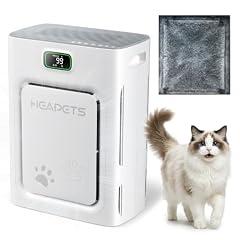
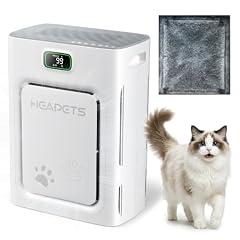
HEAPETS Pet Air Purifier H13 HEPA
Overview
This is a compact, corded room air cleaner for pet households. It measures 7.09 by 11.81 by 16.14 inches, weighs about 7.9 pounds, and uses two side-mounted filter assemblies with a washable static pre-filter, an H13 HEPA filter, and activated-carbon media. It has a particulate display, automatic mode, timer, five fan settings, and a filter-change reminder. The manufacturer states a 176 CFM CADR and says the unit refreshes 2,500 square feet hourly. That is not an independently verified AHAM CADR, and the stated coverage represents roughly one half air change per hour in a 2,500 square foot room with 8-foot ceilings. California's official registry does verify the exact P358 as a mechanical air-cleaning device under its indoor-air-cleaner program. Public certification or test records were not found for the stated ETL listing, H13 filter performance, energy use, or the advertised particle-cleaning rate.
What works
- California officially lists the exact product as a certified mechanical air-cleaning device, supporting a low-ozone design.
- The exact product is covered by a California certification record that requires ozone and electrical-safety testing for the device category.
- The manual gives concrete maintenance steps for removing, washing, fully drying, and reinstalling the pre-filter.
- Genuine replacement pre-filters and composite filters are sold for this product, reducing the risk of having to improvise a filter fit.
- The manufacturer states a 176 CFM CADR, which is a potentially useful airflow level for a medium-sized enclosed room when operated at an appropriate higher setting.
What does not
- The 176 CFM CADR is manufacturer-stated, not independently verified through AHAM or ENERGY STAR records located for this product.
- The 2,500 square foot coverage claim is framed as one hourly refresh and does not disclose air-change assumptions or a room size for stronger particle control.
- No public pollutant-specific odor testing, carbon-media mass, or chemical-gas performance data was found. Pet-odor removal therefore remains unproven.
- The product materials describe the HEPA filter alongside odor capture. HEPA media is for particles, while odor control depends on the unspecified activated-carbon component.
- An ETL claim appears in product materials, but a matching public NRTL directory record was not located. California certification is not the same as a public ETL product listing.
Who is it for
It suits a pet owner who wants a compact floor unit for a bedroom, office, apartment living area, or another medium-sized enclosed room, especially where airborne fur and dust make frequent pre-filter cleaning practical. The official California record is useful for households that want confirmation the exact mechanical model meets that program's ozone limit. It also fits a buyer who can wash and completely dry the pre-filter regularly, obtain the specified replacement filters, and use the unit continuously at a fan setting appropriate for the actual room size.
Who is it not for
It is not a strong fit for someone who needs independently verified smoke CADR, ENERGY STAR efficiency data, or a publicly traceable ETL listing before using an appliance around vulnerable occupants. Do not rely on the 2,500 square foot figure for fast cleaning of a large open-plan home, wildfire-smoke room, or severe allergy space. It is also unsuitable as a solution for mold, combustion gases, radon, or litter-box ammonia. Those needs require source control, ventilation, remediation, or pollutant-specific equipment.
Integrity
The strongest verified health point is California certification of the exact P358 as a mechanical indoor air-cleaning device. California's program requires applicable ozone and electrical-safety testing, and the product is not listed as an electronic ionizing or ozone-generating cleaner. That lowers concern about intentional ozone production. No relevant U.S. recall or regulator warning was located in the checked public sources. Particle cleaning and odor removal have weaker evidence. The manufacturer states H13 HEPA media, a 176 CFM CADR, and activated carbon, but no public AHAM result, ENERGY STAR record, carbon weight, or chemical-gas test was found. A washable pre-filter can reduce disposable waste from hair buildup, while the composite filters still require replacement about every six months according to the manual. Filters should be handled carefully and replaced when indicated, because overloaded particle and carbon media lose effectiveness.

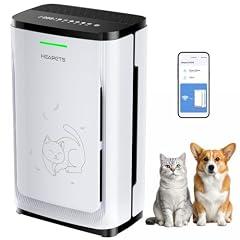
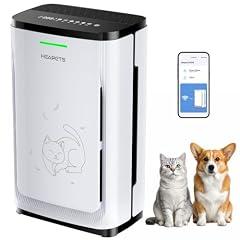
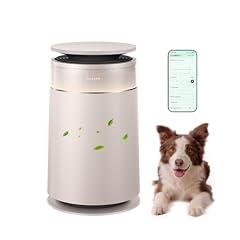
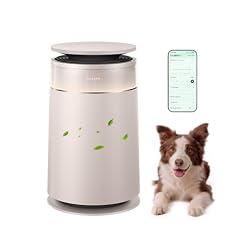
HEAPETS Smart WiFi HEPA Air Purifier
Overview
This is a 21-pound, floor-standing pet air purifier with app and touch controls, a PM2.5 display, four fan modes, and a front-access filter compartment. HEAPETS states that it uses a seven-layer system with a pet-hair prefilter, HEPA media, activated carbon, bio-enzyme material, UV light, and an anion function. The company lists a claimed airflow rating of 205 CFM and a 30 dB sleep mode figure. The exact product is listed in California's CARB registry as a mechanical air-cleaning device, which is meaningful independent support for low ozone emissions. Its particle-cleaning capacity is less clear. The 205 CFM figure is manufacturer-stated, not found in AHAM or ENERGY STAR records, and it conflicts sharply with the 4,200 square foot coverage claim. At an 8-foot ceiling, that airflow is roughly enough for one air change per hour in about 1,540 square feet, not 4,200 square feet.
What works
- The exact product appears in California's CARB registry, independently supporting low ozone emissions.
- A removable prefilter is intended to collect fur and can be vacuum cleaned, which can protect the main filter from pet-hair loading.
- Genuine replacement filters are publicly available as a set with one composite filter and three prefilters.
- The front panel must be correctly closed for operation, providing a basic filter-compartment safety check.
What does not
- The 4,200 square foot coverage claim is inconsistent with the stated 205 CFM airflow figure, especially at ordinary ceiling heights.
- No exact-model AHAM smoke CADR, ENERGY STAR certification, or public independent particle-performance test was located.
- Product materials conflict on the HEPA grade, with H13 claimed in retail text and H12 stated in the available filter manual.
- Odor-control claims lack disclosed carbon mass, chemical-specific test results, and a clear measure of gas-removal capacity.
- The product description includes anion and UV functions, but public documentation does not explain their operating conditions or pathogen performance.
Who is it for
It suits a pet household that wants a substantial floor unit for a bedroom, pet zone, or moderately sized open living area, and that is willing to use the stated 205 CFM rating cautiously rather than rely on the advertised 4,200 square foot figure. It is particularly relevant where floating fur is a maintenance nuisance, since the design uses a removable prefilter and genuine replacement set. Buyers should plan for routine vacuuming and periodic replacement of the composite filter.
Who is it not for
It is not suited to someone who needs independently verified smoke, pollen, or dust CADR for a very large room, high ceilings, wildfire smoke, or a whole-home application. The stated airflow does not substantiate the 4,200 square foot claim. It is also not appropriate as a substitute for ventilation, source control, mold remediation, litter-box cleaning, or medical infection control. People seeking a fully documented H13 filter or quantified pet-odor and VOC removal should choose a product with those exact specifications publicly tested.
Integrity
The strongest health finding is the exact product's listing in California's CARB registry as a mechanical air cleaner. That registry is relevant because CARB certification addresses ozone emissions. This is important here because HEAPETS also describes an anion function and UV light. Ionizing and some UV air-cleaning designs can create ozone under some conditions, so the CARB record provides stronger evidence than a seller's zero-ozone statement alone. The filtration story is less settled. HEAPETS describes a hair-catching prefilter, HEPA media, activated carbon, and bio-enzyme layers, but public materials do not disclose carbon quantity or pollutant-specific odor testing. The composite filter is disposable, though the separate prefilters can be replaced and vacuum cleaned. Published maintenance intervals also vary between product materials, from 3 to 6 months, 6 to 8 months, or about 2,000 operating hours. No relevant U.S. recall or regulatory action was located in the checked public sources.

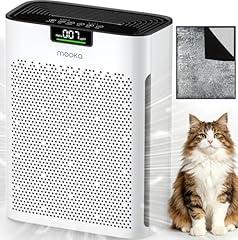
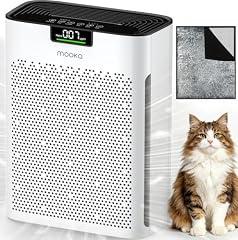
MOOKA H13 Air Purifier for Large Rooms
Overview
This is a compact, corded room air cleaner, about 12.2 inches wide and 15.75 inches high, with touch controls, four fan speeds, an automatic mode, sleep mode, a particle display, timer, child lock, and fragrance pad. It uses a combined three-stage filter with a washable outer pre-filter, a HEPA layer, and activated-carbon media. The manufacturer sells a matched replacement cartridge and indicates a 2,000-hour filter reminder. Its most consequential independently confirmed attribute is California certification for the exact KJ190L mechanical model, which addresses ozone limits. MOOKA states that the filter captures 99.97% of 0.3-micron particles and that it can serve up to 2,200 square feet per hour. No public AHAM smoke CADR, DOE performance result, or ENERGY STAR record was located for this product, so its real clean-air output and practical room sizing cannot be independently established.
What works
- California's air-cleaner registry lists the exact KJ190L as a certified mechanical model, supporting a strong low-ozone assessment.
- The product uses mechanical filtration rather than an ionizer, plasma device, or UV treatment feature.
- The washable component is the outer pre-filter, which can capture larger hair and lint before they load the replaceable filter.
- MOOKA offers a specifically matched replacement filter, and the product has a 2,000-hour maintenance reminder.
What does not
- No public AHAM CADR or other independent whole-unit particle-cleaning test was found, despite the large room-size claim.
- The 2,200-square-foot claim does not disclose CADR, ceiling height, fan setting, or air-change target, so it is not a comparable room-size rating.
- MOOKA describes activated-carbon pellets, but does not state carbon mass, target gases, breakthrough life, or pollutant-specific gas-removal results.
- The HEPA and carbon layers are replaceable, not washable. Calling the product a washable-filter purifier can obscure that recurring cartridge replacement is still necessary.
- An ETL claim appears in seller materials, but a public exact-model electrical listing record was not located during this review.
Who is it for
It suits a household seeking a mechanically filtered, low-ozone room air cleaner for everyday dust, pollen, pet dander, and loose pet-hair management. It is particularly practical for someone willing to vacuum or rinse and fully dry the outer pre-filter, then replace the combined inner filter when the reminder appears. The compact footprint, sleep mode, automatic mode, and child lock fit a bedroom, office, or ordinary living area. Use the claimed large coverage only as a manufacturer estimate, not as a verified sizing figure.
Who is it not for
It is not for a buyer who needs a purifier sized precisely for a large open-plan room, wildfire smoke, severe allergies, or an immunocompromised household. Those uses call for a published, independently measured smoke CADR matched to the room volume and desired air changes. It is also not a substitute for fixing mold, ventilation problems, combustion emissions, litter-box hygiene, or a strong chemical odor source. People seeking verified VOC or odor control should not infer broad gas removal from the presence of activated carbon alone.
Integrity
The exact KJ190L appears in California's certified air-cleaner registry as a mechanical device. That is meaningful for ozone exposure because the certification program limits ozone emissions, although it does not verify particle-cleaning effectiveness or make a general health-safety finding. The product's described mechanism is fan-driven filtration, not intentional ozone generation, ionization, or UV treatment. For maintenance and waste, the washable item is the pre-filter only. MOOKA says it can be rinsed or vacuumed, then completely dried, while the inner HEPA and activated-carbon cartridge must be replaced. This can reduce hair and lint buildup, but it does not eliminate disposable-filter waste. Matched replacements are sold by MOOKA. No public recall, federal warning letter, or exact-model safety action was located in the reviewed U.S. sources. The manufacturer provides no public carbon quantity or gas-specific test results, so odor and VOC expectations should remain modest.

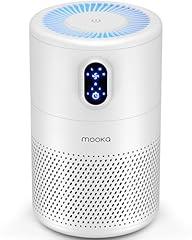
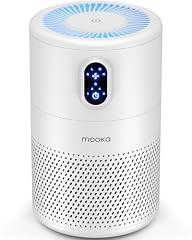
MOOKA H13 True HEPA Air Purifier
Overview
This is a small, corded tabletop air purifier with a cylindrical filter that fits inside the base. It uses a prefilter, a claimed H13 HEPA layer, and activated carbon, with four fan settings, timers, child lock, and a switchable night light. The manufacturer states a 7.1-inch square footprint, 11.1-inch height, and 3 to 6 month filter interval. The important limitation is evidence. MOOKA states coverage up to 1,076 square feet, but does not publish a smoke, dust, or pollen CADR for this product, the fan setting used, or the air-change assumption behind that area. Public AHAM and ENERGY STAR records did not establish an independently certified cleaning rate for this exact product. Its filter-media claims are plausible, but they are not a substitute for whole-unit room cleaning results.
What works
- A compact 7.1-inch square footprint can suit a bedside table, desk, or small floor space, manufacturer-stated.
- The product uses a three-stage filter arrangement with prefilter, HEPA, and activated-carbon layers, manufacturer-stated.
- Official model-specific replacement filters were available directly from MOOKA when checked.
- The manual provides filter installation, replacement, and basic electrical-use instructions, including removal of filter packaging before use.
What does not
- No publicly traceable AHAM CADR or ENERGY STAR record was found for this exact product, so particle-cleaning output cannot be independently matched to the advertised room size.
- The 1,076-square-foot coverage claim lacks disclosed CADR, ceiling height, operating speed, and air-change assumptions.
- MOOKA does not state activated-carbon mass, adsorbent type, or pollutant-specific gas testing, so meaningful pet-odor and VOC removal is unproven.
- The exact product's current CARB and NRTL registry entries could not be independently matched, despite marketplace claims that refer to certifications.
- The product page and replacement-filter page give differing replacement guidance, 3 to 6 months versus 6 months.
Who is it for
This product suits a budget-conscious user who wants a compact, simple mechanical-filter unit near a bed, desk, or in a modest enclosed room, and who is prepared to replace the filter regularly. It is most appropriate where the goal is supplemental reduction of ordinary dust, pollen, and pet dander rather than documented high-rate cleaning of a large open area. The available official replacement filter is a practical advantage for a buyer willing to follow the installation and maintenance instructions.
Who is it not for
It is not well suited to households that need a purifier sized with independently verified CADR, especially for wildfire smoke, substantial tobacco smoke, severe allergies, asthma management, or a large open-plan room. It also does not provide the carbon-media details or chemical-gas test results needed for buyers managing persistent litter-box odor, cooking odors, VOCs, or other gas pollutants. Anyone requiring a publicly confirmed exact-model electrical listing or ozone certification should obtain that confirmation before relying on this product.
Integrity
The product is described as a mechanical three-stage purifier, with prefilter, HEPA, and activated-carbon media. Its manual does not describe an ionizer, plasma generator, UV lamp, or intentional ozone function, which reduces the reason to expect reactive-emission technology. However, I could not independently match this exact product to a current CARB registry entry or a public zero-ozone validation record. California's registry is useful for checking ozone-compliance status, but it does not establish cleaning effectiveness. Fine-particle reduction remains plausible because of the stated filter construction, yet no public exact-product CADR result was found. The environmental tradeoff is recurring disposable filter waste. MOOKA advises replacement every 3 to 6 months on the product page, while its filter page recommends six months. The prefilter is part of the disposable cartridge rather than a separately documented washable component. Official replacements were available when checked, which can help avoid using an ill-fitting cartridge.

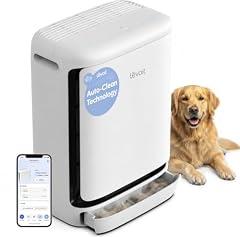
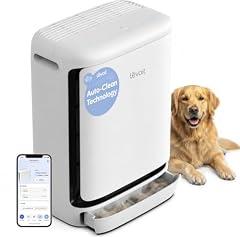
Levoit Vital Pet Pro Air Purifier
Overview
This is a 11.5-pound floor air purifier for pet households, measuring about 13 by 8 by 18 inches. It uses a removable washable prefilter, a combined particle and activated-carbon main filter, three manual fan speeds, automatic control from PM2.5 and TVOC sensors, and optional VeSync app control. The manual calls for cleaning the prefilter every two to four weeks and replacing the main filter at about six months. Its defining evidence is independently verified whole-unit particle performance. AHAM-recorded ratings are 148 CFM for smoke, 152 CFM for dust, and 163 CFM for pollen, with a stated 229 square foot room size. CARB separately lists the exact product as a certified mechanical air cleaner, supporting that it does not rely on an ionizer or intentional ozone generation. The claimed high-carbon odor filter has no published carbon mass or pollutant-specific gas-removal result located in this review.
What works
- AHAM independently verifies smoke, dust, and pollen CADR ratings for this product.
- The 148 CFM smoke CADR supports meaningful fine-particle cleaning in the stated 229 square foot room under AHAM sizing assumptions.
- CARB lists the exact product as a certified mechanical air cleaner, rather than an ozone-generating electronic device.
- The manual provides a washable prefilter, self-cleaning mode, filter indicator, and clear six-month main-filter guidance.
- The manual specifies a removable, correctly oriented filter assembly and instructs users to vacuum debris from inside before replacement.
What does not
- The product is described as using a HEPA filter in the catalog record, while the AHAM-derived listing identifies its filter as HEPA-Type. That contradiction leaves the exact particle-filter classification unclear.
- No public pollutant-specific testing, carbon mass, or gas CADR was located to substantiate broad pet-odor, VOC, or smoke-gas removal claims.
- No exact-product UL, ETL, CSA, or other OSHA-recognized electrical-safety listing was located in public certification directories reviewed here.
- The combined main and carbon filter is disposable and the manual expects replacement around every six months under its usage assumptions.
- CARB certification addresses ozone exposure limits, not cleaning effectiveness or general product safety.
Who is it for
This product suits a pet owner using one closed bedroom, home office, nursery-free sitting room, or similarly sized space of about 229 square feet with standard-height ceilings. It is especially relevant where dander, pollen, dust, or outdoor smoke particles are the practical concern, because its whole-unit CADR values are independently verified. The washable self-cleaning prefilter also fits households managing visible shedding hair and lint, provided they will empty debris, wash the prefilter, and replace the combined filter when indicated.
Who is it not for
It is not suited to an open-plan living area, a large room, or rooms with high ceilings where the verified airflow will produce fewer air changes. It is also not the right tool for active mold growth, a litter-box source problem, tobacco smoke produced indoors, carbon monoxide, or chemical spills, since source control and ventilation are needed. Buyers who require documented true-HEPA classification, verified chemical-gas removal, or an independently listed electrical-safety certification for this exact product need documentation not found here.
Integrity
The strongest health evidence is whole-unit particle cleaning, not filter-media marketing. AHAM records independently verified CADR values of 148 CFM for smoke, 152 CFM for dust, and 163 CFM for pollen. CARB lists this exact product as a mechanical air cleaner under its ozone-control program. This supports low-ozone operation, but CARB explicitly says its certification does not establish pollutant-removal effectiveness or overall health safety. The washable prefilter and automatic cleaning mechanism can reduce disposable prefilter waste and help preserve airflow when pet hair accumulates. However, the combined main and activated-carbon filter is disposable at roughly six-month intervals. No public carbon quantity or chemical-gas test was found, so odor and VOC expectations should remain modest. No applicable CPSC recall or public safety action for this product was located in the reviewed U.S. sources, but a public exact-product NRTL electrical listing was also not found.

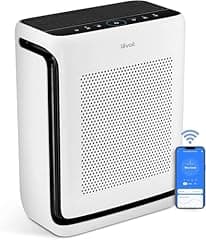
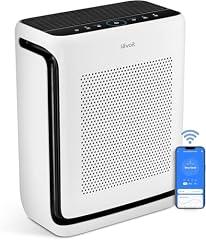
LEVOIT Vital 200S-P Smart Air Purifier
Overview
This is a 13.2-pound, app-connected, floor-standing air purifier with a washable pre-filter and a combined main particle and activated-carbon filter. It is designed for bedrooms and other lived-in rooms with airborne pet fur, dander, pollen, dust, and smoke particles. The front pre-filter is removed for cleaning, while the main filter is replaced rather than washed. Its clearest strength is independently traceable particle performance. The exact product is listed by ENERGY STAR with a 242 CFM smoke CADR, a meaningful measure of whole-unit particle cleaning, and it is represented in AHAM Verifide records. Levoit states 388 square feet at 4.8 air changes per hour and about 1,862 square feet at one air change per hour. The latter is a slower-cleaning scenario, not equivalent to rapid cleanup. Levoit also states 99.97% capture at 0.3 microns and HEPA-grade performance in Sleep Mode, but publicly available evidence does not establish a broad, whole-product HEPA certification.
What works
- ENERGY STAR independently lists the exact product with a 242 CFM smoke CADR, supporting substantial fine-particle removal in a properly sized room.
- The stated room-size conditions disclose both a more useful 388-square-foot, near-five-air-change scenario and a much slower one-air-change scenario.
- A removable, washable pre-filter is specifically designed to intercept pet fur, hair, lint, and larger dust before the main filter.
- The manual gives practical maintenance steps, including pre-filter cleaning every 2 to 4 weeks and main-filter replacement around 12 months.
- The filtration system is mechanical, with no ionizer, plasma, or UV feature described.
What does not
- The product's California Proposition 65 warning says it can expose users to lead. The warning does not quantify exposure or identify the component involved.
- The exact product was not located in CARB's current certified-device register, despite a CARB certification claim in the catalog record. This leaves ozone and electrical-safety traceability incomplete.
- Levoit claims odor, fume, smoke, and VOC reduction, but does not publicly state the carbon mass or provide pollutant-specific whole-unit gas testing. The carbon layer should not be treated as proof of broad VOC control.
- The main filter is disposable. It is not washable, and the manufacturer directs users to use its own replacement filters.
- HEPA wording is limited and conditional. Levoit describes HEPA-grade performance in Sleep Mode, while independent review material does not identify the product as HEPA certified.
Who is it for
This product suits a pet household that needs a substantial mechanical air cleaner for a bedroom, home office, or moderately sized living area, especially where airborne fur, dander, pollen, or smoke particles are the main concern. Its independently listed smoke CADR supports use in rooms around 375 to 400 square feet with standard-height ceilings when stronger cleaning is wanted. It also fits users willing to vacuum or wash the pre-filter regularly and replace the main filter about yearly. App control and automatic fan adjustment are useful for households that want scheduled operation and filter reminders.
Who is it not for
It is not suited to someone expecting dependable control of heavy cooking emissions, litter-box odors, wildfire odor, formaldehyde, or other gases. The product has activated carbon, but its quantity and gas-removal capacity are not publicly substantiated. It is also not a disease-prevention device, mold-remediation tool, or replacement for ventilation and source control. Buyers who require an exact-model California ozone certification or a publicly traceable NRTL electrical listing should seek documentation before relying on this product. Homes with much larger rooms, high ceilings, or open floor plans should not interpret the one-air-change coverage figure as rapid cleaning.
Integrity
The strongest health evidence is for particles, not gases. ENERGY STAR lists the exact product with a 242 CFM smoke CADR, and AHAM Verifide documentation is traceable to the same product family. This supports reduction of airborne fine particles when the cleaner is run in a closed, appropriately sized room. It does not remove settled pet allergens until they are stirred back into the air, and it does not replace ventilation, cleaning, or source control. The unit uses mechanical filtration rather than a stated ionizing, plasma, or UV process. However, the exact product was not found in CARB's current certified-device list, so its low-ozone and electrical-safety documentation is less complete than its particle-performance documentation. Levoit posts a Proposition 65 warning for possible lead exposure. The washable pre-filter can reduce disposable waste and protect the main filter, but the main particle and carbon filter remains a disposable annual consumable. Levoit states that its carbon is FSC-certified wood carbon, without publishing carbon mass or gas-capacity testing.
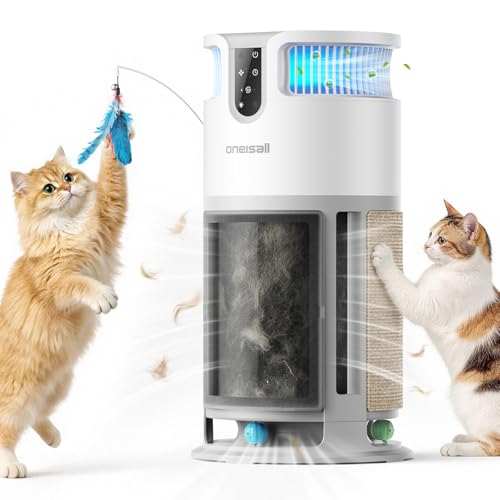
Oneisall Pet Air Purifier PP04
Overview
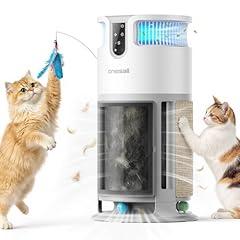
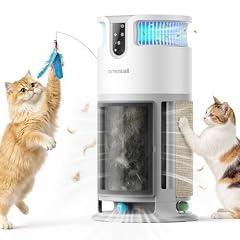
The oneisall PP04 is a plug-in, floor-standing pet air purifier that also incorporates scratching boards, a teaser wand and a cat platform. It has a removable filter assembly, a PM2.5 indicator, automatic and sleep modes, a filter reminder and three fan speeds. The manufacturer describes a washable prefilter, H13 HEPA media and an activated-carbon stage, rather than a washable HEPA filter. Its 390 m³/h, or 230 CFM, CADR and 3,000 square foot coverage are manufacturer-stated. No public AHAM or ENERGY STAR exact-product performance record was located. That airflow can reduce airborne particles in a room, but the coverage statement does not disclose ceiling height or air-change assumptions. California Air Resources Board records independently list this exact product as a mechanical air cleaner, confirming it does not use ionization or ozone-generating technology.
What works
- CARB independently lists the product as a mechanical air cleaner, a design category that does not generate ozone or ions.
- The manual gives practical maintenance steps, including weekly hair removal and rinsing of the black prefilter after unplugging the unit.
- Exact replacement filters, adapter and scratching-board parts are currently listed on the manufacturer's US accessories store.
- The manufacturer provides a two-year warranty and a filter-change indicator.
What does not
- The particle-cleaning CADR and 3,000 square foot coverage claim lack public AHAM or ENERGY STAR confirmation and do not state the air-change assumptions behind the room size.
- The catalog's washable H13 filter wording conflicts with the manual, which permits rinsing the black prefilter and says to keep the filter dry.
- No public pollutant-specific odor or gas test, carbon-media mass or replacement interval was located, so litter-box and broad odor claims remain unsubstantiated.
- FCC compliance in the manual addresses radio interference, not a public exact-product NRTL electrical-safety listing.
Who is it for
This product suits a cat household that wants a mechanical air cleaner for airborne fur, dander and particles in one regularly occupied room, and that will clean the prefilter weekly. It is also relevant for households that specifically want to avoid ionizers, because CARB lists this model as mechanical. The cat platform and replaceable scratch boards make most sense where the unit can sit on a hard, level surface with clear airflow around it. Treat the large-room figure as a manufacturer claim, not a verified sizing result.
Who is it not for
It is not well suited to buyers who need independently verified smoke CADR, energy-use data or a room-size recommendation at a defined air-change rate, including people managing serious smoke exposure or substantial allergy symptoms. It is also not appropriate as a substitute for source control, ventilation, litter cleaning, medical care or mold remediation. Buyers needing documented electrical listing from UL, ETL, CSA or another NRTL should seek a product with a public exact-model record. Do not wash the main filter media.
Integrity
The strongest health finding is the California Air Resources Board entry for this exact product. CARB classifies it as mechanical, meaning it uses physical filtration and does not generate ozone or ions. This certification concerns ozone exposure, not particle-removal effectiveness or general health safety. I found no exact-product AHAM or ENERGY STAR result that independently confirms the advertised CADR, coverage or energy efficiency. The filter design includes a washable prefilter, which can reduce hair buildup and extend the useful life of the main filter when maintained as instructed. The main filter is a consumable and should be kept dry. Replacement filters are sold separately by the manufacturer, but no fixed replacement interval, carbon mass or chemical-gas test was publicly disclosed. No specific CPSC recall or regulator warning for this product was located in the checks performed through August 16, 2026.

Dreame FP10 Air Purifier for Pets
Overview
The Dreame FP10 is a 19.8-pound floor air purifier for pet households. It uses a removable prefilter, a composite particulate and activated-carbon filter, and a powered roller that moves collected hair into a 0.12-gallon chamber. Controls include the unit panel and app. The prefilter, hair chamber, and roller are user-maintainable, while the composite filter is replaced rather than washed. The strongest independently checked fact is its California certification as a mechanical air cleaner, which supports a low-ozone design but does not verify cleaning effectiveness. Dreame states a 350 m³/h particle CADR, 45 W rated power, H14-grade filter media, and a two-year filter interval. These are manufacturer claims, not publicly matched AHAM or ENERGY STAR results. The very large marketplace room claim is not adequately explained by a disclosed air-change assumption.
What works
- California lists this exact product as a certified mechanical air cleaner, providing credible low-ozone assurance.
- The removable prefilter can be washed, and the roller and hair chamber can be emptied and cleaned.
- Dreame specifies a sealed 0.12-gallon hair chamber, which can reduce direct handling of accumulated pet hair.
- An exact replacement composite filter is listed by Dreame in the United States, with a manufacturer-stated two-year replacement interval.
- The stated 45 W power draw paired with the claimed 350 m³/h CADR suggests efficient delivery, although the performance figure is not independently verified.
What does not
- No public AHAM, ENERGY STAR, or comparable independent particle-cleaning result was found for this exact product.
- The 3,708-square-foot marketplace coverage claim is not supported by disclosed CADR assumptions, ceiling height, or air changes per hour.
- Dreame's own materials describe H14-grade filter media, while the marketplace record describes H13, and neither provides a complete filter test specification for the shipped US configuration.
- Odor and bacteria-removal messaging rests on manufacturer chamber tests and unspecified odor-control materials, without disclosed activated-carbon mass or independent gas-removal testing.
- No exact-model listing was located in a public US NRTL electrical-safety directory, despite the product's CARB certification and absence of a located recall.
Who is it for
This product suits a pet household that wants to reduce airborne hair, dander, and ordinary particle pollution in one regularly used room, and is willing to clean a collection chamber and maintain an app-connected appliance. Its washable prefilter and roller-driven hair collection are especially relevant where shedding is frequent. It is also suited to buyers who value an exact-model California mechanical-air-cleaner certification and can treat Dreame's CADR and two-year filter-life statements as manufacturer information rather than independently verified performance.
Who is it not for
It is not well suited to people choosing an air purifier specifically for asthma, smoke events, or severe allergies who need independently measured smoke CADR and transparent room sizing. It is also a poor fit for anyone relying on a purifier to prevent infection, kill pathogens, solve mold, or replace veterinary care, cleaning, source control, and ventilation. Buyers who need robust removal of litter-box gases or household VOCs should not infer that the included carbon layer provides broad chemical control, because its adsorbent mass and independent gas test results are not disclosed.
Integrity
California's public registry lists this exact product as a mechanical air cleaner. That is meaningful for ozone exposure because CARB certification is designed around the state's portable-air-cleaner requirements, though CARB explicitly does not assess cleaning effectiveness or overall health safety. No product-specific US recall or regulator warning was located in the checked federal recall sources. The product uses a washable prefilter, reusable roller, and washable hair chamber, which can limit routine disposable waste from pet hair. Dreame recommends replacing the non-washable composite filter every two years and sells an exact replacement in the United States. The replacement combines particle filtration and activated carbon, but Dreame does not disclose the carbon mass or a standardized gas-removal result. Its bacteria-removal language should therefore not be read as evidence of disease prevention or indoor sanitization.

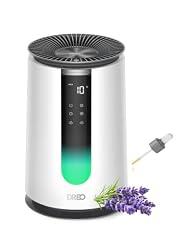
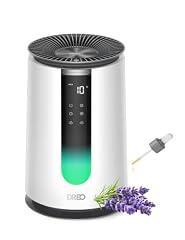
Dreo 338 HEPA Air Purifier
Overview
This is a compact, corded room air purifier, about 9.2 inches square and 14.2 inches tall, with touch controls, four fan speeds, auto and turbo modes, a particulate sensor display, and an aroma-pad tray. It uses a cylindrical three-layer replacement filter with a prefilter, a particle filter marketed as HEPA, and activated carbon. The non-connected version has no Wi-Fi functions. Its defining performance figure is independently traceable. An ENERGY STAR qualified-product record for this exact product lists 115 CFM smoke CADR, 121 CFM dust CADR, 131 CFM pollen CADR, and 118 CFM PM2.5 CADR. That record sizes it for 178 square feet. The much larger 856-square-foot statement corresponds to only one air change per hour, not its faster cleaning rate. DREO sells the matching replacement filter directly and states that it can be installed without tools.
What works
- Exact-product ENERGY STAR data verifies particle CADR values, including 115 CFM for smoke and 118 CFM for PM2.5.
- The California Air Resources Board lists the exact product as a mechanical air cleaner, and the ENERGY STAR record reports 0 ppb ozone emissions.
- The 178-square-foot performance area is tied to disclosed CADR data, while the 856-square-foot figure is clearly a one-air-change-per-hour condition.
- DREO directly sells a compatible three-in-one replacement filter with a prefilter, particle-filter layer, and activated-carbon layer.
- The verified integrated energy factor is 5.5 CFM per watt, with listed annual energy use of 125 kWh.
What does not
- The activated-carbon layer is not supported by disclosed carbon mass or pollutant-specific gas-removal testing, so pet-odor, VOC, and formaldehyde reduction remain manufacturer-stated.
- The manufacturer calls the replacement media a HEPA filter, while the exact ENERGY STAR record categorizes it as HEPA-type. The public evidence does not resolve that terminology difference.
- The product listing's EPA certification language should not be treated as a product endorsement. EPA states that it does not certify or recommend particular home air-cleaner brands.
- An ETL claim appears in retailer and manual material, but an exact-product public NRTL listing was not located during this review.
- The combined disposable filter creates recurring material waste, and the maker provides subscription intervals rather than a single evidence-based replacement life.
Who is it for
This product suits a person using one enclosed bedroom, nursery, office, or small pet room of roughly 178 square feet who wants independently listed particle-cleaning performance for smoke, pollen, dust, and airborne fine particles. It is also suitable for someone who prefers a non-connected appliance, wants a PM2.5 display and automatic operation, and can source genuine replacement filters. Its CARB mechanical classification is relevant for households that want to avoid ionizer or ozone-generator technology.
Who is it not for
It is not sized for fast particle cleaning throughout an 856-square-foot open area, especially with high ceilings, frequent door opening, active smoking, wildfire intrusion, or heavy pet shedding. It is also not a substitute for ventilation, source control, mold remediation, carbon-monoxide protection, or medical treatment for asthma and allergies. People needing demonstrated VOC, litter-box gas, or formaldehyde control should not assume that an unspecified activated-carbon layer provides substantial gas adsorption. Avoid scented pads if fragrances trigger symptoms.
Integrity
The health-positive evidence is unusually clear for particle cleaning. Independent ENERGY STAR data identifies this exact product as a fan-and-filter cleaner with 115 CFM smoke CADR and 118 CFM PM2.5 CADR. California's registry separately lists it as a mechanical air cleaner, while the ENERGY STAR record reports zero ozone emissions. No relevant CPSC recall or public safety warning was located in this review. Its limits matter. Portable air cleaners supplement, rather than replace, pollution-source removal and clean-air ventilation. Their particle filters do not establish prevention of infections, allergy attacks, or other disease outcomes. The fitted activated-carbon layer may help with some odors, but DREO does not disclose its carbon mass or chemical-gas test results. The filter is a disposable combined unit, although the outer prefilter can be cleaned and the matching replacement filter is sold directly. EPA does not certify individual air-cleaner brands or products.

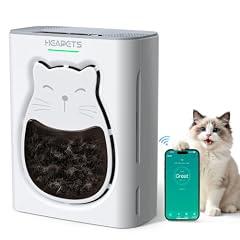
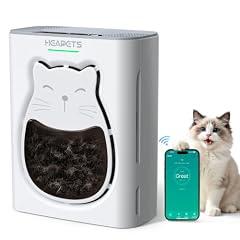
HEAPETS Pet Air Purifier P365 White
Overview
The HEAPETS P365 is a plug-in portable air purifier intended for pet areas. Independent retailer material describes a wide intake, electrostatic pet-hair prefilter, H13 HEPA filter, activated-carbon filter, Wi-Fi app control, air-quality monitoring, auto mode, timer, and filter reminders. It is a compact floor or tabletop unit, rather than a whole-home system. The strongest independently verified fact is that California’s air-cleaner registry lists this exact product as a mechanical device. That supports its ozone-safety credentials. Particle-cleaning capacity is much less clear. Marketing materials state roughly 2,100 to 2,200 square feet, but no public smoke, dust, or pollen CADR, test conditions, or power data were located. The stated H13 filter is plausible for particle capture, but it does not establish whole-room cleaning rate.
What works
- California’s registry lists this exact product as a certified mechanical air cleaner.
- The independently described filter stack combines a pet-hair prefilter, H13 HEPA media, and activated carbon.
- App control, auto mode, air-quality monitoring, and filter reminders may help maintain regular operation, based on manufacturer-stated features.
- Exact replacement filter and prefilter products appear to be sold for this product.
What does not
- No public AHAM or Energy Star CADR result was located, so fine-particle performance in a real room cannot be matched to the large coverage claim.
- The product information gives inconsistent coverage figures of about 2,100 and 2,200 square feet, without ceiling height, fan speed, air-change target, or CADR.
- Activated carbon is stated, but no carbon mass, gas-specific test result, or odor-removal service interval was located.
- No exact-product listing from a U.S. electrical safety laboratory was located during this review.
Who is it for
This product fits a pet household seeking a compact mechanical air cleaner for a bedroom, pet sleeping area, litter-adjacent space, or another clearly bounded room. Its documented CARB registry entry is useful for buyers who want to avoid an ozone-generating design. The prefilter and reminders may also suit households that regularly collect visible pet hair and can stay on top of maintenance. Because room-cleaning output is not independently disclosed, this use case should be treated as a smaller defined space, not the advertised very large area.
Who is it not for
It is not well suited to buyers who need a purifier sized with confidence for wildfire smoke, severe allergy symptoms, asthma management, or a large open-plan home. Those cases need an independently reported smoke CADR and a coverage calculation based on ceiling height and desired air changes. It is also not a substantiated solution for persistent litter-box odor, strong cooking emissions, VOCs, or combustion gases, since the carbon quantity and gas-removal testing are not published. Buyers requiring verified U.S. electrical listing documentation should seek a product with a public exact-model record.
Integrity
The most meaningful health finding is the exact product’s appearance in California’s certified air-cleaner registry as a mechanical device. This is stronger evidence on ozone risk than a seller badge alone. The available descriptions do not indicate UV, plasma, or intentional ion generation. No exact-product CPSC recall or consumer incident report was located in the reviewed public searches, although that does not substitute for an electrical safety listing. The filter design is described as a hair-catching prefilter plus H13 HEPA and activated carbon. Mechanical particle filtration can supplement source control and ventilation, but its practical benefit depends on how much air passes through the unit. The missing CADR prevents that assessment. A prefilter can reduce loading of the main filter, and replacements appear available, but no verified service-life schedule, filter-material breakdown, carbon weight, or recycling program was found. The main composite filter remains a disposable consumable.