
10 Best Dash Cameras
 Daniel Kenitz
Please note that we participate in affiliate marketing programs. When you purchase through links on our site, we may earn a commission. As an Amazon Associate we earn from qualifying purchases. This comes at no additional cost to you and helps support the resources required to provide valuable content.Advertising Disclosure
Top-rated Dash Camera Comparison
1

2
3
4
5
+
6
+
7
8
9
Overview
A dash camera records video from inside a vehicle, usually saving a continuous loop to a removable memory card. Depending on the design, it may cover the road ahead, the rear of the vehicle, the cabin, or multiple sides. Event detection can protect a clip after a sudden movement, while GPS may add time, speed, or location information. Parking recording generally needs a separately purchased hardwire kit and should not be assumed to work from the included accessory-socket charger alone.
A useful dash camera is not defined by its largest resolution number. What matters is whether independent testing shows readable, stable footage in daylight, darkness, glare, and motion, across every advertised channel. “4K” can be upscaled rather than native capture, and a stated frame rate may not represent that many unique frames when more than one camera records. Wide viewing angles add context but can make distant details smaller; a high pixel count therefore does not guarantee readable license plates. Look for exact-model road or laboratory testing that identifies lighting, speed, field of view, bitrate, frame rate, settings, and original video files.
Recording reliability is equally important. A buyer should confirm automatic startup, loop length, timestamp accuracy, G-sensor behavior, manual file locking, power-loss handling, parking-mode limits, and supported card specifications in the manual. A bundled card is useful, but it does not prove endurance. Several reviewed products require routine formatting or periodic card replacement, and protected files can still have storage limits. Use a suitable high-endurance card and check that recordings are actually being saved before relying on them.
Wireless claims should be traceable to the exact camera and radio module in the FCC Equipment Authorization System. An FCC authorization confirms radio compliance; it does not certify video quality, charger safety, mounting, or any crash-prevention feature. For power hardware, look for a matching UL Product iQ or other NRTL listing for the exact adapter or hardwire component, along with fuse protection, thermal limits, and clear battery or supercapacitor information. No public listing for an included vehicle adapter was located for many products reviewed here, so that claim should not be assumed.
Mounting is part of safety. The camera must not materially obstruct the driver’s view, interfere with airbags, windshield sensors, or vehicle systems, or leave loose wiring near controls. Follow the vehicle owner’s manual, applicable state windshield-obstruction rules, and the product’s installation instructions. Touchscreens, app controls, live views, voice prompts, ADAS alerts, and cabin audio should be configured while parked. Driver-alert features are not crash-prevention evidence unless supported by exact-configuration human-factors or crash-outcome research.
Recurring caveats in the supplied reviews are significant: parking mode commonly needs separate hardwire equipment; several products lack model-specific independent testing for night detail, plate readability, heat, or endurance; and many included chargers lack a publicly verified safety listing. Default Wi-Fi passwords, app collection or sharing of location, audio, photos, videos, identifiers, or diagnostics also recur. Rear-cable routing can conflict with airbags or sensors, and some touchscreen products lack a clear in-motion lockout. Products with lithium batteries or uncertain power-storage documentation deserve additional caution in hot parked vehicles. No supplied product establishes a category-wide crash-prevention benefit.
Integrity
A dash camera sits at the intersection of driving safety, vehicle power, installation, electronic waste, and evidentiary reliability. The scores below reflect the supplied reviews and distinguish documented or independently tested capabilities from claims that remain uncertain.
HHealth & Safety
Road-user safety impact
This measures whether screens, controls, alerts, and stated safety benefits reduce rather than add distraction for drivers and people outside the vehicle. High-scoring products document screen-off settings, safer operating limits, or restrained claims; lower-scoring products expose drivers to touch controls, fatigue or ADAS alerts, or unclear in-motion lockouts. The supplied scores range from 52 to 78.
Power and heat safety
This measures protection against overheating, battery failure, short circuits, and vehicle-power faults in a hot parked car. High scores among these products generally pair a stated supercapacitor or thermal range with better documentation, although charger certification is often missing. Lower scores include conflicting battery descriptions or limited power details. Supplied scores range from 53 to 78.
Safe mounting and installation
This measures secure placement, view clearance, airbag and sensor compatibility, and tidy cable routing. High-scoring products provide explicit warnings about road visibility, airbags, or safe wiring; lower-scoring products leave vehicle-specific placement questions unresolved. A secure suction, adhesive, or mirror mount is not enough if the cable crosses an airbag path. Supplied scores range from 60 to 78.
EEcology
Battery and e-waste footprint
This measures how long the camera can remain useful and how responsibly it can be repaired, updated, and discarded. Replaceable cards, cables, mounts, firmware updates, and warranties can extend service life, while recurring card replacement and unclear battery chemistry add burdens. High scores reach 73; low scores reach 69. No supplied product had a clearly documented take-back program.
EEvidence
Useful footage in real driving
This measures preserved detail in day, night, glare, motion, and across claimed channels—not advertised resolution alone. High scores are supported by exact-model road testing showing useful detail; low scores reflect weak night or rear footage, upscaled output, or no independent test. Supplied scores range from 45 to 87, the widest practical separation in this group.
Recording reliability when it matters
This measures startup, looping, timestamps, event protection, storage limits, power-loss behavior, and parking recording. High scores have manuals and testing that document protected folders, GPS time, loop behavior, or reliable saving; low scores have unclear parking limits, card maintenance, or overwrite risks. Supplied scores range from 66 to 80.
Privacy and app security
This measures protection of recordings, location, audio, cabin video, account access, and wireless connections. High scores reflect usable controls and clearer app disclosures; low scores include default passwords, unclear update support, or disclosures allowing collection or sharing. The supplied scores range from 52 to 76, and app-store disclosures are not independent security testing.
Real compliance records
This measures whether radio and power-safety claims match the exact product or module in public records. High scores have traceable FCC authorization, such as matching 2.4 or 5 GHz radio filings; low scores have no exact authorization or unresolved model identity. This topic is weighted more heavily than most others, and supplied scores range from 50 to 88.
Independent proof, not marketing
This measures whether major video, thermal, reliability, and safety claims were tested by credible third parties on the exact model using reproducible methods and original evidence. High scores have exact-model road or laboratory testing; low scores rely mainly on manuals and marketplace claims. Supplied scores range from 68 to 85, but even stronger scores do not prove every advertised feature.
Honest specifications and safety claims
This measures whether resolution, field of view, night vision, GPS, parking, ADAS, and protection claims match the sold configuration and supporting evidence. High scores have fewer conflicts; low scores include upscaled “4K,” inconsistent rear resolutions, disputed card contents, or unsupported 5 GHz claims. Supplied scores range from 48 to 76.
Full reviews

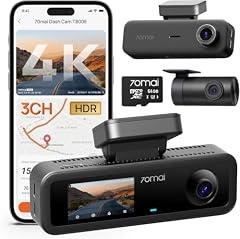
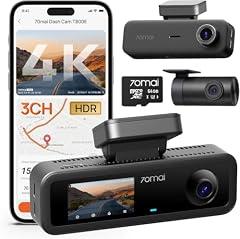
70mai T800E 4K Dash Cam
Overview
This is a windshield-mounted three-channel dash camera with a 4K front camera, 1080p cabin camera, and 1080p rear camera. It includes a 64GB card in the listed package, although the manufacturer says triple-channel recording uses about 2.5 hours of 64GB capacity under its stated settings. The product connects to a phone over Wi-Fi and Bluetooth, records GPS data, and uses a small 1.9-inch screen. Manufacturer documentation includes meaningful operating safeguards. It says not to operate the product or app while driving, offers screen-off and audio-off settings, and instructs users not to block the driver’s view or airbag path. Independent hands-on testing of the closely related T800 found strong daylight and low-light detail, but that is not a laboratory test of this exact T800E configuration. The exact T800E Wi-Fi radio has an FCC equipment authorization.
What works
- Three simultaneous viewpoints can document road, cabin, and rear events, according to the manufacturer.
- The manual provides clear warnings against in-motion operation and against placement that blocks visibility or airbags.
- Screen-off, cabin-camera-off, audio-off, GPS, and Wi-Fi hotspot controls give the owner usable privacy settings.
- The exact T800E radio model is traceable to an FCC authorization for its wireless functions.
- Manufacturer-stated buffered emergency recording keeps protected collision clips separate from ordinary loop recordings.
What does not
- The 64GB included card holds only about 2.5 hours in the manufacturer’s stated three-channel setting, so routine footage can be overwritten quickly.
- Parking surveillance requires a separate compatible hardwire cable, and the manufacturer does not state that this version has vehicle-battery voltage monitoring.
- No verifiable UL or other NRTL safety listing was found for the included vehicle charger or the exact complete product.
- The manufacturer’s product page says it uses a supercapacitor instead of a lithium battery, while the manual also warns of a non-removable lithium coin battery. That wording needs clearer disclosure.
- The North American app’s privacy label declares possible collection of location, recordings, audio, identifiers, and other data for several purposes, even though the company provides deletion and opt-out routes.
Who is it for
This product suits a driver who wants broad incident documentation from one compact front unit plus a wired rear camera, especially a rideshare driver or parent who has a legitimate need for cabin footage. It is better suited to someone comfortable routing cables carefully, reviewing settings while parked, and managing recordings often because the included 64GB card has limited three-channel capacity. It also fits an owner who will actively use the screen, audio, GPS, cabin-camera, and Wi-Fi controls to limit unnecessary collection.
Who is it not for
It is not well suited to a buyer who needs independently reproduced evidence for every claimed video and parking feature, or who expects all-day retention from the included card. It also does not suit anyone unwilling to install a separate hardwire cable for parking surveillance. Drivers in vehicles with windshield cameras, sensor housings, side-curtain airbags, unusual glass coatings, or restricted windshield mounting zones should first follow their vehicle manual and local rules. Cabin recording also requires careful attention to passenger notice and local privacy rules.
Integrity
The manual gives useful safety limits. It says to mount the camera where it does not obstruct the driver’s view or interfere with airbags, to avoid operating it or the phone app while driving, and to use the supplied power hardware. Its stated operating range is 14°F to 140°F. The manufacturer describes a supercapacitor power design, but the manual also identifies a non-removable lithium coin battery and warns that excessive heat can create an explosion risk. The exact wireless model has an FCC authorization, which confirms traceable radio compliance rather than a self-issued wireless claim. No matching public UL or other NRTL listing was located for the charger. The manual directs users not to put the product in household trash and to follow electronics disposal rules, but it does not provide a product-specific United States take-back program or a practical repair path for the internal coin battery. Firmware updates are available through the companion app.

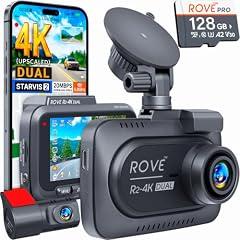
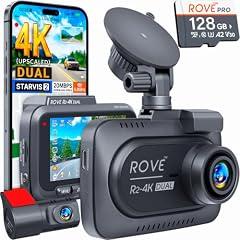
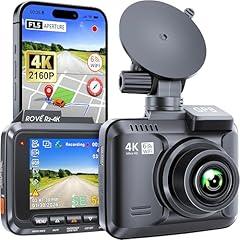
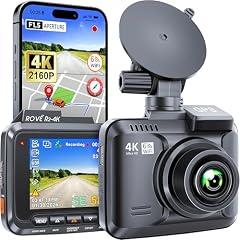
ROVE R2-4K Dual Dash Cam with 128GB Card
Overview
ROVE R2-4K Dual is a two-channel windshield dash camera with a front unit, a wired rear camera, a 3-inch display, GPS, Wi-Fi transfer, and a bundled 128 GB memory card. It is intended to continuously record driving and, with a separately purchased hardwire kit, to monitor some parked-vehicle events. The manual specifies a supercapacitor rather than an internal battery, 5 V and 1.5 A input, and an operating range of 14 F to 131 F. Independent road tests support useful daytime front and rear coverage, although rear detail falls off at distance. Independent technical testing also found that the front camera's 5 MP sensor cannot natively capture 4K detail, despite the product's 4K recording label. Another independent review found weak low-light capture, so the advertised resolution should not be read as a guarantee of readable night plates.
What works
- Independent testing found broad front and rear road coverage, including useful daytime detail for signs and nearby plates.
- The product uses a supercapacitor instead of an internal battery, which the manufacturer specifies for operation in hot and cold vehicle conditions.
- The included manual documents loop recording, impact-triggered file protection, GPS stamps, and parking modes when the separate hardwire kit is correctly installed.
- The companion app supports this product and provides over-the-air firmware updates.
What does not
- The prominent 4K claim is materially overstated as a detail claim. Independent testing identified a 5 MP front sensor and concluded that recorded 4K output is upscaled rather than native 4K capture.
- Independent reviews disagree on night performance, but both identify limits from glare, noise, or low-light detail. Rear-camera detail is particularly limited at distance.
- Parking surveillance requires an additional hardwire kit and careful fuse-box installation. It is not a complete out-of-box feature.
- The app collects location, contact, identifier, usage, and diagnostic data according to its developer disclosure. Public security-update and account-deletion documentation is limited.
Who is it for
This product suits a driver who wants continuous front and rear documentation for routine commuting, parking-lot incidents, or insurance evidence, and who will review footage after an event rather than interact with the screen while driving. It is especially practical for someone comfortable routing a rear-camera cable and using a memory card directly on a computer. The bundled card and documented loop recording reduce the immediate setup burden, while the app can provide firmware updates and file transfer for users willing to create an account.
Who is it not for
It is not suited to drivers who need dependable long-distance plate recognition at night, or who interpret a 4K label as proof of native 4K image detail. It also needs a different setup for buyers unwilling to route cables, mount a rear camera, or add a hardwire kit for parked monitoring. Drivers in very hot climates should note the stated 131 F operating ceiling. Anyone minimizing collection of location and account data should avoid the app and transfer recordings directly from the memory card.
Integrity
The product has an FCC equipment authorization record for its Wi-Fi radio, which provides traceability for the wireless component. Its manual specifies a supercapacitor rather than an internal lithium battery. That design avoids a small lithium cell inside the camera and is manufacturer-described as more tolerant of vehicle heat, but the stated operating range still ends at 131 F. The supplied power hardware should be used as directed, and hardwiring should go through the specified step-down kit rather than directly to battery terminals. For service life, the camera supports firmware updates through the companion app and uses removable microSD storage, so failed storage can be replaced without replacing the camera. The product has a one-year warranty. Clear manufacturer take-back, recycling, repair-parts, and third-party safety-listing records for the exact power adapter were not located, so end-of-life disposal should use a certified electronics recycler and memory cards should be securely erased.

REDTIGER 4K 3 Channel Dash Cam with GPS
Overview
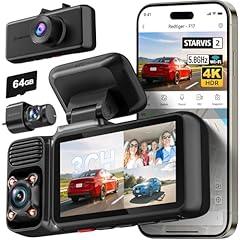
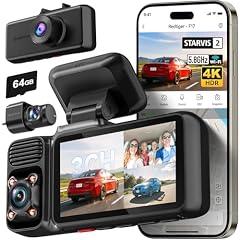
This is a windshield-mounted, three-camera dash camera intended to record forward road events, the cabin, and the rear of a vehicle. The sold configuration states 2160p front recording, 1080p cabin and rear recording, a 3-inch display, GPS, Wi-Fi, four infrared cabin lights, a 64 GB card, and an 18-month manufacturer warranty. Parking recording requires a separately supplied hardwire kit. Its most important limitation is a specification conflict. The product advertises 4K recording and a Sony IMX675 sensor, but Sony specifies that sensor at about 5.12 megapixels, below the 8.29 megapixels in native 3840 by 2160 4K. An independent F17 footage review also identified front video as 1440p and found rear night footage poor for plate reading. The manufacturer documents a screen saver, audio controls, GPS stamps, event locking, and over-the-air updates, but does not document motion lockouts for menu use while driving.
What works
- Three-camera layout can document the road ahead, cabin activity, and rear events, as manufacturer-stated.
- The documented parking modes can lock a clip after detected collision or vibration when the optional hardwire kit is installed.
- The F17 design uses an internal capacitor rather than an internal battery, a more heat-tolerant power-storage approach for a parked vehicle.
- The manual provides a screen-saver setting, GPS and speed-stamp controls, audio control, loop recording, and a manual file-lock button.
What does not
- The advertised 4K claim conflicts with the stated IMX675 sensor's 5.12-megapixel specification, so native 4K capture is not supported by the disclosed sensor specification.
- Independent F17 footage analysis found plate readability inconsistent at night, with particularly weak rear-camera results.
- No matching public FCC equipment authorization or named NRTL safety listing for this exact Wi-Fi camera and included vehicle charger was identified in the verification search.
- The camera has a live display and accessible playback and settings controls while recording. Its documentation does not show a driving-motion lockout for these visual-manual functions.
- The app privacy disclosure says precise location, photos or videos, device identifiers, and diagnostics may be collected, while Apple does not verify that disclosure.
Who is it for
This product fits a driver who wants basic documentation from three viewpoints, especially a rideshare, taxi, family-transport, or fleet user who needs a cabin record as well as front and rear context. It is most suitable when the buyer is prepared to install the rear cable carefully, use a high-endurance memory card, check recordings regularly, and add the compatible hardwire kit only if parked-vehicle recording is needed. It is better suited to contextual incident evidence than dependable nighttime license-plate capture from every angle.
Who is it not for
It is not suited to drivers whose main requirement is consistently readable plates at night, particularly from the rear camera. It is also a poor fit for anyone unwilling to route wiring safely around trim and airbags, or for commercial drivers who need to confirm their exact windshield-placement rules. Privacy-sensitive users should avoid enabling cabin audio, GPS stamps, or app permissions without reviewing local recording-consent rules and the app disclosures. Drivers should not use menus, playback, or the app while moving.
Integrity
The product uses an internal capacitor rather than a lithium-ion battery, which removes the main battery-cell failure mode in a hot parked car. Its documentation gives a general installation instruction to hide the power cable down the A-pillar so it does not obstruct the driver’s view. It does not provide vehicle-specific airbag, windshield-camera, or advanced-driver-assistance sensor placement guidance, so placement should be checked against the vehicle manual. No product-specific U.S. recall was identified in the public recall search performed. The manufacturer documents firmware updates through its app and an 18-month warranty, which can extend usable life. However, no clear product-specific replacement-parts, repair, take-back, or electronics-recycling program was located. The camera, memory card, cables, and vehicle charger should be handled as electronics at end of life. The app can handle location and video-related data, so disabling GPS stamps, cabin audio, and unneeded app permissions reduces exposure of sensitive trip and passenger information.

WOLFBOX G840S 12" 4K Mirror Dash Cam
Overview
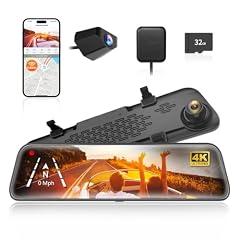
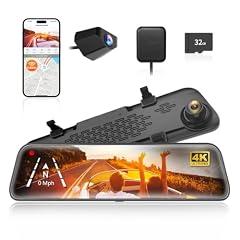
This product is a strap-on 12-inch rearview-mirror dash camera with a wired 1080p rear camera, an external GPS module, a touch display, and USB-C vehicle power. The current manufacturer manual states 4K front recording, 1080p rear recording, 25 fps, Wi-Fi, support for cards up to 256GB, and a stated operating range of minus 4 to 158°F. Parking recording requires a separately purchased hardwire kit. Its strongest independently checkable point is wireless traceability. The G840S name and 2.4 and 5.8 GHz radios match an FCC authorization record. That confirms radio authorization, not footage quality, thermal durability, or crash prevention. The manual documents automatic recording, loop clips, G-sensor file locking, GPS stamps, and optional screen sleep. Published reviews provide some driving impressions, but I found no laboratory report or repeatable original-file endurance test for this exact product.
What works
- The 2.4 and 5.8 GHz Wi-Fi implementation is traceable to an FCC authorization matching the product name.
- The manufacturer documents automatic startup, one to three minute loop recording, G-sensor sensitivity settings, and a separate locked-video folder.
- The screen saver can activate after 10 seconds, which may reduce unnecessary display exposure when the display is not needed.
- The current manufacturer manual states an 18-month warranty, optional six-month extension after registration, and lifetime technical support.
What does not
- The catalog specifications conflict with the current manufacturer manual. The catalog states 30 fps, 128GB maximum storage, a bundled 32GB card, and a supercapacitor, while the current manual states 25 fps, 256GB maximum storage, and does not list a card or capacitor specification.
- No public UL or other NRTL listing was identified for the exact vehicle charger or product, despite the heat and vehicle-power use case.
- The 12-inch touchscreen permits several visual and manual settings, but there is no evidence that its in-motion tasks were tested against NHTSA distraction criteria or locked out while driving.
- The manual gives the Wi-Fi network a published default password. It does not document a password-change process, and the current official app page does not list this product among supported app models.
Who is it for
This product suits a driver who wants continuous front and rear incident recording plus a large rear camera display, and who can install the rear cable carefully or arrange professional installation. It is most appropriate where the factory mirror can securely carry a strap-on display and the vehicle owner has checked mirror, windshield, airbag, and camera-sensor restrictions. It also fits someone willing to manage footage locally on a microSD card, format the card when prompted, and verify recording before relying on it.
Who is it not for
It is not well suited to drivers who need independently tested night plate readability, heat endurance, or long-term parking reliability. It also deserves caution in vehicles with auto-dimming mirrors, mirror-mounted sensors, camera systems, curtain-airbag routing areas, or owner-manual restrictions on aftermarket mirror accessories. Buyers who do not want to route a 20-foot rear cable, make a reverse-light connection, or manage storage and settings should avoid treating this as a simple plug-in safety upgrade. Do not operate its touch menus while driving.
Integrity
The manual provides meaningful operating limits and instructs users to stop using the product if it is damaged or malfunctions, but its stated temperature range and power precautions are manufacturer statements rather than independent thermal or electrical-safety testing. The rear-camera instructions call for routing cable along trim and connecting a wire to the reverse-light positive terminal. That work should be kept clear of airbags and vehicle sensors, and is a sensible case for qualified installation when the vehicle layout is unfamiliar. The manufacturer documents an 18-month warranty, firmware attention, and lifetime technical support, which can help extend service life. It does not provide a clear product-specific repair-parts catalog, battery chemistry disclosure, or end-of-life take-back instruction. The product should therefore go to a certified electronics recycler or local household hazardous-waste program at end of life, not curbside recycling. The FCC record verifies the Wi-Fi radio authorization, but it is not a product-safety certification.

G300 Plus 4K Dual Dash Cam
Overview
This is a slim windshield-mounted dual dash camera with a front unit, a cabled rear camera, a 2-inch screen, Wi-Fi app access, GPS recording, and a supplied 64 GB microSD card. The manufacturer documentation describes 3840 x 2160 front recording and 1080p rear recording, with stated 170-degree and 150-degree fields of view. Its defining verified record is a matching FCC authorization for the G300HPLUS wireless radio. The manufacturer also documents loop recording, impact-triggered file locking, screen-off control, audio on or off, and parking monitoring with a separately purchased hardwire kit. There is independent video-review coverage, but no identified accredited lab report or reproducible endurance test for this exact product. The claimed image quality, plate readability, heat performance, and long-term recording reliability therefore remain principally manufacturer-stated.
What works
- A matching FCC authorization exists for the product's Wi-Fi radio.
- The documented front and rear configuration records both directions, with manufacturer-stated 4K front and 1080p rear files.
- Manufacturer documentation provides loop recording and impact-triggered file locking, intended to preserve an event clip from normal overwrite.
- The manual tells drivers not to operate settings while driving, and offers screen-off and limited voice commands.
- The package documentation lists a 64 GB card, rear camera, installation tool, adhesive materials, and cables.
What does not
- No identified model-specific accredited laboratory test verifies night plate readability, glare handling, bitrate, thermal behavior, or long-duration reliability.
- The parking function needs a separately purchased hardwire kit, so continuous parked coverage is not available from the supplied plug-in setup alone.
- The installation instructions say to avoid obstructing the driver's view, but do not give vehicle-specific guidance for airbags, rain sensors, or windshield-mounted driver-assistance cameras.
- The documented default Wi-Fi password is 12345678 until changed in the app. Physical confirmation is required for first connection, but owners should change it promptly.
- The app's Apple privacy disclosure says identifiers may be used to track users, and it lists location, contact, usage, diagnostic, and payment-related data as potentially collected for app functions.
Who is it for
This product suits a driver who wants a compact two-camera record of trips and rear incidents, can route a rear-camera cable neatly, and is comfortable checking settings before driving. It is most appropriate where the camera can sit behind or just below the rearview mirror without blocking sightlines or vehicle sensors. The buyer should be willing to format and inspect the card periodically, change the default Wi-Fi password, and treat parking monitoring as an optional wired installation rather than an included function.
Who is it not for
It is not suited to drivers who need independently validated night evidence, confirmed plate readability at speed, or demonstrated heat and power-loss endurance for an exact model. It is also a poor fit for anyone unwilling to install or pay for a hardwire kit for parking coverage. Avoid self-installation if your vehicle has windshield cameras, rain sensors, curtain-airbag routing, or trim that makes cable placement uncertain. Privacy-sensitive users should not enable app, GPS, audio, or sharing features without reviewing and changing the relevant settings.
Integrity
The documented safety controls are useful but limited. The manual says not to access settings while driving and says the camera should not obstruct the driver's view or interfere with vehicle safety features. It also supports screen-off control, and its voice commands may reduce the need to touch the unit. These are operational safeguards, not evidence that the camera prevents crashes. Secure placement and cable routing remain the installer's responsibility. A matching FCC authorization was located for the Wi-Fi radio, which supports traceability for that regulated function in the United States. No public UL or other NRTL listing was identified for the supplied vehicle power adapter, and no model-specific recall was identified in the CPSC recall search. The manufacturer describes a supercapacitor design, which can avoid a rechargeable lithium battery in a hot cabin, but no independent thermal or electrical safety report was located. The product uses replaceable microSD storage, but no clear manufacturer take-back, e-waste recycling, or repair-parts policy was found.

Dash Cam 3K 4 Channel
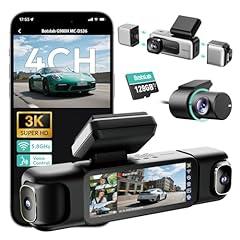
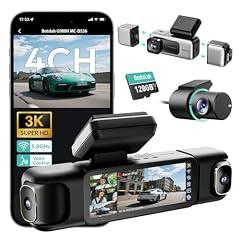
Overview
This is a windshield-mounted four-camera dash camera with a 3.18-inch touch display, front, rear, left, and right recording, built-in GPS, app connectivity, voice commands, and a bundled 128GB memory card. The manufacturer states that all four channels record together, with 3K front video and 1080p rear and side video. Its continuous parking functions require a separately sold hardwire kit. The most defining hardware point is the manufacturer-stated supercapacitor, rated from minus 20 C to 70 C, rather than a large internal lithium-ion operating battery. The wireless hardware is traceable to an FCC authorization record for the G980H-N529-1 360 dash camera. Independent hands-on testing supports the broad daytime coverage, while also finding that secondary cameras, especially the rear unit, lose useful detail in low light and glare.
What works
- Four simultaneous views can document the front, rear, and both sides of the vehicle, a configuration confirmed in independent hands-on testing.
- The product has a traceable FCC record for its Bluetooth, 2.4 GHz Wi-Fi, and 5 GHz Wi-Fi radio configuration.
- The manufacturer states that its supercapacitor is rated for minus 20 C to 70 C, a more suitable power design for parked-car heat exposure than relying on a large internal operating battery.
- The bundled 128GB card and manufacturer-stated loop recording, collision locking, and up to 512GB card support provide a workable starting point for continuous recording.
What does not
- Independent testing found usable daytime footage, but weak low-light detail from the side and rear cameras. Rear glare and motion blur can limit evidentiary value after dark.
- Parking monitoring is not included as sold. It needs a dedicated hardwire kit, and constant-power use without low-voltage protection can drain a vehicle battery.
- The touch display, live views, and app add visual-manual interaction. There is no evidence that this interface was tested against NHTSA distraction timing guidance, and one reviewer found its nighttime screensaver bright.
- The official material supports FCC radio compliance, but no public UL or other NRTL listing was found for the included vehicle power adapter or the optional hardwire kit.
Who is it for
This product suits a driver who needs broad documentation around a parked or moving vehicle, particularly where side contact, passenger disputes, or rear incidents matter alongside forward footage. It is most appropriate for someone willing to install it carefully near the rearview-mirror area, route cables out of the way, and add the dedicated hardwire kit if parking recording is needed. The buyer should treat the secondary cameras as coverage tools, not as dependable long-distance night plate cameras.
Who is it not for
It is not well suited to a buyer whose main requirement is dependable license-plate reading from every direction at night, in rain, or under headlight glare. Independent testing found the side and rear footage substantially weaker after dark. It is also unsuitable for drivers who cannot safely manage a windshield installation around vehicle cameras, airbags, and trim, or who want parking surveillance without fuse-box wiring. Privacy-sensitive users may object to creating an app account to connect to their own camera.
Integrity
The safety-relevant strength is its stated supercapacitor power design, rated by the manufacturer for minus 20 C to 70 C. A public FCC record identifies a matching G980H-N529-1 360 dash camera and documents the Bluetooth and Wi-Fi bands. No product-specific CPSC recall or regulator warning was found in the reviewed sources. Installation still deserves care. The camera uses windshield adhesive and multiple cables, while the parking feature requires optional permanent power. Cables should be secured away from airbags, trim hazards, pedals, and the driver’s view. The manufacturer offers a one-year warranty and sells some accessories, but clear repair, firmware-support duration, battery disposal, and end-of-life electronics recycling commitments were not found. Use an appropriate high-endurance memory card when replacement is needed, and recycle the product through a certified electronics recycler when it reaches end of service.

R2-4K Dash Cam WiFi GPS Night Vision
Overview
The Rove R2-4K is a compact, front-facing windshield dash camera with a 2.4-inch screen, GPS, Wi-Fi connection to a phone app, microSD recording, and a claimed 512GB card limit. It is designed to start recording with vehicle power, loop over older clips, and lock clips after an impact. The current manufacturer manual says its 24-hour parking mode needs a separately sold hardwire kit. Independent testing found clear daytime footage and automatic saving of rolling three-minute clips. The same testing found license plates harder to read at night with headlight glare, a frustrating menu system, and a bulky suction mount that could come loose in warm conditions. Current manufacturer materials state a supercapacitor and a 2023 FCC-authorized Wi-Fi version, but older public documentation describes a lithium-ion battery and different camera hardware. That revision history makes it important to verify the label and included hardware on the individual product.
What works
- Independent testing found clear daylight footage across a wide front view.
- Independent testing confirmed automatic rolling recording in three-minute clips.
- The current manual instructs the camera not to be operated or adjusted while driving.
- The current product documentation identifies a supercapacitor rather than a lithium-ion battery, which is better suited to hot parked-car conditions, manufacturer-stated.
- The current Wi-Fi model has a matching FCC equipment authorization for its 2.4 GHz radio.
What does not
- Independent testing found night license-plate readability can be impaired by glare and shadows.
- The suction mount was reported to be bulky, difficult to adjust, and less reliable on warm days.
- Parking monitoring requires a separately sold hardwire kit, it is not an out-of-box function.
- The app requires account registration for first-time users and its Apple privacy disclosure lists precise location, contact information, identifiers, usage data, and diagnostics.
- The product's 4K and hardware claims have changed across public documentation, and older independent hardware analysis disputes native 4K capture.
Who is it for
This product suits a driver seeking a front-only record of ordinary daytime trips, who is willing to set it up before driving and periodically check recordings. It is most appropriate where continuous loop recording and an automatically locked impact clip matter more than discreet placement or strong nighttime plate capture. The buyer should have room high on the windshield for the camera and mount, use a suitable endurance microSD card, and accept that parking monitoring requires a separately purchased hardwire kit and careful vehicle-specific installation.
Who is it not for
It is not well suited to drivers who need dependable night identification of plates at distance or through headlight glare, because independent testing found those conditions difficult. It is also a poor fit for small windshields, vehicles with crowded camera or sensor areas near the mirror, or anyone unable to position it without obstructing forward view. Do not rely on the suction mount in sustained heat without checking retention. Buyers who will not create an app account, or who need clearly documented data-security controls, should also look elsewhere.
Integrity
The current manual tells users not to manipulate the camera or accessories while driving and to place it where it does not block the view. Those are important safeguards because its screen, buttons, and phone-connected functions can create distraction if used in motion. Its current Wi-Fi radio is traceable to an FCC equipment authorization issued in August 2023 for the named product and grantee. No matching public UL or other NRTL listing for the supplied vehicle charger was identified in the verification work. Current ROVE materials say this version uses a supercapacitor, with a stated operating range of minus 4 to 140 degrees Fahrenheit. That design avoids an internal lithium-ion battery, which can improve heat tolerance and simplify end-of-life battery handling. However, no clear brand take-back, repair-parts, or product recycling program was found. The camera still becomes e-waste at end of life, and its microSD card should be erased before using a certified electronics recycler.

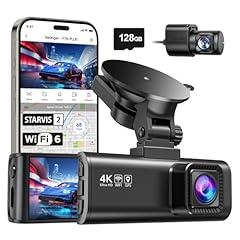
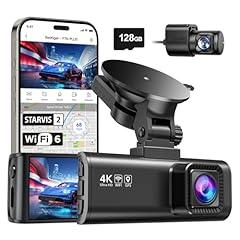
4K Dash Cam with GPS and Wi-Fi
Overview
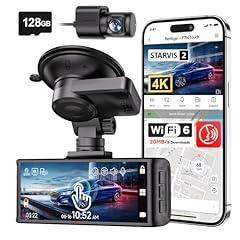
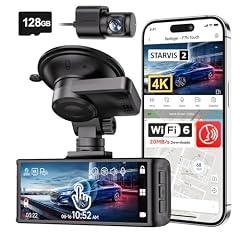
This is a windshield-mounted, two-channel dash camera with a 3.18-inch display, front camera, cabin-facing rear camera, GPS, local Wi-Fi connection, loop recording, and a bundled 128GB card in this configuration. It runs from vehicle power and uses a supercapacitor rather than an internal lithium battery. Continuous parking recording requires a hardwire kit. Independent Consumer Reports testing of the F7NP Basic found excellent daytime video, satisfactory nighttime video, very easy installation, and excellent audio. REDTIGER states that the current version exports 3840 by 2160 front files and 1080p rear files, uses 5.8GHz Wi-Fi, and has a STARVIS 2 sensor. Its own page also defines 4K as exported-file resolution, so sensor-level resolution and low-light claims remain less independently established than the daytime footage result.
What works
- Consumer Reports independently rated daytime video quality 5 out of 5 for the tested product.
- Front and rear recording provides two viewpoints, independently confirmed in Consumer Reports specifications.
- The manual provides loop-recording options and says G-sensor collision or vibration events are locked against normal overwrite.
- A supercapacitor replaces an internal lithium battery, which avoids a rechargeable battery inside a hot windshield-mounted camera.
- The manual includes a screen-off setting, which can reduce the distraction from a live display once setup is complete.
What does not
- Independent testing rated nighttime video 3 out of 5, so the strongest evidence is for daytime capture rather than difficult low-light detail.
- The current product page defines 4K as exported-file resolution. It does not identify the sensor model or provide independent original-file testing of the STARVIS 2 claim.
- The manufacturer page claims 5.8GHz Wi-Fi, while the traceable FCC report for an F7NP sample documents 2.4GHz operation. A matching public authorization record for the claimed 5.8GHz revision was not located.
- The available manual displays a simple default Wi-Fi password, 12345678. It does not document encryption, password-change requirements, or a security-update commitment for the camera.
- Parking mode needs separate hardwiring on marketplace purchases, and evidence of long-duration heat, power-loss, and bundled-card endurance testing was not found.
Who is it for
This product suits a driver who wants front and rear documentation for routine daytime commuting, school runs, or road trips, and who is comfortable mounting a camera behind the rear-view mirror and routing a rear cable carefully. It is also suited to someone who can retrieve files from the card or app after an event and who will configure it while parked. The independently tested strengths are daytime video, audio, and installation ease, not a claim of crash prevention or guaranteed plate readability in every condition.
Who is it not for
It is not suited to drivers who need independently proven night plate readability, continuous parking recording without extra wiring, or compliance documentation that clearly maps every current wireless claim to the exact hardware revision. It also needs extra caution for people who cannot safely install a windshield device around vehicle cameras, airbags, trim, or defroster wiring. Drivers who would use the live screen, app, or playback while moving should choose a setup that keeps those tasks inaccessible until parked.
Integrity
The most meaningful heat-safety feature is the manufacturer-stated supercapacitor, rather than an internal rechargeable lithium battery. REDTIGER lists operating limits around minus 4°F to 150°F in its available manual, while the current product page says minus 4°F to 158°F. The manual also warns against prolonged sun exposure and identifies vehicle-power use. No product-specific UL or other NRTL listing for the supplied vehicle charger was located during verification, so its power-safety certification remains unconfirmed. The product has firmware-update support, separately sold mounting and cable accessories, and a stated 18-month marketplace warranty. However, REDTIGER does not provide a clear U.S. take-back or recycling program for the camera or supplied memory card. At end of life, electronics should go to an appropriate recycler, not household trash. The app can collect precise location, user content, device identifiers, and diagnostics depending on permissions, so GPS, audio, and media permissions should be limited to the functions actually needed.
REDTIGER F7N Touch 4K Dash Cam
Overview
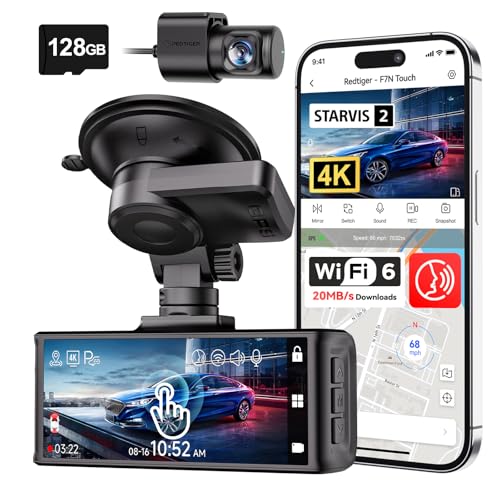
This is a windshield-mounted, two-channel driving recorder with a 3.18-inch touch display, a separate rear camera, GPS mount, Wi-Fi connection and microSD storage. The manufacturer manual specifies front recording up to 2160P at 30 frames per second, or 2160P front plus 1080P rear, with one, three, or five minute recording loops. It is powered from a 5V, 2.5A vehicle adapter and has a stated operating range of minus 4 to 158 degrees Fahrenheit. The manual documents adjustable G-sensor sensitivity, manual clip locking, audio, GPS and speed-stamp controls, screen-off settings, voice commands and firmware updates through the app. Its Wi-Fi radio has a traceable FCC authorization covering this product model family. Independent testing of the closely related F7N variants found strong daytime front footage but substantially weaker night and rear license-plate readability, and reported that earlier front hardware was interpolated rather than native 4K.
What works
- The official manual provides concrete operating limits, recording modes, card range of 32GB to 256GB, and a stated 18-month warranty.
- Front and rear recording, manual incident locking, G-sensor settings, GPS stamps, and configurable loop lengths are documented in the manufacturer manual.
- A screen saver can turn the display off after 10 seconds, 30 seconds, or two minutes, and voice control can operate selected functions without touching the screen.
- The wireless function is traceable to an FCC authorization that expressly lists F7N Touch among the covered models.
What does not
- Independent review evidence for this product family found night footage and rear-camera plate readability limited, especially in glare or low light.
- The 4K marketing needs caution. Independent analysis of related F7N Touch hardware reported an upscaled front image, while the manual confirms a 2160P output setting but does not identify the image sensor or establish native sensor resolution.
- Parking monitoring requires a separately purchased ACC hardwire kit, so it is not available from the supplied plug-in power lead alone.
- The manual gives a default Wi-Fi password of 12345678. Wi-Fi should be disabled when not actively transferring footage, and the password should be changed if the product permits it.
- No public UL or other NRTL listing was identified for the supplied vehicle charger, and no model-specific thermal endurance report was located.
Who is it for
This product suits a driver who wants documented front and rear recording controls in a compact windshield unit, can install and route cables carefully, and is willing to verify footage after setup. It is most practical for routine daytime commuting, delivery driving, or road trips where a rear view, GPS time and location options, manual file locking, and local phone transfer are useful. The buyer should be comfortable managing a memory card, formatting it periodically, setting the time zone, and treating the hardwire kit as a separate accessory if parked-car recording is needed.
Who is it not for
It is not well suited to drivers who need independently proven night license-plate capture from both cameras, or who expect a marketed 4K label alone to guarantee native-sensor detail. It is also a poor fit for anyone unable to mount hardware outside the driver’s sight line or safely route wiring away from airbags and trim. Privacy-sensitive users who do not want a Wi-Fi device with GPS, audio, phone-app permissions, and a documented default password should avoid enabling those functions or choose a product with independently assessed security controls.
Integrity
The safety documentation is more useful than many basic dash-camera manuals. It tells the installer not to obstruct the road view or airbag deployment, not to adjust controls while driving, and to conceal the power cable along the windshield and A-pillar area. It also specifies a wide stated operating temperature range and directs users to use the supplied power hardware. The mounting guidance still depends on correct placement for the particular vehicle, including avoiding factory cameras, sensors, and airbag paths. The product uses replaceable microSD storage rather than sealed internal storage, and the manufacturer documents over-the-air updates and an 18-month warranty. Those features can extend service life. However, no clear manufacturer take-back program, recycling instructions, charger safety listing, or public model-specific repair-parts program was located. The app disclosures describe collection of location, user content, identifiers, diagnostics, and other data depending on use. Audio and GPS stamps can be switched off from the product, which is important where recording consent or location sharing is a concern.

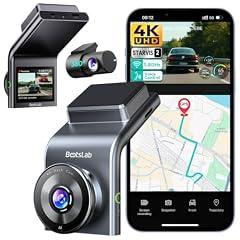
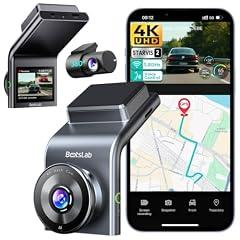
BOTSLAB 4K Dual Dash Cam with ADAS
Overview
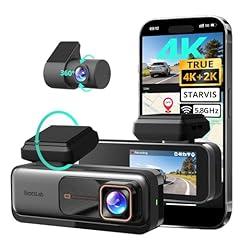
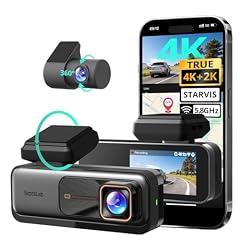
This is a windshield-mounted dual dash camera with a front camera, a separate rear-window camera, a 2.45-inch display, GPS, Bluetooth, and 2.4 GHz and 5 GHz Wi-Fi for phone access. It uses a microSD card for local recording and is powered from the vehicle, with parking monitoring requiring suitable constant power or the separate hardwire setup. Independent hands-on testing confirms a 4K front stream, 1080p rear stream, a bundled 64 GB card in the tested package, and a supercapacitor rather than an internal lithium-ion battery. The camera can time out its screen and disable its status light, which can reduce persistent visual distraction. However, the same testing found low-light and highway-speed plate reading difficult, while its ADAS alerts were not reliable enough to treat as crash-prevention technology.
What works
- Uses a supercapacitor, not an internal lithium-ion battery, to preserve footage during shutdown and avoid a battery inside a hot cabin.
- Independent hands-on testing found the compact unit can fade its display after setup, reducing ongoing screen distraction.
- The manual documents loop recording, adjustable event-recording sensitivity, separate emergency-video storage, and an audio-recording off switch.
- The manual specifies local controls for Wi-Fi hotspot use, speed overlay, audio recording, parking sensitivity, and ADAS calibration.
What does not
- The product listing claims a 4K plus 2K configuration, but independent testing and the available manual describe 4K front and 1080p rear recording. This is a material specification conflict.
- Independent road testing found license plates can be difficult to read in low light or at highway speeds, despite the high front resolution claim.
- ADAS warnings were reported as imprecise and potentially tedious. The manual also says calibration, glare, darkness, weather, and lane-marking conditions can limit alerts.
- Parking monitoring needs compatible constant vehicle power or a separate hardwire kit. Independent testing did not verify its long-duration parking performance.
- No public, model-matched UL or other NRTL listing for the supplied vehicle charger was located in this review, and no accredited full-product performance report was located.
Who is it for
This product suits a driver who primarily wants local front and rear incident documentation, is prepared to install a rear camera and route cables carefully, and will treat driver alerts as optional reminders rather than safety automation. It is better aligned with people who can use a high-endurance microSD card, periodically check saved clips, and want app-based clip transfer. It also suits drivers who prefer a supercapacitor design over an internal lithium-ion battery in a hot parked vehicle.
Who is it not for
It is not suited to anyone who needs consistently readable license plates at high speed or in poorly lit conditions, because independent testing found those conditions challenging. It is also unsuitable for drivers likely to rely on lane, pedestrian, or following-distance warnings to prevent a crash. Vehicles with curtain airbags, windshield sensors, or complex camera systems need vehicle-specific installation guidance before cable routing. Privacy-sensitive users who do not want location-enabled footage or an app that discloses tracking and third-party data sharing should use local settings cautiously or avoid app connection.
Integrity
The most relevant heat and power feature is the supercapacitor design, independently observed in hands-on testing. The available manual lists a 0 to 50 C operating range and says the camera has high-temperature shutdown protection. It also directs owners to use the supplied accessories. Those are useful safeguards, but this review did not locate a public, exact-model safety listing for the included vehicle charger. For disposal, the manual directs users to an appropriate collection facility rather than household waste, and it gives the camera and power adapter a one-year warranty. It does not provide a clearly identified repair-parts catalog, battery replacement path, or dedicated United States take-back program. The product records GPS-linked driving footage, while the companion app discloses tracking identifiers and collection or sharing of certain data. Audio, speed overlay, Wi-Fi, and parking functions should be deliberately configured.