
10 Best Bottle Sterilizers
 Lauren Wilson
Please note that we participate in affiliate marketing programs. When you purchase through links on our site, we may earn a commission. As an Amazon Associate we earn from qualifying purchases. This comes at no additional cost to you and helps support the resources required to provide valuable content.Advertising Disclosure
Top-rated Bottle Sterilizers Comparison
1

2
+
3
4
5
6
7
8
9
10
Bottle sterilizers: what matters
Bottle sterilizers use steam, and sometimes heated air, to sanitize feeding items after they have been cleaned. Some models also wash bottles, pump parts, and accessories; others are sterilizer-and-dryer units only. That distinction matters: steam does not reliably remove milk or formula residue, so a sterilizer-only product must plainly require thorough washing, rinsing, disassembly, and inspection first. A washer should explain how its spray pattern and loading instructions reach bottle interiors, nipples, valves, threads, and pump-part pathways without overcrowding.
The most useful performance evidence is not an empty-chamber claim or a headline percentage. A strong sanitizing claim should be supported by an ISO/IEC 17025-accredited laboratory report for the exact product and cycle, at the maximum stated load, with the stated item placement, water conditions, and soiled-item conditions. The difficult surfaces not just easily exposed bottle walls should be included. Claims such as “99.9%,” “99.99%,” “sterilizes,” or “hospital-grade” are incomplete when they do not identify the organisms, test method, exposure time, load, or meaning of the result. Independent testing in this set found that some units did not heat consistently, showing why a marketing percentage cannot stand in for repeatable full-load performance.
Drying is a separate part of hygiene. Look for instructions and evidence showing that items emerge dry, that pooled water in bottle bases, nipple flanges, and valves is addressed, and that any storage mode limits recontamination. A claimed 24-, 48-, or 72-hour storage period is not proof that contents remain sterile unless airflow, loading, storage duration, and microbiological or airborne-contamination conditions have been tested. A filter label is similarly incomplete without a filter specification, test method, replacement interval, and evidence for the exact product.
Safety and material transparency deserve equal attention. Steam, hot surfaces, low-water or dry-boil protection, leaks, grounding, overheating, and automatic shutoff should be covered by practical instructions and, ideally, a product-specific UL, ETL, or CSA listing that can be matched in the relevant public directory. “BPA-free,” “food-grade,” or “baby-safe detergent” statements are manufacturer claims unless supported by food-contact documentation, a bill of materials, detergent safety information, and rinse-residue testing. A warranty, model information, replacement parts, support route, product registration, and recall process help make problems traceable after purchase.
Resource claims need similar precision. Compare measured water and electricity per complete bottle-ready cycle, not just reservoir size or a claim that a machine uses less water than hand washing. Proprietary detergent tablets, filters, descalers, and single-use packaging add recurring waste; repairable, inspectable components and a clear maintenance schedule can improve a product’s practical lifespan. Across the supplied products, recurring caveats include the need to clean before sanitizing, manage steam and hot surfaces, descale and clean heating plates or spray paths, and dry items completely before protected storage. Several products lacked independently documented full-load sanitization or electrical-safety evidence. One compact model showed inconsistent heating in independent testing, and reports of crumbling or disintegrating internal plastic components appear in reviews of two washer products; inspect for debris and stop using a product if parts crack, crumble, or shed pieces. No supplied evidence establishes a category-wide contraindication, but caregivers of infants under two months, premature infants, or infants with weakened immune systems should place particular weight on reliable daily sanitizing guidance and independently supported performance.
Integrity
The scores below compare the supplied products against the category’s health, ecological, and evidence questions. They indicate relative strength in the reviewed material; they do not turn an unsupported marketing claim into proof.
HHealth & Safety
Infant hygiene benefit
This measures whether the product supports a realistic clean, sanitize, dry, and store routine without implying that routine use prevents disease. Higher-scoring products generally combine a useful workflow with clear clean-first guidance and a plausible fit for the household. Lower scores reflect sterilizer-only limitations, unclear use boundaries, or storage claims that could encourage treating the appliance as a substitute for cleaning.
Milk-residue removal or clear pre-cleaning rules
A washer should show how it reaches bottle and pump-part geometries; a sterilizer should plainly require thorough washing first. This matters because steam does not remove milk or formula soil. The supplied scores were highest for products with explicit wash-and-rinse instructions, pre-rinse rules, or practical loading guidance, and lower where cleaning performance, compatible geometries, or even a usable manual were unclear.
Proven sanitizing performance at a full load
This measures repeatable germ reduction under the exact claimed cycle, maximum load, placement, water conditions, and soiled-item conditions. It is the most important performance discriminator. Higher scores in this set reflect independent temperature or performance testing and stronger supporting evidence, while lower scores reflect only manufacturer percentages or, in one case, independent findings that sampled units stopped heating too early.
Drying and clean storage protection
The question is whether items fully dry and remain protected from dirty air or pooled water during storage. Higher-scoring products have independent drying evidence or unusually clear drying and maintenance instructions. Lower scores occur where condensation may remain, bottle geometry can trap water, or 24- to 72-hour storage claims lack recontamination testing.
Food-contact materials and rinse safety
This covers steam-exposed parts, milk-contact surfaces, replacement components, detergent suitability, and rinsing. Higher scores reflect clearer material descriptions, multiple rinses, or better-documented detergent handling. Lower scores reflect broad BPA-free or food-grade language without a compliance file, absent detergent safety data, or no rinse-residue testing. A product’s material label alone does not establish food-contact safety.
Steam, burn, and electrical safety
This measures safeguards against escaping steam, hot surfaces, dry boiling, leaks, shock, overheating, and fire, alongside a product-specific recognized safety listing. Higher-scoring products provide practical cooling, low-water, grounding, or overheat instructions and some traceable listing evidence. Lower scores commonly reflect missing UL, ETL, or CSA matches, even when the manual contains ordinary steam warnings.
Maintainable, hygienic design
A maintainable product lets the owner clean reservoirs, spray arms, seals, filters, heating plates, and drainage paths, and gives descaling and service instructions. Higher scores in the supplied set reflect removable parts, drain hoses, cleanable filters, self-cleaning or descaling guidance, and clear schedules. Lower scores reflect hidden buildup risks, unclear replacement support, or reports of leaks, residue, overheating, or degrading internal plastic.
EEcology
Water, energy, and consumables footprint
This measures water and electricity per bottle-ready cycle plus waste from tablets, filters, descalers, and replacement parts. Higher scores generally reflect measured or manufacturer-stated low water use, no detergent system, or modest consumable dependence, though measured energy data was often absent. Lower scores reflect recurring proprietary tablets, filters, and descalers, especially when durability and repair options are undocumented.
EEvidence
Honest sanitizing and filtration claims
This measures whether claims state their limits, test conditions, and evidence. Higher-scoring products distinguish manufacturer claims from independently tested results and avoid presenting storage, HEPA, or germ-reduction figures as universal guarantees. Lower scores occur when percentages omit organisms, loads, exposure conditions, or test methods, or when “sterile,” “HEPA,” lead, or PFAS language has no accessible supporting report.
Independent proof, not badge-only marketing
The strongest evidence is a certificate or accredited report that can be matched to the exact model and covers the claimed function. Higher scores in the supplied products reflect traceable Consumer Reports testing, a directory listing for a relevant model type, or clearer third-party support. Lower scores reflect badges, TÜV or other general references, or marketing language without a certificate scope or full-load report.
Traceable maker and safety follow-through
This measures whether the responsible company, model information, warranty, replacement parts, support route, product registration, and recall process are identifiable. Higher-scoring products provide model-based registration, a warranty, and a working support path. Lower scores reflect sparse manuals, unclear seller or maker accountability, missing service information, or no documented route for correcting a safety problem after purchase.
Full reviews

Momcozy KleanPal Pro Baby Bottle Washer
Overview
This countertop bottle washer is a 12.9-pound appliance for washing, steam-treating, drying, and holding infant bottles, pump parts, and small accessories. Its two-tier layout is manufacturer-stated to hold up to four bottles, with upper and lower spray arms, a refillable water tank, drainage hose, detergent tablet use, and an air-filtration component. Momcozy states that rapid washing takes 19 minutes at 55 C, normal washing takes 29 minutes at 68 C, and its steam mode reaches 100 C. It also states that a storage mode can run for up to 72 hours. Those are operating claims, not independently verified full-load sanitation or recontamination results. No traceable accredited laboratory report, recognized electrical-safety listing, or exact-model certification record was located in this review.
What works
- The documented wash, steam, dry, and storage functions can consolidate several bottle-care steps in one enclosed appliance.
- Momcozy provides placement guidance for bottles, pump parts, and wearable-pump components, which supports more deliberate loading.
- The cover, both spray arms, racks, and water tank are identified as washable components, allowing routine inspection and cleaning.
- Replacement parts, a listed US support route, and a one-year warranty policy are available from the manufacturer.
What does not
- No independent, exact-model full-load test report was located for milk-residue removal, germ reduction, drying, or 72-hour storage protection.
- No UL, ETL, or CSA listing for this exact product was located during verification, so electrical and heat-safety claims remain unverified.
- Food-contact shelves and clips are described by Momcozy as food-grade BPA-free polypropylene, but no public food-contact compliance file or detergent safety data sheet was located.
- A proposed federal class action filed May 18, 2026 alleges that internal plastic components can degrade and shed pieces during normal high-heat use. These are unproven allegations, not a recall or adjudicated finding, but they warrant inspection for cracking or loose debris.
Who is it for
This product suits a household that routinely uses several bottles or compatible pump parts daily and values a contained countertop workflow over sink washing. It is most practical where there is stable counter space, access to a nearby drain for the hose, and willingness to follow loading, water, detergent, filter, and descaling instructions. The four-bottle stated capacity makes it better aligned with repeated smaller loads than with a large collection of feeding equipment at once. Buyers should be comfortable treating its sanitation and storage claims as manufacturer-stated rather than independently proven.
Who is it not for
It is not well suited to caregivers of infants younger than 2 months, premature infants, or infants with weakened immune systems who need the strongest possible evidence for sanitation performance. CDC identifies these groups as needing particular attention to daily sanitizing. It also is not suited to households unable to inspect and clean spray arms, tank, seals, and filtration parts regularly, or to anyone unwilling to use detergent tablets and periodic descaling. Stop using the product and seek manufacturer support if internal plastic cracks, flakes, loose pieces, leaks, or persistent residue appear.
Integrity
The useful health feature is that this is a washer as well as a steam unit. CDC guidance emphasizes cleaning feeding items, and a dishwasher-style hot-water wash with heated drying can remove the need for a separate sanitation step when those functions work as intended. Momcozy specifies wash temperatures, steam, drying, and a filtered storage mode, but did not provide a public accredited test report demonstrating sanitation at a fully loaded, soiled configuration. Momcozy says bottle-contact shelves and clips are BPA-free polypropylene. That statement is not matched by a public material-compliance dossier, and the detergent ingredient disclosure and rinse-residue testing were not located. The appliance uses water, electricity, disposable detergent tablets, replacement air filters, and descaling products, while measured per-cycle resource data were not found. A pending 2026 lawsuit alleges plastic degradation during high-heat use. The allegation is unresolved, but it makes regular visual inspection especially important.

GROWNSY Bottle Washer Pro
Overview
This countertop appliance is a combined washer, steam sanitizer, heated dryer, and enclosed storage unit for baby bottles, nipples, pump parts, and similar feeding accessories. The manufacturer states that it uses 26 spray jets, 212°F steam, heated air drying, a drain hose, and supplied detergent tablets. Its own product page lists capacity as up to four bottles plus accessories. The practical value is consolidating the clean, sanitize, and dry workflow that CDC recommends for infant feeding items. CDC advises cleaning first, then sanitizing when needed, especially for babies under 2 months, premature babies, or infants with weakened immune systems. GROWNSY gives loading, spray-arm clearance, and descaling instructions, but no publicly traceable accredited full-load soil-removal or microbial-reduction report was located for this product.
What works
- Manufacturer instructions tell users to separate small parts, avoid crowding, and keep spray arms free to rotate.
- The manufacturer provides a drain hose, heated drying, and enclosed storage, which can reduce handling after a completed cycle.
- Descaling guidance calls for an empty cleaning cycle and a thorough rinse afterward, supporting routine hygiene maintenance.
- The maker provides a support route, a product-registration form for safety alerts, and a 30-day direct-purchase return policy.
What does not
- The 99.99% germ-reduction, HEPA filtration, and 72-hour sterile-storage claims were not supported by a publicly available accredited test report for this product and a full load.
- Food-contact material specifications, detergent safety documentation, rinse-residue testing, and a bill of materials were not publicly available.
- No traceable UL, ETL, or CSA listing for this exact product was located, despite the electrical heating and steam functions.
- Capacity claims are inconsistent. The product page says four bottles plus accessories, while another GROWNSY page says four to eight bottles.
- GROWNSY's advice that bottles need sterilizing after every use for the first 12 months is broader than CDC guidance, which emphasizes careful cleaning after each use and targeted daily sanitizing for higher-risk infants.
Who is it for
This suits a household that uses several bottles or compatible pump parts daily and wants an enclosed, countertop workflow rather than separate hand washing, steaming, and rack drying. It is most relevant during the newborn period, particularly when a caregiver has been advised to sanitize feeding items daily. The user should be prepared to follow the loading rules, inspect parts after washing, maintain the drain path, and descale according to local water hardness. It is better suited to families with enough counter and sink-adjacent space for the appliance and drain hose.
Who is it not for
This is not the right safety-critical choice for a household that needs independently documented full-load sanitizing performance, such as one caring for a premature infant or an infant with a weakened immune system, unless the manufacturer supplies product-specific test records. It also does not suit buyers who need disclosed food-contact materials, documented detergent ingredients and residue testing, or a publicly verifiable electrical safety listing. Families with limited counter space, no practical route for the drain hose, or a need to wash more than four confirmed bottles at once should account for the unresolved capacity information.
Integrity
Steam and thorough drying can support CDC-consistent feeding-item care when cleaning occurs before sanitizing. The manufacturer states that this product washes with detergent, uses 212°F steam, dries with heated air, and stores items in a closed chamber. Those are useful functions, but the claimed germ reduction, airborne-particle removal, and 72-hour storage protection remain manufacturer-stated because no product-specific accredited test report was found. The maker gives loading and descaling instructions, including keeping spray arms clear and running an empty cycle with descaling solution or diluted white vinegar, then rinsing. It includes disposable detergent tablets and recommends descaling, so there is an ongoing consumables footprint. Its claim of using 86% less water than hand washing was not accompanied by a published test method. No product-specific CPSC recall or regulatory warning was located in the reviewed public sources, and the maker offers support and safety-alert registration.

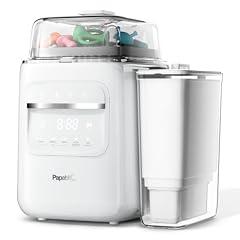
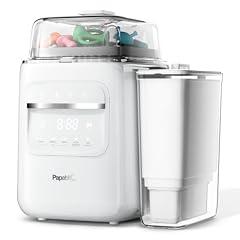
Papablic SafeguardPlus Baby Bottle Washer
Overview
This countertop system is a bottle washer, steam sanitizer, dryer, water-filtering unit, and enclosed storage appliance. Papablic states that it accommodates up to eight bottle sets plus pump parts, uses a detergent tablet for more thorough removal of milk and formula fats, and has replaceable PurifyClean water filters. The manufacturer identifies the principal materials as PP plastic, Tritan plastic, stainless steel, and silicone, and says bottle-contacting parts are food-contact-safe. It also claims 99.99% germ reduction, 72-hour hygienic storage, and removal of lead, PFAS, and hard-water minerals. Those performance and filtration claims were not accompanied by a model-specific accredited laboratory report, NSF certification, or a public third-party certificate that could be matched to this product. CDC guidance remains clear that feeding items must be cleaned before sanitizing, and that daily sanitizing is especially important for infants under 2 months, premature infants, and infants with weakened immune systems.
What works
- Its washer, sanitizer, dryer, and covered-storage format can support a repeatable feeding-item cleaning routine.
- Papablic specifically advises using a cleaning tablet because milk and formula fats may not rinse away with water alone, which is consistent with cleaning before sanitizing.
- The stated capacity of up to eight bottle sets plus pump parts can reduce the need for multiple small loads in high-volume feeding routines.
- The manufacturer gives a concrete maintenance interval, with a filter reminder at about every 30 wash cycles.
- Published material information identifies PP, Tritan, stainless steel, and silicone rather than relying only on a broad baby-safe label.
What does not
- The claimed 99.99% germ reduction was not supported by a public, model-specific accredited test report covering the stated cycle, full load, item placement, and soiled feeding parts.
- The claims to remove lead, PFAS, and hard minerals do not state tested influent concentrations, filter life under those conditions, certification standard, or a public independent filtration report.
- No model-specific UL, ETL, or CSA safety listing was located in the public certification registers checked, so electrical and heat-safety verification remains unproven.
- Filters need replacement about every 30 wash cycles, and recommended detergent tablets and periodic descaling add continuing material use and waste.
- The claimed 72-hour hygienic-storage period is manufacturer-stated, without a public recontamination or airborne-particle test report.
Who is it for
This product fits a household that routinely washes many bottles or pump components, has enough counter and sink-adjacent space, and can consistently manage detergent tablets, filter changes, and descaling. It is particularly practical for formula-feeding, combination-feeding, or exclusive-pumping routines where several disassembled parts accumulate daily. It can also help caregivers follow a more repeatable wash, sanitize, dry, and protected-storage workflow. For infants with elevated infection vulnerability, the unit should be used only with careful loading, complete cleaning, and the infant's clinician's guidance.
Who is it not for
It is not suited to households seeking independently documented full-load sanitizing performance or certified reduction of lead and PFAS before relying on those claims. It is also a poor fit for people who do not want recurring filters, tablets, descaler, or hands-on maintenance. Caregivers using bottle parts that cannot tolerate steam or high heat should follow the component maker's instructions instead. Families with unsafe water, such as water affected by a contamination advisory, should not treat this appliance's unverified filtration claims as a substitute for local public-health guidance.
Integrity
The useful health feature is the integrated workflow. CDC guidance supports thoroughly cleaning feeding items after use, then sanitizing when needed, and allowing them to dry completely in a clean area. Papablic's own tablet guidance acknowledges that water alone may not remove breast-milk or formula fats, which is an important limit on treating sanitization as a replacement for cleaning. Papablic states that bottle-contacting components use PP, Tritan, stainless steel, and silicone, but it does not publish a bill of materials, migration testing, detergent rinse testing, or a model-specific food-contact compliance file. The company also claims water purification for lead, PFAS, and minerals, but public certification and condition-specific filtration data were not located. Ecologically, the appliance may reduce handwashing water in some homes, but there are no measured water or electricity figures. Its filters, tablets, and descaling needs create recurring consumables and waste. No relevant U.S. recall or regulator warning was located in the checked public sources.

Momcozy Large Bottle Sterilizer and Dryer
Overview
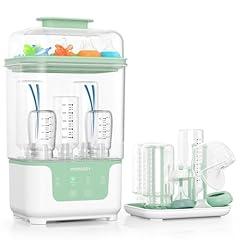
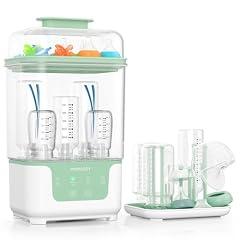
This is a countertop, three-layer steam sterilizer and hot-air dryer for cleaned baby bottles, nipples, pacifiers, teethers, and compatible breast pump parts. Momcozy specifies 160 mL of purified water for its 9-minute steam cycle, then offers separate drying, combined automatic, and 24-hour storage modes. Its stated capacity is six larger 6-11 oz bottles or six to twelve smaller 2-4 oz bottles, subject to bottle dimensions and loading. The most important practical limitation is confirmed in the manufacturer instructions, it is not a washer. Bottles and pump parts must be thoroughly cleaned before loading, which is consistent with CDC guidance that cleaning precedes sanitizing. Momcozy also states that storage mode runs five minutes of drying per hour and that drying air passes through an H13 HEPA filter. No product-specific accredited laboratory report was located to independently confirm full-load germ reduction, filter performance, drying completeness, or the 24-hour storage claim.
What works
- The instructions explicitly require cleaned bottles and pump parts before steam treatment, rather than presenting sanitizing as a substitute for washing.
- Three layers and dedicated pump-part racks support separate placement of bottles, nipples, and compatible pump components.
- The manufacturer provides a 9-minute steam cycle, adjustable 10-60 minute drying, and a 24-hour dry-storage mode.
- Maintenance guidance covers emptying water, wiping the heating plate, descaling with diluted white vinegar, and checking the air filter.
- A named US contact route, support email, manual, model identification, and warranty pathway are published by the manufacturer.
What does not
- The product does not wash away milk or formula residue, so every bottle, valve, nipple, and pump part still needs complete hand washing before use.
- The 99.9% sanitizing claim was not accompanied by a traceable accredited laboratory report for this product, its maximum load, or difficult-to-reach pump-part surfaces.
- The H13 HEPA, complete drying, and 24-hour clean-storage claims are manufacturer-stated. No independent filter, airborne contamination, or recontamination test report was located.
- Detailed composition and food-contact compliance documentation for the steam-exposed chamber, trays, racks, and replacement filter were not publicly located.
- No traceable UL, ETL, or CSA listing for this exact product was located in the searched certification registers.
Who is it for
This product suits a household that already has a disciplined bottle and pump-part washing routine and wants one covered countertop place to steam and dry a substantial batch. Its stated capacity is most useful for families rotating several small bottles, or for pumping households that need to dry compatible, fully washed parts on the supplied racks. It also fits users willing to use purified water, empty the base after use, and regularly descale the heating plate. For infants younger than 2 months, premature infants, or infants with immune concerns, sanitizing can be an added hygiene step after thorough cleaning.
Who is it not for
It is not for anyone seeking an all-in-one bottle washer. Steam does not remove milk film, formula residue, or soil trapped in valves and nipples, and the manufacturer specifically requires items to be cleaned first. It is also a poor fit for users who need independently documented full-load sanitizing performance, verified HEPA filtration, or a traceable electrical safety listing. Families using pump parts should confirm each part is heat-safe with that pump maker, especially thin membranes, tubing, electronic components, or parts that the pump manufacturer says not to steam.
Integrity
Steam sanitizing is a CDC-recognized option for infant feeding items when used according to the equipment instructions, but it follows, rather than replaces, washing. CDC gives particular importance to daily sanitizing for babies younger than 2 months, babies born prematurely, and babies with weakened immune systems. For other healthy older babies, careful cleaning after every use may make daily sanitizing unnecessary. The product's clear pre-cleaning instruction is an important hygiene positive. Momcozy specifies an 800 W, 120 V appliance using 160 mL of purified water per steam cycle. It needs no detergent tablets, but it does consume electricity for heat and drying and uses a replaceable air filter. The manufacturer advises emptying residual water, wiping the heating plate, and descaling with diluted vinegar to control mineral buildup. Publicly available material composition, food-contact compliance records, accredited performance reports, and a product-specific recognized electrical safety listing were not located.

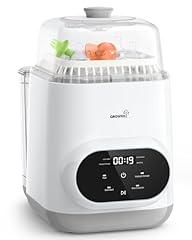
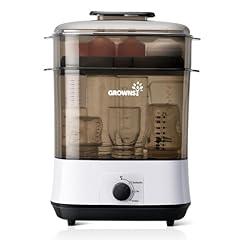
GROWNSY Bottle Sterilizer and Dryer Grey
Overview
This is a compact countertop electric steam sterilizer and hot-air dryer for bottles, nipples, pacifier-type accessories, and compatible breast-pump parts. The manual specifies 120 V, 60 Hz, 500 W operation, 90 mL of distilled water, an 8-minute steam-only cycle, and drying or combined steam-and-dry cycles lasting 60 or 80 minutes. Its most important practical safeguard is manufacturer-stated, not independently tested, the manual instructs users to load cleaned bottles rather than treating steam as a washing step. The same manual provides descaling and drain-and-wipe instructions. GROWNSY also claims 99.99% steam sanitization, filtered drying air, and contamination protection, but no public full-load microbiological test report, drying validation, or certification listing for this exact product was located.
What works
- The instructions clearly require cleaned bottles before steam treatment, aligning with CDC guidance that cleaning comes before sanitizing.
- The manual provides defined cycle settings, including 8 minutes of steam and 60 or 80 minutes of drying.
- The base is maintainable in a basic sense, with instructions to drain it after use and descale it with citric acid.
- A public third-party document identifies this exact product for IEC 62321 RoHS substance testing.
What does not
- The 99.99% sanitization claim is not accompanied by a public accredited laboratory report showing performance at maximum load, on difficult item geometries, or after milk soil.
- Filtered drying and contamination-protection claims are manufacturer-stated, with no public particle, microbial recontamination, or storage-duration test report located.
- No public UL, ETL, or CSA listing for the complete electrical product was located. The manual warns users not to open the lid immediately after steaming because of burn risk.
- The BPA-free statement does not identify the plastics, coatings, or food-contact compliance documentation for steam-exposed components.
Who is it for
This product fits a household that already washes feeding items thoroughly after use and wants a compact countertop step for steam treatment and drying. It is most practical for parents who can follow the loading directions, use distilled water, drain the base, and descale it regularly. The defined 60 and 80 minute dry options can be useful when bottles and compatible pump parts need to be fully dry before being placed in a clean, protected storage area. It is not a bottle washer.
Who is it not for
It is not suited to households seeking independently proven full-load sanitizing performance, verified sterile-storage duration, or a publicly traceable North American electrical-safety listing. It also should not be used as a substitute for handwashing or dishwasher cleaning of milk and formula residue. Families with a premature infant, an infant younger than 2 months, or an infant with immune compromise should be especially careful to follow CDC cleaning, sanitizing, drying, and protected-storage practices, and should seek clinician-specific advice when needed.
Integrity
Steam can be a CDC-consistent way to sanitize feeding and pump parts after they have been cleaned, and drying items fully before protected storage helps limit microbial growth. This product's manual correctly separates cleaning from steaming and gives practical scale-control instructions, including distilled water and citric-acid descaling. It also warns against immediately opening the lid after steaming. Evidence gaps matter here. The company’s 99.99% germ-removal, filtered-air, and contamination-protection claims were not matched to a public, accredited full-load efficacy or recontamination report. A third-party RoHS document identifies the product and its manufacturer, but it covers hazardous-substance test standards and explicitly does not assess whole production. No public UL, ETL, or CSA listing for the complete product was located, and no CPSC recall was located in the searches performed. Its 90 mL water dose is modest, but electricity use and filter replacement needs were not independently measured or clearly specified.

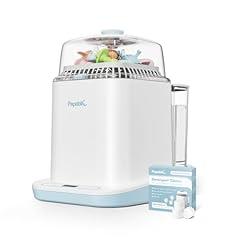
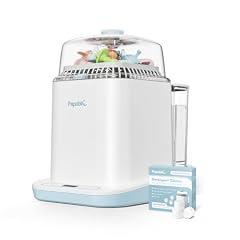
Papablic Baby Bottle Washer
Overview
This countertop bottle-care product is a 4-in-1 washer, steam sanitizer, dryer, and storage unit for bottles, pump parts, pacifiers, and other small baby items. It measures about 10.8 by 14.9 by 16.1 inches, uses a 2.5-liter water tank, and drains through a hose to a sink. The maker says it holds more than four bottles or two complete pump kits and includes 60 detergent tablets. Its defining feature is an automated wash-to-dry routine using 26 spray jets, steam, and hot-air drying. The maker also claims 99.99% germ removal and 72-hour clean storage. Those performance and storage figures are manufacturer claims, not results supported by a publicly traceable accredited full-load test report found in this review.
What works
- The manufacturer provides specific loading guidance, including a stated capacity of more than four bottles or two pump kits.
- Its instructions recognize that heavy milk residue may need pre-rinsing or the longer wash mode, which is more consistent with cleaning before sanitizing.
- A drain hose sends used water to the sink rather than retaining it in a separate dirty-water tank.
- Published instructions call for interior cleaning, regular descaling, rack cleaning, and filter replacement.
- The maker offers product support, registration, and a stated three-year warranty.
What does not
- No publicly traceable accredited test report was found to verify the claimed germ reduction on a maximum, soiled load.
- No public electrical-safety listing for this exact product was located in the UL, ETL, or CSA registers reviewed.
- The published material description is not specific enough to establish food-contact compliance for all steam-exposed and milk-contact surfaces.
- The detergent tablet ingredients, safety data sheet, and rinse-residue testing were not located publicly.
- The 72-hour storage and filtration claims lack published testing conditions, filter classification details, and recontamination data.
Who is it for
This product suits a household that repeatedly cleans a modest daily rotation of bottles or pump parts, has stable counter space near both an outlet and sink, and is willing to follow a maintenance schedule. It is especially practical for someone who values a single loaded cycle rather than hand-washing each item. The stated capacity fits parents cycling several bottles or up to two pump kits, but users should still inspect parts after washing and pre-rinse visibly heavy milk residue as the instructions advise.
Who is it not for
It is not the right fit for households needing independently documented sanitizing performance for a premature, medically fragile, or immunocompromised infant. CDC guidance emphasizes cleaning before sanitizing and thorough drying, and this product's full-load sanitizing and storage claims were not independently substantiated in public records reviewed. It also does not suit buyers who need documented food-contact materials, detergent ingredients, an accessible safety-data sheet, or a confirmed third-party electrical listing before using an appliance around infant feeding equipment.
Integrity
The product's basic hygiene approach is compatible with the CDC sequence of cleaning first, then sanitizing when extra germ removal is warranted, followed by thorough drying and protected storage. Its instructions specifically advise pre-rinsing heavy residue, keeping spray jets unobstructed, descaling about every three months, and drying items so water can drain. These are useful operational safeguards, but the claimed 99.99% germ reduction, hot-air dryness, HEPA filtration, and 72-hour storage protection were not backed by a publicly available accredited test report for this product. The product uses one detergent tablet per wash and requires periodic descaling and filter replacement, creating recurring consumable and packaging waste. No public per-cycle water or electricity measurement, tablet ingredient disclosure, safety data sheet, rinse-residue test, or detailed food-contact material documentation was found. No recall specific to this product was identified in the sources reviewed. Papablic does have an open 2026 FDA recall for certain replacement toothbrush heads, unrelated to this bottle-care product.

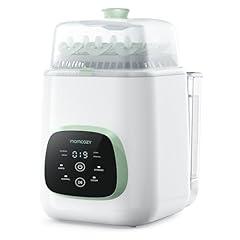
Momcozy Sterilizer and Dryer for Baby Essentials
Overview
This is a countertop steam sterilizer and hot-air dryer, not a bottle washer. Momcozy’s support materials identify it as the BS04, a two-layer unit for up to six bottles, pump parts, nipples, and small feeding accessories. Items must be washed before loading, then placed with bottle openings downward. The standard Auto cycle uses 120 mL of water and is manufacturer-stated to run for 35 minutes, with 8 minutes of steam treatment and 27 minutes of drying. The unit can also dry alone and enter a 72-hour storage mode that runs drying for five minutes every hour. The manufacturer claims 99.9% reduction of common bacteria, but it does not publish an accredited full-load test report, test organisms, loading map, or recontamination study for this product. Its practical hygiene value therefore depends on careful washing, correct loading, and allowing the cycle to complete.
What works
- Its instructions clearly distinguish washing from sterilizing, consistent with CDC guidance that feeding and pump items should be cleaned before sanitizing.
- The Auto cycle combines steam treatment and drying, which can help users avoid handling wet parts with towels after cleaning.
- The supported loading guidance places bottle openings downward and accessories on the upper rack, a sensible arrangement for steam exposure and drainage.
- Momcozy provides a named model, US support contact, 30-day return terms, and a one-year warranty policy.
What does not
- The product does not wash bottles or pump parts, so dried milk or formula residue still requires thorough hand washing before every cycle.
- The 99.9% claim and 72-hour storage claim are not accompanied by publicly available accredited test reports for a maximum six-bottle load or complex pump-part geometry.
- No traceable UL, ETL, or CSA listing for the US version was located in the relevant public certification registers during this review.
- Published materials identify the construction only broadly as plastic or BPA-free plastic. They do not provide a resin-level bill of materials or food-contact compliance documentation for steam-exposed parts.
- Steam and hot air create a real scald risk. Momcozy instructs users to wait five minutes before opening after a cycle.
Who is it for
This product suits a household that already washes feeding equipment carefully and wants a compact, dedicated steam-and-dry station for several bottles at once. It is particularly relevant for families regularly using bottles, detachable pump parts, nipples, and pacifiers, where drying items without a dish towel is useful. It can also support households that choose daily sanitizing for a baby under 2 months old, born prematurely, or immunocompromised, provided every compatible part is first cleaned and rinsed according to its own manufacturer instructions.
Who is it not for
It is not suited to anyone expecting an appliance to remove formula film, breast-milk residue, or detergent residue. Those users need a washing process before this product. It is also a weaker fit for buyers who require independently documented full-load microbial performance, a traceable US electrical-safety listing, or detailed food-contact material documentation. Households with limited safe counter space or young children able to reach the unit should take the steam, hot-lid, and hot-air warnings seriously.
Integrity
Steam is a CDC-recognized option for sanitizing already cleaned infant feeding and breast-pump parts. CDC emphasizes that cleaning comes first, that sanitized items should dry thoroughly, and that daily sanitizing is especially important for babies younger than 2 months, premature babies, and babies with weakened immune systems. This product’s instructions are aligned on the important pre-cleaning point, but the manufacturer’s 99.9% and 72-hour storage claims remain unverified by publicly available accredited product-specific reports. The unit uses 120 mL of water per steam cycle, manufacturer-stated, and does not require detergent tablets. That limits water use and avoids recurring wash chemicals, but its 72-hour storage setting periodically runs heated drying, so electricity use may rise if used routinely. Public materials disclose plastic construction, with some retailer materials calling it BPA-free, but do not provide detailed food-contact documentation. No US recall or regulator warning specific to this product was located in the CPSC public recall search during this review.

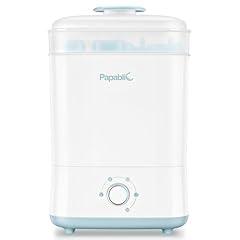
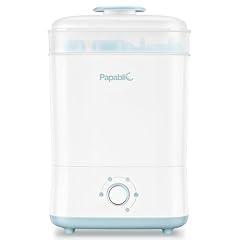
Papablic Electric Steam Sterilizer and Dryer
Overview
This is a countertop electric steam unit for already-washed baby bottles, pump parts, and selected accessories. The manufacturer identifies six modes: combined sanitize, dry, and storage, sanitize only, dry only, storage, food heating, and food dehydrating. Its manual specifies 120 V operation, a 600 W motor, a 165 W heater, and use of distilled water. The most consequential instruction is clear and CDC-consistent: users must thoroughly wash, rinse, and drain every item before it enters the unit. The manufacturer states that the chamber can be configured for up to 13 bottles and that a closed storage setting runs brief drying periods for up to 24 hours. Those capacity, drying, and storage claims were not accompanied by a traceable independent full-load sanitization, drying, or recontamination test for this exact product.
What works
- The instructions explicitly require washing, rinsing, and draining items before steam treatment.
- The manual provides a 12-minute sanitize-only cycle and adjustable 10, 30, or 60-minute dry cycles.
- A closed storage mode is designed to run a 10-minute drying interval every four hours for up to 24 hours, according to the manufacturer.
- The visible heating plate, removable large basket, and weekly descaling instructions support routine inspection and cleaning.
- The maker provides model-specific instructions, customer-service contact information, date-code traceability, and a stated one-year warranty.
What does not
- No traceable ISO 17025 laboratory report or certification record was found for sanitization at a maximum load, including bottle interiors, nipples, pump parts, and soiled-item conditions.
- The 24-hour clean-storage claim and claims of complete drying are manufacturer statements without independent airborne-particle, moisture, or recontamination evidence.
- The product page says it is BPA-free and lead-free, but no material specification, food-contact compliance documentation, or component-level test record was located.
- The manual warns that excess or misdirected water can enter the air vent and damage the electronic base. It also directs users to stop using the unit if an electrical burning smell occurs.
- The manufacturer recommends weekly descaling and distilled water, adding ongoing maintenance and water-use requirements.
Who is it for
This suits a household that already has a reliable bottle-washing routine and wants a separate steam and hot-air step for several feeding items at once. It is most relevant for families managing frequent bottle or pump-part turnover, especially where daily sanitizing is advised for a baby younger than 2 months, born prematurely, or immunocompromised. The user needs counter space, access to distilled water, and willingness to inspect the heating plate, clean the filter area, and descale at least weekly.
Who is it not for
It is not suited to anyone seeking a machine that removes milk or formula residue. This product is a steam and drying unit, and its own instructions require fully washed and rinsed items first. It is also a poor fit for buyers who need independently documented germ reduction at a full 13-bottle load, independently substantiated 24-hour storage protection, or traceable food-contact material documentation. Avoid continued use if water reaches the air vent, the unit leaks, or an electrical burning smell occurs.
Integrity
Steam is a CDC-recognized option for sanitizing infant feeding items, but it follows cleaning rather than replaces it. This product’s manual makes that distinction clearly by requiring thorough washing, fresh-water rinsing, and removal of excess water before use. That is especially important for milk-contact grooves, nipples, valves, and pump parts. CDC notes that daily sanitizing is particularly important for infants younger than 2 months, premature infants, and infants with weakened immune systems. The maker claims BPA-free and lead-free construction, yet publicly available materials reviewed here did not provide a component list or food-contact compliance records. No certification listing or independent full-load sanitization report was located. Maintenance is substantial but concrete: use distilled water, descale the visible heating plate at least weekly, clean removable parts, and keep water out of the drying air outlet. The relevant CPSC recall located involved Papablic infant swings, not this bottle product.
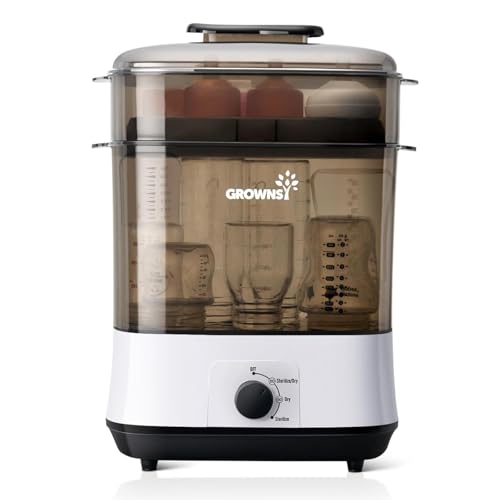
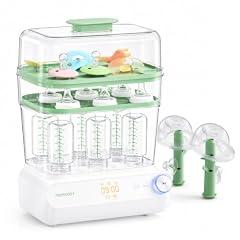
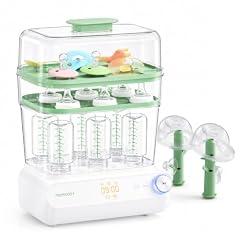
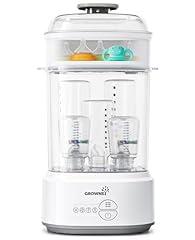
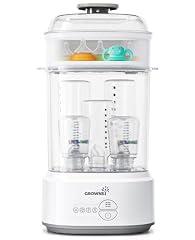
GROWNSY Electric Steam Baby Bottle Sterilizer and Dryer
Overview
This is a countertop electric steam bottle sterilizer and dryer with a lower bottle basket, upper accessory tray, lid, measuring cup, and tongs. Product documentation describes four modes, sterilize and dry, sterilize only, dry only, and enclosed storage. It is intended for bottles, nipples, pacifier parts, and compatible breast-pump parts that have already been cleaned. The published instructions state that it holds up to eight tall bottles and runs a combined sterilize and dry cycle in 60 minutes. They also claim 99.99% germ reduction and up to 72 hours of protected storage after the combined cycle. Those performance and storage claims are manufacturer-stated. No traceable accredited laboratory report was located for this exact product, including testing of a fully loaded chamber with real-world bottle and pump-part geometries.
What works
- Its two-basket layout is documented for bottles plus smaller feeding accessories, with a stated capacity of up to eight tall bottles.
- The instructions include a combined steam and drying program, avoiding counter drying after a cycle when items are correctly arranged.
- Maintenance directions are concrete, including washing the lid and baskets by hand, wiping the cooled heating plate, and descaling mineral buildup.
- The product has a documented one-year warranty and identifiable product instructions, which offer a basic support route.
What does not
- This is not a bottle washer. The available instructions do not clearly tell users to thoroughly wash milk or formula residue from every item before each steam cycle.
- The 99.99% germ-reduction and 72-hour storage claims were not accompanied by a traceable independent test report for a full, soiled load.
- No matching UL, ETL, or CSA electrical safety listing was located in the major public certification registers searched.
- The product documentation identifies plastic, and one published guide describes polypropylene and stainless steel, but food-contact compliance documents and a bill of materials were not located.
- Water use, electricity use, filter specifications, replacement parts, and long-term consumables information were not found.
Who is it for
It suits a household that already hand-washes bottles and wants a dedicated enclosed appliance to steam-treat and dry several bottles or small accessories at once. The stated eight-bottle capacity can be practical for families doing multiple bottle feeds per day, provided each component is steam-safe, fully disassembled where its maker requires it, and positioned with openings exposed. It also fits buyers willing to use distilled water, clean the removable pieces routinely, and descale the heating plate when mineral residue appears.
Who is it not for
It is not suited to anyone expecting milk-film removal, because this product does not wash bottles. Families caring for a baby younger than two months, a premature infant, or an infant with weakened immunity should be especially careful to follow CDC cleaning and sanitizing practices, and may prefer a product with independently documented full-load sanitization results and verified electrical certification. It is also a poor fit for users who cannot keep up with hand washing, drying, descaling, and safe handling of hot steam.
Integrity
Steam is a reasonable sanitizing mechanism for already cleaned infant feeding items, and the drying function may reduce the need to leave wet parts on a counter. CDC guidance emphasizes cleaning first, complete drying, and extra attention to daily sanitizing for babies younger than two months, premature babies, or babies with weakened immune systems. This unit should be treated as the sanitizing and drying step, not a replacement for washing away milk or formula residue. The available documentation calls the body plastic, with one published product guide describing food-grade polypropylene and stainless steel. Neither source provides traceable food-contact compliance records for the exact materials. No product-specific recall or regulator warning was located in the searched United States consumer-safety sources. The product requires electricity, water, and periodic descaling, but published material does not quantify cycle energy or water use, identify replaceable filters, or document repair parts. No independently verifiable safety or performance certification was located.

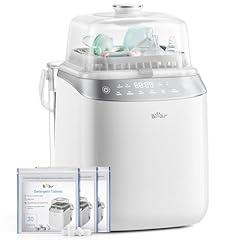
Bear Bottle Washer Pro
Overview
This countertop appliance washes, steam-sanitizes, hot-air dries, and holds baby bottles, pump parts, and small feeding accessories. Its independently located operating manual identifies a 2.6 L water tank, 530 W rating, hot-air drying, a 10-minute 100°C steam program, and an automatic 99-minute wash, steam, dry, and storage program. The manual instructs users to empty milk residue, disassemble parts, orient bottle openings over the jets, and use one dedicated detergent tablet per wash. The product page claims 26 jets, HEPA-filtered 72-hour storage, 99.99% germ removal, and 2.5 L water use per cycle. Those are manufacturer claims, not supported by a located accredited full-load sanitization, drying, filter, residue, or rinse test. Capacity is also inconsistent, with the located manual specifying four bottles while the product page says up to eight.
What works
- The located manual provides explicit loading, drainage, rinsing, temperature, and hot-surface instructions.
- The automatic program combines washing, two hot-water rinses, steam, and hot-air drying in one sequence.
- Upper and lower racks, both spray arms, and the filter cup are removable for inspection and cleaning.
- The manual lists a 2.6 L tank and 530 W rated power, while the product page states 2.5 L per cycle.
What does not
- No ISO/IEC 17025-accredited, full-load test report was located for the claimed 99.99% germ reduction, milk-residue removal, drying, or 72-hour storage result.
- No traceable UL, ETL, CSA, or other North American electrical safety listing was located for this exact product.
- The maker does not publish a food-contact material specification, detergent ingredient list, safety data sheet, or rinse-residue test for the supplied tablets.
- The product page claims up to eight bottles, but the located manual specifies a maximum load of four bottles, creating a material capacity inconsistency.
- The HEPA claim, filter efficiency, filter replacement interval, and sterile-storage claim lack disclosed test conditions or independent verification.
Who is it for
This product fits a household using a modest daily rotation of bottles or compatible pump parts that wants a countertop wash and dry workflow rather than hand washing each item. It is most suitable where users can follow the loading diagrams, empty visible milk promptly, disassemble components, route the drain hose correctly, and inspect parts after washing. The located manual specifies four bottles, so buyers should plan around that documented load rather than the larger capacity claimed elsewhere. It is also better suited to heat-safe accessories whose own care instructions permit hot washing and steam exposure.
Who is it not for
It is not well suited to households that need independently documented sanitizing performance for a medically vulnerable infant, including a baby younger than 2 months, a premature infant, or an infant with immune concerns. CDC guidance emphasizes thorough cleaning before sanitizing and gives these groups particular reason to sanitize daily. Buyers who require a verified electrical safety listing, documented food-contact compliance, an ingredient disclosure for detergent, or validated 72-hour protected storage should use a product with those records. It is also unsuitable for non-heat-resistant plastics, damaged pump parts, or accessories whose maker prohibits machine washing or steam.
Integrity
Steam at 100°C is a CDC-recognized sanitizing method when feeding items have first been thoroughly cleaned and the item manufacturer permits steaming. The located manual gives useful operational detail, including a 10-minute steam program, two hot-water rinses in the normal and automatic wash programs, correct inverted bottle placement, and a warning that altitude can reduce maximum steam temperature. It also tells users to avoid washing non-heat-resistant plastics and to wait before handling hot items. Important evidence gaps remain. No accredited full-load performance report was located for the 99.99% sanitizing, milk-removal, HEPA, drying, or 72-hour storage claims. No exact-model North American safety certification, food-contact documentation, tablet ingredient disclosure, safety data sheet, or rinse-residue report was located. The removable shelves, spray arms, and filter cup support maintenance, but the detergent tablets create recurring single-use packaging and chemical consumption. No product-specific U.S. recall or regulatory warning was located in the searched sources.