
10 Best Air Quality Monitor
 Daniel Kenitz
Please note that we participate in affiliate marketing programs. When you purchase through links on our site, we may earn a commission. As an Amazon Associate we earn from qualifying purchases. This comes at no additional cost to you and helps support the resources required to provide valuable content.Advertising Disclosure
Top-rated Air Quality Monitor Comparison
1

2
3

4

5

6

7
8

9
10
Overview
An indoor air-quality monitor can show changes in selected pollutants or comfort conditions, helping you investigate sources, ventilation, filtration, or occupancy. It is not automatically a complete picture of indoor air, and it is not automatically a safety alarm. The first buying decision is therefore scope: some products measure only carbon dioxide, temperature, and humidity; others add particulate matter or broad VOC indicators; a few report carbon monoxide as a supplementary reading. A purifier’s built-in sensor may only detect particles and may show a color band rather than a concentration.
Look for clearly named measurements rather than a single “air quality” score. Particle readings should distinguish PM1.0, PM2.5, and PM10 where claimed. Carbon dioxide should be identified as true CO2, not confused with carbon monoxide or estimated from a VOC signal. TVOC and formaldehyde readings need especially cautious interpretation: a broad gas indicator does not identify a particular chemical or provide a complete health assessment. A product that reports carbon monoxide should plainly say whether it is a listed life-safety alarm. In the supplied products, several explicitly state that they are not substitutes for dedicated CO alarms; that limitation is essential.
The useful technical details are measurement range, units, resolution, update interval, accuracy under stated conditions, warm-up time, and known effects from humidity, temperature, placement, and cross-pollutant interference. Headline claims such as “16-in-1,” “high precision,” or “0.001 accuracy” are weak without a pollutant, unit, test method, range, and uncertainty. A fast refresh rate describes how often the display changes, not whether the number is accurate. A broad AQI or color indicator may make changes easy to notice while concealing which pollutant triggered it or what action is appropriate. Battery runtime can also be misleading when the product updates less often on battery power than when connected to USB power.
Independent, model-matched evidence is the strongest separator between a documented monitor and a marketing claim. Look for testing by South Coast AQMD’s AQ-SPEC program, an EPA evaluation, an ASTM D8405-21 PM2.5 or ASTM D8624-25 CO2 report, or an ISO/IEC 17025 accredited laboratory report for the exact model. Independent testing should use traceable reference instruments and relevant indoor conditions, and should address repeatability, response, humidity effects, and interference. In the supplied set, independent evidence was limited: one monitor had peer-reviewed co-location evidence for PM2.5, but the study still noted bias correction, while most products had no public model-matched performance evaluation.
Also check the product’s life after purchase. Useful disclosures include calibration instructions, sensor life, firmware support, replacement or repair options, warranty terms, data retention and export limits, and whether app or cloud access is required. For connected products, FCC authorization supports radio compliance but does not establish measurement accuracy or whole-product electrical safety. For electrical safety, look for exact-model evidence in UL Product iQ, the Intertek ETL directory, or CSA’s listing database; also check CPSC recalls and SaferProducts.gov.
Across the supplied products, a recurring safety boundary is that general monitors cannot replace listed carbon-monoxide alarms, smoke alarms, radon testing, or professional assessment. Many also lack validated accuracy for medical, workplace, legal, remediation, or building-control decisions. CO2 monitors do not detect CO, and particle-only purifier sensors do not detect gases. Treat readings as evidence for investigation unless model-specific performance is documented, and recycle electronics and lithium batteries through appropriate collection routes rather than household trash.
Integrity
The scores below compare the supplied products on what they measure, how dependable and actionable the readings appear, how clearly limits are disclosed, and what is documented about safety and end of life. A high score reflects stronger evidence and disclosure within this group; it does not turn a consumer monitor into a certified life-safety or professional instrument.
HHealth & Safety
Health-relevant pollutant coverage
This measures whether the product directly covers the pollutants relevant to its stated indoor use and distinguishes PM, true CO2, CO, and broad VOC indicators. Higher-scoring products separate several readings, such as particles and CO2, while making scope clear; lower-scoring products show only particles, a generic score, or broad claims without establishing what is directly measured.
Accuracy in real indoor conditions
This asks whether readings remain credible despite humidity, temperature, placement, and cross-pollutant interference. It matters because buyers may use a display to decide whether to ventilate or reduce an exposure. The supplied scores were strongest for products with published conditions or some field evidence, and weakest where accuracy claims lacked units, test methods, or independent confirmation.
Carbon-monoxide safety clarity
This measures whether a CO-reporting product clearly says it is not a life-safety alarm, or provides evidence that it is a listed alarm. High-scoring products explicitly separate CO2 from CO or warn that a dedicated alarm is required. Lower-scoring products make CO or combustible-gas claims without verified UL 2034, ETL, or CSA evidence, creating a risk of dangerous substitution.
Useful alerts and next steps
This measures whether alerts identify the pollutant, show understandable units or trends, use explained thresholds, and suggest a safe response rather than presenting only a vague good-or-bad color. Higher scores in the supplied set went to products with named thresholds, ppm displays, configurable alerts, or practical ventilation prompts; lower scores reflected unexplained AQI bands and alerts that were not emergency warnings.
Electrical safety and recall record
This measures exact-model electrical-safety evidence and whether unresolved recalls or warnings were found. It matters because monitors use mains adapters, USB power, wireless radios, or batteries. The better-scoring products had CARB mechanical-air-cleaner certification, documented radio authorization, or clearer product-safety records, but the reviews repeatedly noted that UL, ETL, or CSA listing evidence for the exact monitor or adapter was not located.
Accuracy over the product's life
This measures calibration, sensor drift, service life, firmware support, placement and warm-up guidance, and realistic repair or replacement options. Higher scores reflected disclosed outdoor calibration, a stated service life, automatic calibration, or warranty support. Lower scores reflected no sensor-life statement, no recalibration path, no replacement parts, or no explanation of how readings remain reliable over time.
EEcology
Lower lifetime waste and energy burden
This measures power use, battery and charger design, durability, replaceable parts, repair, packaging, and end-of-life handling. Higher-scoring products had features such as washable pre-filters, rechargeable or replaceable batteries, e-ink displays, recycled-plastic housing, or longer claimed runtimes. Lower scores reflected disposable filters, unclear battery details, no take-back route, or no repair and recycling documentation.
EEvidence
Honest limits on what it can tell you
This measures whether claims match the exact product and plainly state important limits. Higher scores came from products that said they did not measure CO, distinguished CO2 from CO, or explained that VOC and formaldehyde readings were broad indicators. Lower scores reflected “high precision,” “complete assessment,” or multi-function claims unsupported by pollutant-specific specifications and appropriate caveats.
Independent proof, not just brand claims
This measures public, model-matched testing against traceable reference instruments under relevant indoor conditions. It is one of the strongest discriminators in this category. The supplied scores were highest where independent co-location or ENERGY STAR evidence supported a relevant performance claim, although ENERGY STAR data documented purifier CADR rather than monitor accuracy; most consumer monitors had no independent model-matched evaluation.
Transparent sensors, data, and smart features
This measures whether the product identifies direct versus estimated values, gives ranges, accuracy, resolution, update intervals, and explains app, cloud, and export dependence. Higher-scoring products disclosed NDIR CO2 sensing, calibration, local history, or CSV export. Lower scores reflected unclear sensor technologies, values grouped together as “16-in-1,” unavailable data without an account, or update rates that changed on battery power.
Full reviews

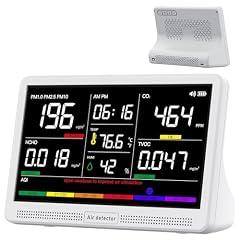
YNAK 16-in-1 Indoor Air Quality Monitor
Overview
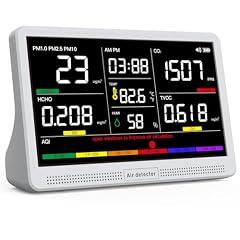
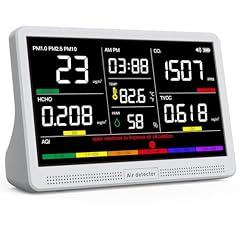
This is a rechargeable tabletop indoor air monitor with a 7-inch LED screen, USB-C charging hardware, and a manufacturer-stated 2500mAh battery rated for up to eight hours of cordless use. Its screen is intended to show CO2, PM1.0, PM2.5, PM10, formaldehyde, total VOCs, temperature, humidity, an AQI indicator, and time at once. The advertised “16-in-1” count combines nine displayed measures or indicators with seven alerts. The available product documentation is manufacturer-derived or third-party hosted, not a technical datasheet or independent laboratory report. It states temperature accuracy of plus or minus 1 to 3 F and humidity accuracy of plus or minus 2 to 3% RH, but gives no pollutant-specific accuracy, range, response time, sensor technology, or cross-sensitivity data. It also says perfumes, strong odors, chemicals, direct airflow, and sensor contact can affect readings.
What works
- The large, single-screen format is designed to make particle, CO2, temperature, and humidity changes easy to view without navigating menus, manufacturer-stated.
- It covers several useful indoor trend indicators, including fine and coarse particle fractions and CO2, manufacturer-stated.
- The supplied USB-C power setup and rechargeable battery allow temporary placement away from an outlet, manufacturer-stated.
- The documentation gives placement cautions, including avoiding vents, direct airflow, perfumes, and strong odors.
What does not
- No public, model-matched independent accuracy or repeatability evaluation was located in the EPA or South Coast AQMD resources checked.
- The claimed “0.001 units” air-sensor accuracy has no pollutant, unit, test method, range, or uncertainty attached, so it is not a meaningful accuracy specification.
- The product reports no carbon monoxide measurement and does not document UL 2034 life-safety alarm certification. It cannot take the place of installed CO alarms.
- No sensor service life, calibration interval, recalibration method, firmware policy, repair path, replacement parts policy, energy-use figure, or end-of-life recycling program was found.
- The available documentation has inconsistent product details across third-party copies, which weakens confidence in the support information.
Who is it for
This product suits a household user who wants a large, local display for observing relative changes around everyday activities, such as cooking, opening windows, running an air cleaner, or increasing ventilation. It is most appropriate when treated as a trend screen rather than a measurement instrument for proving exposure levels. The rechargeable format may also suit short checks in different rooms. Users should be comfortable relying on the manufacturer’s stated functions because independent model-specific performance evidence was not located.
Who is it not for
It is not suitable for homes that need a certified carbon monoxide warning device, including homes with fuel-burning appliances, fireplaces, attached garages, or sleeping areas. Use listed CO alarms in those settings. It also does not fit buyers who need documented particle, CO2, formaldehyde, or VOC accuracy for health decisions, remediation verification, schools, workplaces, or professional investigations. People reacting to symptoms, suspected gas leaks, smoke intrusion, or chemical exposure should not use its AQI display as a diagnosis or safety clearance.
Integrity
The product is a low-cost style of indoor monitor, not a life-safety alarm. Its stated pollutant set includes particle measures and CO2, but not carbon monoxide. EPA explains that low-cost monitor alerts are not designed to signal immediate life-threatening danger in the way certified CO alarms are. The product documentation does acknowledge that strong odors, chemicals, airflow, and handling can affect readings, which matters particularly for its broad VOC and formaldehyde displays. No public model-specific UL, ETL, or CSA electrical-safety listing, independent laboratory performance report, CPSC recall, manufacturer take-back program, repair policy, sensor replacement plan, battery-recycling instruction, or packaging disclosure was found in the sources checked. The rechargeable battery may avoid routine disposable-battery use, but the available documentation does not establish battery longevity, charger safety certification, replaceability, or a credible end-of-life route. Follow local electronics and lithium-battery recycling rules when the product reaches end of life.

LEVOIT Vital 200S-P Smart Air Purifier
Overview
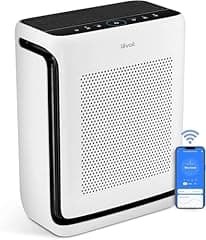
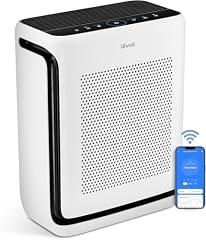
This is a corded, Wi-Fi connected room air purifier measuring 15.6 by 8.5 by 19.8 inches and using a washable pre-filter, particle filter, and activated-carbon filter. It has an infrared dust sensor, a color air-quality display, automatic fan control, and app access through VeSync. It is intended for airborne particles, pet hair and dander, odors, smoke, and some gases rather than for measuring every indoor pollutant. Levoit states a 250 CFM CADR and coverage of 388 square feet at 4.8 air changes per hour, while the much larger 1,862 square foot figure represents one change per hour. California independently lists the exact model as a mechanical air cleaner, meaning it uses physical filtration rather than an ionizer. The maker does not publish sensor accuracy, calibration, PM units, or testing against a reference monitor.
What works
- California independently lists the exact product as a mechanical air cleaner, which avoids ozone-generating ionizer technology.
- The manufacturer states a 250 CFM CADR and 388 square foot coverage at 4.8 air changes per hour, a more useful sizing figure than its one-change-per-hour claim.
- Its washable pre-filter can capture hair and lint before the main filter, and the maker sells replacement filters and provides a filter-check reminder.
- The connected controls can show the product's air-quality status, adjust fan speed automatically, schedule operation, and report filter life.
What does not
- The air-quality feature is an infrared dust sensor, not a comprehensive indoor-air monitor. It does not report true carbon dioxide, carbon monoxide, radon, or a specified VOC measurement.
- No public model-specific accuracy, humidity-interference, repeatability, calibration, or sensor-service data were found. The display should be treated as a trend indicator, not an exposure measurement.
- Color-coded air-quality status is not accompanied by published concentration units, alert thresholds, or practical source-control and ventilation guidance.
- The product page carries a California Proposition 65 warning for lead. The warning does not quantify exposure or establish a use-related health risk, but it is material information for households seeking low-exposure products.
- Levoit claims activated-carbon removal of odors, fumes, smoke, and VOCs, but does not publish the carbon mass or model-specific gas-removal performance data. CADR is a particle metric, not a gas-removal rating.
Who is it for
It suits a household that wants supplemental particle filtration in a bedroom, pet area, or roughly 388 square foot room with standard-height ceilings, especially where airborne dust, pollen, smoke particles, or pet dander are the main concern. It also fits users who value automatic fan adjustment, scheduled operation, and a pre-filter that can be washed. The displayed air-quality status can be useful for noticing changes after cooking, cleaning, or pet activity, provided it is understood as a dust-sensor trend rather than a full indoor-air assessment.
Who is it not for
It is not suitable as a carbon-monoxide alarm, smoke alarm, radon monitor, true carbon-dioxide monitor, or a device for deciding whether a space is safe to occupy. Homes with fuel-burning appliances still need listed carbon-monoxide alarms. It is also a poor fit for people who need documented particle-sensor accuracy, numeric PM readings, calibration support, local data export, or quantified VOC removal. Buyers managing serious chemical odors, wildfire gases, mold sources, or ongoing health symptoms should prioritize source control, ventilation, and condition-specific assessment rather than relying on this product's indicator ring.
Integrity
The strongest independently confirmed safety point is that California lists this exact model as mechanical, not electronic. That classification means physical filtration rather than ozone or ion generation. Its FCC authorization record also identifies the Wi-Fi product configuration. No product-specific CPSC recall or safety warning was found in the searched federal recall resources. However, Levoit posts a California Proposition 65 warning that the product can expose users to lead. The warning does not state dose, route, or actual user exposure. The washable pre-filter can reduce replacement waste, while the main filter remains a consumable part that the maker suggests checking at about 12 months. Rated power is 50 watts, so continuous high-speed use has an electricity cost. The product is not battery powered, which avoids battery disposal, but Levoit does not provide model-specific repair instructions, sensor recalibration, electronics take-back, packaging, or end-of-life recycling information. Its carbon filter may reduce some odors and gases, but published evidence does not quantify gas capacity or VOC removal.

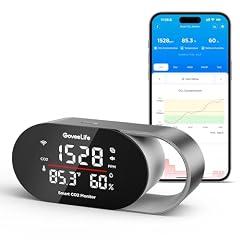
GoveeLife Smart Air Quality Monitor
Overview
This is a compact, mains-powered indoor monitor with a 4.82-inch display, Wi-Fi connectivity, and a supplied USB-C power cable and adapter. It is designed to show carbon dioxide in parts per million, temperature, humidity, and time at the bedside, in a home office, or in another single indoor space. The product documentation identifies CO2, temperature, and humidity as its measurements, not particulate matter, carbon monoxide, radon, or volatile organic compounds. It states a 5-second CO2 refresh rate, CO2 accuracy of ±(40 ppm + 5%), temperature accuracy of ±0.54°F, and humidity accuracy of ±3%. Those accuracy figures are manufacturer-stated, not independently validated for this exact product. FCC equipment authorization independently confirms the wireless radio authorization, but it does not validate sensing accuracy or electrical safety.
What works
- Direct CO2, temperature, and humidity readouts make its measurement scope easier to understand than a single generic air-quality score.
- The documentation provides stated accuracy figures, a CO2 range of 400 to 9,999 ppm, and a stated 5-second update interval.
- User-set alerts can use a buzzer, flashing display, app notification, and email report, according to the product manual.
- CSV export and stated historical data access can help identify occupancy or ventilation patterns over time.
- The exact wireless model has FCC equipment authorization for its 2.4 GHz and Bluetooth radio functions.
What does not
- It does not measure particulate matter, carbon monoxide, radon, or VOCs, so it cannot provide a complete indoor air assessment.
- No public, model-matched independent laboratory or government performance evaluation was located for its CO2, temperature, or humidity readings.
- The stated green, yellow, and red CO2 bands simplify decisions, but CO2 is only a ventilation indicator and cannot establish that all indoor pollutants are safe.
- The manual permits app calibration but does not disclose sensor service life, calibration traceability, drift specifications, or a replacement sensor path.
- FCC authorization is not an electrical-safety listing. Public evidence of UL, ETL, or CSA listing for this exact product was not located.
Who is it for
This product suits a household, renter, or small-office user who wants to watch occupancy-related CO2 buildup in one room and use that information to consider ventilation changes. It is also appropriate for someone who values a readable local display, configurable notifications, and spreadsheet export for trend tracking. The best fit is a user who treats the readings as practical indicators, places the monitor away from vents and windows, and understands that its published accuracy claims have not been independently verified for this exact model.
Who is it not for
It is not appropriate as protection from combustion gases, because it does not detect carbon monoxide and is not presented as a listed carbon-monoxide alarm. Homes with fuel-burning appliances still need properly installed compliant CO alarms. It also does not fit people managing wildfire smoke, cooking particles, chemical odors, radon, or mold concerns, because it does not directly measure PM, VOCs, radon, or biological contaminants. Buyers who need defensible measurements for workplace compliance, clinical decisions, or formal building diagnostics need model-specific independent validation and a documented calibration program.
Integrity
The useful health function here is ventilation awareness. EPA notes that indoor CO2 can provide information about ventilation when interpreted carefully, but low-cost monitors only report the pollutants and conditions they are designed to measure. This product's stated measurement scope is CO2, temperature, and humidity. A low displayed CO2 value therefore does not rule out carbon monoxide, particles, radon, or chemical pollutants. The product is powered from an external adapter rather than an internal rechargeable battery, which avoids an embedded battery replacement issue. However, the documentation reviewed does not state power consumption, repair parts availability, a sensor replacement program, packaging details, or a model-specific take-back and recycling route. The wireless radio has FCC authorization, while an electrical-safety listing for the exact product was not located. A 2024 CPSC recall involved certain Govee and GoveeLife space heaters, not this monitor model.

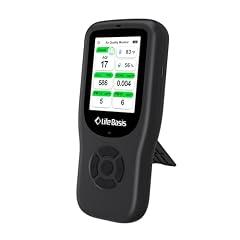
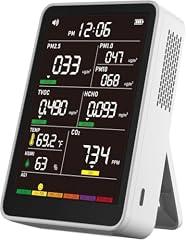
LifeBasis 11-in-1 Air Quality Monitor
Overview
This is a handheld, rechargeable indoor air monitor with a stand, a color LCD, audible alerts, and a stated 2,500 mAh battery. It is intended for room-to-room checks of particulate matter, carbon dioxide, TVOC, formaldehyde, temperature, and humidity. Manufacturer materials describe PM1.0, PM2.5, PM10, CO2, HCHO, TVOC, particle count, AQI, temperature, and humidity, plus a claimed NDIR CO2 sensor and laser particle sensor. The concrete strength is breadth of displayed information in a compact battery device. The important limitation is evidence quality. No public model-matched AQ-SPEC, EPA, ASTM, or accredited-laboratory performance report was located. Published product material also does not provide accuracy ranges, response times, cross-sensitivity data, sensor life, or a recalibration and repair program. Treat the display as a screening tool for changes and possible ventilation or source-control needs, not as a complete health assessment or a reference instrument.
What works
- Manufacturer-stated coverage includes PM1.0, PM2.5, PM10, CO2, TVOC, HCHO, temperature, and humidity in one portable display.
- Manufacturer materials specify an NDIR CO2 sensor and laser particle sensor, which are more informative disclosures than an unexplained overall air score alone.
- Color changes and audible alerts are stated to identify elevated displayed readings, which can make a developing indoor-air issue easier to notice.
- The built-in rechargeable battery and Type-C charging can reduce use of disposable batteries during normal operation.
What does not
- No public independent, model-matched performance evaluation was located, so accuracy, repeatability, humidity effects, and gas cross-interference remain unproven.
- The formaldehyde and TVOC readings should not be treated as chemical-specific exposure measurements. Low-cost gas sensors can have selectivity and interference limitations.
- The product reports no carbon monoxide value and is not presented as a listed carbon monoxide alarm. Homes with fuel-burning appliances still need UL 2034 compliant CO alarms.
- No published accuracy specifications, measurement ranges, resolution, sensor service life, firmware policy, calibration interval, repair path, or take-back program was located.
- The seller wording that the monitor can guarantee family breathing health is not supported by the available evidence and overstates what a low-cost monitor can establish.
Who is it for
This product suits a budget-conscious renter, homeowner, classroom user, or office worker who wants a portable screen for noticing broad changes after cooking, cleaning, opening windows, running filtration, or changing occupancy. It is most appropriate when used for patterns rather than single readings, such as checking whether PM falls after a particle source stops or whether stated CO2 readings decline with ventilation. The rechargeable format and all-on-one display fit occasional checks across several small indoor spaces.
Who is it not for
It is not for households relying on a device for carbon monoxide protection, especially homes with gas, oil, wood, or other fuel-burning equipment, attached garages, or sleeping areas. Use listed CO alarms for that role. It is also not for people making medical, occupational, remediation, legal, or real-estate decisions that require traceable quantitative measurements. Buyers needing defensible formaldehyde or VOC identification, documented accuracy in humid conditions, long-term calibration support, remote records, or data export need a product with those model-specific disclosures and independent testing.
Integrity
The product's stated PM and CO2 coverage can help users notice changes related to cooking, cleaning, ventilation, or filtration. EPA notes that low-cost monitors can support indoor-air decisions, but detect only the contaminants for which they are designed and may have limited indoor performance information. TVOC and HCHO values therefore need cautious interpretation, particularly because no model-specific interference or accuracy evidence was located. No recall or product safety warning for this exact product was located in the CPSC material searched. No UL, ETL, or CSA listing evidence was located for the product or its charging setup, so electrical safety certification remains unverified. Its internal rechargeable lithium-polymer battery reduces disposable-battery use, but the maker does not publish a battery replacement or take-back route. At end of life, the device should go to a battery or electronics recycler, not household trash or curbside recycling.

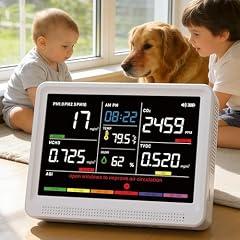
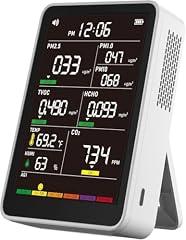
Bonoch Air Quality Monitor 16-in-1
Overview
This is a tabletop, rechargeable indoor air monitor with a 7-inch LED display, USB-C charging, and a stated 2500mAh lithium-polymer battery. Published documentation for the product says it displays carbon dioxide, PM1.0, PM2.5, PM10, formaldehyde, total VOCs, temperature, humidity, an AQI indicator, and time. It is intended for room monitoring rather than regulatory measurement or life-safety protection. The product documentation also describes separate audible alerts for CO2, particle readings, HCHO, TVOC, and AQI, plus a reset described as auto recalibration. Those are manufacturer-stated functions, not independently verified performance results. The available specifications give temperature and humidity accuracy ranges, but do not identify the sensor technologies, give pollutant-specific accuracy ranges, or provide a public model-matched laboratory report. It does not claim to measure carbon monoxide.
What works
- Broad manufacturer-stated display coverage includes CO2, three particle size fractions, HCHO, TVOC, temperature, and humidity.
- Published documentation describes pollutant-specific audible alerts rather than only a single overall score.
- The large display, three brightness levels, USB-C power, and stated eight-hour cordless runtime can make room checks easy to read and move.
- The documentation distinguishes CO2 from carbon monoxide by listing CO2 only, which reduces the risk of treating it as a CO alarm.
What does not
- No public model-matched independent performance evaluation was located in EPA or South Coast AQMD sensor resources.
- Pollutant accuracy, operating range, response time, humidity interference, and cross-sensitivity specifications are not publicly disclosed for this product.
- The stated "0.001 units" air-sensor accuracy has no pollutant, unit, test method, or uncertainty context, so it cannot support precision decisions.
- Published materials show certification claims, including UL and CE, but no exact product listing or certificate number was provided for verification in U.S. safety directories.
- No published sensor replacement interval, calibration service route, repair program, take-back program, or end-of-life recycling plan was located.
Who is it for
This product suits a household or small office user who wants a large, local display to notice relative changes from cooking, cleaning, open windows, wildfire smoke infiltration, or crowded rooms. It is most appropriate when used as a trend indicator, with readings checked before and after ventilation or filtration changes. Its stated rechargeable battery and audible alerts may also suit someone who wants to move it between rooms. The user should be comfortable treating the readings as screening information rather than validated exposure measurements.
Who is it not for
It is not for homes needing a carbon-monoxide life-safety alarm, including homes with fuel-burning appliances, fireplaces, attached garages, or generators. Use a listed CO alarm for that purpose. It is also not suited to buyers who need documented accuracy for workplace compliance, formaldehyde investigation, medical decisions, mold assessment, or professional wildfire-smoke exposure management. People seeking long-term data records, app access, exportable history, sensor replacement, or verified calibration support should choose a product with those functions and policies documented.
Integrity
The useful health feature is breadth of display coverage. The product documentation says it separately reports CO2, particulate matter, HCHO, and TVOC, rather than presenting only an overall air-quality color. It does not measure carbon monoxide, so it must not be used in place of a listed CO alarm. EPA notes that lower-cost indoor monitors measure only the contaminants they are designed for, and that performance can vary with placement, temperature, humidity, time in use, and multiple contaminants. The monitor uses a stated rechargeable lithium-polymer battery and USB-C charging, which can avoid disposable battery use. However, no public information was located on battery replacement, repair parts, sensor life, recycling or take-back, packaging, or product energy use. Published product material claims UL, CE, RoHS, CNAS, ILAC-MRA, and SIMT credentials, but no model-specific U.S. electrical-safety listing record or certificate number was available to confirm those claims. No relevant CPSC recall or safety warning was located in the searched public sources.
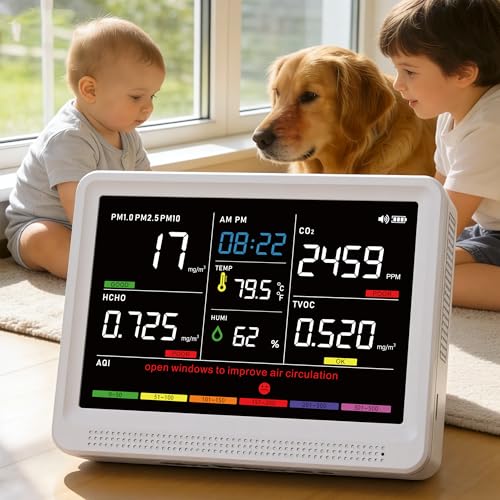
YNAK 16-in-1 Indoor Air Quality Monitor
Overview
This is a portable, rechargeable indoor air-quality display with a 7-inch screen. An independent retailer description and a model-matched manual describe nine displayed environmental values, CO2, PM1.0, PM2.5, PM10, formaldehyde, total VOCs, temperature, humidity, and an AQI-style score, plus time. The unit is intended for home or office spot checks and continuous room observation. The manufacturer-stated design includes a 2500mAh battery, USB-C charging, selectable display brightness, audible alerts, and roughly eight hours of cordless use. Its major limitation is evidence quality. Public materials found for the product do not identify the sensor makes, measurement ranges, pollutant-specific accuracy, calibration interval, or independent laboratory validation. The large display can make changing conditions easy to notice, but the numerical readings should be treated as screening information rather than reference measurements.
What works
- A large screen presents particulate, gas, temperature, and humidity readings together, as confirmed by an independent retailer description.
- The displayed set includes PM1.0, PM2.5, and PM10 separately, rather than reducing particle information to one generic score.
- Manufacturer materials describe audible alerts, a mute control, three brightness settings, and portable battery operation.
- The product description does not claim carbon-monoxide alarm protection, which reduces the risk of confusing its CO2 display with a life-safety CO alarm.
What does not
- No model-specific independent test report was located from AQ-SPEC, EPA, or an accredited laboratory, so real-world accuracy and cross-sensitivity remain unproven.
- The available manual does not disclose sensor manufacturers, sensing method, measuring ranges, resolution by pollutant, update rate, or direct versus estimated values.
- The advertised 0.001 accuracy statement does not identify a pollutant, unit, test method, or tolerance, so it is not a usable accuracy specification.
- No model-specific calibration schedule, sensor service life, firmware policy, replacement-parts route, electrical-safety listing evidence, or take-back program was located.
Who is it for
This product suits a homeowner, renter, classroom user, or small-office user who wants an easy-to-read local display for observing broad changes from cooking, cleaning, open windows, occupancy, wildfire smoke, or humidity. It is most appropriate when the readings are used as prompts to investigate ventilation, source control, or filtration rather than as definitive exposure measurements. The portable battery operation and large display are useful for moving it between rooms and for users who do not want an app-dependent monitor.
Who is it not for
It is not suited to households needing a life-safety carbon-monoxide alarm near fuel-burning appliances, garages, fireplaces, or sleeping areas. CPSC recommends UL 2034-compliant CO alarms for that role, and this product is described as measuring CO2, not CO. It is also a poor fit for people who need validated readings for medical decisions, workplace compliance, mold or formaldehyde investigations, HVAC commissioning, legal documentation, or precise ventilation control. Those uses need documented accuracy, calibration, and model-specific independent testing.
Integrity
The product covers several indoor indicators that can be useful for recognizing changing conditions, including particulate matter, CO2, VOC, formaldehyde, temperature, and humidity. EPA cautions that low-cost monitors detect only their designed targets and that accuracy can be affected by placement, operating time, temperature, humidity, and other contaminants. The product's broad AQI-style display therefore should not be treated as a complete health assessment. CO2 can be a ventilation indicator, but it is not carbon monoxide and does not replace a listed CO alarm. No matching CPSC recall was located in the public search performed for this review. However, no credible U.S. electrical-safety listing or product-specific recall and safety documentation was located either. The manufacturer states that the product has a rechargeable battery, but it does not disclose battery chemistry, replaceability, repair support, or an end-of-life program. EPA advises taking battery-containing electronics to appropriate battery or electronics recyclers, not household trash or curbside recycling.

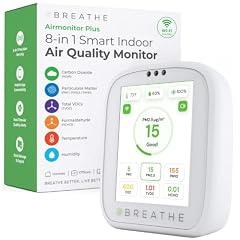
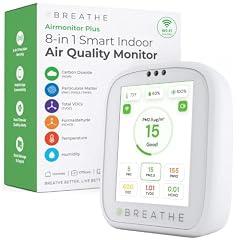
BREATHE Airmonitor Plus: Smart Air Quality Monitor
Overview
This is a compact, rechargeable indoor air monitor with a display, a 1,000 mAh battery, USB-C power input, 2.4 GHz Wi-Fi, and an app. The manufacturer states that it measures PM1, PM2.5, PM10, carbon dioxide, total volatile organic compounds, formaldehyde, temperature, and relative humidity. It is intended for live room-level readings, trend viewing, alarms, and CSV export. The manufacturer identifies its carbon-dioxide sensor as NDIR and publishes ranges and accuracy claims for PM, CO2, temperature, and humidity. It also instructs users to calibrate CO2 outdoors or in a ventilated area before first use. No public, model-matched independent laboratory or government performance evaluation was located, so the published accuracy figures and the formaldehyde and TVOC readings remain manufacturer-stated rather than independently confirmed.
What works
- Broad manufacturer-stated coverage includes separate PM size readings and true CO2, rather than a single generic air-quality score.
- The app provides adjustable CO2 and PM2.5 alarm settings, alarm controls, graphs, notifications, and CSV export, according to the manufacturer.
- The manual discloses numeric PM, CO2, temperature, and humidity ranges and accuracy claims, plus operating humidity and temperature limits.
- A two-year repair-or-replace warranty is published by the manufacturer.
What does not
- No public independent, model-matched evaluation against reference instruments was located for PM, CO2, VOC, or formaldehyde performance.
- The product does not measure carbon monoxide and is not presented as a certified life-safety CO alarm. Homes with fuel-burning equipment still need appropriate dedicated CO alarms.
- TVOC and formaldehyde ranges are stated, but the manual does not publish accuracy, resolution, cross-sensitivity, sensor make, or sensor life for those readings.
- Calibration guidance is limited to initial CO2 calibration and automatic temperature and humidity adjustment. There is no published long-term recalibration, sensor replacement, or repair pathway.
Who is it for
This product suits a household, classroom, or small office user who wants a compact screen-based tool for spotting ventilation-related CO2 rises and changes in airborne particle levels from cooking, candles, dust, or outdoor smoke. It is most appropriate for users who can treat the readings as directional information, follow the placement and initial calibration instructions, and use the app for adjustable CO2 or PM2.5 alerts and short-term data review. It also suits users who value downloadable trend data but do not require validated exposure measurements.
Who is it not for
It is not suited to anyone who needs a certified carbon-monoxide alarm, fire safety device, radon monitor, or a measurement instrument for medical, occupational, legal, remediation, or compliance decisions. It is also a poor fit for people assessing suspected formaldehyde exposure after renovation or furnishing, because the product publishes no accuracy or interference data for its formaldehyde channel and no independent validation was located. Users unable to maintain Wi-Fi access should expect live display readings, but not cloud history, remote access, notifications, or exports while offline.
Integrity
The monitor covers several useful indoor indicators, including direct PM size categories and manufacturer-stated NDIR CO2 measurement. That can help identify patterns associated with occupancy, cooking, smoke, dust, and ventilation. It should not be confused with a full health assessment. EPA notes that lower-cost indoor monitors detect only the pollutants they are designed for and that their alerts are not equivalent to emergency alarms. This product does not measure carbon monoxide, so dedicated CO alarms remain necessary where CO risks exist. The manufacturer provides a two-year warranty, a rechargeable 1,000 mAh battery, USB-C charging, and instructions to separate the product and battery from household waste at end of life. Those features may reduce disposable-battery waste. However, no manufacturer take-back program, replaceable battery plan, sensor replacement program, repair manual, or independently verified lifecycle information was found. The published FCC identifier maps to a Tuya wireless module, not a product-specific electrical-safety listing.

AQItech 16-in-1 Smart Air Quality Monitor
Overview
This is a portable, rechargeable indoor air monitor with a color screen, a 2,000 mAh lithium battery, USB-C charging, and manufacturer-stated 4-5 hour cordless runtime. It is intended to sit in homes, offices, vehicles, bedrooms, nurseries, and similar spaces, or operate while charging for continuous display. The product documentation says it displays PM1.0, PM2.5, PM10, carbon dioxide, total VOCs, formaldehyde, temperature, humidity, an air-quality index, and audible alerts. It also says readings update every three seconds. Those are manufacturer-stated specifications, not independently validated performance results. A factory brochure identifies the underlying product model and says it supports app monitoring, while the available consumer documentation does not explain app setup, data export, sensor make, accuracy range, or whether carbon dioxide is measured by an NDIR sensor.
What works
- Manufacturer documentation describes coverage of particulate matter, carbon dioxide, total VOCs, formaldehyde, temperature, and humidity in one portable display.
- The display provides separate pollutant readings rather than only a single overall air-quality score, according to the product documentation.
- The manual includes practical placement cautions, including avoiding direct heat, drafts, strong odors, and obstructed airflow.
- Manufacturer-stated USB-C charging and 4-5 hour battery operation allow short cordless checks away from an outlet.
- The manual states a 12-month warranty for manufacturing defects under normal use.
What does not
- No public, model-matched independent test report was located from EPA, AQ-SPEC, an accredited laboratory, or an ASTM-based evaluation. Accuracy, repeatability, humidity response, and cross-sensitivity remain unproven.
- The manual labels PM2.5 values up to 50 µg/m³ as good. That threshold is not a conservative health interpretation for fine particles and can give misleading reassurance.
- The product is not presented as a listed carbon-monoxide alarm and does not report carbon monoxide. It cannot replace required life-safety CO alarms.
- The available documentation does not provide measurement ranges, accuracy tolerances, resolution, sensor life, recalibration instructions, firmware policy, or a repair pathway.
- Its built-in lithium battery is described as not user-replaceable, and no take-back, recycling, packaging, or spare-parts program was identified.
Who is it for
It suits an adult user who wants a portable, screen-based way to notice broad changes in particles, ventilation-related carbon dioxide readings, odors or VOC indicators, temperature, and humidity across rooms or in a vehicle. It is most appropriate for exploratory checks, such as seeing whether cooking, cleaning, opening windows, or running a purifier changes the displayed trend. The user should be comfortable treating the numbers as unverified screening information, using placement guidance, and confirming important findings with more suitable instruments or professional assessment.
Who is it not for
It is not for households that need a dependable safety device for combustion risks, especially homes with fuel-burning appliances, attached garages, fireplaces, generators, or sleeping occupants. Use listed CO alarms for that purpose. It is also unsuitable as the sole basis for decisions about a child, pregnancy, asthma, severe allergies, unexplained symptoms, mold, radon, or formaldehyde exposure. Buyers needing calibrated measurements, documented accuracy in humid or variable indoor conditions, long-term logging, exportable data, or repairable equipment need fuller technical evidence than the available documentation provides.
Integrity
The product offers broad manufacturer-stated screening coverage for particles, carbon dioxide, total VOCs, formaldehyde, temperature, and humidity, but this does not represent a complete health assessment. It does not measure carbon monoxide, and no evidence was found that it is a listed life-safety alarm. Keep listed CO alarms installed and respond to symptoms or suspected combustion exposure with appropriate safety action, rather than relying on this monitor. No product-matched recall, CPSC warning, or independent performance evaluation was identified in the reviewed public sources. That is not proof of electrical or measurement performance. The product uses a rechargeable built-in lithium battery and USB-C charging, which can reduce disposable-battery use, but the battery is not user-replaceable. No verified recycling, take-back, replacement-part, packaging, or sensor-service program was located. At end of life, the device and its battery should be handled through an appropriate electronics and battery recycling route.

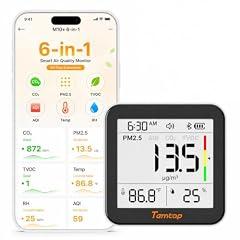
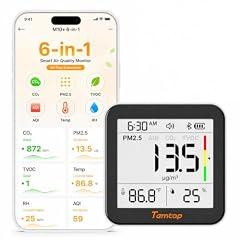
Temtop M10+ Indoor Air Quality Monitor
Overview
This compact, rechargeable indoor monitor measures PM2.5, carbon dioxide, total volatile organic compounds, temperature, humidity, and a combined air-quality index. It has an 82 by 82 by 31 mm housing, a 2200 mAh battery, an e-ink display, Bluetooth app connection, a color indicator, and an optional audible alert. The manufacturer states up to 60 days of battery life and specifies carbon-dioxide measurement from 400 to 5,000 ppm. Its particle sensor has meaningful external support. A published study identifies the M10+ as using Temtop's M2000 second-generation particle sensor, and South Coast AQMD testing of that sensor found strong PM2.5 correlation with reference instruments, alongside systematic overestimation in laboratory testing. The product does not measure carbon monoxide, radon, or individual VOC chemicals. Its TVOC result is a broad indicator, not an identification or health assessment of a specific chemical.
What works
- Combines PM2.5, carbon dioxide, TVOC, temperature, and humidity readings in a compact battery-powered unit, according to manufacturer documentation.
- The product's M2000 second-generation PM sensor has relevant independent South Coast AQMD testing, with strong field correlation for PM2.5 and high precision across tested conditions.
- The manual gives measurement ranges, resolution, and stated accuracy for PM2.5, carbon dioxide, temperature, and humidity.
- Bluetooth connection, an e-ink display, color status indication, and an audible alert can make changes easier to notice without continuous phone use.
- FCC authorization exists for the Bluetooth-equipped product, supporting its U.S. radio compliance.
What does not
- Independent testing supports the shared PM sensor, not the complete product's carbon-dioxide, TVOC, temperature, humidity, alerts, or long-term performance.
- AQ-SPEC found the related PM sensor overestimated PM2.5 in laboratory experiments, so absolute PM readings should be interpreted with that limitation in mind.
- There is no carbon-monoxide measurement or listed life-safety alarm. A separate listed carbon-monoxide alarm remains necessary where combustion sources or an attached garage create risk.
- The supplied specifications describe TVOC as a total value. They do not identify individual chemicals, establish health-safe concentrations, or detect radon.
- The available warranty is one year, and no manufacturer take-back program, replaceable battery path, sensor service life, or accredited recalibration program was found.
Who is it for
This product suits a renter, homeowner, teacher, or office worker who wants a small portable screen for spotting ventilation-related carbon-dioxide buildup, particle events such as cooking or outdoor smoke intrusion, and broad changes in VOC conditions. It is most appropriate for trend tracking and for checking whether practical steps such as source control, ventilation, or filtration coincide with lower readings. Its rechargeable design and long manufacturer-stated runtime also suit use away from a constant outlet, including bedrooms, classrooms, and small offices.
Who is it not for
It is not suitable as the only safety device in a home with fuel-burning appliances, fireplaces, an attached garage, or other carbon-monoxide risks. Those settings need properly installed, listed carbon-monoxide alarms. It also does not suit buyers who need formal exposure assessment, radon detection, identification of a specific VOC such as formaldehyde, or validated compliance measurements. People making consequential health, workplace, remediation, or building-control decisions need professional sampling or instruments with model-specific independent validation for the relevant pollutant.
Integrity
The product covers several useful indoor indicators, but its health scope has clear boundaries. It measures PM2.5, carbon dioxide, and a total VOC signal, while the AQI is a summary output rather than another pollutant. EPA notes that low-cost monitors detect only the contaminants for which they are designed and do not provide a complete indoor-air assessment. This product has no carbon-monoxide sensor or life-safety alarm, so it cannot replace a listed carbon-monoxide alarm. For particle monitoring, the M2000 second-generation sensor used in the product has independent AQ-SPEC evidence of strong PM2.5 correlation and high precision, but the same testing found laboratory overestimation. The manufacturer provides a one-year warranty and uses a rechargeable 2200 mAh lithium battery with an e-ink display, which can reduce routine disposable-battery waste. No documented battery replacement, product take-back, recycling program, or U.S. electrical-safety listing was found. No product-specific U.S. recall or safety warning was found in the searched public records.

MORPTRA 16-in-1 Air Quality Monitor
Overview
This is a portable, rechargeable desktop air-quality display for short indoor spot checks in a home, office, vehicle, or similar small space. The supplied product information describes a color screen, a USB-C charging setup, and roughly 4 to 5 hours of operation per charge. An OEM page for the matching AK16C model lists PM1.0, PM2.5, PM10, carbon dioxide, total VOCs, formaldehyde, temperature, humidity, AQI, and time. The available manual and OEM material describe a buzzer, color-coded status display, and frequent screen updates. They do not provide sensor make and model, pollutant-specific measurement range, test conditions, humidity correction, calibration interval, or a model-specific accuracy report. Public searches did not locate independent performance testing or a U.S. electrical-safety listing for this product.
What works
- The stated measurement set includes particle sizes, carbon dioxide, temperature, humidity, total VOCs, and formaldehyde indicators.
- The display presents individual readings rather than only a single air-quality score, according to the available manual.
- A rechargeable battery and USB-C charging support portable, short-duration checks, according to matching model documentation.
- Audible and color-coded alerts can draw attention to a changing displayed reading, according to the manual.
What does not
- No public, model-matched independent laboratory evaluation was located, so displayed accuracy and repeatability remain unproven.
- The documentation does not identify sensor components or give pollutant-specific ranges, resolutions, cross-sensitivities, or environmental operating limits.
- The advertised plus or minus 0.01 percent accuracy statement is not supported by a method, analyte, range, or third-party report.
- Alert thresholds and their health basis are not clearly documented. Low-cost monitor alerts are not emergency warnings.
- No public UL, ETL, or CSA listing evidence was located for the product or its included power components.
Who is it for
This product suits a user who wants a portable visual tool for observing relative changes after cooking, cleaning, opening windows, running an air cleaner, or moving between a desk, bedroom, and vehicle. It is most appropriate when the screen is treated as a prompt to investigate sources, improve ventilation, or compare before-and-after conditions. The short stated battery life also makes it better suited to attended spot checks than continuous all-day or overnight monitoring.
Who is it not for
It is not suited to households that need a life-safety carbon monoxide alarm, a smoke alarm, or a radon test. It does not claim to measure carbon monoxide, and its alerts should not be treated as emergency alarms. It is also a poor fit for people making health-critical, legal, occupational, or remediation decisions that require traceable accuracy. Buyers needing continuous records, remote alerts, data export, known calibration intervals, or independently verified performance need a product with those records available.
Integrity
The claimed pollutant set is useful for observing several common indoor-air indicators, particularly particles, carbon dioxide, temperature, and humidity. However, total VOC and formaldehyde readings should be interpreted as screening indicators, not as a complete chemical assessment. The manufacturer materials do not establish that the monitor can identify a specific pollutant source or quantify personal health risk. It also does not measure carbon monoxide, so it cannot replace a certified carbon monoxide alarm. The rechargeable lithium-ion battery and USB-C charging can reduce disposable-battery use. The stated 4 to 5 hour run time, however, may require frequent recharging for regular use. No public repair program, replacement-battery policy, take-back route, recycled-material claim, packaging detail, sensor replacement plan, or end-of-life recycling program was located. Public searches also did not locate a product-specific recall or safety warning, but no U.S. electrical-safety listing evidence was found.